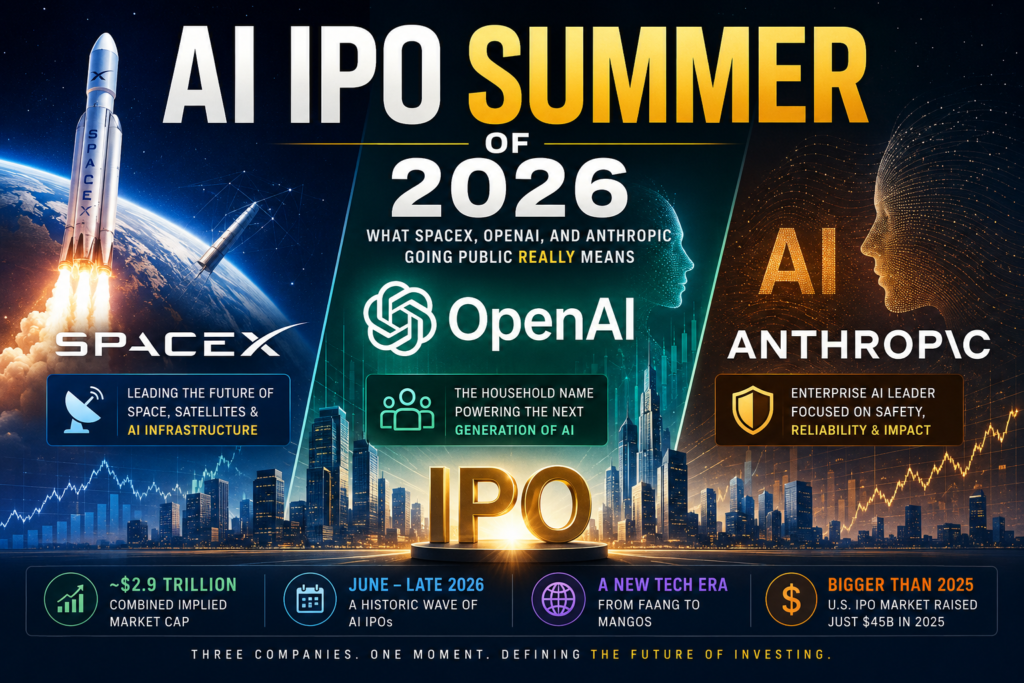
The AI IPO summer of 2026 is already the most consequential market event in a generation — and it’s just getting started. Three of the most valuable private companies in history are heading to public markets within the same window, and understanding what’s at stake could reshape how you think about investing in technology for the next decade. AI IPO Summer of 2026
What Is the AI IPO Summer of 2026?
Definition: The AI IPO summer of 2026 refers to the unprecedented wave of major artificial intelligence and deep-tech companies filing for and executing initial public offerings within the same concentrated market window, primarily between June and late 2026.
This isn’t a coincidence — it’s a convergence. For years, the biggest names in AI stayed private, raising capital at increasingly stratospheric valuations accessible only to venture funds and institutional backers. In 2026, that wall came down. SpaceX priced its shares at $135 on June 11 and began trading on Nasdaq under the ticker SPCX on June 12 — the largest IPO in history. OpenAI and Anthropic have confirmed confidential S-1 filings, with no dates or tickers set yet, but both have clearly signaled their intent to go public before year’s end.
Together, these three companies carry a combined implied market capitalization that analysts at Tomasz Tunguz’s research firm estimate at nearly $2.9 trillion. To put that number in context: the entire U.S. IPO market raised just $45 billion throughout all of 2025.
This is not a hot IPO season. This is a stress test.
From FAANG to MANGOS — A New Tech Hierarchy
For the better part of a decade, “FAANG” — Facebook (now Meta), Amazon, Apple, Netflix, and Google — was shorthand for the dominant layer of the tech economy. Those five companies set the pace for market returns, set the agenda for regulatory debates, and employed many of the best engineers in the world.
FAANG is no longer the right acronym. A new one is forming.
According to TechCrunch’s Equity podcast and widely cited analysis from June 2026, the new power structure is called MANGOS: Meta (or Microsoft, depending on who you’re asking), Anthropic, Nvidia, Google, OpenAI, and SpaceX. The striking thing about this group is that half of its members — Anthropic, OpenAI, and SpaceX — are about to test public markets simultaneously.
The AI IPO summer of 2026 is, in many ways, the formal installation ceremony for this new hierarchy. The question isn’t whether these companies will list. The question is what happens to valuations, liquidity, and the broader market when they do.
The Three Companies Going Public — What You Need to Know
SpaceX — The First Mover
SpaceX is the first company out of the gate and, as of June 12, 2026, officially a public company. On its first day of trading, shares surged well above the $135 IPO price, pushing the company’s market valuation past $2 trillion — making founder Elon Musk the world’s first trillionaire by some measures.
But SpaceX is more than a rocket company. Its S-1 filing, submitted May 20, 2026, revealed the scope of its SpaceXAI division. That segment generated $3.2 billion in revenue in 2025, though it also posted a $2.47 billion operating loss in Q1 2026 alone. Crucially, Anthropic has agreed to purchase compute capacity from SpaceX’s Colossus 1 data center at $1.25 billion per month through 2029 — making it one of the anchor customers underpinning SpaceX’s AI-infrastructure thesis.
Goldman Sachs is leading a 21-bank syndicate for the deal, signaling the institutional appetite is real. SpaceX is AI-adjacent rather than a pure-play AI company, which gives it a revenue diversification story that OpenAI and Anthropic cannot yet offer.
OpenAI — The Household Name
OpenAI is perhaps the most anticipated IPO in technology history. The company behind ChatGPT has crossed approximately 900 million weekly active users as of early 2026, with 50 million paying subscribers. Its annualized revenue run rate grew from roughly $6 billion in 2024 to above $20 billion by year-end 2025 — a pace the company internally projects will extend toward $280 billion by 2030.
OpenAI’s IPO target valuation is reportedly around $1 trillion, a figure that would make it the most valuable company ever to debut on a public exchange. It has filed confidentially with the SEC, and discussions with underwriters are advanced.
The AI IPO summer of 2026 arguably exists because of OpenAI. Its S-1 filing lit the fuse for Anthropic to accelerate its own timeline and for investors to begin repricing AI exposure across every asset class.
Anthropic — The Dark Horse
Anthropic — the company behind the Claude family of AI models — presents what analysts describe as the most compelling near-term profitability story among the three. Its run-rate revenue reportedly crossed $44 billion annualized as of May 2026, according to a source cited by CNBC, and the company is on track to post its first-ever operating profit — approximately $559 million — in Q2 2026.
Anthropic’s last private funding round closed at a $380 billion valuation in February 2026. It has reportedly entered early discussions with Goldman Sachs, JPMorgan, and Morgan Stanley regarding its own listing.
Unlike OpenAI, Anthropic has built a reputation for enterprise-first deployment and safety-focused model development. Its Claude models are increasingly dominant in enterprise software stacks. For investors looking at the AI IPO summer of 2026 through the lens of fundamentals rather than hype, Anthropic may be the most interesting of the three.
SpaceX vs. OpenAI vs. Anthropic — IPO Snapshot
| Company | IPO Status (June 2026) | Implied Valuation | Primary Revenue Driver | Profitability Status |
|---|---|---|---|---|
| SpaceX | Trading on Nasdaq (SPCX) | ~$1.77T (IPO price) / >$2T (first day) | Satellite broadband + launch services + SpaceXAI | Profitable overall; SpaceXAI operating at a loss |
| OpenAI | Confidential S-1 filed | ~$1T (target) | ChatGPT subscriptions + API revenue | Pre-profit; rapid revenue growth |
| Anthropic | Pre-filing discussions underway | ~$380B (last private round) | Claude API + enterprise licensing | First operating profit projected Q2 2026 |
What this table reveals is that these three companies are not racing to the same finish line. SpaceX is offering infrastructure and diversification. OpenAI is offering consumer adoption velocity. Anthropic is offering the earliest signs of sustainable economics. Each thesis appeals to a different type of investor — and that’s exactly why the AI IPO summer of 2026 is such a complex moment to navigate.
Why the AI IPO Summer of 2026 Is a Market Stress Test
The phrase “stress test” is not hyperbole. It’s the most precise description available.
The Float Problem
When a company goes public, it typically sells between 15% and 25% of its shares to the public market. That’s the “float.” At those standard percentages, a combined $2.9 trillion in implied market cap would require public markets to absorb between $432 billion and $576 billion in a single quarter.
For reference: from 2016 to 2025, the entire U.S. IPO market raised approximately $469 billion in total — across a full decade.
Analyst Tom Tunguz put it plainly: “It’s like throwing a boulder into a pond.” The concern isn’t whether the demand exists — it’s whether the pond is wide enough to absorb the wave without distorting prices across the rest of the market.
Goldman Sachs analysts projected 2026 IPO proceeds could reach approximately $160 billion — a near-quadrupling from 2025 — and that estimate was made before the full scope of this AI IPO summer became clear.
The potential counterbalance is that there is an estimated $8 trillion sitting in U.S. money market funds. If even a fraction of that capital rotates into the AI IPO summer of 2026, the liquidity pressure eases considerably.
The Valuation Gap
Private-market valuations are set by negotiation between companies and their investors. Public-market valuations are set by thousands of actors every millisecond. These two mechanisms do not always agree.
If either SpaceX-AI, OpenAI, or Anthropic prices materially below its reported target range — or experiences first-day underperformance — the ripple effects could freeze the broader IPO pipeline, forcing dozens of other unicorns to delay or abandon their own listing plans.
That’s the structural risk beneath the excitement of the AI IPO summer of 2026.
What Does This Mean for Everyday Investors?
For most people, the answer is nuanced.
- Institutional access came first. Investors who wanted exposure to OpenAI or Anthropic before 2026 had to do it indirectly — buying Nvidia for chip exposure, Microsoft for its OpenAI stake, or Alphabet for its DeepMind and Anthropic positions. The AI IPO summer of 2026 eliminates that indirect layer.
- Direct ownership is now possible. Once these companies are publicly listed, any retail investor with a brokerage account can buy shares. But buying on day one at elevated open-market prices after a hyped roadshow carries very different risk than buying into a company at its private-round valuation.
- Volatility is a feature, not a bug. The first year of trading for any high-profile IPO is almost always characterized by significant price swings. Lock-up periods expire, early investors sell, and the market continuously reprices based on quarterly earnings data that was previously unavailable.
- The proxy plays still exist. For investors who want AI exposure without the direct IPO risk, companies like Nvidia (hardware), Microsoft (OpenAI investment), and Google (Anthropic investment) remain accessible alternatives.
Understanding these layers is essential before making any decisions based on the excitement surrounding the AI IPO summer of 2026.
Key Questions Every Investor Should Ask Before Buying In
This is not financial advice. These are the questions that any thoughtful investor should bring to their own research and to qualified financial advisors.
What is the path to profitability — and on what timeline? Anthropic appears closest to positive operating income. OpenAI’s revenue trajectory is steep, but its infrastructure costs are enormous. SpaceX’s core business is profitable; its AI segment is not yet.
What governance structure does this company have? OpenAI’s nonprofit-to-public-benefit corporation conversion is still working through legal and structural questions. Anthropic’s governance model emphasizes long-term safety commitments. SpaceX operates under Elon Musk’s control, which introduces a single-point-of-decision-making dynamic that markets will need to price.
What is the lock-up period, and who holds the large blocks? When major early investors — venture funds, strategic partners — become eligible to sell, supply expands rapidly. Timing your exposure relative to lock-up expirations matters more for volatile AI IPO summer names than for mature-market companies.
How much of the business is “pure AI” versus AI-adjacent? SpaceX earns most of its revenue from Starlink and launch contracts, not from AI. OpenAI earns from AI subscriptions and API. Anthropic earns from enterprise AI licensing. The revenue composition determines how much the stock tracks “AI sector sentiment” versus the company’s own fundamentals.
The Broader Signal — What Comes After the AI IPO Summer?
The AI IPO summer of 2026 is not just a financial event. It’s a structural inflection point for the technology industry.
When private companies go public, they submit to a new kind of accountability. Quarterly earnings calls, SEC disclosures, analyst coverage, and shareholder activism all introduce friction — and transparency — that private companies are insulated from. For AI companies, that transparency will be particularly revealing.
How much does it actually cost to train and serve frontier AI models at scale? What are the real retention rates for paid AI subscriptions? What percentage of enterprise AI pilots are converting to sustained revenue contracts? These questions have answers today, but only a small circle of insiders knows them. After the AI IPO summer of 2026, the market will start to learn.
The broader MANGOS group — Meta, Microsoft, Nvidia, and Google — will also be affected. Their valuations have been partially inflated by their roles as proxies for AI investment. Once direct investment in pure-play AI companies is possible, the premium those proxy positions commanded may compress.
The AI IPO summer of 2026 is also a test of the MANGOS thesis itself. If SpaceX, OpenAI, and Anthropic all succeed in going public at or near their target valuations, it validates the idea that AI is the organizing principle of the next decade’s market returns. If any of them stumble badly, it reopens the debate about whether AI valuations are grounded in genuine economic value or in a narrative that public markets will be less willing to fund than private ones were.
Either outcome will be instructive. And either way, the AI IPO summer of 2026 marks the moment the AI era stopped being a story told by venture capitalists to each other and started being a story told in public — to everyone.
The Bottom Line
The AI IPO summer of 2026 is the most consequential public-market moment since the dot-com era — with one critical difference: the companies going public this time have real, auditable revenue. SpaceX has already begun trading. OpenAI and Anthropic are close behind. Together, they are rewriting the rules for how transformational technology gets valued, funded, and scrutinized.
For investors, for technologists, and for anyone paying attention to how AI reshapes the global economy, this summer is required reading. The numbers are enormous, the stakes are real, and the next few months will do more to reveal the actual economics of the AI industry than the previous five years of private fundraising ever could.