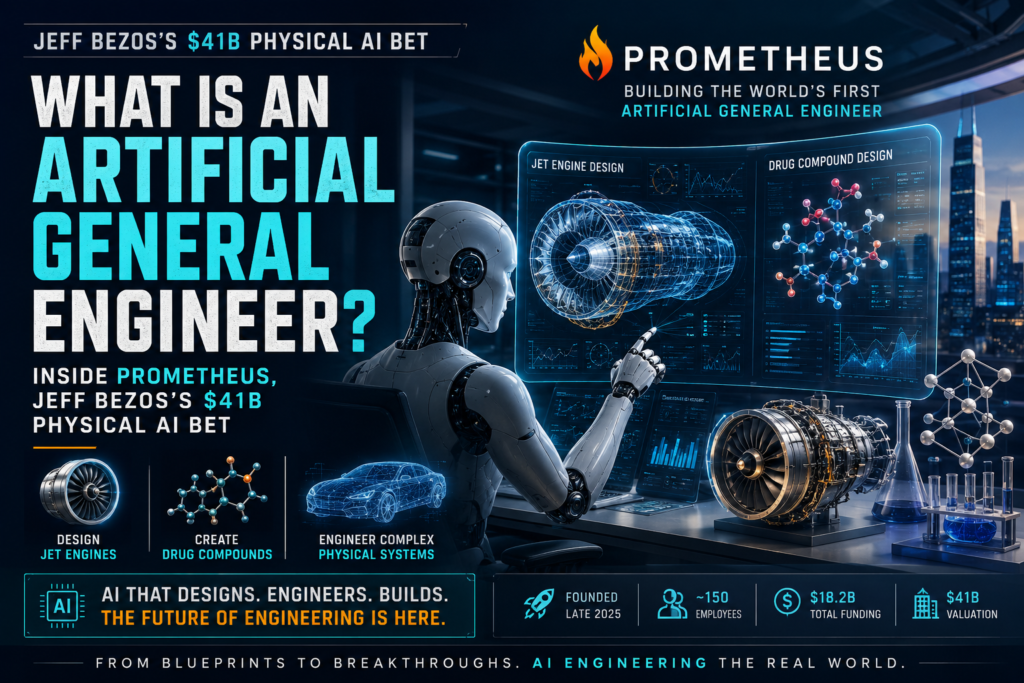
Jeff Bezos just committed $12 billion to a single thesis: that software can replace engineers. The startup behind that bet, Prometheus, is building what it calls an “artificial general engineer” — an AI system capable of designing jet engines, drug compounds, and other complex physical systems from scratch. If it works, it could be the most consequential application of AI to the physical world since computers first entered the factory floor.
What Is an Artificial General Engineer?
An artificial general engineer is an AI system designed to automate the full cycle of engineering work across multiple physical domains — not just assist a human engineer with one task, but independently conceive, model, analyze, and refine complex physical systems.
Definition: Unlike a narrow AI tool that, say, optimizes a single parameter in a chemical reaction, an artificial general engineer would be capable of tackling a broad class of design-and-manufacturing challenges: from the aerodynamics of a turbine blade to the molecular structure of a therapeutic compound.
Expansion: The term deliberately echoes “artificial general intelligence” (AGI), the long-sought AI that can perform any intellectual task a human can. Prometheus is not claiming AGI — it is claiming something arguably more commercially valuable in the near term: a system general enough to work across engineering disciplines, but grounded in the physical constraints of the real world.
Think of it this way: a software coder’s output is a file. An artificial general engineer’s output is a blueprint for something that has to survive heat, stress, chemical reactions, and time.
How an Artificial General Engineer Differs from AGI
| Feature | AGI (Artificial General Intelligence) | Artificial General Engineer |
|---|---|---|
| Scope | Any cognitive task | Engineering and physical design tasks |
| Domain | Abstract reasoning, language, logic | Physical systems, materials, molecular biology |
| Output | Text, decisions, predictions | Designs, schematics, compound structures |
| Current status | Theoretical / contested | In active development at Prometheus |
| Commercial focus | Broad | Heavy engineering + drug design |
| Key constraint | Human-level cognition | Laws of physics, chemistry, thermodynamics |
The distinction matters because physical AI has a built-in moat: the physical world does not forgive mistakes the way software does. A bad line of code crashes a program; a bad engineering decision can fail catastrophically at scale. That real-world accountability raises both the bar for the AI and, investors argue, the durability of any competitive advantage it creates.
The Prometheus AI Startup: Key Facts at a Glance
Before diving into the “why,” here are the core facts about Prometheus as of June 2026:
- Founded: Late 2025
- Co-founders: Jeff Bezos and Vik Bajaj (former co-founder of Verily, Google’s life sciences unit)
- Total funding raised: $18.2 billion ($6.2B initial round + $12B Series B)
- Valuation: $41 billion
- Employees: ~150, across San Francisco, London, and Zurich
- Mission: Build the world’s first artificial general engineer for the physical world
- Primary investors: Bezos personally, JPMorgan Chase, Goldman Sachs, BlackRock, and others
- Stealth status: The company has not publicly disclosed what it has built
At $41 billion, Prometheus is one of the most richly valued AI startups ever funded at this stage — and it has fewer than 200 employees. That ratio of capital to headcount underlines just how compute-intensive the ambition is. Bezos has confirmed that a large share of the $12 billion will go toward the company’s infrastructure needs.
Why Jeff Bezos Is Betting $12 Billion on the Physical World
The Founders Behind Prometheus
Jeff Bezos needs little introduction. As executive chairman of Amazon — a company with over 1.5 million employees and one of the world’s most aggressive automation programs — he has watched AI transform logistics, warehousing, and customer service at an unprecedented scale. His co-founder, Vik Bajaj, brings a different kind of credibility: as a co-founder of Verily (formerly Google Life Sciences), Bajaj spent years at the intersection of biology, data, and engineering. That pairing is not accidental. The two domains Prometheus is most focused on — heavy industrial engineering and pharmaceutical design — map directly onto the experience base of its leadership.
Who Is Funding This Round?
The $12 billion Series B is notable not just for its size but for the profile of its backers. Unlike many AI rounds that are led by venture capital firms, Prometheus has attracted institutional financial giants:
- JPMorgan Chase — the largest U.S. bank, increasingly active in infrastructure and deep tech
- Goldman Sachs — with a long history of backing transformative industrial companies
- BlackRock — the world’s largest asset manager, whose participation signals long-duration confidence in the thesis
- Jeff Bezos personally — putting his own capital behind his own company
The involvement of Wall Street’s most conservative institutions alongside a founder-operator suggests that Prometheus has cleared a credibility bar that purely visionary AI pitches often cannot.
What Will Prometheus Actually Build?
From Jet Engines to Drug Compounds
Prometheus describes its mission as automating “the design and manufacturing of complex physical systems.” The two specific examples the company has cited publicly could not be more different from each other — and that is the point.
Heavy engineering (e.g., jet engines): Designing a jet engine requires simultaneous optimization across thermodynamics, materials science, aerodynamics, stress tolerance, weight, and manufacturability. Today, that process takes teams of specialized engineers years and hundreds of millions of dollars. An artificial general engineer working in this domain would need to hold all of those constraints in tension at once — and explore a solution space far larger than any human team could.
Drug design (e.g., pharmaceutical compounds): Drug discovery is another notoriously slow, expensive process. The average drug takes 10–15 years and over $2 billion to bring to market, largely because identifying a molecule that is both therapeutically effective and safe requires exhaustive trial and error. AI-assisted drug design has already shown promise in narrow domains; Prometheus is betting it can generalize the capability.
The common thread is complexity across physical constraints. Both domains require reasoning about systems that exist in the real world, where the laws of physics and chemistry are non-negotiable. That is what separates the artificial general engineer concept from AI coding assistants or language models: the output has to work in a world that does not bend to prompts.
Physical AI vs. Pure Software AI: Why Investors Are Choosing the Physical World
The term “physical AI” refers to AI systems that model, design, or interact with the physical world — as opposed to pure software AI, which operates entirely in digital environments.
Investors have increasingly poured capital into physical AI startups because of one central argument: defensibility. A software product can be copied, forked, or commoditized. A company that has trained its models on proprietary physical data — manufacturing tolerances, materials performance under stress, molecular behavior — has accumulated a training advantage that competitors cannot simply replicate by downloading an open-source model.
Why physical AI attracts massive investment:
- Physical processes generate proprietary, hard-to-acquire data that cannot easily be scraped from the internet
- Real-world feedback loops (does the design actually work?) create higher-quality training signals than text prediction
- Regulatory and safety requirements in engineering and pharma raise switching costs for customers
- The problem space is vast: virtually every physical product humans make could theoretically be optimized by AI
- The compute requirements create a capital moat — not every competitor can raise $18B
Prometheus is not alone in this bet. Venture capitalists have been accelerating investments in the physical AI sector throughout 2025 and 2026, with the thesis gaining mainstream credibility as language models plateau on pure text benchmarks and attention shifts to applied, domain-specific systems.
The Jobs Debate: Will an Artificial General Engineer Replace Human Engineers?
This is the question that shadows every announcement about AI automation — and Prometheus, given its explicit mission to “replace large swaths of engineering work,” cannot avoid it.
The short answer: Bezos believes it will not cause the mass unemployment that critics predict, but he does not deny that the nature of engineering work will change fundamentally.
Bezos’s “Labor Scarcity” Theory, Explained
What is “labor scarcity”? Bezos used this term in a CNBC interview to describe his predicted outcome of widespread AI productivity gains: not mass unemployment, but a world where demand for human workers outpaces supply. In his framing, AI-driven productivity growth raises the overall standard of living so significantly that the economy generates more demand for human effort than it can satisfy.
His exact argument:
- Significant productivity gains will raise the standard of living broadly
- Higher standards of living historically increase demand for services and new industries
- Two-earner households may shift to one-earner households by choice — not by force
- Workers currently doing overtime may simply choose to work less
This puts him in explicit disagreement with AI researchers and economists who forecast structural unemployment — the view that AI will eliminate more jobs than the economy can create in replacement.
What is the counterargument? Critics of the “labor scarcity” view point out that historical technological disruptions — from mechanized agriculture to factory automation — caused significant transitional unemployment even when they eventually created new jobs. The pace of AI development may not leave enough time for labor markets to adjust. Engineers whose entire skill sets are automated may not smoothly transition to new roles.
It is worth noting that Bezos’s confidence on this point comes as Amazon, the company he built, has laid off tens of thousands of workers under CEO Andy Jassy as part of an aggressive automation push. The gap between the macro-optimism of the “labor scarcity” thesis and the micro-reality of displacement is one that Prometheus will have to reckon with as its technology matures.
What This Means for the Future of Engineering and Drug Design
Assuming Prometheus delivers on even a fraction of its ambition, the downstream effects on two industries are significant.
For engineering:
The current model of engineering relies on deep human specialization. A structural engineer does not design drug molecules; a materials scientist does not draft aerodynamic profiles. The artificial general engineer concept breaks that specialization model by operating across domains. This could accelerate design iteration dramatically — compressing years of human design work into weeks — and open engineering problem-solving to organizations that currently cannot afford large teams of domain experts.
For drug design:
The pharmaceutical industry’s pipeline problem — too many candidate compounds, too little time and money to test all of them rigorously — is well understood. AI-assisted screening has already improved early-stage discovery. A system that can reason across molecular biology, toxicology, and clinical trial design simultaneously would represent a step-change in how new medicines are developed.
For the workforce:
The most likely near-term scenario is augmentation rather than replacement: the artificial general engineer as a highly capable collaborator that makes individual engineers dramatically more productive, rather than a wholesale replacement for engineering departments. But the trajectory is clear, and Prometheus is explicit about the long-term direction.
For the competitive landscape in AI:
The $41 billion valuation places Prometheus among the most highly valued AI startups globally. Its emergence signals a maturation of the AI investment thesis — away from foundation models competing on benchmark performance and toward domain-specific systems competing on real-world capability. The question for the broader industry is whether the artificial general engineer is a singular bet or the first of many such systems targeting specific high-complexity professional domains.
Frequently Asked Questions
What is Prometheus AI? Prometheus is a physical AI startup co-founded by Jeff Bezos and Vik Bajaj, launched in late 2025. Its mission is to build an artificial general engineer — an AI system that can automate complex engineering and drug design work. In June 2026, it raised $12 billion at a $41 billion valuation.
What does “artificial general engineer” mean? An artificial general engineer is an AI system designed to handle engineering tasks across multiple physical domains — unlike narrow AI tools that specialize in a single function. Prometheus uses the term to describe software that can design jet engines, drug compounds, and other complex physical systems without being constrained to a single discipline.
How much has Prometheus raised in total? As of June 2026, Prometheus has raised a total of approximately $18.2 billion across two rounds: a $6.2 billion initial round and a $12 billion Series B.
Who are the investors in Prometheus? The Series B round was backed by Jeff Bezos personally, JPMorgan Chase, Goldman Sachs, and BlackRock, among others.
Will an artificial general engineer replace human engineers? Bezos argues that AI productivity gains will create “labor scarcity” — more demand for workers than supply — rather than mass unemployment. Critics disagree, pointing to historical disruption patterns. The consensus view among industry observers is that augmentation of human engineers is more likely in the near term than wholesale replacement.
What is physical AI? Physical AI refers to AI systems that model, design, or interact with the physical world. It contrasts with pure software AI (like language models) by having outputs — designs, control systems, simulations — that must conform to real-world physical constraints like thermodynamics, materials behavior, and chemical reactions.