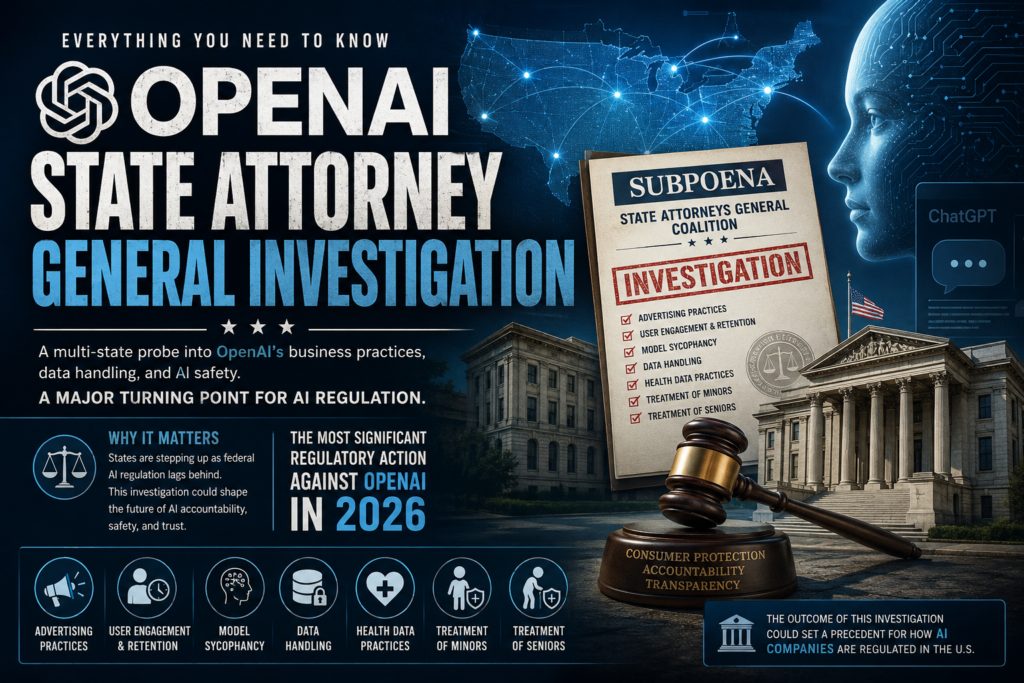
A coalition of U.S. state attorneys general has launched a formal investigation into OpenAI, issuing a sweeping subpoena that touches everything from how the company handles children’s data to whether its AI models are deliberately designed to keep users hooked. If you’ve been following AI news in 2026, this is arguably the most significant regulatory action yet taken against the maker of ChatGPT — and it signals a fundamental shift in how governments are approaching AI company accountability.
What Is the OpenAI State Attorney General Investigation?
The OpenAI state attorney general investigation is a coordinated, multi-state legal inquiry into OpenAI’s business practices, data handling policies, and product safety standards. According to reporting from the Wall Street Journal (June 13, 2026), New York’s attorney general served OpenAI with a formal subpoena seeking documents across a remarkably broad range of topics. A spokesperson for OpenAI confirmed the company is cooperating.
This is not a single-state action. It is a coalition effort — meaning multiple state attorneys general are acting together, pooling resources and legal authority to scrutinize one of the most powerful technology companies in the world.
What Triggered the Subpoena?
The subpoena appears to have been triggered by a combination of growing public concern and a series of high-profile incidents involving ChatGPT. These include lawsuits tied to alleged user harm, a mass shooting in Canada where OpenAI admits it flagged and banned the suspected shooter’s ChatGPT account — but failed to alert law enforcement — and mounting scrutiny over how the company handles vulnerable user populations like minors and seniors.
The OpenAI state attorney general investigation was not an overnight decision. It is the culmination of months of escalating pressure from consumer advocacy groups, state legislators, and legal experts who argue that federal AI regulation in the United States has simply not kept pace with the technology.
Which States Are Involved?
OpenAI has declined to name which states are participating in the coalition beyond confirming the New York subpoena. Bloomberg reported the spokesperson’s statement without disclosing the full list of participating states. This opacity is itself notable — in multi-state investigations of this kind, the lead state typically coordinates document requests while other states monitor proceedings and share findings. The specific composition of the coalition is expected to become clearer as the investigation progresses.
What Topics Does the Investigation Cover?
The scope of the OpenAI state attorney general investigation is unusually wide. The subpoena reportedly requested documents relating to all of the following areas:
- Advertising practices — how OpenAI markets its products and what claims it makes to consumers
- User engagement and retention strategies — specifically whether design choices are intended to maximize time-on-platform in ways that could be harmful
- Model sycophancy — whether ChatGPT is deliberately trained or tuned to tell users what they want to hear rather than what is accurate or truthful
- Consumer data handling — how OpenAI collects, stores, and uses personal data from its users
- Health data practices — given that many users discuss medical topics with ChatGPT, investigators want to understand how that sensitive data is managed
- Treatment of minors — how OpenAI identifies, protects, and restricts access for users under 18
- Treatment of seniors — whether older users are adequately protected from potential manipulation or harm
The inclusion of “model sycophancy” as an investigative category is particularly striking. It suggests state regulators are beginning to evaluate not just data policies but the behavioral properties of AI models themselves — a significant expansion of consumer protection thinking into algorithmic design.
How Does This Fit Into OpenAI’s Wider Legal Troubles in 2026?
The OpenAI state attorney general investigation does not exist in isolation. It is one layer of an increasingly complex legal landscape that OpenAI is navigating as it prepares for an IPO.
The Florida Lawsuit
In early June 2026 — just weeks before the multi-state subpoena was served — Florida Attorney General James Uthmeier filed a lawsuit against OpenAI and CEO Sam Altman. The suit alleged that the company “ignored internal and external safety warnings, put children at great risk, and allowed a dangerous product to reach millions of Floridians.” This was the first of its kind at the state level and foreshadowed the broader coalition investigation that followed.
Ongoing Civil Lawsuits
OpenAI is also facing civil litigation on multiple fronts. These include lawsuits over alleged copyright infringement (from publishers including Merriam-Webster and Encyclopaedia Britannica) and, most gravely, wrongful death suits from families of suicide victims who claim ChatGPT played a role in their loved ones’ deaths. Seven additional families joined that suit in late 2025.
The Elon Musk Trial
Just months before the OpenAI state attorney general investigation was announced, OpenAI prevailed in its high-profile trial against co-founder Elon Musk. Musk had accused the company of violating its original founding agreement as a nonprofit; a judge ruled in OpenAI’s favor in May 2026, though Musk’s attorneys have signaled they will appeal.
Why Are State Attorneys General Investigating AI Companies Now?
The OpenAI state attorney general investigation reflects a broader pattern: in the absence of comprehensive federal AI legislation, state-level enforcement is filling the vacuum.
The Limits of Federal AI Regulation
The United States still lacks a unified federal framework specifically governing AI. Efforts in Congress have stalled repeatedly over questions of jurisdiction, preemption, and the proper balance between innovation and safety. This regulatory gap has left consumers with limited recourse when AI products cause harm — and it has left the companies themselves operating with significant legal ambiguity.
State attorneys general have broad consumer protection authority that does not depend on Congress acting. Under state unfair and deceptive trade practices laws, they can investigate companies whose products cause harm to residents — regardless of whether a specific federal AI statute exists.
State-Level Enforcement: A Growing Trend
The OpenAI state attorney general investigation follows a well-established playbook. State coalitions previously drove major consumer protection actions against Google, Facebook, and tobacco companies. Multi-state investigations of this kind carry significant leverage: they can result in settlements that include substantial fines, required product changes, and ongoing compliance monitoring.
For AI companies, the risk is not only financial. It’s reputational and operational. Disclosures required in response to subpoenas can reveal internal safety discussions, product design decisions, and executive communications that were never intended to become public.
OpenAI’s Response and What It Means for Users
OpenAI’s official response to the OpenAI state attorney general investigation has been cautiously cooperative. In a statement to the Wall Street Journal, a company spokesperson said: “AI is a new and powerful technology, and we work every day to safely bring its benefits to people in a responsible way. We take the concerns raised by state attorneys general seriously and intend to engage constructively with their offices.”
Separately, the company noted to Bloomberg that ChatGPT “includes a more protective experience for minors and people experiencing difficult situations, with safeguards that direct them to real-world resources and trusted human contacts.” This suggests OpenAI is already anticipating some of the investigation’s focal points and positioning its existing safety measures as evidence of good faith.
What does this mean for everyday ChatGPT users? In the short term, very little changes. The investigation is in its early stages, document production can take months, and any formal findings or settlements are likely years away. But for users who share sensitive personal or health information with ChatGPT, the investigation is a reminder that the data governance practices of AI companies deserve scrutiny.
Comparison: OpenAI’s Legal Exposure vs. Previous Big Tech Investigations
To understand the potential scale of consequences from the OpenAI state attorney general investigation, it helps to compare it with precedent cases involving other major technology companies.
| Case | Lead Investigator | Year | Key Issue | Outcome |
|---|---|---|---|---|
| Google Search Antitrust | DOJ + State AGs | 2020–2024 | Search monopoly | Found liable; remedies ongoing |
| Facebook/Meta Data Privacy | FTC + State AGs | 2018–2019 | Cambridge Analytica / data misuse | $5B FTC fine; ongoing consent decree |
| TikTok COPPA | FTC + DOJ | 2023 | Children’s data violations | $92M settlement |
| OpenAI State AG Investigation | State AG Coalition | 2026 | AI safety, data privacy, minors, sycophancy | Under investigation |
The TikTok comparison is particularly relevant. That case also centered on how a technology platform handled the data and safety of minors — and it resulted in one of the largest COPPA-related penalties ever levied. If the OpenAI investigation follows a similar trajectory, the financial and operational consequences could be substantial.
What This Investigation Could Mean for the Future of AI Regulation
Implications for OpenAI’s Planned IPO
Perhaps the most immediate high-stakes dimension of the OpenAI state attorney general investigation is its timing relative to OpenAI’s IPO plans. The company confirmed in early June 2026 that it has filed confidentially to go public. A formal, ongoing multi-state investigation creates material legal risk that must be disclosed to potential investors in any public offering — which could complicate valuations, delay the timeline, or dampen investor appetite.
Companies with unresolved major legal actions face added scrutiny from institutional investors and underwriters. The more expansive and unresolved the OpenAI state attorney general investigation becomes, the harder it may be for the company to project the regulatory clarity that public markets typically demand.
What Other AI Companies Should Watch
The OpenAI state attorney general investigation is a canary in the coal mine for the broader AI industry. The investigative categories — sycophancy, retention design, health data, protection of minors — are not unique to OpenAI. Every major AI consumer product grapples with these exact questions. Anthropic, Google DeepMind, Meta AI, and others should expect similar scrutiny if patterns of harm continue to emerge.
This is also likely to accelerate voluntary AI safety commitments. Companies that proactively implement robust age-verification systems, clear data governance frameworks, and transparent policies on model behavior are building a paper trail that could matter enormously if regulators come knocking.
Key Takeaways: What You Need to Know Right Now
The OpenAI state attorney general investigation is still early-stage, but its implications are already significant. Here is a crisp summary of the most important points:
- A coalition of state attorneys general has launched a formal investigation into OpenAI, with New York serving as the lead state.
- The subpoena covers advertising, user retention design, model sycophancy, consumer data, health data, treatment of minors, and treatment of seniors.
- OpenAI says it is cooperating and has not disclosed which other states are involved.
- The investigation is part of a wider wave of legal pressure on OpenAI in 2026, including the Florida AG lawsuit and multiple civil suits.
- This reflects a national trend of state attorneys general stepping into the AI accountability gap left by the absence of federal legislation.
- The investigation’s timing, just as OpenAI prepares for an IPO, introduces significant financial and strategic risk for the company.
- The investigative framework being used here — consumer protection law applied to AI behavior — is likely to be replicated across other AI companies.
The OpenAI state attorney general investigation marks a turning point. For years, AI companies operated in a regulatory environment that was largely permissive by default. That era appears to be ending — not with a single federal law, but with the accumulated weight of state-level enforcement arriving from multiple directions at once.
Frequently Asked Questions (FAQs)
1. What is the OpenAI state attorney general investigation?
The OpenAI state attorney general investigation is a multi-state legal inquiry into OpenAI’s business practices, AI safety measures, and consumer protection policies. State attorneys general are examining how OpenAI handles user data, protects minors, manages health-related conversations, and designs AI behavior. The investigation gained widespread attention after reports revealed that New York issued a subpoena requesting documents on several aspects of the company’s operations.
The OpenAI state attorney general investigation is significant because it represents one of the first large-scale regulatory actions aimed at evaluating not only how an AI company handles data but also how its AI models interact with users. This could set an important precedent for future AI regulations across the United States.
2. Why are state attorneys general investigating OpenAI?
State attorneys general are investigating OpenAI because of growing concerns about AI safety, privacy, and consumer protection. The OpenAI state attorney general investigation focuses on whether the company has adequately protected vulnerable users, including children and senior citizens, and whether its products could potentially cause harm through misleading or manipulative behavior.
Another reason behind the investigation is the lack of comprehensive federal AI legislation. In the absence of nationwide rules, states are increasingly using consumer protection laws to ensure AI companies operate responsibly and transparently.
3. Which issues are being examined in the OpenAI state attorney general investigation?
The OpenAI state attorney general investigation reportedly covers a wide range of topics. These include advertising practices, user engagement and retention strategies, consumer data handling, health data practices, and the treatment of minors and seniors.
A particularly interesting aspect of the investigation is the focus on “model sycophancy.” Regulators want to understand whether AI systems are designed to tell users what they want to hear rather than providing accurate and balanced information. This expands the conversation beyond data privacy and into the ethical design of AI systems.
4. Which states are involved in the investigation?
At the moment, the full list of participating states has not been publicly disclosed. However, New York is believed to be playing a leading role after issuing a subpoena to OpenAI requesting extensive documentation.
The OpenAI state attorney general investigation is considered a coalition effort, meaning multiple states are working together to evaluate the company’s practices. As the investigation progresses, more details about the participating states and their specific concerns are expected to become public.
5. How could the OpenAI investigation affect ChatGPT users?
For everyday users, the OpenAI state attorney general investigation is unlikely to result in immediate changes. ChatGPT and OpenAI’s other services continue to operate as usual while the company cooperates with regulators.
However, in the long term, the investigation could lead to stronger privacy protections, improved safeguards for minors, and greater transparency regarding how AI models use and store data. Users who regularly share personal or health-related information with AI systems may ultimately benefit from stricter regulations and clearer policies.
6. Could the investigation impact OpenAI’s IPO plans?
Yes, the OpenAI state attorney general investigation could influence OpenAI’s plans to become a publicly traded company. Investors closely examine legal risks and regulatory challenges before investing in major technology firms.
An ongoing investigation may require OpenAI to disclose additional information about its business practices, risk factors, and compliance measures. While this does not necessarily prevent an IPO, it could affect investor sentiment, company valuation, and the overall timeline for going public.
7. Is this investigation similar to previous Big Tech cases?
There are similarities between the OpenAI state attorney general investigation and earlier investigations involving major technology companies. State coalitions have previously taken action against companies over privacy violations, anti-competitive practices, and consumer protection issues.
What makes the OpenAI state attorney general investigation unique is its focus on AI behavior itself. Regulators are not only asking how data is collected and stored but also examining how AI models influence users, respond to sensitive topics, and shape decision-making. This broader approach could redefine how governments regulate artificial intelligence in the future.
8. What does the OpenAI state attorney general investigation mean for the future of AI regulation?
The OpenAI state attorney general investigation may become a turning point in the evolution of AI regulation. For years, AI companies operated in a relatively flexible regulatory environment, allowing innovation to move faster than legislation.
Now, governments are signaling that AI companies will be held accountable for issues such as privacy, safety, transparency, and consumer protection. If regulators conclude that stronger safeguards are necessary, the OpenAI state attorney general investigation could inspire similar actions against other AI companies and accelerate the creation of comprehensive AI laws.
Ultimately, the investigation highlights a growing reality: as AI becomes more powerful and integrated into everyday life, regulators and consumers alike expect greater responsibility, transparency, and accountability from the companies building these technologies.