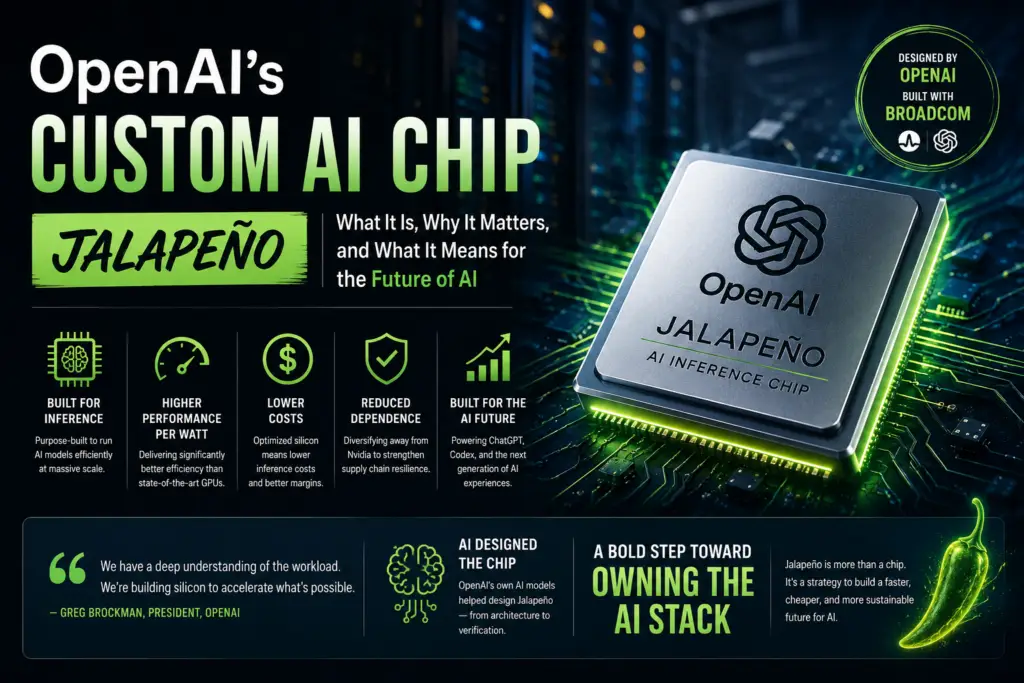
OpenAI has just revealed its first-ever custom AI chip — and it could fundamentally reshape how the company (and the entire AI industry) thinks about infrastructure costs. Named Jalapeño and built in partnership with Broadcom, this inference-specific processor is OpenAI’s most direct move yet toward owning every layer of its AI stack.
If you’ve been watching the AI chip wars unfold, this is the moment the last major AI lab without custom silicon officially enters the race.
What Is the OpenAI Jalapeño Chip?
Definition: A Purpose-Built AI Inference Accelerator
The OpenAI custom AI chip, codenamed Jalapeño, is a proprietary inference processor designed and manufactured in collaboration with semiconductor giant Broadcom. Unveiled on June 24, 2026, Jalapeño is not a general-purpose processor — it was built from the ground up to handle one very specific task: inference.
In AI, inference is the process of running a pre-trained model in response to a user’s input. When you type a prompt into ChatGPT and receive an answer, that’s inference. Training (teaching the model to understand language in the first place) is a separate, far more computationally intensive process that still typically relies on Nvidia’s hardware.
This distinction is critical. By building an OpenAI custom AI chip optimized entirely around inference workloads, OpenAI can dramatically reduce the cost and energy required for the billions of daily interactions across all of its products.
How Jalapeño Differs From a General-Purpose GPU
Most AI workloads today run on Nvidia’s GPUs — chips designed for graphics rendering that were repurposed for machine learning because of their parallel processing architecture. GPUs are extraordinarily capable, but they’re also expensive to buy, power-hungry to run, and designed to do far more than inference alone.
A custom inference chip like Jalapeño can strip away everything that isn’t needed for running models at scale. It can be architected around the exact memory access patterns, data types, and numerical precision that OpenAI’s own models require — no more, no less. According to OpenAI, early testing shows the Jalapeño chip delivers significantly better performance-per-watt than current state-of-the-art alternatives, which in large-scale deployments translates to millions of dollars in operational savings.
Why Did OpenAI Build Its Own Custom AI Chip?
The Nvidia Dependence Problem
OpenAI’s relationship with Nvidia has been both indispensable and strategically precarious. Nvidia’s H100 and H200 GPUs are the backbone of virtually every frontier AI training and inference cluster in the world. But that dependence comes with real costs: the chips are expensive, allocation is constrained, and every dollar spent on Nvidia hardware flows out of OpenAI’s ecosystem.
Long-rumored as a strategic priority, the OpenAI custom AI chip initiative was officially confirmed in October 2025 when the company announced its strategic partnership with Broadcom. The underlying motivation was clear: reduce GPU dependence, lower inference costs, and gain more direct control over the infrastructure that delivers its AI products to users.
OpenAI president Greg Brockman articulated the strategic rationale publicly: “We have a deep understanding of the workload. We’ve really been looking for specific workloads that are underserved — how can we build something that will be able to accelerate what’s possible?”
That philosophy — understanding your own workload better than any chip vendor ever could — is exactly why custom silicon makes sense for a company at OpenAI’s scale.
The Economics of Inference at Scale
Here’s the financial reality that makes the OpenAI custom AI chip project so significant: inference costs are the primary driver of OpenAI’s operational expenses. Every ChatGPT query, every Codex completion, every API call — each one costs fractions of a cent in compute. But at billions of requests per day, those fractions add up to staggering sums.
By switching even a portion of its inference load from expensive third-party GPUs to a purpose-built, in-house accelerator, OpenAI can:
- Reduce per-token compute costs by optimizing silicon for its exact workloads
- Improve margins on consumer and enterprise API products
- Lower prices for end users, increasing adoption and competitive positioning
- Reduce supply chain risk by diversifying away from a single hardware vendor
- Increase throughput on real-time coding and agentic AI products like Codex
This isn’t just a technical milestone — it’s a business model inflection point.
The OpenAI-Broadcom Partnership Explained
Who Built What?
The OpenAI custom AI chip reflects a careful division of expertise. OpenAI brought the deep workload knowledge: an intimate understanding of how its models access memory, perform matrix operations, and handle the unique communication patterns of large-scale transformer architectures.
Broadcom brought the silicon engineering muscle. As one of the world’s leading semiconductor companies, Broadcom has deep experience in custom ASIC (Application-Specific Integrated Circuit) design — the same category of chip that powers Google’s TPUs and Amazon’s Trainium. Broadcom has previously worked with Google on TPU silicon, making it a logical partner for this kind of specialized AI accelerator work.
The partnership was announced in October 2025 and the Jalapeño chip is the first tangible deliverable — still in testing as of the June 2026 announcement, but already showing promising early benchmark results.
AI-Assisted Chip Design
One of the more striking details in OpenAI’s announcement is that the company’s own AI models helped design the chip itself. This is a significant proof-of-concept for the role AI can play in accelerating the development of next-generation hardware — and a fitting example of the “full-stack” vision OpenAI is pursuing.
The idea of AI-assisted electronic design automation (EDA) has been explored by researchers for years, but OpenAI applying its own frontier models to the design of its own inference hardware represents a notable real-world deployment of this concept.
Jalapeño’s Key Technical Capabilities
Performance-Per-Watt: The Metric That Matters Most at Scale
When evaluating AI inference hardware, raw performance benchmarks like FLOPS (floating-point operations per second) only tell part of the story. At the scale OpenAI operates, performance-per-watt is arguably the more important metric — because energy costs are a dominant factor in data center operating expenses.
OpenAI’s early results indicate that the OpenAI custom AI chip achieves significantly better performance-per-watt than current alternatives. While the company has not released specific numerical comparisons, this claim suggests Jalapeño can process more AI inference requests per joule of energy consumed than equivalent Nvidia hardware handling the same tasks.
For a company running data centers globally, this efficiency gain is not incremental — it’s potentially transformational at scale.
Optimized for Real-Time Coding Workloads
OpenAI specifically called out real-time coding models as a primary target workload for Jalapeño. This is a deliberate choice. Codex — OpenAI’s AI coding agent — is one of the company’s fastest-growing product lines and a workload that demands both low latency and high throughput simultaneously.
Coding inference has a particular profile: models need to generate long outputs quickly, often in streaming fashion, with tight latency requirements (users notice delay in their code completions). Designing the OpenAI custom AI chip around this specific workload pattern means Jalapeño’s architecture can be tuned for the memory bandwidth, cache behavior, and output generation patterns that coding models demand.
Comparison: OpenAI Jalapeño vs. Competing Custom AI Chips
How does OpenAI’s new chip fit into the broader landscape of custom AI silicon? Here’s a side-by-side overview of where each major player stands:
| Company | Chip Name | Primary Use | Key Partner | Status (as of 2026) |
|---|---|---|---|---|
| OpenAI | Jalapeño | Inference | Broadcom | Early testing |
| TPU (v5e/v5p) | Training & Inference | In-house | Deployed at scale | |
| Amazon | Trainium 2 / Inferentia | Training & Inference | In-house | Deployed at scale |
| Meta | MTIA | Inference & Ranking | In-house | Deployed internally |
| Microsoft | Maia 100 | Training | In-house | Deployed in Azure |
| Nvidia | H200 / B200 | Training & Inference | N/A (GPU) | Industry standard |
Key takeaway: OpenAI is the last of the major AI labs to enter the custom silicon space. Google and Amazon have spent years refining their chips through multiple hardware generations. OpenAI is starting from a focused position — inference-only — which is arguably the smarter initial bet given where costs are concentrated in their business.
The Full-Stack AI Company Model
Owning Every Layer of the AI Stack
The Jalapeño chip is more than a hardware story — it’s a declaration of strategic intent. In its announcement, OpenAI made its vision explicit:
“OpenAI is not only developing frontier models or building products on top of them; it is designing the infrastructure underneath them: chip architecture, kernels, memory systems, networking, scheduling, deployment systems, and product experience.”
This is the full-stack AI company model in its most complete form. Rather than relying on commodity hardware from Nvidia and infrastructure services from Microsoft Azure (though OpenAI maintains its deep partnership with Microsoft), the company is now actively working to control every layer of the computing stack — from the silicon that runs its models to the products that end users interact with.
This approach mirrors what Amazon did with AWS: by building its own servers, networking hardware, and custom chips (Nitro, Graviton, Trainium), Amazon was able to offer cloud infrastructure at prices competitors couldn’t match while simultaneously improving performance. OpenAI is following a strikingly similar playbook.
Impact on AI Pricing and Accessibility
What does the OpenAI custom AI chip mean for people who use OpenAI’s products?
In the near term, relatively little will change. Jalapeño is still in testing, and production deployment is likely months away at minimum. But in the medium-to-long term, successful deployment of purpose-built inference hardware could meaningfully reduce OpenAI’s operating costs — and the most competitive AI markets tend to see those savings passed along to users in the form of lower API prices and faster model responses.
For developers building on the OpenAI API, this is broadly good news. Cheaper inference means lower costs per API call, which makes building AI-powered products more economically viable.
What This Means for Nvidia
Let’s address the elephant in the data center: does the OpenAI custom AI chip threaten Nvidia?
The direct answer is: not immediately, and probably not catastrophically in the near term. Here’s why:
- Training still depends on Nvidia. Jalapeño is an inference-only chip. Large-scale model pre-training — the most compute-intensive part of AI development — still requires the kind of high-bandwidth, high-memory GPUs that Nvidia excels at. OpenAI has not announced any plans to build custom training hardware.
- Scale takes time. Google has been iterating on TPUs since 2016. It took years before TPUs became a significant portion of Google’s AI compute. OpenAI is starting this journey now.
- The custom chip trend is industry-wide. OpenAI is not the first and won’t be the last. This is a structural shift in the industry, not a single competitive threat. Nvidia has already been adapting by deepening its software ecosystem (CUDA, cuDNN) to make switching costs as high as possible.
That said, the long-term trajectory is clear: as AI inference scales into the trillions of daily requests, the economics of custom silicon become increasingly compelling. Every major AI company is building chips. Nvidia’s share of the inference market will almost certainly decline over time — the question is how quickly and by how much.
Frequently Asked Questions
What is the OpenAI Jalapeño chip? Jalapeño is OpenAI’s first custom AI chip, an inference-specific AI accelerator designed in partnership with Broadcom. It is purpose-built to run OpenAI’s AI models at lower cost and higher energy efficiency than general-purpose GPUs.
Who manufactures the OpenAI custom AI chip? Broadcom designed and manufactures the Jalapeño chip in collaboration with OpenAI. Broadcom has prior experience building custom AI silicon for companies like Google.
Is OpenAI replacing Nvidia with Jalapeño? No — not for training. Jalapeño is specifically designed for inference (running models), not for the intensive pre-training process that continues to depend on Nvidia’s high-end GPUs like the H100 and H200 series.
When will Jalapeño be deployed? As of June 2026, the chip is still in early testing. OpenAI has not announced a specific production deployment timeline.
Did AI help design the Jalapeño chip? Yes. OpenAI stated that its own AI models assisted in the development of the chip — an early real-world example of AI being applied to hardware design.
How does Jalapeño compare to Google’s TPU? Google’s Tensor Processing Units (TPUs) are more mature, having been developed since 2016 and deployed across both training and inference workloads at massive scale. Jalapeño is inference-focused and represents OpenAI’s first generation of custom silicon, making direct performance comparisons premature at this stage.
Conclusion: A Hardware Turning Point for the AI Industry
The launch of the OpenAI custom AI chip marks far more than a routine hardware announcement. It represents a major strategic shift in how leading AI companies approach infrastructure, scalability, and long-term competitiveness. For years, OpenAI relied heavily on third-party hardware providers to power products such as ChatGPT, Codex, and its developer APIs. With the introduction of the OpenAI custom AI chip, the company is taking direct control of one of the most expensive and critical layers of the AI ecosystem.
What makes the OpenAI custom AI chip especially important is its focus on inference. While training advanced AI models remains incredibly resource-intensive, inference is where costs accumulate every single day. Every prompt, response, code completion, and API request requires compute resources. By optimizing the OpenAI custom AI chip specifically for these workloads, OpenAI can improve efficiency, reduce energy consumption, and lower operational expenses at an unprecedented scale.
The significance of the OpenAI custom AI chip also extends beyond OpenAI itself. The broader AI industry is increasingly moving toward specialized silicon designed for specific workloads. Google has its TPUs, Amazon has Trainium and Inferentia, Meta continues investing in custom accelerators, and Microsoft has developed Maia. The arrival of the OpenAI custom AI chip confirms that custom silicon is no longer optional for frontier AI companies—it is becoming a competitive necessity.
Another reason the OpenAI custom AI chip matters is its partnership with Broadcom. Combining OpenAI’s deep understanding of AI workloads with Broadcom’s semiconductor expertise creates a powerful foundation for future innovation. As the OpenAI custom AI chip evolves through future generations, performance gains could become even more substantial, enabling faster responses, lower latency, and improved experiences across AI-powered products.
The OpenAI custom AI chip also highlights the growing importance of vertical integration. OpenAI is no longer focused solely on developing advanced models. Instead, it is building a full-stack AI ecosystem that includes chip architecture, networking systems, deployment infrastructure, optimization software, and user-facing applications. This approach gives OpenAI greater control over performance, reliability, and costs while creating barriers that are increasingly difficult for competitors to replicate.
For developers and businesses, the long-term implications of the OpenAI custom AI chip are encouraging. Reduced inference costs could eventually translate into lower API pricing, expanded AI capabilities, and more affordable access to powerful models. As AI adoption accelerates across industries, cost-efficient infrastructure will become a key factor in determining which platforms can scale successfully.
Ultimately, the OpenAI custom AI chip is more than a first-generation processor. It is a statement about the future direction of artificial intelligence. The OpenAI custom AI chip signals that the next era of AI innovation will not be driven solely by better models but also by smarter, more efficient hardware designed specifically for AI workloads. As the OpenAI custom AI chip matures and future versions emerge, it could fundamentally reshape AI economics, accelerate adoption, and redefine how the world builds and deploys intelligent systems. The chip wars have entered a new phase, and the OpenAI custom AI chip has positioned OpenAI as a serious contender in the race to control the future of AI infrastructure.