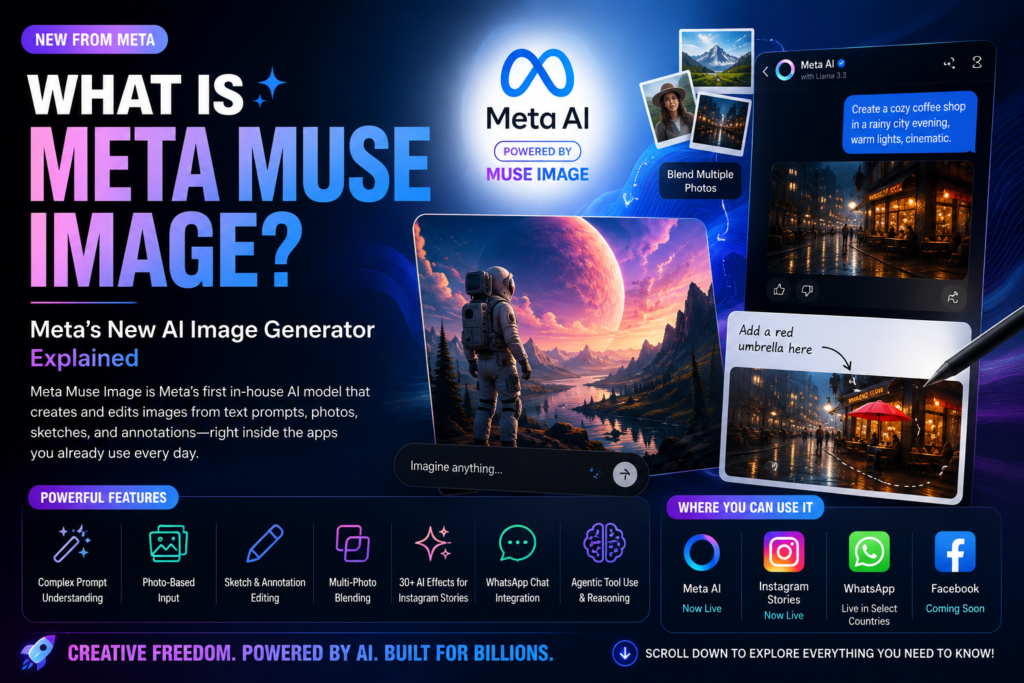
Meta Muse Image is Meta’s first in-house AI image-generation model, launched on July 7, 2026, and built into Meta AI, Instagram, and WhatsApp. If you’ve wondered how Meta plans to compete with Google’s and OpenAI’s image tools, the short answer is: by putting its own model directly inside the apps billions of people already use every day.
This launch marks a turning point for Meta’s generative AI strategy. Rather than relying on partner models or open-weight Llama derivatives for anything visual, Meta now owns its full image stack — from prompt understanding to pixel generation to in-chat editing. Below, we break down exactly what Meta Muse Image is, how it works, where you can use it, and how it stacks up against the competition.
What Is Meta Muse Image?
Definition: Meta Muse Image is a generative AI model developed by Meta Superintelligence Labs (MSL) that creates and edits images from text prompts, photos, sketches, and annotations, directly inside Meta’s family of apps.
Expansion: Unlike a standalone AI art app, Meta Muse Image is embedded natively into products people already use daily. The company said Muse Image, which is integrated into its Meta AI chatbot, can interpret complex prompts, use photos as inputs and let users edit generated images directly through sketches or annotations. That means you don’t need a separate account or app — if you already use Meta AI, Instagram, or WhatsApp, Muse Image is either already available to you or coming soon. Yahoo!
The model can also work from multiple reference images at once. The model understands complex prompts and blends multiple photos into creations that can be downloaded and shared to the user’s chat, story or feed. It also includes features like suggested prompts to spark ideas and the ability to “@ mention” photos to pull them directly into a new creation. PYMNTS
Why Meta Built Muse Image Now
The Meta Superintelligence Labs Connection
Muse Image didn’t appear out of nowhere. In April, the company launched Muse Spark, the first text-and-reasoning AI model from the Meta Superintelligence Labs team it assembled last year to catch up with rivals in the AI race. Muse Image is the visual counterpart to that text-and-reasoning foundation, and Meta has said the two are designed to work together. Yahoo!
This lab wasn’t cheap to build. It was reported in June that after spending $14 billion to bring Alexandr Wang and his Scale AI team into the fold in 2025, Meta is facing pressure to prove it can monetize the resulting AI tools such as Muse Spark. Muse Image, in that sense, is also a proof point — a visible, consumer-facing product that shows the investment is producing results. PYMNTS
Catching Up to Google and OpenAI
Meta AI launching without a first-party image generator would have looked conspicuously behind, since rival assistants from Google and OpenAI already ship native image tools. Meta Muse Image closes that gap, though Meta isn’t claiming outright superiority. According to reporting on benchmark comparisons, the company says it outperforms Google’s Nano Banana 2 on several image-generation and editing evaluations, while ranking just behind OpenAI’s latest GPT Image model in overall image quality. The Tech Portal
That framing matters. Meta isn’t trying to win a leaderboard — it’s playing a distribution game. As one industry analysis put it, the strategy is about reach rather than raw benchmark supremacy, since Meta’s apps already have enormous built-in audiences.
Key Features of Meta Muse Image
Meta Muse Image ships with a set of capabilities aimed at both casual users and, eventually, advertisers. Here’s what’s included at launch:
- Complex prompt interpretation — understands multi-step instructions covering objects, lighting, camera angle, and style
- Photo-based input — users can feed existing photos into the model as a starting point
- Sketch and annotation editing — draw directly on an image to request specific changes
- Multi-photo blending — combine several reference photos into one new image
- Instagram Stories effects — over 30 new AI-powered effects built on Muse Image
- WhatsApp chat integration — generate and edit images inside an ongoing conversation
- Agentic tool use — the model can reason about a request and use tools rather than generating a single static output in one pass
Prompt-Based Generation and Editing
At its core, Meta Muse Image works the way most modern AI image tools do: you describe what you want, and the model generates it. What sets Muse Image apart is its emphasis on iterative refinement rather than one-shot generation — the model is designed to interpret a request, act on it, and let you keep adjusting through natural conversation.
Sketch and Annotation Editing
This is one of the more distinctive Muse Image features. Instead of rewriting a text prompt to fix a small detail, users can draw directly on the generated image — circling an object to remove it, or sketching where a new element should go — and Muse Image will apply the edit.
Multi-Photo Blending
Muse Image can pull in multiple source photos and merge them into a single composed image. This is particularly useful for social content, where users might want to combine a personal photo with a generated background or stylistic element.
Where Can You Use Meta Muse Image?
Meta Muse Image is rolling out across several surfaces, though not all at once. Muse Image will power more than 30 new AI effects for Instagram Stories and enable image generation in direct chats with Meta AI on WhatsApp, initially in select countries. Yahoo!
Availability breaks down like this:
| Platform | Status at Launch | Notes |
|---|---|---|
| Meta AI (app & chatbot) | Live | Primary hub for Muse Image generation |
| Instagram Stories | Live | Powers 30+ new AI effects |
| Live in select countries | Generate/edit images inside chat threads | |
| Coming soon | Meta plans to expand Muse Image to more countries and integrate it into Facebook and Messenger Yahoo! | |
| Messenger | Coming soon | Same phased rollout as Facebook |
| Meta Advantage+ (ads) | Rolling out within weeks | Built for advertiser creative generation |
The initial release is concentrated in the US and English-language markets, with Meta describing broader language and regional support as coming “in the coming weeks” — typically a sign of a gradual, staged rollout rather than an instant global switch-on.
Meta Muse Image vs. Other AI Image Generators
How does Meta Muse Image compare to the tools people already know, like GPT Image and Google’s Nano Banana? Here’s a side-by-side look based on available reporting:
| Feature | Meta Muse Image | OpenAI GPT Image | Google Nano Banana 2 |
|---|---|---|---|
| Native integration | Meta AI, Instagram, WhatsApp | ChatGPT, API | Google apps, API |
| Sketch/annotation editing | Yes | Limited | Limited |
| Multi-photo blending | Yes | Yes | Yes |
| Pricing model | Free for basic use; subscription for advanced | Per-image API pricing | Per-image API pricing |
| Developer API at launch | Not published | Yes | Yes |
| Benchmark positioning | Reportedly ahead of Nano Banana 2, behind GPT Image | Top-ranked in image quality per Meta’s comparison | Reportedly behind Muse Image per Meta’s comparison |
This table highlights an important distinction: Meta Muse Image is not currently positioned as a developer product. There’s no published per-image API pricing, which contrasts with the metered, pay-per-image models offered by OpenAI and Google. Muse Image is, first and foremost, a consumer feature.
Is Meta Muse Image Free?
Question: Do you have to pay to use Meta Muse Image?
Direct Answer: No — basic use of Meta Muse Image is free. While basic use of Muse Image with Meta AI is free, additional creation capabilities will be available through Meta’s subscription plans, the company said. Yahoo!
In practice, this likely means standard image generation and simple edits are free for anyone using Meta AI, Instagram, or WhatsApp, while more advanced creation tools — higher resolution outputs, extended editing capabilities, or priority generation — will sit behind a paid Meta subscription tier.
What Muse Image Means for Businesses and Advertisers
Meta Muse Image isn’t just a consumer novelty — it has a direct commercial application. Meta said Muse Image will start helping power image generation in Meta Advantage+ creative within weeks and will bring smarter reasoning and iterative refinement to Meta’s existing generative AI ad creation tool. PYMNTS
Early feedback from advertisers testing the feature has reportedly been positive. Early results with Muse Image-powered generation variants show strong promise, with advertisers who tested the experience citing higher-quality creative, with photorealism and product integrity standing out. PYMNTS
For businesses, this could mean:
- Faster generation of multiple ad creative variations for A/B testing
- Reduced reliance on external design tools or agencies for simple visual assets
- Editing existing campaign images without starting from scratch
- Lower content-production costs at scale, since digital advertising is Meta’s largest revenue source
Privacy Considerations With Meta Muse Image
As with any AI feature tied to a social platform, Meta Muse Image raises questions about how existing user content factors into AI generation. As part of Meta’s Muse Image model rollout, Instagram users with public accounts need to opt out to block AI generations of their content. Ground News
This is worth flagging clearly for anyone with a public Instagram account: the default setting permits use of public content, and turning that off requires an active opt-out rather than being off by default. If you have a public Instagram profile and want to avoid having your photos used in AI generation, check your Meta AI and Instagram privacy settings directly rather than assuming you’re excluded automatically.
Meta Muse Image and the Bigger Picture: Muse Spark and Muse Video
Meta Muse Image is one piece of a broader “Muse” family of models coming out of Meta Superintelligence Labs:
- Muse Spark (launched April 2026) — Meta’s first text-and-reasoning model, powering the Meta AI app and website
- Muse Image (launched July 7, 2026) — the image-generation model covered in this post
- Muse Video (early preview) — Meta also announced an early preview of Muse Video, its video generation model Yahoo!
Together, these three models suggest Meta is building a unified, multimodal AI stack — text, image, and eventually video — all developed in-house rather than licensed or adapted from outside partners. Muse Image is designed to integrate with Muse Spark specifically, meaning the reasoning capabilities from Meta’s text model can inform how Muse Image interprets and executes a visual request.
Frequently Asked Questions
What is Meta Muse Image?
Meta Muse Image is Meta’s first proprietary AI image-generation model, built by Meta Superintelligence Labs, that creates and edits images from text prompts, photos, and sketches inside Meta AI, Instagram, and WhatsApp.
When was Meta Muse Image released?
Meta Muse Image was announced and rolled out on July 7, 2026.
Is Meta Muse Image available on Facebook?
Not yet at launch. Facebook and Messenger integration is planned for a later phase of the rollout.
Does Meta Muse Image cost money?
Basic use is free. Advanced creation features require a Meta subscription plan.
How does Meta Muse Image compare to GPT Image and Nano Banana 2?
Meta has described Muse Image as outperforming Nano Banana 2 on several benchmarks while ranking just behind GPT Image in overall image quality — though independent, third-party benchmark verification is still limited this early in the rollout.
Can businesses use Meta Muse Image for ads?
Yes. Muse Image is being integrated into Meta Advantage+ creative to help advertisers generate and iterate on marketing visuals.
Final Takeaway
Meta Muse Image represents Meta’s most direct move yet to own its AI image stack rather than depend on outside models. It’s not aimed at professional AI artists chasing benchmark-topping quality — it’s aimed at the billions of people already inside Meta AI, Instagram, and WhatsApp, plus the advertisers who rely on Meta’s ad platform. Whether Muse Image can match the polish of GPT Image over time remains to be seen, but its built-in distribution alone makes it one of the most widely accessible AI image generators on the market from day one.
If you use Instagram, WhatsApp, or Meta AI, the simplest way to understand Meta Muse Image is to open the app and try it — the free tier is available now in the US and other initial launch markets.