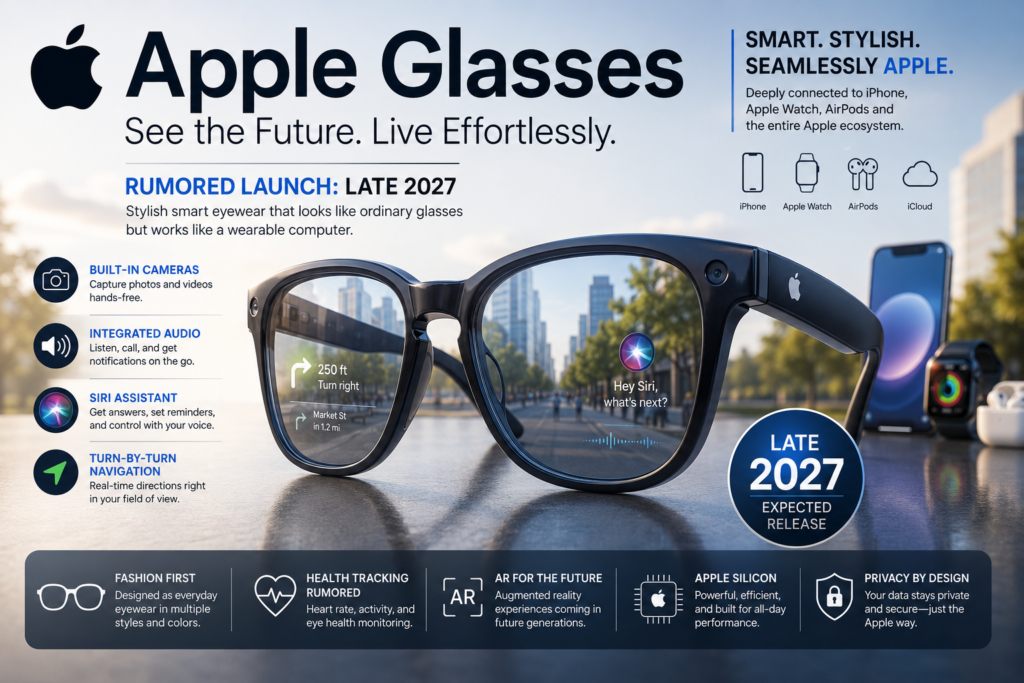
Apple Glasses are the company’s rumored smart eyewear, expected to launch in late 2027 with built-in cameras, Siri integration, turn-by-turn navigation, and deep ties to the Apple ecosystem. They are designed to look like ordinary eyeglasses while quietly functioning as a wearable computer — no bulky headset required.
If you’ve been tracking wearable tech leaks, you already know Apple has been circling this category for years. What’s changed recently is the level of detail emerging about design, features, and timing. This guide breaks down everything currently known about Apple Glasses, based on the latest reporting, so you can understand exactly what Apple is building and why it matters.
What Are Apple Glasses?
Apple Glasses are a rumored line of smart eyewear that combine everyday-wearable design with computing features like hands-free photo capture, voice assistant access, and real-time navigation. Unlike Apple’s Vision Pro, which is a fully immersive mixed-reality headset, Apple Glasses are built to look and feel like a normal pair of glasses.
The distinction matters. Vision Pro targets deep, seated AR/VR experiences — gaming, spatial computing, immersive media. Apple Glasses instead target the moments in between: walking down the street, running errands, commuting. Apple is reportedly preparing to redefine wearable technology with this device, targeting a release in late 2027, combining augmented reality, advanced health tracking, and seamless integration with Apple’s ecosystem into a sleek, everyday accessory. geeky-gadgets
The strategic goal is bigger than a single product category. If successful, Apple Glasses could significantly impact the $200 billion global eyewear market, in a manner comparable to how the Apple Watch transformed the watch industry. geeky-gadgets
When Will Apple Glasses Launch?
Apple Glasses are currently targeted for a late 2027 release. Apple’s approach prioritizes polished design and reliable performance over rushing to market, ensuring the final product meets the company’s high standards.
This deliberate pace is consistent with how Apple has historically handled new hardware categories — the original Apple Watch, AirPods, and Vision Pro all went through extended internal development before their public debut. For Apple Glasses specifically, getting the balance right between fashion and function appears to be the bottleneck, not the underlying chip or sensor technology.
Why the wait matters: A rushed smart glasses launch risks repeating the mistakes of earlier entrants in the category — bulky designs, awkward social perception, or underwhelming battery life. By waiting until late 2027, Apple is signaling that it wants Apple Glasses to debut as a refined consumer product rather than a developer preview.
Apple Glasses Design and Style Options
Apple Glasses are being designed first as a fashion accessory and second as a piece of technology. That ordering is intentional, and it’s the key difference between this device and most smart glasses that have come before it.
Definition: A “fashion-first” wearable is one where the industrial design is built to match existing eyewear conventions — frame shapes, materials, and colorways people already wear — rather than forcing users to adapt to a visibly “techy” form factor.
Expansion: Apple Glasses are expected to come in multiple frame styles and colors, including black, ocean blue, and light brown, catering to a wide range of personal preferences. This approach mirrors Apple’s strategy with Apple Watch bands and iPhone finishes — offering enough variety that the product feels personal rather than uniform. By prioritizing comfort and wearability, Apple intends to make the glasses suitable for daily use, positioning them as a product that bridges fashion and functionality rather than choosing one over the other.
Key Apple Glasses Features
What can Apple Glasses actually do? Based on current reporting, the feature set centers on four core capabilities designed to work without pulling out a phone.
- Built-in cameras — capture photos and video hands-free, directly from the frames.
- Integrated audio — built-in speakers and microphones for calls, music, and notifications.
- Siri voice assistant — hands-free access to information, reminders, and commands.
- Turn-by-turn navigation — real-time directions displayed in your field of view.
Built-In Cameras
Built-in cameras on Apple Glasses are designed to offer hands-free photo and video capture, giving users a new way to document and share experiences effortlessly. This mirrors the camera-glasses approach already popularized by competitors, but with the added weight of Apple’s ecosystem behind it — meaning captured content could sync instantly to Photos, iCloud, and other Apple apps.
Integrated Audio
Integrated speakers and microphones are expected to allow music playback, phone calls, and notification interaction without needing additional devices like AirPods. For users who already rely on AirPods throughout the day, this positions Apple Glasses as a potential audio hub in its own right, not just a camera accessory.
Siri Voice Assistant
Siri integration is expected to provide quick access to information, reminders, and commands, enabling productivity on the go. Given Apple’s ongoing push to modernize Siri, voice control is likely to be one of the primary interaction methods for Apple Glasses, since there’s no touchscreen to tap.
Turn-by-Turn Navigation
Real-time directions displayed directly in the user’s field of view are designed to simplify navigation and enhance convenience. This is arguably the most practical everyday use case of the four — turning walking or driving directions into a passive, glanceable experience instead of a phone screen you have to check.
How Apple Glasses features work together: These features are designed to simplify daily tasks while maintaining a minimalist, user-friendly interface, with Apple aiming to deliver a product that feels natural and effortless to use.
How Apple Glasses Connect With the Apple Ecosystem
Apple Glasses are expected to function less like a standalone gadget and more like a new access point into devices you already own. As an Apple user, you can expect the glasses to sync effortlessly with devices such as your iPhone, Apple Watch, and AirPods, enabling access to notifications, music control, and health metrics without juggling multiple devices.
This ecosystem lock-in is a deliberate strategy. The glasses are positioned as an extension of Apple’s ecosystem, reinforcing the brand’s dominance in wearable technology, so that Apple Glasses function not only as a standalone device but also enhance the overall Apple experience. In practice, that likely means features like automatic handoff between your iPhone and Apple Glasses, shared authentication through Face ID or Apple Watch unlock, and a unified notification system across all your Apple devices.
Augmented Reality and Health Tracking Capabilities
Question: Will Apple Glasses have full AR capabilities like Vision Pro?
Direct answer: Not initially — but AR is part of Apple’s long-term roadmap for the product, alongside health tracking features inspired by Apple Watch.
AR is expected to play a pivotal role in Apple’s long-term vision, offering immersive experiences that could transform industries such as gaming, education, and remote work — from virtual collaboration tools to interactive learning environments. Rather than launching with full spatial computing on day one, Apple Glasses appear positioned to grow into these capabilities over successive hardware generations, similar to how the Apple Watch’s health features expanded gradually after its 2015 debut.
On the health side, the glasses could include sensors to monitor metrics such as heart rate, activity levels, and even eye health, building on the success of the Apple Watch and aligning with Apple’s broader commitment to health and wellness. Combining AR with biometric sensing would let Apple Glasses function as both a productivity tool and a passive health-monitoring device — two categories Apple has invested in heavily but never fully merged into one wearable.
Apple Glasses vs. Meta Ray-Ban vs. Snap Specs
Apple isn’t entering an empty market. Meta and Snap already sell smart glasses today, which gives useful context for where Apple Glasses are expected to land competitively.
| Feature | Apple Glasses (Rumored) | Meta Ray-Ban | Snap Specs |
|---|---|---|---|
| Expected/Actual Release | Late 2027 | Available now | Available now |
| Built-in Camera | Yes | Yes | Yes |
| Voice Assistant | Siri | Meta AI | Snap AI |
| Full AR Display | Planned long-term | No | Limited (51° FOV) |
| Ecosystem Integration | iPhone, Apple Watch, AirPods | Meta apps, Instagram, Facebook | Snapchat |
| Health Tracking | Rumored (heart rate, activity, eye health) | No | No |
| Price Positioning | Premium (unconfirmed) | Mid-range | Premium ($2,195) |
The table underscores why Apple Glasses are generating so much attention: no current competitor combines a mainstream ecosystem, health sensors, and a long-term AR roadmap in one pair of everyday-wearable frames.
What This Means for the Smart Eyewear Market
Apple entering this space isn’t just another product launch — it’s a potential category-defining moment for wearable tech.
Apple’s entry into the smart glasses market has the potential to significantly disrupt the eyewear industry, with the company positioning its glasses as a must-have accessory for both tech-savvy users and fashion-forward consumers by combining advanced technology with stylish design. The company’s cautious, standards-first development approach echoes how it handled the Apple Watch — enter late, but enter with a more complete and polished product than the incumbents.
The potential market impact extends beyond individual consumers: industries such as retail, healthcare, and entertainment could benefit from the glasses’ AR capabilities, opening new opportunities for innovation and growth as Apple sets a new benchmark for smart eyewear.
Apple Glasses FAQ
Q: When are Apple Glasses coming out?
A: Apple Glasses are currently expected to launch in late 2027, based on current development timelines.
Q: How much will Apple Glasses cost?
A: Pricing hasn’t been confirmed. Given the premium positioning of comparable devices like Snap Specs ($2,195), expect Apple Glasses to sit in a similar or higher price bracket.
Q: Do Apple Glasses have a screen or AR display?
A: Not at launch, based on current reporting. Full AR display capability is described as part of Apple’s longer-term vision rather than a first-generation feature.
Q: Will Apple Glasses work without an iPhone?
A: Details haven’t been confirmed, but given the deep ecosystem integration with iPhone, Apple Watch, and AirPods, an iPhone connection is likely necessary for full functionality.
Q: What colors will Apple Glasses come in?
A: Reported color options include black, ocean blue, and light brown, with multiple frame styles to match different personal aesthetics.
Q: Will Apple Glasses track health data?
A: Health tracking is rumored, potentially including heart rate, activity levels, and eye health monitoring — building on Apple Watch’s health platform.