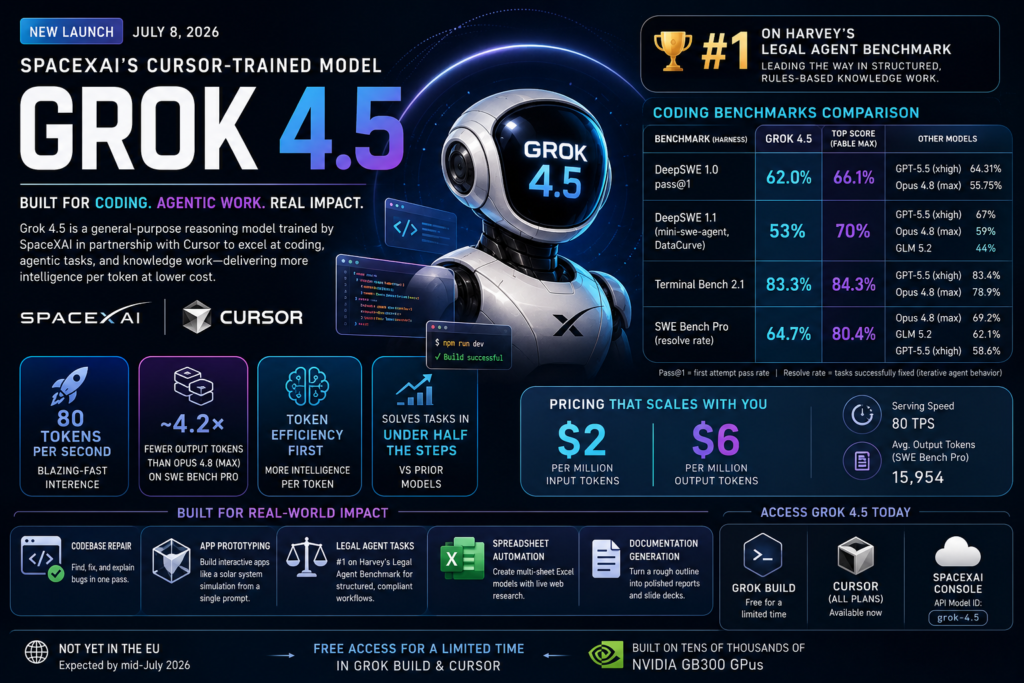
Grok 4.5 is SpaceXAI’s newest large language model, built specifically for coding, agentic tasks, and knowledge work, and trained in partnership with the AI coding editor Cursor. It launched on July 8, 2026, priced at $2 per million input tokens and $6 per million output tokens, with SpaceXAI positioning it as the most token-efficient model in its lineup.
If you write code, run agentic workflows, or evaluate frontier LLMs for enterprise use, Grok 4.5 is worth understanding on three fronts: how it performs against Fable, GPT-5.5, and Opus 4.8; how much it costs to run at scale; and where it genuinely leads the pack. This guide breaks down all three, using SpaceXAI’s own published data.
What Is Grok 4.5?
Grok 4.5 is a general-purpose reasoning model tuned for real engineering work rather than open-ended chat. SpaceXAI trained Grok 4.5 on datasets spanning coding, science, engineering, and mathematics, with the explicit goal of producing a model that reasons efficiently — not just accurately.
The headline differentiator is training methodology. Grok 4.5 was developed alongside Cursor, meaning its coding behavior was shaped by direct feedback loops with a production coding tool rather than benchmarks alone. SpaceXAI describes this collaboration as central to why Grok 4.5 performs well on multi-step software engineering tasks specifically, as opposed to generic text generation.
Grok 4.5 in one line: it’s a coding- and agent-first model that trades raw benchmark-topping scores for lower latency, fewer output tokens, and a #1 ranking on Harvey’s Legal Agent Benchmark — a proxy for real office and knowledge-work capability.
Is Grok 4.5 the Best Coding Model Available?
No. Based on SpaceXAI’s own published chart, Fable (max) posts the top score on all four coding benchmarks SpaceXAI tested. Grok 4.5 does not claim the top spot on any of them, though it stays closest to the leader on Terminal Bench 2.1. This is worth stating plainly, because SpaceXAI’s marketing language claims Grok 4.5 “exceeds comparable leading models,” while its own chart tells a more mixed story. Grok 4.5’s real strength lies elsewhere: efficiency and cost, not peak accuracy.
How Was Grok 4.5 Trained?
Understanding how Grok 4.5 was built explains why it behaves the way it does in production.
Training Infrastructure
SpaceXAI trained Grok 4.5 across tens of thousands of NVIDIA GB300 GPUs, using training and stability techniques designed specifically for runs at that scale. Rather than simply maximizing token volume, the SpaceXAI team invested heavily in data filtering and curation — including deduplication, quality scoring, and domain-focused selection — before the model ever touched the bulk of its training corpus.
Reinforcement Learning at Scale
Beyond pretraining, SpaceXAI scaled reinforcement learning with a specific focus on per-token intelligence: getting more reasoning value out of every token generated, rather than encouraging longer, more verbose outputs. RL for Grok 4.5 covered hundreds of thousands of tasks, most centered on multi-step software engineering and related technical work. Grading combined automated methods with model-based evaluation.
Why this matters: the RL stack supports highly asynchronous training, where agentic rollouts can run for many hours while learning continues in parallel. This is the same operational pattern Grok 4.5 is expected to handle in production — long-running, multi-step agentic tasks rather than single-turn Q&A.
Grok 4.5 Benchmarks: How Does It Compare?
SpaceXAI published Grok 4.5 scores across four coding benchmarks, with competitor figures sourced from each model’s own published system card or public leaderboard. Before reading the table, it helps to know two terms:
- Pass@1 counts only first-attempt passes — the model gets one shot, no retries.
- Resolve rate measures the share of tasks the model successfully fixed, typically allowing for iterative agent behavior.
| Benchmark (harness) | Grok 4.5 | Top Listed Score | Other Models |
|---|---|---|---|
| DeepSWE 1.0 — pass@1 | 62.0% | Fable (max) — 66.1% | GPT-5.5 (xhigh) 64.31%; Opus 4.8 (max) 55.75% |
| DeepSWE 1.1 (mini-swe-agent, DataCurve) | 53% | Fable (max) — 70% | GPT-5.5 (xhigh) 67%; Opus 4.8 (max) 59%; GLM 5.2 44% |
| Terminal Bench 2.1 | 83.3% | Fable (max) — 84.3% | GPT-5.5 (xhigh) 83.4%; Opus 4.8 (max) 78.9% |
| SWE Bench Pro — resolve rate | 64.7% | Fable (max) — 80.4% | Opus 4.8 (max) 69.2%; GLM 5.2 62.1%; GPT-5.5 (xhigh) 58.6% |
What Do the Grok 4.5 Benchmarks Actually Show?
Grok 4.5 is consistently mid-pack against Fable (max), GPT-5.5, and Opus 4.8 on raw accuracy. It is closest to the top score on Terminal Bench 2.1 (83.3% vs. 84.3%) and furthest behind on SWE Bench Pro, where it trails Fable (max) by nearly 16 points. If your selection criteria is pure task-resolution accuracy, Grok 4.5 is not the strongest option in this comparison set. If your criteria includes cost and speed alongside accuracy, the picture changes — which is where token efficiency comes in.
Grok 4.5 Speed and Token Efficiency
This is where Grok 4.5 differentiates itself most clearly. SpaceXAI serves Grok 4.5 at 80 tokens per second and reports roughly double the token efficiency of leading competitor models.
On SWE Bench Pro specifically, Grok 4.5 resolved tasks using an average of 15,954 output tokens. SpaceXAI reports that Opus 4.8 (max) used 67,020 output tokens on the same benchmark — meaning Grok 4.5 used about 4.2 times fewer output tokens to complete comparable work.
Why token efficiency matters in practice:
- Fewer output tokens generally means lower per-task cost, since output tokens are billed at a higher rate than input tokens.
- Shorter completions typically reduce end-to-end latency, which matters for agentic workflows running many sequential steps.
- SpaceXAI states Grok 4.5 solves tasks in under half the number of steps compared to prior models, compounding the efficiency gain across a full agent run.
In other words, Grok 4.5 may not win on accuracy alone, but a lower-accuracy answer delivered in a quarter of the tokens can still be the more economical choice for high-volume production workloads.
Grok 4.5 Pricing: What Does It Cost?
Grok 4.5 costs $2 per million input tokens and $6 per million output tokens. Combined with its token efficiency, this pricing structure is central to SpaceXAI’s positioning of Grok 4.5 as a cost-effective option for teams running large volumes of agentic or coding tasks rather than occasional single queries.
Grok 4.5 Pricing at a Glance
| Item | Cost |
|---|---|
| Input tokens | $2 / million tokens |
| Output tokens | $6 / million tokens |
| Serving speed | 80 TPS |
| Avg. output tokens (SWE Bench Pro) | 15,954 |
Pricing for frontier models changes frequently. Confirm current Grok 4.5 pricing directly in the SpaceXAI console before budgeting a production deployment.
Grok 4.5 Use Cases
SpaceXAI targets Grok 4.5 at practical, real-world knowledge work rather than purely academic benchmarks. Documented use cases include:
- Codebase repair — locating a bug, fixing it, and explaining the root cause in one pass.
- App prototyping — building interactive applications, such as a Three.js solar-system simulation, from a single prompt.
- Legal agent tasks — Grok 4.5 ranks #1 on Harvey’s Legal Agent Benchmark, a strong signal for structured office and compliance workflows.
- Spreadsheet automation — constructing multi-sheet Excel models that pull in live web research.
- Documentation generation — converting a rough outline into a finished slide deck and a formatted Word report.
Why Does Grok 4.5 Rank #1 on Harvey’s Legal Agent Benchmark?
SpaceXAI cites this ranking as evidence of Grok 4.5’s strength in structured, rules-based office work — a different skill set from open-ended coding. Legal agent tasks reward precise instruction-following, citation accuracy, and multi-step document reasoning, areas where Grok 4.5’s efficiency-focused RL training appears to pay off even though it doesn’t top the coding benchmarks.
How to Get Started With Grok 4.5
Grok 4.5 is available in Grok Build, in Cursor on all plans, and through the SpaceXAI console. The model ID for API calls is grok-4.5.
Calling Grok 4.5 via the API
curl -s https://api.x.ai/v1/responses \
  -H "Authorization: Bearer $XAI_API_KEY" \
  -H "Content-Type: application/json" \
  -d '{
    "model": "grok-4.5",
    "input": "Find and fix the bug, then explain it: function median(a){a.sort();return a[a.length/2]}"
  }'
Installing the Grok Build CLI
To use Grok Build from the terminal:
curl -fsSL https://x.ai/cli/install.sh | bash
Grok 4.5 at a Glance
| Attribute | Detail |
|---|---|
| Vendor | SpaceXAI |
| Focus | Coding, agentic tasks, knowledge work |
| Training partner | Cursor |
| Hardware | Tens of thousands of NVIDIA GB300 GPUs |
| Serving speed | 80 TPS |
| Token efficiency | ~4.2× fewer output tokens than Opus 4.8 (max) on SWE Bench Pro |
| Input price | $2 / million tokens |
| Output price | $6 / million tokens |
| Access | Grok Build, Cursor (all plans), SpaceXAI console |
| Model ID | grok-4.5 |
Availability and Limitations
Grok 4.5 is live now in Grok Build and in Cursor across all plans, and it’s also accessible through the SpaceXAI console. It is not yet available in the EU; SpaceXAI expects EU availability by mid-July 2026. For a limited time, SpaceXAI is offering free usage of Grok 4.5 in both Grok Build and Cursor.
Frequently Asked Questions
Is Grok 4.5 the top-performing model on coding benchmarks? No. According to SpaceXAI’s own published chart, Fable (max) leads all four coding benchmarks tested, with Grok 4.5 coming closest on Terminal Bench 2.1.
What is the main advantage of Grok 4.5? Token efficiency. Grok 4.5 used roughly 4.2 times fewer output tokens than Opus 4.8 (max) on SWE Bench Pro, which lowers cost and latency for high-volume agentic workflows even where raw accuracy trails top competitors.
How much does Grok 4.5 cost? Grok 4.5 is priced at $2 per million input tokens and $6 per million output tokens, served at 80 tokens per second.
Who trained Grok 4.5, and how? SpaceXAI trained Grok 4.5 in partnership with Cursor, using tens of thousands of NVIDIA GB300 GPUs, curated multi-domain data, and large-scale reinforcement learning focused on per-token intelligence across hundreds of thousands of software engineering tasks.
Where can I access Grok 4.5? Grok 4.5 is available in Grok Build, in Cursor on all plans, and via the SpaceXAI console, using the model ID grok-4.5. It is not yet live in the EU.
Does Grok 4.5 work well for legal or office tasks? Yes. Grok 4.5 ranks #1 on Harvey’s Legal Agent Benchmark, suggesting particular strength in structured, rules-based knowledge work beyond coding.