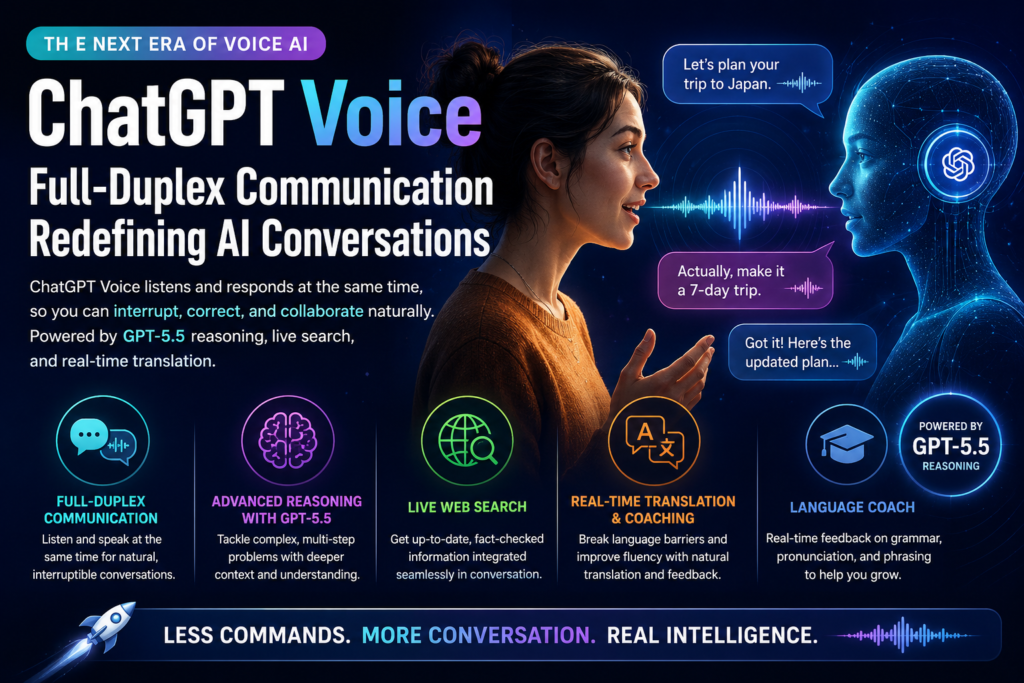
ChatGPT Voice now supports full-duplex communication, meaning it can listen and respond at the same time instead of taking turns like older voice assistants. This single architectural shift lets you interrupt, correct, or redirect the AI mid-sentence, and it’s paired with GPT-5.5-powered reasoning, real-time translation, and live search — making the assistant feel less like a command-response tool and more like a genuine conversational partner.
If you’ve ever talked to a voice assistant and felt the awkward “wait your turn” lag, you already understand why this update matters. Below, we break down exactly what’s changed, how each feature works, and how ChatGPT Voice compares to the voice assistants you’re used to.
What Is ChatGPT Voice?
ChatGPT Voice is OpenAI’s conversational voice interface for ChatGPT, built to handle spoken interactions with the same reasoning depth as the text-based app. Rather than functioning as a simple speech-to-text-to-speech pipeline, it’s designed around continuous, natural dialogue — closer to talking with a knowledgeable colleague than issuing commands to a smart speaker.
The system combines four core capabilities into one experience:
- Full-duplex audio processing for simultaneous listening and speaking
- GPT-5.5 reasoning for complex, multi-step problem-solving
- Live web search for up-to-date, fact-checked answers
- Multilingual translation and coaching for cross-language conversations
Each of these is worth unpacking on its own, since they solve different problems that have historically made voice AI feel clunky.
Full-Duplex Communication: What Does It Actually Mean?
Full-duplex communication means ChatGPT Voice processes your speech and generates its response concurrently, rather than waiting for you to finish talking before it starts “thinking.” In telecommunications terms, this is the difference between a walkie-talkie (half-duplex, one direction at a time) and a phone call (full-duplex, both people can talk and be heard simultaneously).
Why Does This Matter for Everyday Use?
Older voice assistants, including earlier versions of ChatGPT Voice, operate in a strict turn-taking loop: you speak, the system processes silence as an end-of-turn signal, then it responds. That model breaks down the moment you pause to think, change your mind, or want to add a detail — the assistant either interrupts you or waits through an awkward silence.
With full-duplex processing, ChatGPT Voice can:
- Register a correction or clarification while you’re still speaking
- Adjust its answer in real time if you redirect the conversation
- Allow you to interrupt a long response instead of sitting through all of it
- Maintain a natural back-and-forth rhythm similar to human conversation
This is arguably the headline feature of the update, since it directly addresses the biggest usability complaint about voice AI: it never felt like a real conversation.
Advanced Reasoning: ChatGPT Voice Powered by GPT-5.5
For queries that require more than a quick factual answer, ChatGPT Voice hands off to GPT-5.5, OpenAI’s model built specifically for intricate, multi-step reasoning. This means the voice assistant isn’t limited to surface-level responses — it can walk through project planning, debug a technical problem out loud, or help structure a brainstorm, all while maintaining context across a long spoken exchange.
This matters because reasoning quality is often where voice assistants fall short compared to their text counterparts. By routing complex requests through GPT-5.5, ChatGPT Voice narrows that gap, offering context-aware answers whether you’re troubleshooting code, planning a trip logistics, or working through a business decision verbally.
Real-Time Translation: Conversations Without Language Barriers
ChatGPT Voice’s real-time translation feature prioritizes meaning and cultural context over literal, word-for-word conversion, so translated conversations sound natural rather than robotic. If you’re speaking English and need to communicate with a French speaker, the system doesn’t just swap vocabulary — it adjusts tone, idiom, and phrasing to preserve what you actually meant to say.
Where Does This Feature Help Most?
- International business calls, where tone and nuance affect how a message lands
- Travel, for ordering food, asking directions, or handling logistics on the fly
- Cross-language collaboration, where teams need fast, accurate back-and-forth
- Casual conversation, where literal translation often misses humor or context
Because ChatGPT Voice processes this in real time rather than as a separate translation step, the exchange keeps its conversational flow instead of feeling like a stop-and-start interpreter session.
Language Coaching: A Built-In Tutor for Learners
Beyond translation, ChatGPT Voice functions as a language coach, giving real-time feedback on grammar, pronunciation, and phrasing as you practice speaking. If you make a mistake, the system corrects you gently and offers a specific, actionable fix rather than just flagging that something was wrong.
This is a meaningfully different use case from translation: instead of doing the language work for you, it’s designed to help you build the skill yourself, whether you’re prepping for a presentation in a second language or just practicing conversational fluency.
Search and Reasoning Integration: Staying Current Mid-Conversation
ChatGPT Voice can trigger a live web search mid-conversation when a question requires current information, then fold the results into a natural spoken answer. This closes a longstanding gap for voice assistants, which have historically either relied on stale training data or required you to switch to a separate search app.
Whether you’re asking about breaking news, a scientific concept, or a restaurant recommendation nearby, ChatGPT Voice combines contextual understanding with fresh, verified data — so you get an informed answer without leaving the conversation or repeating your question elsewhere.
User-Centric Customization: Matching Your Communication Style
ChatGPT Voice lets you set the depth and pace of interactions, choosing between quick, concise answers or longer, more detailed discussions depending on the situation. This flexibility is what bridges the gap between the “text ChatGPT” experience many users already know and a voice-first interaction — you’re not locked into one conversational style regardless of context.
Over time, this adaptability is what tends to build user trust in a voice assistant: it responds the way you actually want to be spoken to, not a fixed default that ignores context.
Safety and Accessibility: Built for Broad, Responsible Use
ChatGPT Voice incorporates safeguards designed to prevent harmful or inappropriate interactions while also including accessibility features like voice modulation and simplified language settings. These aren’t cosmetic additions — voice modulation options can assist users with speech impairments, and simplified language settings support users who prefer more direct, less complex phrasing.
Combining safety guardrails with accessibility design is part of what makes ChatGPT Voice usable across a genuinely broad range of users, not just a narrow, tech-fluent audience.
ChatGPT Voice vs. Traditional Voice Assistants
Here’s how the full-duplex ChatGPT Voice update stacks up against the turn-based voice assistants most people are used to:
| Feature | ChatGPT Voice (Full-Duplex) | Traditional Voice Assistants |
|---|---|---|
| Conversation style | Listens and responds simultaneously | Strict turn-taking (speak, then wait) |
| Interruptions | Can be interrupted or redirected mid-response | Interruptions often break the interaction |
| Reasoning depth | GPT-5.5 for complex, multi-step problems | Typically limited to scripted or shallow responses |
| Live information | Real-time web search integrated into dialogue | Often relies on static or cached data |
| Translation | Context-aware, natural-sounding translation | Frequently literal, word-for-word translation |
| Personalization | Adjustable depth and conversational pace | Largely fixed response format |
| Accessibility | Voice modulation and simplified language options | Varies widely by platform |
Frequently Asked Questions
Does ChatGPT Voice let me interrupt it mid-response? Yes. Because ChatGPT Voice uses full-duplex communication, you can interrupt, correct, or redirect it while it’s still speaking, and it adjusts without losing the thread of the conversation.
What model powers ChatGPT Voice’s reasoning? Complex queries are routed through GPT-5.5, OpenAI’s model optimized for multi-step reasoning and problem-solving, rather than being handled by a lighter-weight response system.
Can ChatGPT Voice translate conversations in real time? Yes. ChatGPT Voice offers real-time translation that adjusts for tone and cultural context rather than translating literally, which keeps cross-language conversations sounding natural.
Is ChatGPT Voice able to search the web during a conversation? Yes. ChatGPT Voice integrates real-time search, so it can retrieve current information and fold it into its spoken answer without you needing to switch apps.
What accessibility features does ChatGPT Voice include? ChatGPT Voice includes voice modulation options to support users with speech impairments and simplified language settings for users who prefer more direct communication.
Key Takeaways
- ChatGPT Voice’s full-duplex update removes the turn-taking lag that made older voice assistants feel unnatural, letting users interrupt or redirect the conversation freely.
- GPT-5.5 integration gives ChatGPT Voice the reasoning depth to handle complex, multi-step queries, not just quick factual replies.
- Real-time translation and language coaching make ChatGPT Voice useful for both live cross-language communication and active language learning.
- Live search integration keeps ChatGPT Voice’s answers current without requiring users to leave the conversation.
- Safety and accessibility safeguards are built into the core design, not added as an afterthought.
Taken together, these updates push ChatGPT Voice closer to feeling like a genuine conversational partner rather than a command-based tool — and the full-duplex shift in particular sets a new bar for what people will expect from voice AI going forward.