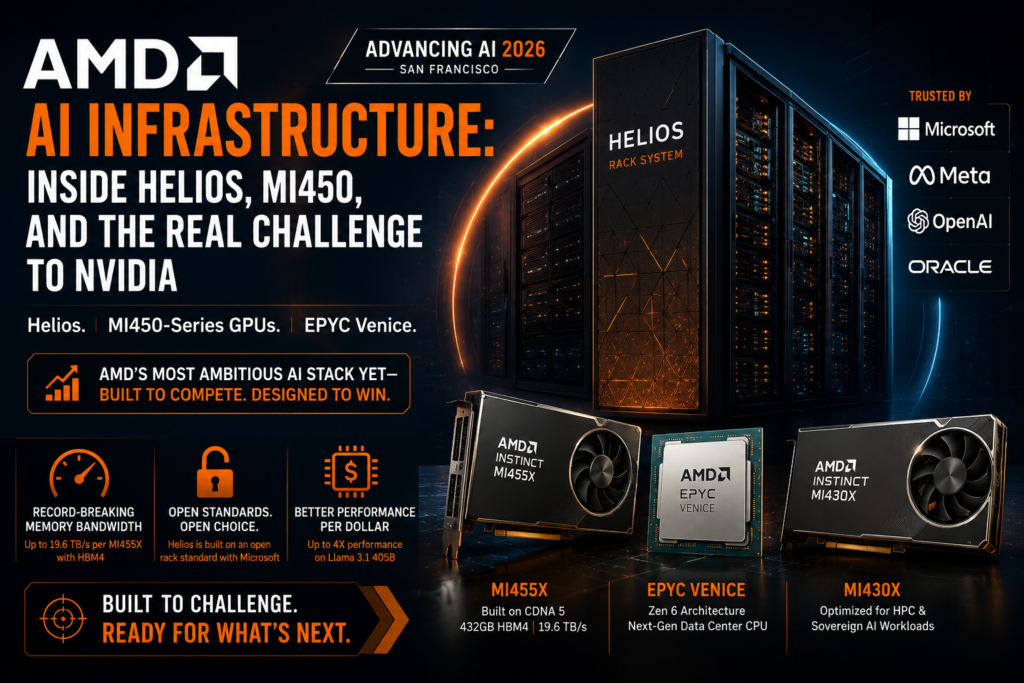
AMD’s new AI infrastructure stack — headlined by the Helios rack system, the MI450-series GPUs, and the Zen 6-based EPYC Venice CPU — is the company’s most direct attempt yet to break Nvidia’s grip on the data center. Unveiled at AMD’s “Advancing AI 2026” event in San Francisco, this lineup pairs record-breaking memory bandwidth with new hyperscaler commitments from Microsoft, Meta, OpenAI, and Oracle.
If you’re trying to understand what AMD actually announced, how it stacks up against Nvidia’s Vera Rubin platform, and whether it’s a credible threat — this breakdown covers it all in plain language.
What Is AMD’s New AI Infrastructure Strategy?
AMD’s AI infrastructure strategy is no longer about selling individual chips. It’s about selling entire systems — compute, networking, memory, and rack-level design — as a single competitive package aimed squarely at Nvidia’s dominant position in AI data centers.
This is a meaningful shift. For years, AMD competed with Nvidia primarily on GPU specifications. Now, with the acquisition of ZT Systems and the rollout of the Helios rack, AMD is building complete, deployable AI infrastructure that hyperscalers can drop into their data centers with minimal integration work. That’s the same playbook Nvidia has used with its DGX systems, and it signals AMD believes chip-level parity alone won’t be enough to win market share.
The stakes are high. Nvidia currently controls somewhere in the range of 80% to 95% of the AI accelerator market, according to industry estimates. Any AMD AI infrastructure strategy that hopes to dent that lead has to solve for hardware performance, total cost of ownership, and software compatibility simultaneously — not just one of the three.
Advancing AI 2026 — What AMD Actually Announced
AMD hosted its fourth annual “Advancing AI” conference on July 22–23, 2026, at Moscone West in San Francisco. <cite index=”4-1″>The event was framed as a watershed moment for gauging the success of AMD’s ambitious, vertically integrated hardware strategy.</cite> Three product lines anchored the announcements: the Helios rack, the new MI400-series GPUs, and the EPYC Venice server CPU.
The Helios Rack System
Helios is AMD’s first-generation rackscale AI system, and it’s the centerpiece of the company’s new AI infrastructure push. <cite index=”1-1″>It’s a first-generation server rack design that AMD is marketing as a direct rival to a similar system from Nvidia, which is currently rolling out its own second-generation product.</cite>
What makes Helios notable isn’t just the hardware — it’s the standard behind it. <cite index=”7-1″>Helios is built on an open rack standard that AMD and Microsoft co-authored together</cite>, positioning it as an alternative to Nvidia’s more closed, proprietary rack architecture. That open-standard approach is a deliberate wedge: it gives hyperscalers a way to diversify suppliers without redesigning their entire data center from scratch.
Pricing tells its own story here. <cite index=”4-1″>Helios reportedly carries a price tag roughly 40% higher than Nvidia’s Vera Rubin platform, yet its total cost of ownership competitiveness has still attracted major clients including Meta, OpenAI, Oracle, and now Microsoft.</cite> In other words, AMD isn’t trying to win on sticker price — it’s betting that better performance-per-dollar over the system’s lifetime will close the gap.
MI450, MI455X, and MI430X GPUs
The GPU lineup inside this AI infrastructure refresh is built on AMD’s CDNA 5 architecture and spans three distinct chips, each targeting a different workload:
- MI455X — AMD’s most advanced accelerator to date, and the chip that powers the Helios rack.
- MI450X — aimed at large-scale AI training and general inference workloads.
- MI430X — built for high-performance computing and sovereign AI use cases where FP64 precision matters more than raw AI throughput.
<cite index=”7-1″>Each MI455X chip carries 432 gigabytes of HBM4 memory spread across 16 stacks, delivering 19.6 terabytes per second of memory bandwidth per chip.</cite> That leap comes from a redesigned memory interface: <cite index=”7-1″>the HBM4 generation uses a 2,048-bit routing interposer, double the 1,024-bit layout used in the prior HBM3e generation, which allows the higher bandwidth without a proportional increase in power draw.</cite>
There’s a practical catch worth flagging for infrastructure buyers: <cite index=”7-1″>the physical redesign also creates a hard incompatibility — MI455X cards cannot be migrated into Nvidia server infrastructure, and Nvidia’s HBM3e-based hardware cannot accept MI455X cards either.</cite> Once a data center commits to one ecosystem at the rack level, switching later isn’t a simple card swap.
For context on how far AMD’s memory advantage already extends, the outgoing MI350 series — <cite index=”5-1″>unveiled in June 2025 and including the MI350X and MI355X — packs 288 GB of HBM3e memory, compared to 180 GB on Nvidia’s Blackwell architecture.</cite> <cite index=”5-1″>AMD claims that generation delivers up to 4x the performance on Llama 3.1 405B workloads compared to the previous MI300X chip.</cite> The new MI450 series pushes that memory lead even further.
EPYC Venice CPU (Zen 6, 2nm)
The other half of AMD’s AI infrastructure announcement is on the CPU side. <cite index=”4-1″>AMD unveiled a detailed roadmap for its next-generation 2-nanometer server CPU, EPYC Venice, alongside the Helios rack system.</cite> <cite index=”4-1″>Built on the Zen 6 architecture, EPYC Venice is set to be the first high-performance computing processor manufactured on TSMC’s cutting-edge 2nm process.</cite>
<cite index=”6-1″>AMD is expected to formally launch the Venice CPU at the event, arriving the same week Nvidia released a wave of technical detail on its own “Vera” CPU — designed to pair with Nvidia’s Rubin GPU as a combined system.</cite> The timing isn’t a coincidence; both companies are racing to establish their CPU-GPU pairing as the reference design hyperscalers standardize around.
AMD vs Nvidia: How Does the New AI Infrastructure Compare?
Here’s how AMD’s latest AI infrastructure lines up against Nvidia’s competing platform:
| Feature | AMD (Helios / MI455X) | Nvidia (Vera Rubin) |
|---|---|---|
| Rack system | Helios (1st generation, open standard) | Vera Rubin (2nd generation) |
| Flagship GPU | MI455X (CDNA 5) | Rubin GPU |
| CPU pairing | EPYC Venice (Zen 6, 2nm) | Vera CPU |
| Memory per GPU | 432 GB HBM4 | Not yet fully disclosed |
| Memory bandwidth | 19.6 TB/s per chip | Not yet fully disclosed |
| Software ecosystem | ROCm (open source) | CUDA (proprietary, dominant) |
| Pricing (system) | ~40% higher list price | Lower list price |
| Confirmed customers | Microsoft, Meta, OpenAI, Oracle | Broad hyperscaler base |
| Cross-compatibility | Not compatible with Nvidia hardware | Not compatible with AMD hardware |
The table makes one thing clear: AMD isn’t losing on raw specs anymore. Where it still trails is ecosystem maturity — and that gap is exactly where Nvidia’s moat has held up longest.
Why Microsoft, Meta, OpenAI, and Oracle Are Betting on AMD
The customer list behind this AMD AI infrastructure launch is arguably more significant than the specs themselves. Just ahead of the event, <cite index=”4-1″>AMD secured Microsoft as a new customer for Helios, mounting a direct challenge to Nvidia’s dominance in the data center GPU market.</cite>
Microsoft didn’t just place an order — it committed publicly and specifically. <cite index=”7-1″>Microsoft confirmed its commitment on July 20, announcing three new Azure VM families built on AMD hardware: the ND MI455X v7 for inference workloads, the HDv2 EPYC Venice instance targeting agentic AI orchestration with roughly 500 physical cores and 4 TB of RAM, and the HXv2 for electronic design automation and scientific computing running at clock speeds up to 5 GHz.</cite>
That level of specificity — three named VM families tied to distinct workload types — suggests this isn’t a hedge purchase. It reads as Microsoft actively routing production workloads through AMD’s AI infrastructure rather than simply keeping AMD on the shelf as a backup supplier.
The Software Problem: Can ROCm Compete With CUDA?
Does AMD’s AI infrastructure have a software gap compared to Nvidia? Yes — and nearly every analyst covering the launch flags it as the single biggest risk to AMD’s momentum, even as hardware parity improves.
<cite index=”7-1″>Hardware specifications only determine what Helios can do if AMD’s software stack can actually execute against them in production, which puts the spotlight on ROCm — AMD’s open-source alternative to CUDA.</cite> Historically, ROCm has lagged CUDA in developer tooling, framework support, and general ease of use, though the gap has narrowed with each generation.
Analysts covering the sector are blunt about where the real battle sits. <cite index=”8-1″>One firm noted that software and ecosystem remain the gating factors for AMD, pointing to Nvidia’s entrenched CUDA platform, which continues to dominate AI development workflows.</cite> <cite index=”8-1″>Despite that gap, the same analysis concluded that AMD’s new hardware could position it as a credible second source for hyperscalers seeking supplier diversification amid surging AI infrastructure demand — provided AMD can close the software gap over time.</cite>
What’s the bigger risk for AMD — hardware or software? Software, by most industry accounts. AMD has effectively matched or exceeded Nvidia on memory capacity and bandwidth this generation. But enterprise AI teams have spent nearly a decade building pipelines around CUDA, and that institutional lock-in doesn’t disappear just because a competing chip has better specs on paper.
What This Means for the AI Hardware Market
Zooming out, AMD’s AI infrastructure launch signals several broader shifts worth tracking:
- Supply diversification is accelerating. Hyperscalers no longer want a single point of dependency on one chipmaker, and AMD gives them a credible second source.
- The competition has moved to the rack level. Both AMD and Nvidia are now selling integrated systems — compute, networking, and memory bundled together — not standalone chips.
- Memory bandwidth is the new battleground. With LLM inference increasingly bottlenecked by memory rather than raw compute, HBM4 capacity and bandwidth are becoming the specs that matter most.
- Open standards are a genuine differentiator. Helios’s open rack design, co-developed with Microsoft, gives AMD a positioning advantage among buyers wary of vendor lock-in.
- Software remains the deciding factor. Even strong hardware wins won’t matter much if ROCm can’t close the gap with CUDA for real production workloads.
- Pricing power is shifting toward TCO arguments. AMD is charging more upfront and winning customers anyway — a sign that raw list price is no longer the primary purchasing lever for AI infrastructure buyers.
FAQs
What is AMD’s Helios rack system? Helios is AMD’s first-generation rackscale AI infrastructure product, combining GPUs, CPUs, networking, and system design into a single deployable unit built on an open standard co-authored with Microsoft.
Is AMD’s AI infrastructure more expensive than Nvidia’s? Yes, on a list-price basis. AMD’s Helios system reportedly costs around 40% more than Nvidia’s Vera Rubin, but AMD argues its total cost of ownership is competitive over the system’s lifespan.
Which companies are buying AMD’s new AI infrastructure? Confirmed customers include Microsoft, Meta, OpenAI, and Oracle, with Microsoft’s Azure commitment being the most detailed public deployment announced so far.
Can AMD’s MI455X GPU work with Nvidia hardware? No. The HBM4 memory interface redesign creates a physical incompatibility — MI455X cards cannot be used in Nvidia server infrastructure, and vice versa.
Is AMD’s ROCm software ready to compete with Nvidia’s CUDA? It’s closing the gap but hasn’t caught up. Most analysts see software and developer ecosystem maturity as AMD’s primary remaining disadvantage against Nvidia in AI infrastructure.
Meta Description: AMD’s new AI infrastructure — Helios, MI450 GPUs, and EPYC Venice — takes direct aim at Nvidia. Here’s what was announced and how it compares.
Slug: amd-ai-infrastructure-helios-mi450-vs-nvidia