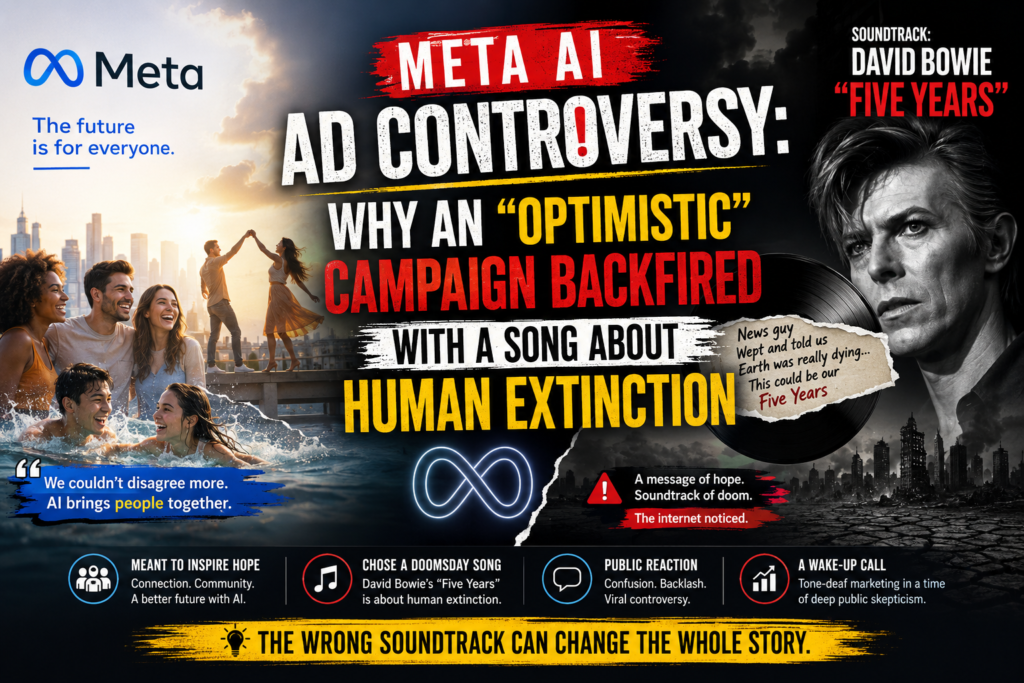
The Meta AI ad controversy erupted on July 23, 2026, after the company released a new advertisement meant to project optimism about artificial intelligence — but soundtracked it with David Bowie’s “Five Years,” a song that is explicitly about humanity learning it has five years left to live before total extinction. The mismatch between the ad’s upbeat message and the song’s apocalyptic lyrics turned what was meant to be a feel-good campaign into a viral case study on tech industry tone-deafness.
What Happened With Meta’s New AI Ad?
Meta’s advertisement opens in black and white, showing a close-up of an eye taking in a stream of anxious headlines about AI stealing jobs, isolating people, and triggering a global crisis. A voiceover pushes back: “Some people will have you believe AI is going to make us feel less connected… We couldn’t disagree more.” The footage then shifts to color, cutting between people smiling, a couple dancing on a rooftop, teens swimming, and friends reuniting. The Meta AI ad controversy centers on one specific choice buried underneath all of it: the soundtrack.
Meta used the instrumental-and-vocal section of “Five Years,” a track that repeats the word “people” throughout — which, stripped of context, sounds warm and communal. CEO Mark Zuckerberg reinforced the ad’s message directly, writing that Meta believes “the future is for everyone” and that the company is “focused on giving every person the tools to reach your full potential.”
What Is David Bowie’s “Five Years” Actually About?
Direct answer: “Five Years” tells the story of a news broadcaster announcing that Earth has five years left before a mass extinction event, and the panic that follows. The verses immediately preceding the section Meta used include lines about a “news guy” weeping on air after confirming “the earth was really dying” — hardly the tone of a company trying to reassure the public about its AI ambitions.
This is the core of the Meta AI ad controversy: a company spending enormous sums to convince the public that AI represents hope and connection accidentally licensed a song about civilizational collapse to make that case.
Why This Meta AI Ad Controversy Matters for Big Tech
Marketing missteps happen constantly, but this one lands at a sensitive moment. AI companies are locked in a public-perception battle, each trying to convince a skeptical public that their version of AI is the safe, trustworthy one. A campaign built around a hidden doomsday metaphor undercuts that effort — and it isn’t the only recent example.
A Definition Worth Expanding On: “Optimism-Washing”
In the context of AI marketing, optimism-washing refers to advertising that leans heavily on emotionally warm imagery and language to reassure the public about a technology’s risks, without addressing those risks substantively. The Meta AI ad controversy is a textbook example: viewers get rooftop dancing and rainbows instead of any real engagement with job displacement, misinformation, or safety concerns that the ad itself acknowledges exist.
Meta Isn’t Alone: A Pattern of Tech Industry PR Missteps
Just weeks before the Meta AI ad controversy, Anthropic released its own unsettling advertisement — one that leaned into anxiety rather than avoiding it, opening with a burning house and cutting to images of surveillance, homelessness, and cemeteries, while a voiceover asked “Can AI be trusted?” OpenAI CEO Sam Altman publicly mocked the ad, joking he expected the account handle to be a parody.
| Company | Ad Tone | Intended Message | Actual Public Reaction |
|---|---|---|---|
| Meta | Upbeat, colorful, hopeful | AI brings people together | Confusion and mockery over the extinction-themed soundtrack |
| Anthropic | Somber, unsettling, visually bleak | We understand AI’s risks and take them seriously | Compared to “creepy” or unintentionally dystopian |
| OpenAI | N/A (commentary only) | Distance itself from both approaches | Public jab from CEO Sam Altman at Anthropic’s ad |
Both campaigns, despite opposite tones, ended up reinforcing the very anxieties they were trying to manage — which is a big part of why the Meta AI ad controversy resonated so widely online.
Public Sentiment on AI: What the Data Shows
The timing makes the Meta AI ad controversy more consequential than a simple meme cycle. A recent Pew survey found that only 16% of Americans believe AI’s impact on society over the next twenty years will be positive, while 40% expect a negative impact. Against that backdrop, an ad that unintentionally reinforces extinction anxiety is a costly unforced error.
Tech’s Long History of Missing the Point of the Media It References
The Meta AI ad controversy fits a broader pattern of technology companies citing or referencing media whose actual message runs counter to their business goals:
- Meta’s Oculus division reportedly gave new hires copies of “Ready Player One,” a novel about a monopolistic tech company turning virtual reality into a dystopian escape from a collapsing world.
- OpenAI’s Sam Altman has cited the film “Her” as inspiration for ChatGPT’s voice features, despite the movie serving as a cautionary tale about emotional dependence on AI.
- Palantir takes its name from the “seeing stones” in “The Lord of the Rings” — objects the story’s villain uses for surveillance and psychological manipulation.
- Elon Musk recently criticized a film adaptation of “The Odyssey” for historical inaccuracy, despite the source material featuring sea monsters, sorcery, and divine intervention.
Each example underscores the same theme running through the Meta AI ad controversy: companies borrowing cultural touchstones for their surface-level associations, without engaging with what those stories are actually warning against.
Frequently Asked Questions
Q: Why is Meta’s AI ad considered controversial? A: The ad promotes an optimistic view of AI’s impact on society while using David Bowie’s “Five Years,” a song about the last five years of human life before extinction, as its soundtrack — creating an unintended and jarring contradiction.
Q: Did Meta respond to the backlash? A: As of this writing, Meta and Mark Zuckerberg have not issued any statement addressing the song choice specifically; Zuckerberg’s public comments focused only on the ad’s stated message of optimism and connection.
Q: How does this compare to Anthropic’s recent AI ad? A: Anthropic’s ad took the opposite approach, using unsettling, somber imagery to acknowledge AI risk directly. Both ads, despite different strategies, drew criticism — highlighting how difficult AI companies are finding it to strike a convincing public tone.
Q: What does public opinion data say about AI right now? A: A recent Pew survey found just 16% of Americans expect AI to have a positive societal impact over the next two decades, versus 40% who expect a negative one — a skepticism gap that campaigns like this one seem to be widening rather than closing.
Key Takeaways
- The Meta AI ad controversy stems from a mismatch between the ad’s hopeful message and its soundtrack, David Bowie’s apocalypse-themed “Five Years.”
- The ad arrives amid a broader trend of AI companies, including Anthropic, releasing marketing that inadvertently amplifies public anxiety instead of easing it.
- Public sentiment data shows most Americans remain skeptical of AI’s long-term societal impact, raising the stakes for tone-deaf marketing.
- This is part of a recurring pattern of tech leaders referencing cautionary media without absorbing its underlying warnings.