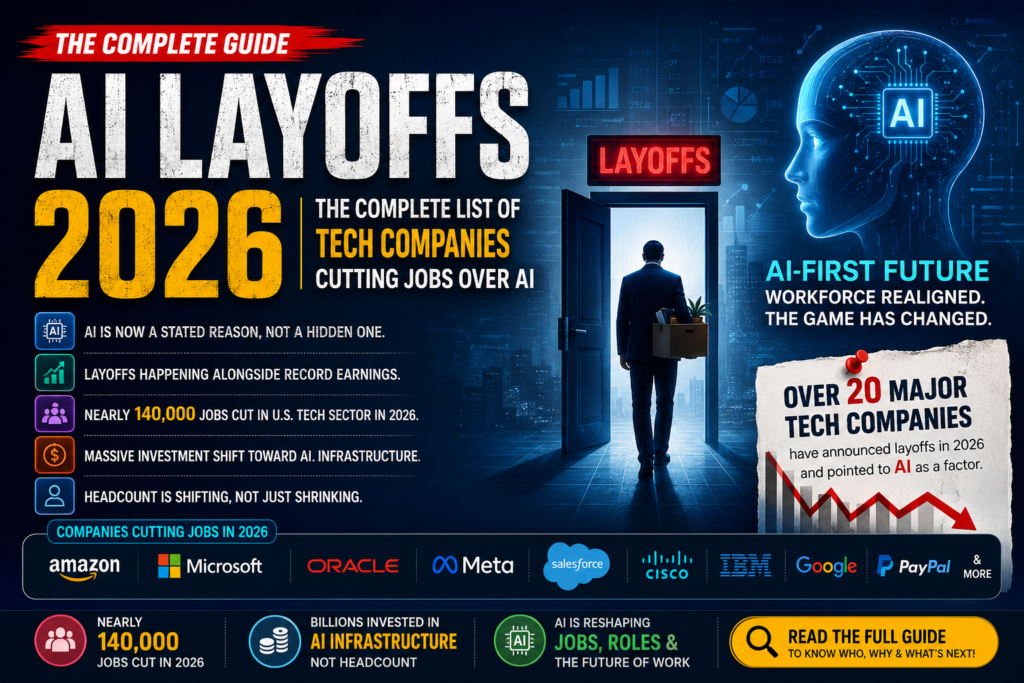
Over 20 major tech companies have announced layoffs in 2026 and pointed to artificial intelligence as a factor, and the running total across the U.S. tech sector has climbed to nearly 140,000 jobs since January. This wave of AI layoffs 2026 spans companies as different as Amazon, Salesforce, Monday.com, and General Motors — and the reasons range from genuine automation to simple restructuring dressed up in AI language.
If you’re trying to make sense of which companies are cutting staff, why they say AI is involved, and whether the layoffs are actually about artificial intelligence or something else entirely, this guide breaks it all down.
What Are AI Layoffs 2026, and Why Are They Happening?
The term refers to the wave of job cuts announced by technology companies this year in which executives explicitly cited artificial intelligence — whether AI-driven efficiency, AI infrastructure investment, or a broader “AI-first” restructuring — as a reason for reducing headcount.
Unlike earlier rounds of post-pandemic tech layoffs, which were largely framed around slowing growth and cost discipline, the current cycle of job cuts is different in one key way: companies are volunteering AI as the explanation, even when they’re simultaneously reporting record revenue.
The Scale of AI Layoffs 2026 So Far
According to Financial Times analysis, <cite index=”1-11″>U.S. tech companies have slashed nearly 140,000 jobs since the start of 2026, with Amazon, Oracle, Meta, and Microsoft alone accounting for almost 50,000 of those cuts</cite> as they pour enormous sums into AI data center buildouts. That concentration among just four companies shows how much of the current wave of cuts is tied to a handful of hyperscalers redirecting capital toward AI infrastructure rather than headcount.
Here’s what makes this cycle worth watching closely:
- AI is now a stated reason, not a hidden one. Companies used to blame “macroeconomic headwinds.” In 2026, many name AI directly in SEC filings and internal memos.
- Layoffs are happening alongside record earnings. Cisco, Cloudflare, and Oracle all posted strong or record quarterly numbers even as they announced cuts.
- The market isn’t fully convinced. <cite index=”1-13″>Companies citing AI as a factor in job cuts have underperformed the Nasdaq by almost 10% in the 30 trading days following their announcements</cite>, according to the FT — suggesting investors are skeptical of the narrative.
- Headcount is shifting, not just shrinking. Some companies are simultaneously cutting roles and creating new AI-focused ones.
- Hiring hasn’t stopped everywhere. <cite index=”1-15″>AI-focused companies like Anthropic and OpenAI are hiring rapidly, absorbing some of the talent shed elsewhere in the industry</cite>.
The Complete List of Tech Companies Announcing AI Layoffs in 2026
Below is a comparison table summarizing the major 2026 layoff announcements in reverse chronological order, based on company statements, SEC filings, and reporting compiled by TechCrunch.
| Company | Date | Jobs Cut | Stated AI Connection |
|---|---|---|---|
| Monday.com | Jul 2026 | ~600 (20%) | Restructuring to support “AI-driven growth strategy” |
| Microsoft | Jul 2026 | ~4,800 (2.1%) | AI “changing how work gets done” amid rising AI investment |
| Oracle | Jun 2026 | 21,000 (13% over 12 months) | AI adoption reducing workforce needs, per annual SEC filing |
| GitLab | Jun 2026 | ~350 (14%) | Funding AI infrastructure to handle agentic workloads |
| Google (Cloud) | Ongoing | 1,500–3,000+ (est.) | Rolling reviews and reorgs tied to AI-era restructuring |
| Intuit | May 2026 | ~3,000 (17%) | Reallocating resources toward AI |
| Meta | May 2026 | ~8,000 (10%) | AI investment; 7,000 moved into new AI roles |
| Cisco | May 2026 | ~4,000 (5%) | Realigning resources around AI, silicon, and security |
| Cloudflare | May 2026 | ~1,100 (20%) | AI reducing need for “measurer” roles |
| GM | May 2026 | 500–600 | AI played a role in IT workforce evaluation |
| Coinbase | May 2026 | ~700 (14%) | AI efficiency and organizational flattening |
| PayPal | May 2026 | 4,500+ (20% over 2–3 yrs) | Aggressive AI adoption across functions |
| Snap | Apr 2026 | ~1,000 (16%) | AI reducing repetitive work, increasing velocity |
| IBM | Rolling 2026 | 3,000–9,000 (est.) | AI agents replacing some roles; entry-level AI hiring rising |
| Atlassian | Mar 2026 | ~1,600 (10%) | Rebalancing toward AI and enterprise sales |
| Dell | Jan–Mar 2026 | ~11,000 (10%) | Shift toward AI-optimized server business |
| Block | Feb 2026 | 4,000 (~40%) | Smaller, flatter teams enabled by AI tools |
| Salesforce | Feb 2026 | <1,000 | Agentforce AI reducing need for support backfill |
| Amazon | Jan 2026 | 16,000 | Reducing layers; efficiency gains expected from AI |
Figures reflect company disclosures and media reporting as of late July 2026 and may be revised as companies release further updates.
Company-by-Company Breakdown: The Biggest AI Layoffs 2026 Stories
Monday.com: The Latest to Join the List
Monday.com became the newest entrant to this list in late July, disclosing plans to cut about 20% of its workforce, or just over 600 employees, as part of a restructuring plan. <cite index=”1-4″>Co-founder Eran Zinman told employees the move was not made to reduce costs or replace people with AI</cite>, framing it instead as an adjustment to the company’s AI-first vision announced roughly a year earlier. The company still expects up to 20% revenue growth for the year.
Amazon, Meta, Microsoft, and Oracle: The Big Four
These four companies alone account for the bulk of this year’s job losses. Amazon started the year by cutting 16,000 corporate roles, following 14,000 cuts in late 2025, with CEO Andy Jassy having predicted that generative AI and agents would reduce total corporate headcount over time. Oracle disclosed a 13% workforce reduction — 21,000 people — over twelve months, explicitly linking the cuts to AI adoption in a regulatory filing. Meta cut about 8,000 roles while moving roughly 7,000 employees into new AI-focused positions. Microsoft trimmed nearly 4,800 roles, mostly in its Xbox division, while insisting the cuts weren’t a direct AI replacement.
Mid-Size SaaS and Fintech Companies
A second tier of layoff announcements came from software and fintech firms explicitly tying cuts to AI efficiency:
- GitLab cut 14% of staff to fund a “generational rebuild” of its platform for AI agent workloads.
- Coinbase cut 14% of staff and began experimenting with one-person teams that combine engineering, design, and product work using AI tools.
- PayPal plans to cut around 20% of its workforce over two to three years as part of an AI-driven transformation initiative.
- Salesforce reduced support and product roles after Agentforce, its AI agent platform, cut the number of support cases needing human handling.
- Snap cut 16% of its global workforce, citing AI’s ability to reduce repetitive work.
Hardware and Infrastructure Companies
Dell, Cisco, and Cloudflare all cut staff despite reporting healthy or record financial results. Dell’s workforce fell about 10% in fiscal 2026 even as it projected AI server revenue could double the following year. Cisco cut 5% of its workforce while posting better-than-expected profit, with its CFO describing the move as a realignment toward AI, silicon, and security rather than a cost-cutting exercise. Cloudflare cut 20% of staff after a record quarter, with CEO Matthew Prince noting that most of those affected were in management, finance, and legal — roles he called “measurers.”
Is AI Really the Cause of These Layoffs?
Short answer: Partly — but not always the way companies describe it. Many of these layoff announcements bundle genuine automation-driven efficiency together with older, familiar cost-cutting motives, and it’s often hard to separate the two from public statements alone.
What the Companies Say
Executive language falls into a few recurring patterns:
- Direct automation claims — Salesforce and Snap both said AI tools directly reduced the volume of human work required.
- Investment reallocation — Cisco, GitLab, and PayPal frame cuts as freeing up budget to spend more on AI infrastructure and products, not as headcount being replaced outright.
- Organizational flattening — Coinbase, Cloudflare, and Amazon describe removing management layers and “bureaucracy,” with AI cited as an enabler of leaner teams rather than the sole cause.
- Explicit denial paired with AI framing — Monday.com, Microsoft, and Atlassian all say the cuts weren’t about replacing people with AI, even while tying the restructuring to their AI strategy.
What the Market Says
The financial markets appear skeptical of the AI-efficiency narrative. As noted above, <cite index=”1-13″>companies that cited AI in their layoff announcements underperformed the Nasdaq by nearly 10% in the following month</cite>, based on FT’s analysis — a sign that investors may see some of these announcements as cost-cutting measures wrapped in more palatable AI language, rather than proof of a genuinely more efficient operating model.
Which Companies Are Hiring Despite AI Layoffs 2026?
Not every part of the tech industry is shrinking. Even as these layoffs dominate headlines, several companies are expanding hiring, particularly for AI-specific roles:
- Anthropic and OpenAI are both hiring aggressively, absorbing talent released by larger, slower-moving companies.
- IBM is tripling entry-level hiring for AI and hybrid-cloud roles even while cutting elsewhere in the organization.
- Meta shifted roughly 7,000 employees into new AI-focused roles as part of the same restructuring that eliminated 8,000 other positions.
- GM still had around 80 open IT positions, including AI and autonomous vehicle roles, even after cutting 500–600 jobs elsewhere.
This pattern — cutting in some areas while hiring aggressively for AI talent in others — is one of the clearest signals that AI layoffs 2026 represent a reallocation of resources as much as a net reduction in tech employment.
How This Compares to Previous Tech Layoff Cycles
2022–2024: Cost-Cutting After Pandemic Overhiring
The last major wave of tech layoffs, roughly between late 2022 and 2024, was driven mostly by companies correcting for pandemic-era overhiring. Firms like Meta, Amazon, and Google had expanded headcount aggressively in 2020 and 2021, then reversed course as growth slowed and interest rates rose. AI was rarely cited as a direct cause; the language of the time centered on “efficiency,” “right-sizing,” and macroeconomic uncertainty.
2026: A Different Kind of Justification
This year’s cuts look different in tone, even when the underlying business logic is similar. Executives are now willing to name AI directly, in some cases in formal SEC filings rather than just internal memos. That shift matters for two reasons. First, it signals that boards and investors now expect companies to have an AI strategy, and workforce reduction is one visible way to demonstrate commitment to that strategy. Second, it creates a public record that researchers, journalists, and regulators can use to track how AI is reshaping employment — something that wasn’t possible during earlier, vaguer rounds of cuts.
Why the Overlap Between “AI Efficiency” and “Cost Cutting” Matters
Not every company on this list is describing the same phenomenon. Some, like Salesforce, point to measurable drops in support ticket volume tied to a specific AI product. Others, like Cisco or GitLab, are essentially saying “we’re spending our budget differently” — money that once went to headcount is now going to AI infrastructure, chips, or data centers. Both get filed under the same “AI layoffs” headline, but they represent very different underlying dynamics, and conflating them makes it harder to judge how much of the current labor market shift is genuinely driven by automation versus capital reallocation.
What This Means for Tech Professionals in India
India’s tech and IT services sector is closely watching how U.S. companies frame their AI-related restructuring, since many of the same companies on this list — Microsoft, Amazon, Oracle, IBM, Salesforce, and Cisco among them — run large engineering, support, and delivery centers in India. A few implications stand out:
- Global headcount decisions increasingly route through India-based teams. As U.S.-headquartered companies flatten management layers and reallocate budgets toward AI infrastructure, decisions about where support, QA, and mid-level engineering work gets done are shaped by the same restructuring logic driving layoffs abroad.
- Demand is rising for AI-adjacent skills, not just traditional software roles. Companies simultaneously cutting generalist roles while hiring for AI infrastructure, agent development, and applied AI engineering suggests the skills premium is shifting quickly, and Indian engineers who build fluency in agentic systems, prompt engineering, and AI tooling are better positioned than those relying solely on legacy stacks.
- Support and back-office functions face the most direct pressure. Roles most likened to what Cloudflare’s CEO called “measurers” — middle management, support ticket handling, financial operations — are exactly the categories most exposed to AI tooling, and these functions employ a significant share of India’s IT services workforce.
How to Protect Your Career During This Wave
If you work in tech, this trend makes a few career moves worth prioritizing:
- Build AI fluency in your current role. Whether you’re in engineering, support, marketing, or operations, understanding how AI tools apply to your function makes you harder to displace.
- Track which functions are shrinking versus growing. Middle management, generalist support roles, and back-office functions have been hit hardest; AI infrastructure, agentic engineering, and specialized technical roles are still expanding at many companies.
- Diversify your skill set toward roles that pair judgment with AI tools, rather than roles that AI tools can fully replace.
- Watch company earnings alongside layoff announcements. As this list shows, layoffs increasingly happen at profitable companies, so financial health alone isn’t a reliable predictor of job security.
Frequently Asked Questions About AI Layoffs 2026
How many tech jobs have been cut in 2026 because of AI?
U.S. tech companies have cut nearly 140,000 jobs since the start of 2026, with Amazon, Oracle, Meta, and Microsoft together accounting for almost 50,000 of that total, according to Financial Times analysis of company disclosures.
Which company cut the most jobs in the AI layoffs 2026 wave?
By raw numbers, Amazon’s 16,000-role cut in January and Oracle’s 21,000-role reduction over twelve months are among the largest. By percentage of workforce, Block’s cut of roughly 40% of its staff stands out as the most severe.
Are AI layoffs 2026 actually caused by AI automation?
It varies by company. Some, like Salesforce, point to specific AI tools directly reducing workload. Others use AI language to describe broader restructuring, budget reallocation toward AI infrastructure, or organizational flattening that isn’t strictly automation-driven.
Is the tech job market recovering from AI layoffs 2026?
Not uniformly. While large companies continue cutting roles, AI-native companies like Anthropic and OpenAI are hiring quickly, and some companies making cuts — including IBM and Meta — are simultaneously growing headcount in AI-specific roles.
Will AI layoffs 2026 continue into 2027?
Executives at companies like Block have suggested more companies will adopt similar AI-driven restructuring in the near future, though the market’s cautious reaction to 2026’s announcements — with affected stocks underperforming the Nasdaq — may influence how future cuts are framed and communicated.