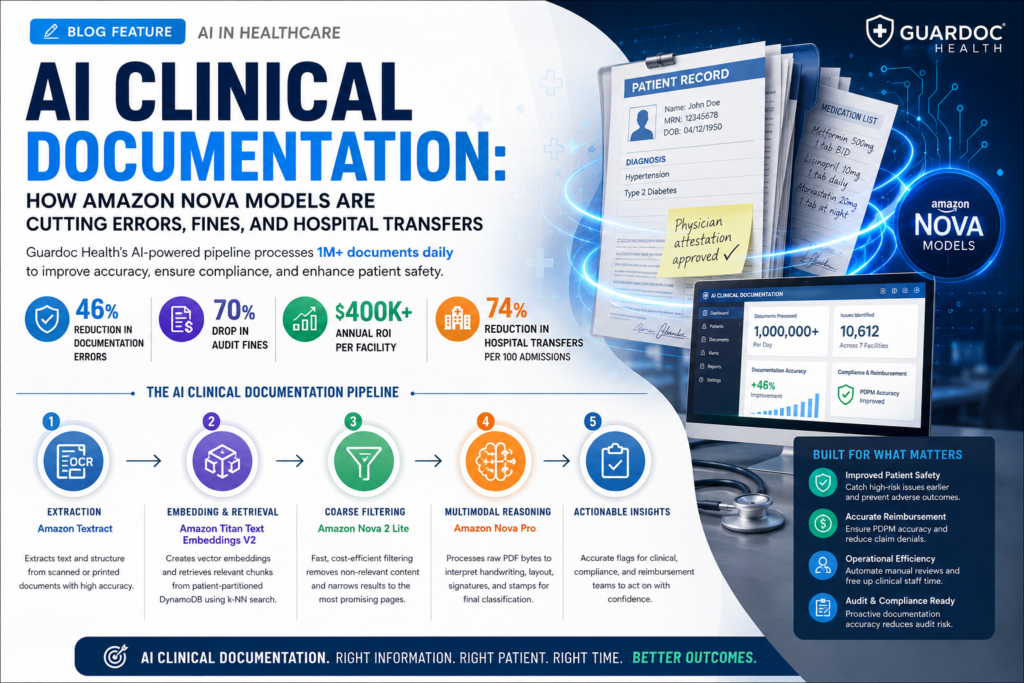
AI clinical documentation is the use of large language models and OCR pipelines to extract, classify, and validate information from patient records automatically. Deployed correctly, it catches the handwritten notes, mismatched medication lists, and coverage-determining checkboxes that manual chart review misses — and at least one long-term care technology company says it is now doing this for more than one million documents a day.
That company is Guardoc Health, and its approach offers a useful blueprint for what a production-grade AI clinical documentation system actually looks like once you get past the marketing slide. It is not one model doing everything. It is a layered pipeline — OCR, embeddings, retrieval, cheap filtering, and expensive multimodal reasoning — built around Amazon Nova models running on AWS Bedrock. This article breaks down how that architecture works, why AI clinical documentation matters for patient safety and reimbursement accuracy, and what the results tell us about where this category is heading.
What Is AI Clinical Documentation?
AI clinical documentation refers to software systems that use machine learning — typically a combination of optical character recognition, embedding models, and large language models — to read, structure, and reason over patient records at the point of care or shortly after.
Unlike older OCR-only tools, modern AI clinical documentation systems don’t stop at converting a scanned page into text. They classify conditions, flag inconsistencies between what a nurse charted and what a physician wrote, and surface issues that affect reimbursement, compliance, and — most importantly — patient safety. The distinction matters: a system that only digitizes text still requires a human to interpret it, while a full AI clinical documentation pipeline does the interpretation itself and hands a clinician a decision-ready flag.
For long-term care and skilled nursing facilities specifically, AI clinical documentation has become tied directly to reimbursement mechanics. Under the Patient-Driven Payment Model (PDPM), the accuracy of coded conditions determines what Medicare pays a facility — which means a documentation error isn’t just a clinical risk, it’s a financial one.
Why Clinical Documentation Errors Are a Growing Problem
How big is the problem, really?
It’s larger than most healthcare operators assume. Research published in BMJ Quality and Safety estimates that roughly 12 million outpatients in the United States are affected by diagnostic error every year, with breakdowns in how information is captured and handled cited as a contributing factor.
Scale that against the kind of volume a single AI clinical documentation vendor now processes — over a million documents daily, in Guardoc’s case — and the arithmetic gets uncomfortable fast. A condition-detection error rate of just one percent at that volume would generate thousands of incorrect records every single day, each one carrying its own downstream risk: a denied claim, an audit finding, or a missed condition that changes how a patient is treated.
What makes healthcare documents so hard to process?
The format chaos is the core challenge. A single long-term care facility can generate:
- Multi-page PDFs with handwritten physician annotations layered over printed templates
- Prior authorisation forms where a single handwritten note can override a printed checkbox
- Medication lists that appear as clean structured tables in one chart and as free-flowing prose in the next
- Patient intake forms that mix typed fields, rubber stamps, and handwriting on the same page
- Faxed documents that have been scanned, re-scanned, and forwarded multiple times, degrading image quality further with each pass
No single extraction method handles all of that reliably. That’s precisely why AI clinical documentation systems built for healthcare, rather than adapted from generic document AI, tend to use multiple specialized models in sequence rather than one general-purpose model doing everything.
How Amazon Nova Models Power a Modern Clinical Documentation Pipeline
Guardoc Health’s system is a useful case study because it exposes the actual mechanics behind AI clinical documentation at scale, rather than treating it as a black box. The pipeline runs condition classification through retrieval-augmented generation (RAG): it pulls the specific evidence from a patient’s own chart before reasoning over that evidence to produce a final answer, rather than asking a model to reason over an entire record at once.
Stage 1: Extraction with Amazon Textract
Every incoming page first passes through Amazon Textract, which extracts raw text and structural metadata. This is deliberately the cheapest step in the pipeline per page processed, and it’s treated as the foundation rather than the finish line. The extracted output is then chunked along clinical boundaries — a medication list or diagnosis section stays intact as one unit rather than getting split arbitrarily by character count, which would otherwise scatter related clinical information across separate chunks and degrade retrieval quality later.
Stage 2: Embedding and retrieval
Each chunk is converted into a vector using Amazon Titan Text Embeddings V2 and stored in Amazon DynamoDB, partitioned by patient so that retrieval can never accidentally cross between two different patients’ records — a non-negotiable requirement in any AI clinical documentation system handling protected health information.
A pre-filter then narrows the candidate pool by document type and recency before a k-nearest-neighbour search retrieves the chunks most relevant to whatever classification question is being asked. At this stage, the system returns only page references rather than full content, which keeps data transfer light and the pipeline fast.
Stage 3: Cheap filtering with Amazon Nova Lite
Amazon Nova 2 Lite runs a text-only pass over the retrieved candidates to eliminate the obvious non-matches. This is the coarse filter — fast and inexpensive — designed to shrink the set of pages down to the ones that genuinely warrant deeper, more expensive reasoning.
Stage 4: Multimodal reasoning with Amazon Nova Pro
Only the pages that survive every earlier filter reach Amazon Nova Pro, which receives the raw PDF bytes directly rather than pre-extracted text. This is the step where the system reasons over layout, handwriting, signatures, and stamps together — the visual context that a text-only model would lose entirely — to produce the classification that downstream systems act on.
Why the tiering matters
The logic threading through all four stages is consistent: cheap, high-volume components (OCR, embedding, coarse filtering) absorb the bulk of the workload, and the expensive multimodal reasoning step is reserved for the small fraction of pages that actually need it. That’s what allows an AI clinical documentation pipeline to run at over a million documents a day without the cost structure becoming unworkable.
| Pipeline Stage | Technology Used | Primary Function | Relative Cost |
|---|---|---|---|
| Text & structure extraction | Amazon Textract | Converts scanned/printed pages into structured text | Low |
| Chunk embedding | Amazon Titan Text Embeddings V2 | Converts clinical text chunks into searchable vectors | Low |
| Vector storage & retrieval | Amazon DynamoDB (patient-partitioned) | Stores embeddings; retrieves relevant chunks via k-NN search | Low |
| Coarse filtering | Amazon Nova 2 Lite | Removes obvious non-matches from retrieved candidates | Medium |
| Final classification | Amazon Nova Pro | Multimodal reasoning over raw PDF bytes, handwriting, layout | High |
The Hardest Cases in AI Clinical Documentation
Why do physician attestation fields keep breaking automated systems?
Because the ground truth often isn’t in the printed field at all. On prior authorisation forms, a handwritten annotation next to a checkbox can override what the checkbox itself indicates — and a purely text-extraction-based system has no way of knowing that unless it’s specifically reasoning over the visual relationship between the handwriting and the printed form, not just transcribing both separately.
Why is medication extraction still one of the hardest problems in AI clinical documentation?
Because drug names, dosages, routes, and frequencies rarely show up in one consistent format. They appear in clean structured tables in some charts, as prose embedded in physician narrative notes in others, as handwritten additions scrawled onto a printed list, and in low-quality scans that have been faxed through several intermediaries. A hybrid approach — Textract handling the clean structured tables first, then passing both the original PDF and the Textract output to Amazon Nova Pro to resolve wrapped columns, handwritten additions, and non-standard formats — is what makes this workable at scale for AI clinical documentation systems in production today.
Assaf Amiaz, Director of Product at Guardoc Health, has framed the goal as helping healthcare organisations catch high-risk cases sooner and intervene before they escalate into costlier problems, while freeing clinical staff from manual review work they’d otherwise have to do by hand.
Real-World Results: What the Deployment Data Shows
Guardoc has published a set of deployment figures tied to its use of Amazon Nova models, though it’s worth noting upfront that the company hasn’t disclosed the baseline period or full methodology behind these numbers — a caveat any operator evaluating AI clinical documentation vendors should weigh carefully.
Reported outcomes include:
- A 46 percent reduction in documentation errors
- A 70 percent drop in audit fines
- More than $400,000 in annual ROI reported for a single facility
- In a quarterly deployment across two facilities and 200 patients: 847 documentation corrections driven, 86 issues flagged tied to PDPM reimbursement accuracy, and a 74 percent reduction in hospital transfers per 100 admissions
- In a separate case study spanning seven facilities and 1,618 residents: 10,612 issues identified
Even treated as vendor-reported figures rather than independently audited results, the direction is instructive: AI clinical documentation systems built around retrieval and tiered multimodal reasoning appear to catch categories of error that manual chart review structurally misses, particularly around handwriting and cross-referencing multiple document types for the same patient.
AI Clinical Documentation vs. Traditional Manual Chart Review
| Factor | Traditional Manual Review | AI Clinical Documentation (RAG-based) |
|---|---|---|
| Document volume handled per day | Limited by staff hours | Over 1 million documents/day (Guardoc’s reported scale) |
| Handwriting + printed text reconciliation | Manual, inconsistent | Multimodal reasoning over raw PDF bytes |
| Cross-document consistency checks | Rare, time-intensive | Automated via patient-partitioned retrieval |
| PDPM/reimbursement flagging | Reactive, post-audit | Proactive, flagged during documentation |
| Cost structure | Labor cost scales linearly with volume | Cost-tiered — cheap filtering absorbs most volume |
| Error visibility | Often surfaces only at audit | Surfaces at point of documentation |
Frequently Asked Questions About AI Clinical Documentation
Does AI clinical documentation replace clinical staff? No. In deployments like Guardoc’s, AI clinical documentation is positioned to flag issues and surface corrections for clinical and compliance staff to review, not to make unsupervised treatment or coding decisions on its own.
Why not just use one large language model for everything instead of a multi-stage pipeline? Cost and accuracy both suffer. Running a full multimodal reasoning pass over every single page of every document would be prohibitively expensive at volumes like a million documents a day, and it would also waste the model’s reasoning capacity on pages that are obviously irrelevant. Tiering — cheap filters first, expensive reasoning last — is what makes AI clinical documentation economically viable at scale.
What role does retrieval-augmented generation (RAG) play in AI clinical documentation? RAG lets the system pull only the specific evidence relevant to a classification question from a patient’s chart, rather than asking a model to hold an entire patient record in context and reason over all of it at once. This keeps retrieval targeted, keeps data transfer low, and — critically for healthcare — keeps patient data compartmentalized when the vector store is partitioned by patient.
Is AI clinical documentation only relevant to long-term care facilities? No, though PDPM-linked reimbursement makes the financial stakes especially visible in that setting. The same core problem — inconsistent document formats, handwriting mixed with print, information scattered across chart sections — exists across hospitals, outpatient clinics, and any care setting generating high volumes of patient records.
What’s the biggest risk in adopting an AI clinical documentation system? Vendor-reported outcome metrics without disclosed baselines or methodology are the most obvious risk to watch for. Any healthcare operator evaluating a system should ask what the error rate and audit-fine baseline looked like before deployment, not just what improvement percentage is being advertised.
Key Takeaways
AI clinical documentation is no longer a single-model novelty — the systems getting real deployment traction are layered pipelines that combine OCR, embeddings, retrieval, and tiered reasoning models like Amazon Nova Lite and Amazon Nova Pro to balance cost against accuracy. The hardest problems in AI clinical documentation remain the same ones that have always plagued healthcare records: handwriting that overrides print, medication data scattered across inconsistent formats, and information buried in one section of a chart that never makes it to the section a clinician is actually reading. Getting AI clinical documentation right means catching those cases before they become a denied claim, an audit fine, or a missed diagnosis — and getting it wrong carries exactly the same consequences it always has, just at a larger scale.
Meta description: AI clinical documentation cuts errors and audit fines using Amazon Nova models. See how Guardoc Health’s RAG pipeline processes 1M+ records daily.
Slug: ai-clinical-documentation-amazon-nova-models