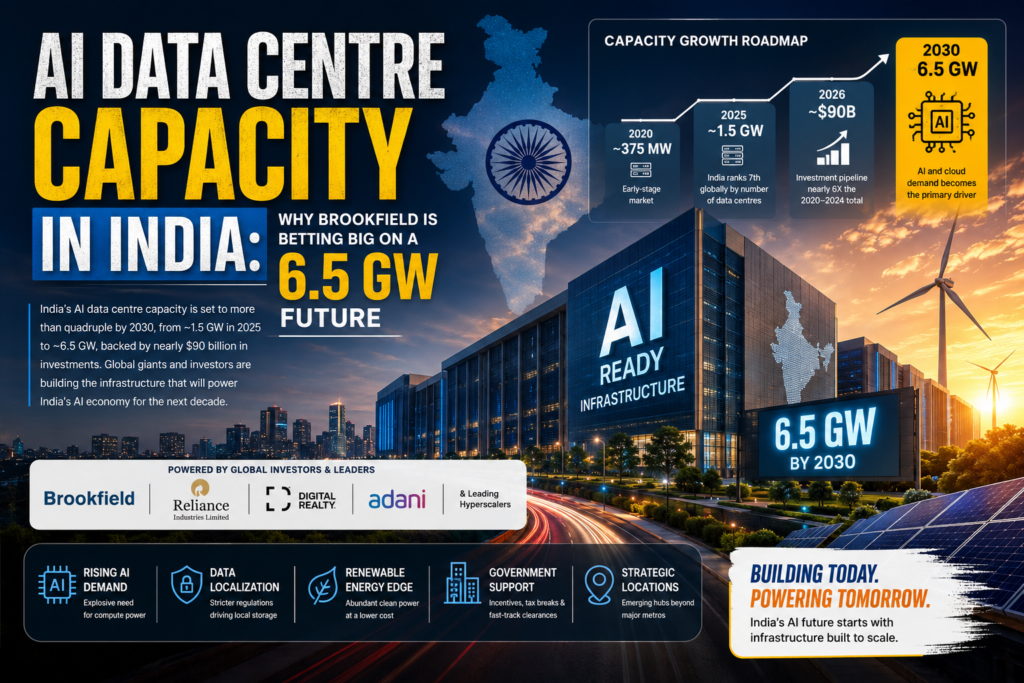
India’s AI data centre capacity is set to more than quadruple by 2030, and global investors like Brookfield are racing to fund the buildout. In short: capacity is projected to jump from roughly 1.5 GW in 2025 to around 6.5 GW by 2030, backed by an investment pipeline worth nearly $90 billion.
That single statistic explains why Brookfield, Reliance Industries, Digital Realty, Adani, and a growing list of hyperscalers are pouring billions of dollars into Indian soil right now. This isn’t a speculative bet on a future market — it’s a race to build the physical infrastructure that will run India’s AI economy for the next decade. This article breaks down what’s driving the surge, where Brookfield fits into the picture, who else is competing for market share, what regulatory and environmental hurdles stand in the way, and what it all means for businesses, policymakers, and job seekers watching the space.
What Is Driving the Surge in AI Data Centre Capacity in India?
The short answer: a combination of explosive AI compute demand, falling data localization barriers, cheap renewable power, and hyperscaler commitments from Amazon, Microsoft, and Google. Together, these forces have turned India from a steady, mid-tier data centre market into one of the fastest-growing AI infrastructure hubs in the world, and they explain why so much capital is now chasing AI data centre capacity in India specifically, rather than general-purpose cloud infrastructure.
From 1.5 GW to 6.5 GW — The Scale of the Opportunity
India’s installed data centre capacity grew from about 375 megawatts in 2020 to roughly 1.5 gigawatts in 2025, according to a report from Rubix Data Sciences. Capacity additions have accelerated sharply in recent years — the country added 387 megawatts of IT capacity in 2025 alone, more than double the 191 megawatts added the year before. By 2030, that number is projected to climb to 6.5 GW, a more than fourfold increase from current levels.
To put that growth curve into perspective:
| Year | Installed Capacity | Notable Milestone |
|---|---|---|
| 2020 | ~375 MW | Early-stage market, mostly enterprise colocation |
| 2025 | ~1.5 GW | India ranks 7th globally by number of data centres |
| 2026 (pipeline) | ~$90B in projects | Investment pipeline nearly 6x the 2020–2024 total |
| 2030 (projected) | ~6.5 GW | AI and cloud demand becomes the primary growth driver |
As of early 2026, 271 facilities across Mumbai, Hyderabad, Delhi NCR, Bengaluru, and Chennai accounted for nearly 65 percent of India’s total data centre footprint. That means the next wave of growth will likely spread beyond these established metros — Andhra Pradesh, in particular, is emerging as the epicentre for gigawatt-scale AI campuses, several of which are already under construction.
Key Growth Drivers Behind the Boom
Several structural factors are converging at once to fuel this expansion:
- Hyperscaler demand: Amazon Web Services, Microsoft, and Google have all committed multi-billion-dollar investments toward Indian cloud and AI infrastructure.
- Data localization rules: India’s regulatory push toward in-country data storage, reinforced by the Digital Personal Data Protection Act, 2023, is pushing global platforms to build locally rather than serve Indian users from overseas cloud regions.
- Cheap, abundant renewable energy: AI workloads are extremely power-hungry, and India’s solar and wind capacity gives operators a cost advantage over markets with tighter grid constraints.
- Falling land and construction costs: Compared with the US and Western Europe, India offers lower land acquisition and build costs for hyperscale campuses.
- Government incentives: States including Andhra Pradesh, Telangana, and Maharashtra are actively courting investment with tax breaks, single-window clearances, and dedicated power allocations for large facilities.
- India’s own AI ambitions: National programs aimed at building sovereign AI capability — from language models to compute subsidies — are adding a domestic demand layer on top of hyperscaler build-outs.
Brookfield’s Expanding Bet on AI Data Centre Capacity in India
Brookfield is not a new entrant to India’s digital infrastructure story — the firm has been building data centre and renewable energy assets in the country since 2021, when it first partnered with Digital Realty to launch BAM Digital Realty. But its recent moves signal a much larger, AI-specific commitment tied directly to the country’s projected 6.5 GW capacity ceiling.
Digital Connexion: The $11 Billion Andhra Pradesh Campus
Brookfield’s most significant India AI infrastructure play is Digital Connexion, a joint venture with Reliance Industries and Digital Realty. The venture has committed $11 billion by 2030 to build a 1-gigawatt, AI-native data centre campus spread across 400 acres in Visakhapatnam, Andhra Pradesh. The site is designed specifically for AI workloads rather than general-purpose cloud computing, with infrastructure built around high-density compute racks and advanced liquid cooling systems.
That single project represents nearly a sixth of the entire capacity target the country is expected to reach by the end of the decade — a sign of just how concentrated the current wave of investment has become around a handful of mega-campuses rather than being spread thin across many smaller sites.
Powering AI: Brookfield’s Renewable Energy Play
Data centres cannot scale without power, and Brookfield’s strategy in India leans heavily on its renewable energy portfolio to solve that bottleneck. The firm holds stakes in Indian renewable players including Clean Max Enviro Energy Solutions, Evren Technologies, Avaada Energy, and Leap Green Energy, with more than 45 gigawatts of operating and planned renewable assets in the country. Clean Max alone now derives a substantial share of its revenue from supplying green power directly to AI customers and data centre operators, including agreements with global tenants like Meta and Iron Mountain.
Brookfield executives have framed India as a market where population scale, rising AI adoption, and clean-power availability line up in a way few other countries can match. Because AI facilities need continuous, round-the-clock electricity while solar and wind generation is intermittent, Brookfield has said it plans to deploy significant capital into battery storage to smooth out supply — with India’s energy storage demand expected to grow roughly 115-fold by 2035, according to Bloomberg New Energy Finance estimates.
How This Fits Brookfield’s Global AI Infrastructure Strategy
India is one piece of a much larger global push. Brookfield has separately launched a $100 billion AI infrastructure program, expanded a fuel-cell power partnership with Bloom Energy to $25 billion, and committed tens of billions more toward AI infrastructure buildouts in France and Sweden. The firm has also launched Radiant, an Nvidia Cloud Partner initiative, to build full-stack “AI factories” using Brookfield’s access to land, power, and data centre assets worldwide. India’s role in this global strategy is significant precisely because it offers a rare combination of scale, cost efficiency, and renewable power availability that’s harder to replicate in mature Western markets.
Who Else Is Building AI Data Centre Capacity in India?
Brookfield is far from alone. The competition to own India’s AI data centre capacity has pulled in nearly every major infrastructure and hyperscale player, each racing to lock in land, power, and compute capacity before demand outpaces supply.
| Company / Consortium | Investment Commitment | Focus Area |
|---|---|---|
| Digital Connexion (Brookfield, Reliance, Digital Realty) | $11 billion by 2030 | 1 GW AI-native campus, Andhra Pradesh |
| Adani Group | $100 billion by 2035 | Expanding AdaniConnex from 2 GW to 5 GW nationally |
| ST Telemedia Global Data Centres (with Tata) | $3.2 billion | Adding 550 MW of capacity over 5–6 years |
| TCS + TPG | $2 billion | Joint venture for AI-focused data centres |
| Multi-year, undisclosed | Largest AI hub outside the US, in Visakhapatnam |
This table makes one thing clear: this next phase of growth is being built by a mix of domestic conglomerates, global asset managers, and hyperscalers, each pursuing a slightly different strategy — Adani focused on national scale, Brookfield on AI-native campuses paired with renewable power, and Google on hyperscale compute for its own AI products.
Why Does AI Data Centre Capacity in India Matter for Businesses?
Does India’s data centre boom actually affect companies outside the infrastructure sector? Yes — directly. More local capacity means lower latency for AI-powered applications, easier compliance with data localization rules, and reduced dependence on overseas cloud regions for training and inference workloads.
Will this drive down the cost of AI compute in India? Likely, over time. As supply catches up with demand and more hyperscale campuses come online, enterprises and startups should see more competitive pricing on GPU access, cloud storage, and inference infrastructure — though near-term pricing will still be shaped by global chip supply constraints and power availability.
Is this growth concentrated in a few cities, or spreading nationally? Both. Established hubs — Mumbai, Chennai, Bengaluru, Hyderabad, and Delhi NCR — still account for the majority of operational capacity, but new AI-specific mega-campuses in Andhra Pradesh and other states are where most of the next wave of growth will actually get built.
Should Indian startups care about who builds this infrastructure? Yes. Where AI data centre capacity in India gets built determines which cities gain cheaper, lower-latency access to GPUs first — an important factor for AI startups deciding where to locate engineering and inference workloads.
Challenges to Scaling AI Data Centre Capacity in India
Despite the momentum, the path to 6.5 GW isn’t guaranteed to be smooth. Several structural constraints could slow the pace of expansion:
- Grid capacity limits: AI data centres require constant, high-density power, and India’s grid infrastructure in some regions still needs significant upgrades to support gigawatt-scale campuses.
- Water availability for cooling: Large AI facilities are water-intensive, raising concerns in water-stressed regions, and pushing operators toward liquid cooling and closed-loop systems.
- Skilled workforce shortages: Building and operating hyperscale AI infrastructure requires specialized electrical, cooling, and AI operations talent that India’s job market is still scaling up to meet.
- Land acquisition delays: Multi-hundred-acre campuses can face regulatory and land-rights bottlenecks, particularly outside established industrial corridors.
- Chip and hardware supply constraints: Global GPU shortages can delay the activation of built-out capacity even after facilities are physically ready.
- Regulatory uncertainty: Evolving data protection and cross-border data transfer rules under the DPDP Act could affect how multinational operators design and locate future facilities.
Environmental and Regulatory Considerations
As AI data centre capacity in India scales toward 6.5 GW, sustainability has become a central part of every major investor’s pitch — not an afterthought. Brookfield, Adani, and other large developers are explicitly pairing new campuses with renewable power purchase agreements, battery storage, and, in some cases, fuel-cell technology to avoid straining local grids. Indian states are also beginning to attach environmental clearance and water-usage conditions to large data centre approvals, which could shape where future gigawatt-scale campuses are permitted to break ground. For businesses evaluating long-term partnerships with data centre operators, an operator’s renewable energy commitments are becoming as important a selection criterion as raw compute pricing.
How India Compares Globally on AI Infrastructure Growth
Is India’s data centre growth rate unusual compared to other countries? Yes — the pace stands out even in a global AI infrastructure boom. While the United States and China still hold far larger absolute capacity, India’s projected jump from 1.5 GW to 6.5 GW represents one of the steepest growth curves of any major economy over the same period.
A few points of comparison help frame the scale of what’s happening:
| Market | Current Scale | Growth Signal |
|---|---|---|
| United States | Tens of GW installed | Mature market; growth now concentrated in mega-campuses (2GW+) |
| China | Tens of GW installed | State-backed buildout, increasingly chip-constrained |
| India | ~1.5 GW installed | Fastest relative growth rate; projected 4x+ by 2030 |
| Southeast Asia (aggregate) | Low single-digit GW | Emerging hub, competing for the same hyperscaler capital |
This relative-growth story is exactly why global investors like Brookfield are prioritizing India now rather than waiting. Locking in land, power agreements, and state incentives early positions a firm to capture outsized returns as the market matures — a dynamic that’s already visible in how quickly Digital Connexion, Adani, and Google have moved to secure sites in Andhra Pradesh.
What This Means for India’s AI Ecosystem and Job Market
The scale-up of AI data centre capacity in India isn’t just an infrastructure story — it’s an employment and skills story. Every gigawatt of new capacity requires electrical engineers, cooling and HVAC specialists, network architects, cybersecurity professionals, and AI/ML operations talent to run it. As Brookfield, Adani, and other players race toward the 6.5 GW milestone, demand for industry-ready professionals in AI infrastructure, data centre operations, and applied AI engineering is expected to rise sharply — creating a direct link between the capital being deployed today and the technical hiring pipelines of the next five years. For professionals and students in India’s tech hubs, this buildout represents one of the clearest near-term job creation stories tied to the broader AI boom.
Frequently Asked Questions
How much data centre capacity does India currently have? India’s installed data centre capacity stood at roughly 1.5 gigawatts in 2025, up from about 375 megawatts in 2020.
How much is Brookfield investing in India’s AI data centres? Through the Digital Connexion joint venture with Reliance Industries and Digital Realty, Brookfield is part of an $11 billion commitment to build a 1 GW AI-native campus in Andhra Pradesh by 2030, alongside a broader renewable energy portfolio exceeding 45 GW that supports data centre power needs.
What is India’s projected data centre capacity by 2030? Industry estimates project India’s total installed capacity will reach approximately 6.5 gigawatts by 2030, driven primarily by AI and cloud infrastructure investment.
Which companies are building the most AI data centre capacity in India? Brookfield (via Digital Connexion), Adani Group, ST Telemedia Global Data Centres, Google, and TCS-TPG are among the largest committed investors currently expanding capacity across the country.
Why is Andhra Pradesh becoming a hub for AI data centres? Andhra Pradesh has attracted large AI-native campuses from Brookfield-backed Digital Connexion and Google, largely due to available land, state government incentives, and proximity to power infrastructure suited for gigawatt-scale development.
Conclusion
The race to build AI data centre capacity in India has moved well past the planning stage — capital, land, and power deals are being signed now, with Brookfield positioned as one of the most aggressive and well-capitalized players in the field. Whether through its Digital Connexion campus in Andhra Pradesh or its expanding renewable energy bets, Brookfield’s strategy reflects a broader truth about India’s AI infrastructure moment: the country’s path to 6.5 GW of capacity by 2030 will be built by whoever can secure power, land, and capital fastest — and right now, Brookfield is betting it can do all three.