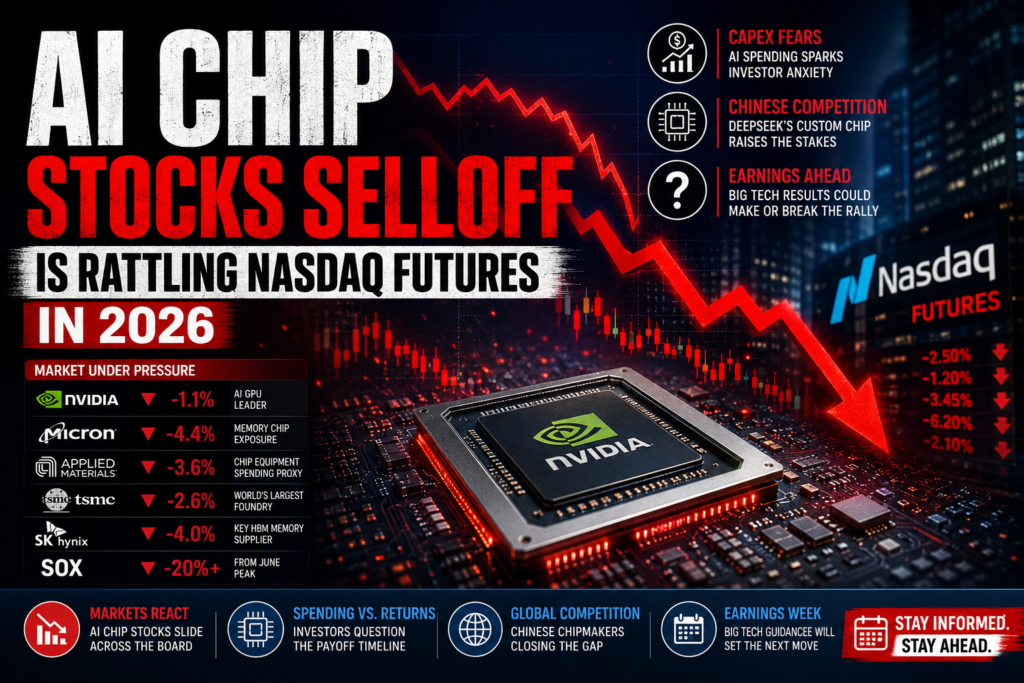
The AI chip stocks selloff gripping Wall Street this week is being driven by two forces colliding at once: mounting anxiety over runaway AI infrastructure spending, and fresh signs that Chinese chipmakers are closing the gap with Nvidia. Nasdaq futures slid on Tuesday, July 28, 2026, as Nvidia, Micron, Applied Materials, TSMC, and SK Hynix all traded lower in premarket action, just as some of the world’s biggest tech companies prepare to report earnings.
If you’ve been watching your portfolio swing wildly over the past few weeks, you’re not imagining things. This is one of the sharpest pullbacks in AI-linked equities since the sector’s meteoric 2024–2025 run, and it’s happening at the worst possible time for investors — right before the numbers that could confirm or kill the AI growth story.
What’s Driving the AI Chip Stocks Selloff Right Now?
The short answer: earnings anxiety. The AI chip stocks selloff is fundamentally a story about whether the enormous sums being poured into AI data centers, GPUs, and memory chips will actually pay off in the near term. Investors have grown skittish that valuations ran too far ahead of proof, and every data point — a capex hike, a competitor announcement, a soft guidance number — is now enough to trigger a sharp reaction.
Key Numbers Behind the Selloff
Premarket trading on Tuesday told the story clearly. Nvidia slipped roughly 1.1%, while Micron dropped as much as 4.4–4.6%. Applied Materials fell around 3.5–3.6%. U.S.-listed shares of Taiwan’s TSMC declined about 2.6%, and South Korea’s SK Hynix dropped between 3.6% and 4%. The Roundhill Memory ETF lost 6.6% on the day and has been trading below its 50-day moving average for two weeks — a technical signal of weakening short-term momentum.
| Company/Index | Approx. Premarket Move | Why It Matters |
|---|---|---|
| Nvidia (NVDA) | -1.1% | Bellwether for AI GPU demand |
| Micron (MU) | -4.4% to -4.6% | Memory chip exposure to AI servers |
| Applied Materials (AMAT) | -3.5% to -3.6% | Chip equipment maker, spending proxy |
| TSMC (TSM, U.S.-listed) | -2.6% | World’s largest chip foundry |
| SK Hynix (U.S.-listed) | -3.6% to -4% | Key HBM memory supplier for AI |
| Philadelphia Semiconductor Index (SOX) | Down over 20% from June peak | Broad chip sector health gauge |
The pattern is consistent: it’s not just one company being punished. The AI chip stocks selloff is hitting the entire supply chain, from GPU designers to memory makers to the equipment manufacturers that build the tools chipmakers rely on.
Why Are Investors Worried About AI Infrastructure Spending?
Why does AI infrastructure spending scare markets when AI demand is still growing? Because spending and returns have decoupled in investors’ eyes — companies are committing tens of billions of dollars to data centers and chips faster than they can show corresponding revenue, and that gap is what’s fueling the current unease.
Alphabet’s Capex Shock
Much of the recent volatility traces back to Alphabet’s decision to sharply raise its capital spending plans, even as the company continues to burn cash to fund AI buildouts. That announcement rattled confidence heading into results from Microsoft, Amazon, Meta, and Apple — all of which are expected to reveal similarly aggressive spending commitments. When one megacap raises the bar on AI capex, the market immediately asks whether the others will follow, and whether any of them can justify it with hard revenue numbers.
Cash Burn vs. Returns
This is the crux of the AI chip stocks selloff: the market isn’t questioning whether AI is real — it’s questioning the return on investment timeline. A few dynamics are compounding the pressure:
- Capex growth is outpacing revenue growth at several hyperscalers, squeezing free cash flow.
- Depreciation schedules on GPU fleets are becoming a bigger drag on reported earnings as the buildout ages.
- Debt-financed data center expansion is raising leverage at companies that were previously cash-rich.
- Investor patience is thinning after two-plus years of promises that AI monetization is “just around the corner.”
None of this means the AI buildout is slowing. It means the market wants to see the payoff show up in the numbers — and until it does, every capex headline becomes a trigger for a fresh leg of the selloff.
Is Chinese Competition Deepening the AI Chip Stocks Selloff?
Yes — reports that Chinese AI startup DeepSeek is developing its own custom AI chip have added a second layer of pressure to the AI chip stocks selloff. A chip designed in-house would reduce DeepSeek’s reliance on Nvidia and Huawei hardware, feeding a broader narrative that Chinese AI labs are finding workarounds to export restrictions and building independent supply chains faster than expected.
DeepSeek’s Custom Chip Push
This isn’t the first time a DeepSeek headline has moved global chip stocks. The company has previously demonstrated that competitive AI models can run on less advanced hardware than assumed, undercutting the premise that only the priciest, most advanced chips can power frontier AI. A move toward proprietary silicon would extend that story: less dependence on Nvidia, more competitive pressure on pricing, and more uncertainty for Western chipmakers whose growth forecasts assume continued dominance in China-adjacent markets.
Which Companies Are Feeling It Most?
The AI chip stocks selloff isn’t evenly distributed. Some names are absorbing far more damage than others, largely based on how directly their revenue depends on AI-related chip demand:
- Memory chipmakers (Micron, SK Hynix, SanDisk) — among the hardest hit, given how tightly their earnings are tied to AI server memory demand and pricing cycles.
- Chip equipment makers (Applied Materials) — sensitive to any signal that hyperscalers might slow orders.
- Foundries (TSMC) — exposed through both AI chip production volume and geopolitical risk.
- GPU designers (Nvidia) — still the bellwether, though its premarket decline has been comparatively milder than memory names.
- Megacap cloud providers (Microsoft, Amazon, Meta, Apple) — not chipmakers themselves, but their capex decisions are the demand signal the entire sector is reacting to.
2026 AI Chip Stocks Selloff vs. Past Corrections: How Does It Compare?
Chip stocks have seen sharp pullbacks before, but the scale and speed of this one stand out. The table below puts the current AI chip stocks selloff in context against other recent AI-driven market shocks.
| Event | Trigger | Approx. Impact |
|---|---|---|
| January 2025 selloff | DeepSeek claims of cheaper AI model training | Nasdaq futures fell over 2% in a single session |
| Mid-2026 chip correction | Valuation concerns after blistering 2026 rally | PHLX Semiconductor Index down ~20% from its June all-time high |
| July 24, 2026 pullback | Alphabet capex hike, megacap earnings anxiety | S&P 500 tech index down 0.88% |
| July 28, 2026 selloff | Combined capex worries + DeepSeek custom chip reports | SOX down over 20% from peak; Memory ETF down 6.6% in a day |
What’s different this time is the convergence of two separate anxieties — spending sustainability and competitive threat — hitting simultaneously, rather than a single isolated headline.
What to Watch Ahead of Big Tech Earnings
Earnings Calendar
The AI chip stocks selloff is unfolding just ahead of results from Microsoft, Amazon, Meta, and Apple — the megacaps whose AI capex commitments are the primary demand driver for the entire chip sector. Their guidance on 2026 and 2027 infrastructure spending will likely matter more to markets than their headline earnings-per-share figures.
Signals That Could Reverse the Selloff
What would it take to stabilize AI chip stocks? A combination of clearer monetization evidence and disciplined capex guidance from megacap earnings calls is the most likely catalyst for a reversal. Specifically, watch for:
- Hyperscalers showing AI-driven revenue growth that’s catching up to spending growth, not just spending growth alone.
- Capex guidance that shows discipline rather than another round of upward revisions.
- Any softening in DeepSeek-related headlines, or confirmation that Chinese custom chip efforts remain years behind Nvidia’s ecosystem.
- Memory chip pricing data showing demand holding steady rather than softening.
Frequently Asked Questions
Is the AI chip stocks selloff a sign the AI boom is over? Not necessarily. Most analysts frame this as a valuation and spending-discipline correction rather than a collapse in underlying AI demand — the same rotation pattern seen after the sector’s blistering 2026 run.
Which stocks are most exposed to the AI chip stocks selloff? Memory chipmakers like Micron and SK Hynix have shown some of the sharpest premarket declines, alongside broader semiconductor equipment and foundry names like Applied Materials and TSMC.
Why does Alphabet’s spending affect the whole chip sector? Because megacap capex plans are the primary demand signal for chipmakers — when one hyperscaler raises spending sharply while burning cash, it raises questions about whether peers will do the same and whether the investment is paying off.
Could Chinese AI chips reduce Nvidia’s dominance? Reports of DeepSeek developing its own chip suggest a long-term shift toward chip independence in China, but Nvidia’s ecosystem advantage in software, tooling, and global supply remains substantial in the near term.