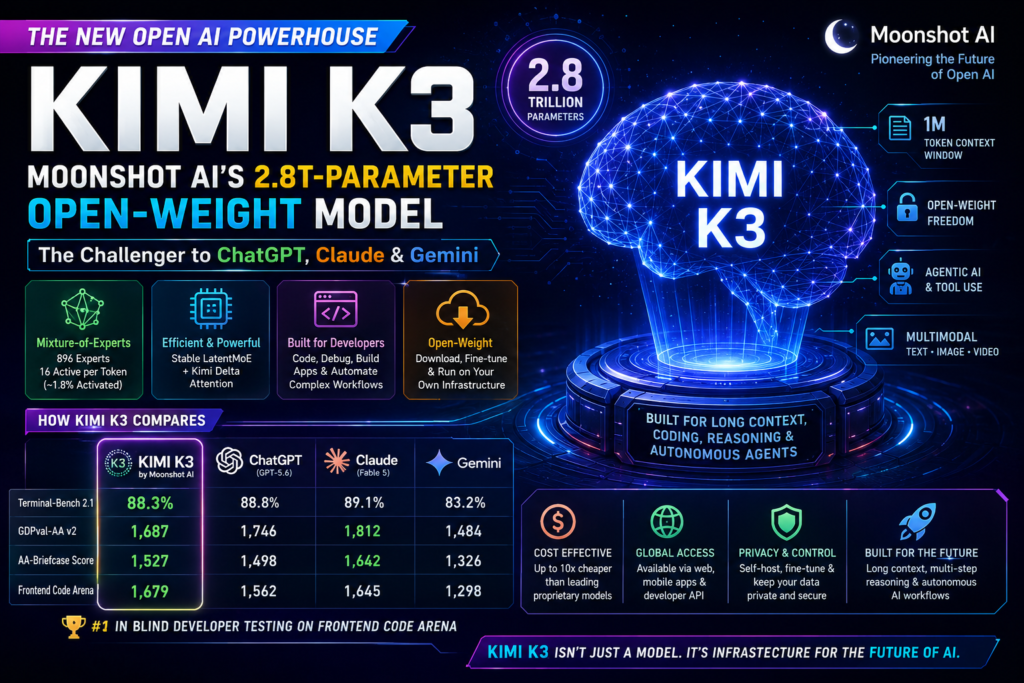
Kimi K3 is a 2.8-trillion-parameter open-weight AI model built by the Chinese startup Moonshot AI, designed to compete directly with flagship systems like ChatGPT, Claude, and Gemini on coding, reasoning, and autonomous agent tasks. Released on July 16, 2026, it is currently the largest open-weight model in the world , and unlike closed models from OpenAI or Anthropic, its weights can be downloaded and run on your own infrastructure.
If you’ve spent any time in AI circles over the past couple of weeks, you’ve likely seen this model mentioned everywhere from developer forums to mainstream tech coverage. Some are calling it China’s next “DeepSeek moment.” Others argue it’s the first genuinely open system capable of trading blows with the best closed models on the market. This guide breaks down exactly what it is, how it works, how it performs, and whether it deserves a spot in your AI toolkit.
What Is Kimi K3?
Kimi K3 is Moonshot AI’s flagship large language model, built as a Mixture-of-Experts (MoE) system with 2.8 trillion total parameters. Instead of activating its entire parameter count on every request, it uses a sparse architecture called Stable LatentMoE that turns on just 16 of 896 available experts per token , roughly 1.8% of the total network. This design keeps inference costs and latency manageable despite the model’s enormous overall size.
Moonshot has positioned the system as the world’s first “open 3T-class” model, a term meant to signal that it approaches the three-trillion-parameter range while still being classified as open-weight. That distinction matters: this release isn’t just bigger than its predecessor, Kimi K2 , it also introduces a new attention mechanism (Kimi Delta Attention) and a technique called “Attention Residuals,” both intended to make long-context reasoning computationally practical at this scale.
Where this model really sets itself apart is in what it’s built to do. Rather than being optimized purely for short question-and-answer exchanges, it’s designed for long-horizon, multi-step work: writing and debugging full codebases, running autonomous research tasks, and coordinating parallel tool calls without constant human supervision. In other words, it’s less a chatbot and more an engine for agentic software.
How It Differs From Closed Models Like ChatGPT and Claude
ChatGPT, Claude, and Gemini are all proprietary , their architectures and weights are locked behind an API. Moonshot’s model flips that approach. The company has committed to releasing the full weights publicly, meaning developers and companies can:
- Download the model and self-host it on their own servers or cloud infrastructure
- Fine-tune it for specialized use cases without relying on a third-party API
- Avoid ongoing per-token API costs by running the model locally
- Inspect and audit the architecture directly, which isn’t possible with closed systems
This openness is a major reason the release has reignited debate around open-source AI, particularly as U.S. labs like OpenAI and Anthropic continue to keep their frontier models closed.
Who Makes Kimi K3? Meet Moonshot AI
The model comes from Moonshot AI, a Beijing-based startup founded in 2023 by researcher Yang Zhilin, who studied at Carnegie Mellon before returning to China to build foundation models. Moonshot first drew international attention with early Kimi chatbots that supported dramatically longer context windows than most competitors at the time.
Since then, Moonshot has become one of China’s most closely watched AI labs, alongside rivals like DeepSeek, MiniMax, Z.ai, and Alibaba. The company has iterated quickly: an earlier version, Kimi K2, launched in mid-2025, followed by specialized variants K2.5, K2.6, and K2.7 Code. The newest release represents a significant jump in scale from that lineage , at 2.8 trillion parameters, it’s roughly 75% larger than DeepSeek’s V4 Pro, the previous largest widely-used open model.
The timing of the launch wasn’t accidental either. Moonshot debuted the model just ahead of the 2026 World Artificial Intelligence Conference in Shanghai, a moment that doubled as a comeback narrative for a company whose market position had slipped over the prior 18 months as DeepSeek’s popularity surged. Positioning a model of this scale at that particular moment sent a clear signal: Moonshot intends to be treated as a frontier lab, not just a regional player.
Specs and Architecture
Parameter Count and Mixture-of-Experts Design
The headline number here is 2.8 trillion total parameters , but thanks to the sparse MoE design, the model only activates a small fraction of that capacity for any given request. By routing each token through 16 of 896 available experts, Moonshot is able to deliver reasoning quality closer to what you’d expect from a model of this size, without the runtime cost of activating the full network on every query. For comparison, a rough back-of-envelope calculation puts the raw weight data at around 1.4 terabytes when quantized to 4 bits per parameter , a genuinely massive footprint, even by frontier-model standards.
Context Window
Like Claude, this model supports an extremely large context window , up to 1 million tokens. That’s nearly four times larger than the context window of Kimi K2.6, and it allows the system to process entire codebases, lengthy legal documents, or full-length books in a single prompt without needing to chunk or summarize content beforehand. For engineering teams working across sprawling repositories, that’s arguably a bigger practical advantage than the raw parameter count.
Pricing and Access
The model is available now through Moonshot’s website, mobile apps, and an OpenAI-compatible developer API , even though the full open-weight release trailed the initial launch by about a week and a half. API pricing is notably aggressive compared to Western frontier models: roughly $0.30 per million cache-hit input tokens, $3 per million tokens on cache misses, and $15 per million output tokens. That cost structure is a big part of why developers have been so quick to test it against pricier alternatives from OpenAI and Anthropic.
What Can Kimi K3 Do?
Moonshot built this model around long-horizon, autonomous workflows rather than simple back-and-forth chat. Here’s what stands out most to developers and technical teams:
- Agentic coding , writes, debugs, and executes multi-file software projects with minimal human intervention
- Massive context handling , analyzes entire codebases, research papers, or books in a single 1-million-token prompt
- Web and game creation , generates interactive 3D web graphics, slide decks, and even multiplayer games on demand
- Multi-step agent workflows , coordinates parallel background tasks using tool calls, useful for research automation and complex pipelines
- Native multimodality , processes text, images, and video understanding within the same system, rather than relying on separate vision add-ons
This combination of scale, context length, and agentic tooling is why the model has been positioned less as a chatbot competitor and more as an infrastructure play for developers building autonomous systems from the ground up.
Kimi K3 Benchmarks: How Does It Compare to ChatGPT, Claude, and Gemini?
Independent evaluators, including Artificial Analysis, have tested it against the current top-tier proprietary models. The results paint a consistent picture: it lands just behind the very best closed systems, while comfortably beating older or mid-tier proprietary models.
| Benchmark | Result | How It Compares |
| Terminal-Bench 2.1 | 88.3% | Just behind GPT-5.6 Sol (88.8%); ahead of most other models |
| GDPval-AA v2 (real-world work tasks) | Score of 1,687 | Third place overall, behind Claude Fable 5 Max and GPT-5.6 Sol Max |
| AA-Briefcase (long-horizon agentic work) | Score of 1,527 | Second place, ahead of GPT-5.6 Sol Max, behind Claude Fable 5 Max |
| Arena Frontend Code Arena | 1,679 points | Ranked first in blind developer testing, ahead of Claude Fable 5 |
| Overall self-reported suite (Moonshot) | Beats Claude Opus 4.8 and GPT-5.5 | Trails only Claude Fable 5 and GPT-5.6 Sol |
The pattern that emerges is fairly consistent across independent reviewers: this model is exceptionally strong on tasks that combine planning, tool use, long context, and a concrete deliverable , like shipping working code or completing multi-step research. It’s less consistently dominant on pure knowledge or abstract reasoning benchmarks, where the very top proprietary models still hold an edge.
For context, on the Frontend Code Arena specifically, Kimi K3 actually outperformed Claude Fable 5 in blind developer testing , a notable result given that Fable 5 is one of Anthropic’s newest and most capable models. That single data point is a big part of why developers have started treating Moonshot’s release as a genuine frontier contender rather than a budget alternative.
Why Is Kimi K3 Making Headlines?
Beyond raw performance, this release has generated buzz for two main reasons. First, it delivers benchmark results that rival or beat several flagship proprietary models while costing a fraction of the price to run , a combination that’s forced Western AI labs to pay closer attention to the pace of Chinese open-weight development.
Second, and more controversially, the launch has become entangled in a geopolitical dispute. Following the model’s debut, U.S. White House officials accused Moonshot AI of training it using outputs from Anthropic’s Claude Fable system through a technique known as distillation, where a newer model learns by studying an established model’s responses rather than training purely from scratch. Moonshot has denied the allegations, maintaining that the model’s performance comes from its own architectural innovations rather than unauthorized distillation. The dispute is still unresolved, but it highlights just how much scrutiny open-weight AI releases are now attracting from governments as much as from developers and enterprise buyers.
That controversy hasn’t slowed adoption much so far. If anything, it’s added to the sense that Moonshot’s model is being taken seriously enough by U.S. officials to warrant a formal response , a level of attention few open-weight releases from Chinese labs have previously received.
Limitations to Keep in Mind
No model this new arrives without caveats, and it’s worth being clear-eyed about where the hype outpaces reality.
- Weight availability lagged the announcement. Moonshot promised the full open-weight release for July 27, 2026, roughly a week and a half after the initial launch , meaning early access was API-only, not truly self-hostable, for anyone testing it in that first window.
- Hardware requirements are steep. With an estimated 1.4 terabytes of quantized weight data, self-hosting isn’t something a hobbyist can spin up on consumer GPUs. This is squarely an enterprise or well-resourced research lab proposition.
- It’s not a category leader everywhere. While benchmark results are genuinely impressive on coding and agentic tasks, the model consistently trails Claude Fable 5 and GPT-5.6 Sol on broader, less specialized evaluations. Treat the “beats ChatGPT” headlines with some skepticism , the reality is more nuanced and task-dependent.
- The distillation dispute is unresolved. Until Moonshot and U.S. officials reach some kind of public resolution, enterprise buyers with strict compliance requirements may want to watch how that story develops before committing to production use.
- Documentation is still catching up. A full technical report from Moonshot was still forthcoming at launch, meaning some architectural details are pieced together from third-party analysis rather than official documentation.
None of this erases what the release accomplishes , it’s still a legitimate step forward for open-weight AI. But teams evaluating it for production use should weigh these factors alongside the benchmark wins.
Kimi K3 vs ChatGPT: Which Should You Use?
Q: Is it better than ChatGPT for everyday use? A: Not necessarily. For casual, everyday tasks , drafting emails, answering general questions, or creative writing , ChatGPT still tends to be the smoother, more polished consumer experience. Moonshot’s model wasn’t primarily designed for that kind of light conversational use.
Q: When does this model make more sense than ChatGPT? A: If you’re building software tools, running autonomous agents, or working with codebases and documents that exceed typical context limits, its massive context window and agentic capabilities give it a real edge. The self-hosting option is also valuable for teams that want to avoid ongoing API costs or need to run models on private infrastructure for compliance reasons.
Q: Does it replace Claude or Gemini for coding work? A: It doesn’t need to replace them outright, but it’s a legitimate alternative. Benchmark results show it beating Claude Opus 4.8 and GPT-5.5 on several coding and agentic tasks, even though it still trails the newest flagship models, Claude Fable 5 and GPT-5.6 Sol, on overall performance. For teams already deep in the Anthropic or OpenAI ecosystems, switching entirely may not be worth the friction , but for cost-sensitive or self-hosted deployments, it’s worth serious evaluation.
Is Kimi K3 Free to Use?
Q: Can I try it without paying? A: Yes. It’s accessible for free through Moonshot’s standard web interface and mobile apps on both iOS and Android. Casual testing and light usage don’t require a paid plan.
Q: What about developers who need heavier usage? A: Developers can access the model through an OpenAI-compatible API, with paid tiers available for higher usage rates and enterprise-scale compute needs. Pricing is considerably lower than many closed competitors, which is part of why it’s gained traction so quickly among cost-conscious engineering teams.
Q: Are there privacy considerations before using it? A: As with any hosted AI service, it’s worth being cautious about entering sensitive personal or proprietary corporate data into the web app without first reviewing Moonshot’s privacy policies , a standard precaution regardless of which AI platform you’re using.
Kimi K3 FAQs
What does “open-weight” mean in this context? It means the underlying model weights , the actual trained parameters , can be downloaded and run independently, rather than being locked behind a company’s proprietary API. This differs from fully “open-source,” since Moonshot hasn’t released all training code or data alongside the weights.
How large is it compared to other open models? At 2.8 trillion total parameters, it’s the largest open-weight model released to date, well ahead of DeepSeek’s 1.6-trillion-parameter V4 Pro and other regional competitors like Xiaomi and Alibaba’s open releases.
Does it support images and video, or just text? Yes , the model is natively multimodal, meaning it can process text, images, and video understanding within a single unified system rather than routing vision tasks to a separate module.
Is it available outside China? Yes. Access is global through Moonshot’s website, mobile apps, and developer API, not restricted to users within China.
Can I run it entirely offline once the weights are released? Once the full open-weight release is available, technically capable teams with sufficient hardware can self-host the model, though the sheer scale , roughly 1.4 terabytes of quantized weight data , means it requires substantial GPU infrastructure, not a laptop-friendly deployment.
The Takeaway
Kimi K3 is one of the clearest signals yet that the gap between open-weight and proprietary AI models is narrowing fast. It won’t necessarily replace ChatGPT for everyday conversational use, but for developers building coding agents, research automation, or long-context applications, it offers a genuinely competitive , and considerably cheaper , alternative to the biggest names in the industry. Whether or not the distillation controversy gets resolved, Moonshot’s flagship release has already proven that Western AI labs no longer have the frontier entirely to themselves.
Meta Description: Kimi K3 is Moonshot AI’s 2.8T-parameter open-weight model rivaling ChatGPT and Claude. Learn its specs, benchmarks, pricing, and if it’s worth using.
Slug: what-is-kimi-k3-moonshot-ai-guide