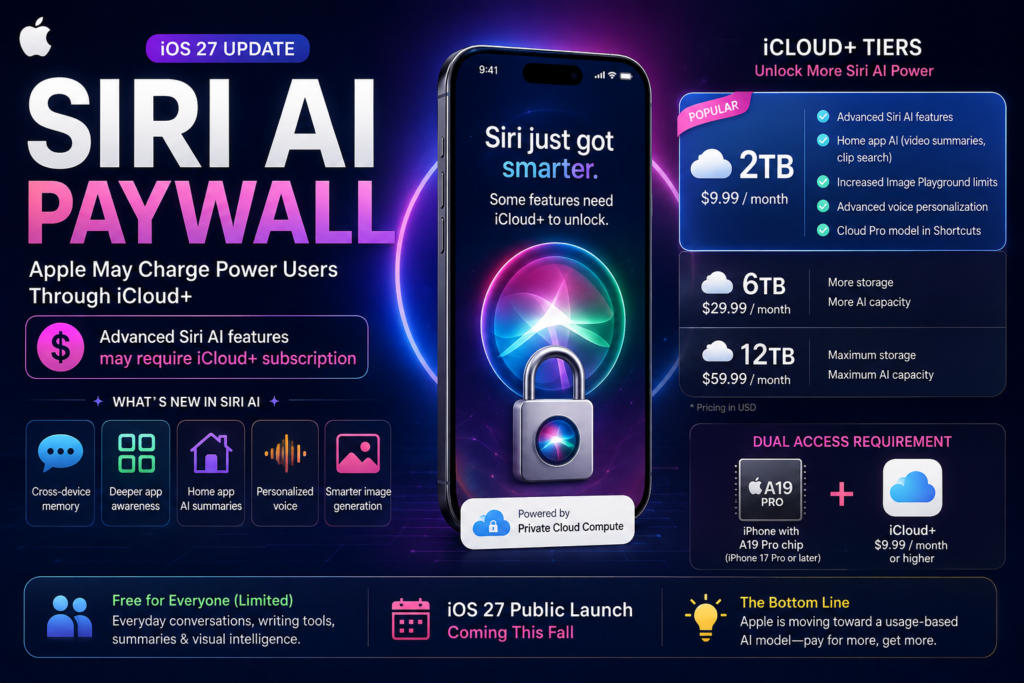
Answer first: Apple is preparing to gate its most advanced Siri AI features behind a Siri AI paywall tied to iCloud+ subscriptions meaning heavy users of the new AI assistant may need to pay a monthly fee (starting around $9.99) to unlock higher usage limits, while casual users keep free access. Outgoing CEO Tim Cook confirmed the plan is still being finalized, but the direction is clear: Apple is moving toward a usage-based AI monetization model similar to OpenAI and Anthropic.
If you’ve been tracking the iOS 27 beta rollout, you’ve probably noticed the signals piling up capability flags in beta code, iCloud+ tier requirements for Home app AI features, and now direct comments from Apple’s own leadership. This article breaks down exactly what the Siri AI paywall means, who it affects, how it compares to competitors, and what to expect when iOS 27 ships broadly this fall.
What’s Actually New in Siri AI With iOS 27?
Before diving into pricing, it helps to understand what Apple is charging for in the first place. The Siri AI overhaul in iOS 27 is the most significant rework of Apple’s voice assistant since it launched in 2011. Rather than routing simple commands through rigid, scripted intents, the new assistant is built on large language model reasoning some of it running on-device, and some of it powered by a custom Gemini model that Apple licensed from Google to fill gaps in its own in-house research.
Key upgrades include:
- Cross-device conversation memory. Users can start a conversation with Siri on an iPhone and pick it up later on an iPad or Mac, with the ability to pin important exchanges for future reference.
- Deeper app awareness. The assistant can reason across on-screen content and third-party apps rather than relying purely on pre-built integrations.
- Natural-language search inside Home. Users can ask about specific events captured on HomeKit cameras and get AI-generated summaries instead of scrubbing through raw footage.
- Personalized voice output. New sliders let users adjust tone, pace, and expressiveness of Siri’s spoken responses on supported hardware.
- Revamped Image Playground. Image generation is faster and more capable, but also one of the first features to run into daily usage caps.
All of this reasoning has to run somewhere, and that’s the root of the story. On-device processing is essentially free once the hardware is sold, but requests that exceed what an iPhone’s chip can handle get forwarded to Apple’s Private Cloud Compute servers infrastructure that costs real money to operate at scale. That server-side cost is exactly what the emerging subscription structure is designed to offset.
What Is the Siri AI Paywall, Exactly?
The Siri AI paywall refers to Apple’s emerging strategy of linking advanced Siri AI functionality to paid iCloud+ subscription tiers rather than offering unlimited access for free. During his final earnings call as Apple CEO, Tim Cook said the company believes there will be people that want to use Siri AI a lot, so Apple will offer some kind of upgrade possibilities on iCloud+ where people can buy up the stack.
Cook was careful to note that these plans are not set in stone, but the intent behind this pricing shift is unmistakable: server-side AI processing is expensive, and Apple wants a mechanism to recoup those costs from its heaviest users without alienating everyone else.
Why Apple Is Introducing This Now
Three forces are converging to push Apple toward this subscription-gated approach:
- Compute costs are rising. Advanced Siri AI requests that can’t be handled on-device get routed to Apple’s Private Cloud Compute servers, which cost significantly more to run than local processing.
- Apple licensed a rival’s model. Apple has fallen behind in building an advanced AI assistant and even licensed a custom Gemini model from Google to augment Siri, adding another layer of infrastructure expense.
- Industry-wide hardware pressure. Apple is also facing a rocky road accessing the supplies it needs, driven by an AI-related RAM shortage that has already pushed Meta, Samsung, Microsoft, and Sony to raise device prices.
How the Siri AI Paywall Will Work
Free Tier vs. Paid Tier: What’s the Difference?
Not everyone will need to pay. According to reporting on the iOS 27 beta, the core version of Siri AI including everyday requests, Writing Tools, summaries, and Visual Intelligence remains free for all users. This emerging pricing structure specifically targets heavy usage and server-intensive features, not baseline functionality.
| Feature | Free Access | Requires iCloud+ Upgrade |
| Everyday Siri AI conversations | ✅ Yes | Higher daily limits with upgrade |
| Writing Tools & summaries | ✅ Yes | No |
| Visual Intelligence | ✅ Yes | No |
| Image generation (Image Playground) | Limited daily cap | ✅ Increased limits |
| Home app AI (video summaries, clip search) | ❌ No | ✅ Requires 2TB plan ($9.99/mo) |
| Cloud Pro model in Shortcuts | ❌ No | ✅ Higher iCloud+ tiers only |
| Advanced Siri voice personalization (A19 Pro devices) | ❌ No | ✅ $9.99/mo iCloud+ tier |
The $9.99 Tier Is the Key Threshold
Multiple beta findings point to the same number: $9.99 per month, which corresponds to Apple’s 2TB iCloud+ plan. This tier was already the entry point for unlimited HomeKit Secure Video cameras, and Apple has now extended it to cover AI-generated video summaries, multi-camera activity grouping, and natural-language clip search inside the Home app.
Apple offers higher-priced iCloud+ tiers as well 6TB at $29.99/month and 12TB at $59.99/month for users who want even more headroom, though it’s not yet confirmed whether those unlock additional Siri AI capacity beyond the 2TB threshold.
Device Requirements Add a Second Gate
Here’s a detail many casual readers miss: this pricing model isn’t just a subscription question it’s also a hardware question. To access Apple’s most capable Siri AI experience, developer beta code has confirmed users need both of the following:
- An iPhone with an A19 Pro chip (iPhone 17 Pro or Pro Max at minimum)
- An active iCloud+ subscription at the $9.99/month tier or higher
This “double-gated” approach means owning an older iPhone even one that technically supports Apple Intelligence, such as the iPhone 15 Pro or iPhone 16 won’t be enough to unlock every premium capability, regardless of subscription status.
Siri AI Paywall vs. Competitor AI Subscription Models
Apple isn’t inventing a new business model here it’s catching up to one already standard across the AI industry. Most other AI providers like Anthropic and OpenAI operate similarly, offering a limited free version to consumers with the option of upgrading to support more usage.
Question: Is the Siri AI Paywall Different From ChatGPT Plus or Claude Pro?
Direct answer: Yes, structurally. ChatGPT Plus and Claude Pro are standalone AI subscriptions purchased specifically for AI access. Apple’s approach, by contrast, is bundled into iCloud+, a storage subscription many users already pay for meaning Apple is monetizing AI usage indirectly through an existing product rather than launching a dedicated “Siri Pro” plan.
| Model | Subscription Type | Starting Price | What You’re Really Paying For |
| Siri AI (Apple) | Bundled into iCloud+ | ~$9.99/mo | Storage + AI usage limits combined |
| ChatGPT Plus (OpenAI) | Dedicated AI subscription | ~$20/mo | AI usage and model access only |
| Claude Pro (Anthropic) | Dedicated AI subscription | ~$20/mo | AI usage and model access only |
| Gemini Advanced (Google) | Bundled into Google One | Varies by plan | Storage + AI usage limits combined |
This bundling strategy is arguably smart: Apple already has hundreds of millions of iCloud+ subscribers, so this bundling strategy doesn’t require converting people to a brand-new product it just asks existing subscribers to consider “buying up the stack.”
What This Means for Apple’s Leadership Transition
The timing of this announcement is notable. Cook shared these comments on what was his final earnings call as CEO of Apple, as longtime Senior Vice President of Hardware Engineering John Ternus steps into Cook’s role at a critical time for the company.
Ternus inherits an AI strategy that’s been publicly criticized for moving too slowly. The overhaul was delayed so significantly that Apple had to pay $250 million to settle a class action lawsuit over how it marketed the iPhone 16’s AI capabilities. Getting the monetization strategy right without repeating past missteps will be one of the new CEO’s first major tests, and it arrives at a moment when the company is also managing rising hardware costs tied to the industry-wide memory shortage.
It’s worth noting that Apple has not been shy about raising prices elsewhere this year. Macs and iPads already saw price increases tied to component shortages, even as iPhone pricing has stayed level so far. Layering a usage-based AI charge on top of that backdrop suggests Apple sees subscription revenue, not hardware markups, as the more sustainable way to fund its AI infrastructure going forward.
How Apple’s Approach Compares to the Rest of the Industry
Zooming out, this move fits a broader pattern that anyone following enterprise and consumer AI pricing will recognize. Every major AI provider has eventually had to answer the same question: how do you offer a helpful free tier without going broke on compute costs?
- OpenAI built ChatGPT’s free tier around older or rate-limited models, reserving its newest and most capable models for Plus and Pro subscribers.
- Anthropic offers Claude with generous but capped free usage, with Pro and Max tiers unlocking higher limits and priority access.
- Google folds Gemini Advanced into Google One storage subscriptions a model that closely mirrors what Apple appears to be building with iCloud+.
- Apple, notably, is the only one of the four tying AI access to a product that wasn’t originally built for AI at all: cloud storage.
That last point matters. Bundling gives Apple a distribution advantage it doesn’t need to convince anyone to sign up for something new but it also creates confusion, since a customer’s storage needs and their AI usage needs are only loosely related. A user might need very little iCloud storage but still want heavy Siri AI access, and under the current structure, they’d have to buy storage they don’t need just to unlock AI headroom.
What Should Users Do Right Now?
Since Apple has not finalized pricing or limits, there’s no need to rush into an iCloud+ upgrade today. That said, a few practical steps make sense for anyone following the rollout closely:
- Check your current iCloud+ tier. If you’re already on the 2TB plan for storage or camera reasons, you may already be positioned to receive expanded AI access at no extra cost when the paywall goes live.
- Confirm your device’s eligibility. Apple Intelligence and Siri AI require an iPhone 15 Pro or newer; the most advanced personalization features additionally require an A19 Pro chip, meaning an iPhone 17 Pro or later.
- Watch for the September rollout. iOS 27 is expected to ship publicly in September, at which point Apple is likely to publish clearer terms around daily limits and upgrade pricing.
- Don’t expect core features to disappear. Based on everything reported so far, everyday Siri AI conversations, Writing Tools, and summaries are staying free the changes target heavy usage and a handful of server-intensive extras.
A Quick Timeline: How Apple Got Here
Understanding why Apple is leaning on iCloud+ rather than launching a dedicated AI subscription requires looking at the bumpy road that got the company to this point.
- 2024: Apple unveiled Apple Intelligence alongside the iPhone 16 lineup, promising a dramatically smarter Siri. Marketing materials leaned heavily on capabilities that weren’t yet shipping.
- Late 2024 – 2025: The promised personalized Siri features slipped repeatedly, drawing criticism from analysts and users who felt misled by the iPhone 16 launch messaging.
- May 2026: Apple agreed to pay $250 million to settle a class action lawsuit tied to how those unreleased AI features were marketed.
- Late 2025 – early 2026: Rather than wait for its own models to catch up, Apple struck a deal reportedly worth roughly $1 billion annually to license a custom Gemini model from Google, giving the new Siri a stronger reasoning engine under the hood.
- Mid-2026: iOS 27 betas began rolling out with the reworked Siri AI experience, alongside quiet signals in the code pointing to iCloud+ tier requirements for certain features.
- July 2026: Tim Cook confirmed the upgrade-based pricing direction on his final earnings call before handing the CEO role to John Ternus, while Apple simultaneously raised prices on Macs and iPads due to memory shortages.
Seen against that backdrop, the emerging pricing model looks less like an opportunistic cash grab and more like Apple trying to build a sustainable funding mechanism after years of expensive, high-profile stumbles. Whether users see it that way is, of course, a separate question and one that will likely shape early reactions once the broader rollout begins in September.
The Bigger Picture: AI Monetization Is Becoming Universal
What’s happening with Siri is really a preview of where the entire consumer tech industry is heading. As generative AI models get more capable, they also get more expensive to run, and someone has to cover that bill. For years, tech companies absorbed those costs to drive adoption. That era appears to be ending.
Apple’s decision to route AI costs through an existing storage subscription, rather than inventing a brand-new “Siri Pro” product, reflects a broader industry lesson: users resist paying for something that feels new, but they’re far more tolerant of paying more for something they already understand and already budget for. Expect other hardware makers facing similar compute costs to study how Apple’s rollout is received before deciding whether to follow the same playbook.
Frequently Asked Questions
Will I have to pay for Siri AI?
Not necessarily. Based on current beta evidence, standard Siri AI conversations remain free. This pricing structure applies mainly to heavy daily usage and specific server-intensive features like Home app video analysis and advanced voice personalization.
When does the Siri AI paywall take effect?
Advanced Siri AI is already available in the iOS 27 beta and is expected to roll out more broadly this fall, alongside the paywalled tier structure.
Which iCloud+ plan do I need for full Siri AI access?
Reports consistently point to the 2TB iCloud+ plan, priced around $9.99 per month, as the minimum tier required for the most advanced AI-gated features.
Does the Siri AI paywall work in Europe or China?
No. Due to regulatory restrictions, Siri AI is not currently planned for availability in Europe or China, so the paywall question is moot in those regions for now.
Is Apple the first company to charge for AI usage limits?
No. This subscription-gated approach follows an established industry pattern OpenAI, Anthropic, and Google all use free-tier-plus-paid-upgrade models for their AI products. Apple’s twist is bundling AI limits into its existing iCloud+ storage subscription rather than launching a separate AI-only plan.
Key Takeaways
- Apple is testing a Siri AI paywall that ties advanced AI features to iCloud+ subscription tiers, starting around $9.99/month.
- Baseline Siri AI functionality is expected to stay free; the paywall targets heavy usage and server-intensive features.
- Full access to the most advanced Siri AI capabilities may also require newer hardware (A19 Pro chip), creating a dual gate of device plus subscription.
- This approach mirrors how OpenAI, Anthropic, and Google monetize their own AI assistants.
- The rollout coincides with a major leadership transition at Apple, as John Ternus takes over as CEO from Tim Cook.
- Nothing is finalized yet Cook explicitly described the plans as still evolving ahead of the broader iOS 27 launch this fall.
Meta Description: Apple may introduce a Siri AI paywall tied to iCloud+ subscriptions. Here’s what heavy users need to know about pricing, device gates, and iOS 27.
Slug: siri-ai-paywall-icloud-subscription-explained