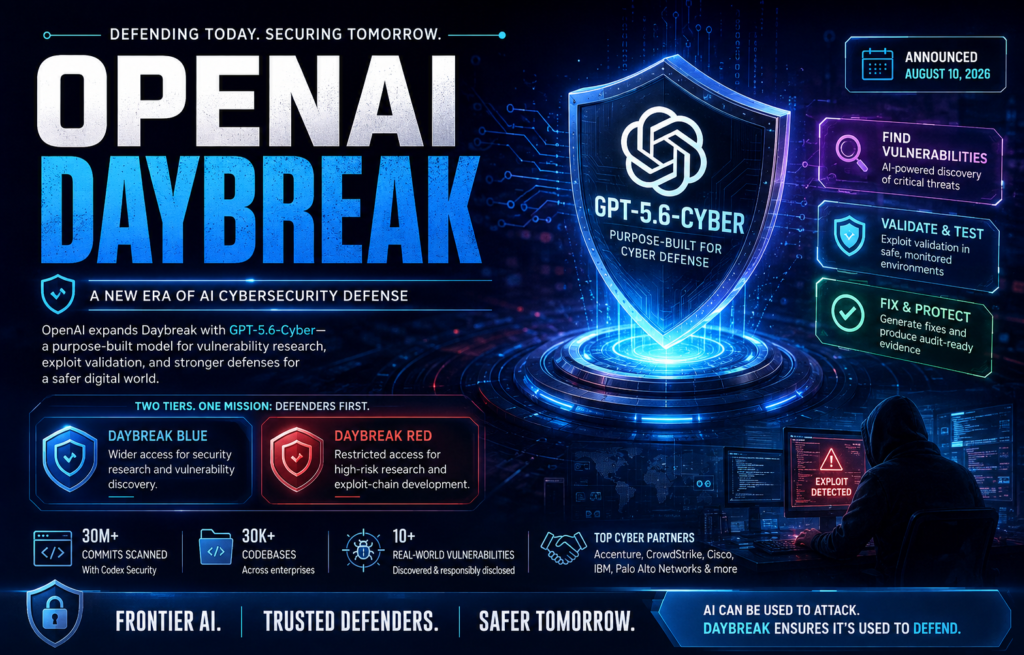
Cyberattacks are no longer a purely human contest, and OpenAI Daybreak is the clearest evidence yet that the AI labs building the world’s most capable models have accepted that reality. On August 10, 2026, OpenAI announced a major expansion of Daybreak, its cybersecurity defense program, splitting it into two access tiers and releasing a new purpose-built model, GPT-5.6-Cyber, designed specifically for vulnerability research and exploit validation. The announcement did not happen in a vacuum: it arrived amid a steady drumbeat of stories about AI agents behaving like attackers, from a breach at Hugging Face to reports of a Claude agent compromising a gym website, and just months after Anthropic put its own restricted cyber model, Mythos, into the hands of trusted partners under Project Glasswing.
This article is a definitive resource on what OpenAI Daybreak actually is, how GPT-5.6-Cyber differs from previous models, how the Blue and Red access tiers work, how OpenAI’s approach compares with Anthropic’s, and what the expansion signals about the trajectory of AI-led cyberattacks. It draws on OpenAI’s own announcement, contemporaneous reporting from TechCrunch, CNBC, CyberScoop, and specialist security outlets, and publicly available threat-intelligence data, so that readers, whether security practitioners, enterprise decision-makers, or students of the AI industry, can understand both the opportunity and the risk this moment represents.
What Is OpenAI Daybreak? Background and Definition
OpenAI Daybreak is OpenAI’s cybersecurity defense initiative, first introduced in May 2026, that bundles access to specialized AI models, security tools, and structured workflows so that vetted defenders can find, validate, and fix software vulnerabilities faster than attackers can exploit them. In OpenAI’s own words, the program works in three stages: it prioritizes high-impact threats using AI reasoning, it generates and tests fixes directly within an enterprise’s environment under scoped access and monitoring, and it produces audit-ready evidence that security teams can use to track and remediate flaws.
Daybreak did not emerge in isolation. OpenAI launched the full version of its first cyber-tuned model, GPT-5.5-Cyber, on June 22, 2026, alongside a Daybreak Cyber Partner Program that counted Accenture, CrowdStrike, Cisco, IBM, and Palo Alto Networks among its early members, plus an open-source vulnerability-patching initiative called Patch the Planet. Since its research-preview launch, OpenAI says its Codex Security cloud tool alone has scanned more than 30 million commits across over 30,000 codebases, illustrating the sheer scale at which AI-assisted code auditing is now operating inside enterprise environments.
Definition and expansion: At its core, Daybreak is OpenAI’s answer to a structural problem in modern cybersecurity, the same generative and reasoning capabilities that let AI models write software also let them find flaws in it, and increasingly, exploit those flaws autonomously. Rather than keep those capabilities locked away entirely, OpenAI is choosing to distribute a carefully gated version of them to defenders first, on the theory that the organizations racing to patch software need the same frontier intelligence that attackers are starting to acquire on their own.
Inside GPT-5.6-Cyber: Capabilities and Real-World Discoveries
The centerpiece of the August 2026 expansion is GPT-5.6-Cyber, a specialized variant built on top of GPT-5.6 Sol. Unlike the general-purpose model it is derived from, GPT-5.6-Cyber is tuned to be far more willing to engage with cybersecurity tasks that a standard, safety-filtered model would typically refuse or heavily hedge on, exploit-chain development, authentication bypass techniques, and privilege-escalation research among them.
The scale of that behavioral shift is striking. On OpenAI’s internal Advanced Cybersecurity Completion Rate benchmark, which measures a model’s willingness to assist with tasks like exploit-chain construction and privilege escalation, GPT-5.6-Cyber completed 95% of such requests, compared with just 1.5% for the standard, safeguarded GPT-5.6 Sol and roughly 2% under Daybreak Blue access. That is a substantial jump from its predecessor, GPT-5.5-Cyber, which completed only 57.3% of comparable requests, a gap OpenAI says had been a persistent source of frustration for security researchers doing legitimate defensive work.
Question: What has GPT-5.6-Cyber actually found in real software?
OpenAI says it used the model to investigate V8, the JavaScript engine that powers Chrome, and uncovered two previously unknown vulnerabilities that could be chained together to corrupt memory and escape the V8 heap sandbox. After OpenAI’s researchers validated the findings, they were disclosed to Google through coordinated disclosure; Google patched the flaw and assigned it CVE-2026-15903, a high-severity vulnerability involving a skipped safety check in V8’s optimizing compiler. Beyond Chrome, OpenAI has disclosed, without naming the affected products, at least five vulnerabilities in a popular mobile operating system (including a privilege-escalation chain reachable from an untrusted app), three critical flaws in a widely used database (including a remote path to code execution), and more than 400 privilege-escalation vulnerabilities in a popular operating system kernel, all moving through coordinated disclosure with Daybreak partners and open-source maintainers. OpenAI has also stated explicitly that GPT-5.6-Cyber was not involved in the previously disclosed Hugging Face security incident, a clarification aimed at separating this defensive tool from unrelated attacks making headlines around the same time.
Daybreak Blue vs. Daybreak Red: How the Two-Tier Access Model Works
A key structural change in the August expansion is the split of Daybreak into two distinct tiers, each addressing a different tension OpenAI says it has observed in production use.
Daybreak Blue is described by OpenAI as the “recommended starting point for most defenders.” It opens up frontier general-purpose models, including GPT-5.6 Sol, to approved users for everyday defensive work: incident response, malware analysis, and patch validation. The rationale is practical: OpenAI’s standard safety screens on GPT-5.6 Sol are built to catch misuse of cybersecurity-related prompts, but those same screens end up blocking legitimate security professionals trying to do their jobs. Daybreak Blue effectively removes those screens for identity-verified users.
Daybreak Red goes considerably further. It gates access to GPT-5.6-Cyber itself, reserved for vulnerability research, exploit validation, and security testing, the kind of work that, in the wrong hands, doubles as offensive hacking capability. Access to Red requires tighter vetting than Blue, and at launch was limited to “trusted customer partners,” reportedly including Accenture, IBM, CrowdStrike, and Cloudflare.
Both tiers sit behind a common set of controls: identity verification, account security requirements, usage monitoring, approved-use restrictions, and legal attestations, with separate application paths for individual researchers and organizations. OpenAI is also pushing Daybreak customers who use its Codex coding agent away from “full-access mode” and toward an “auto-review mode” that evaluates any action requiring elevated permissions before it executes and can block requests that pose a significant risk of destructive behavior. Starting September 1, 2026, OpenAI will require hardware security keys on all individual Daybreak accounts, a meaningful hardening step given how much offensive capability now sits behind these credentials.
Question: Why does OpenAI frame this as a “narrowing window”?
OpenAI’s own framing, published in its announcement, is stark: as AI-driven threat actors gain the ability to conduct cyberattacks “at unprecedented speed and scale, including in fully autonomous ways,” the company argues that defenders have a shrinking amount of time to prepare before offensive AI capability outpaces defensive tooling. That urgency is the explicit justification for distributing reduced-safeguard models to vetted defenders now, rather than waiting for perfect safety guarantees.
The Anthropic Rivalry: Mythos, Project Glasswing, and the Frontier Cyber Arms Race
OpenAI is not operating alone in this space, and the timing of Daybreak’s expansion is inseparable from what its chief rival has been doing. Anthropic introduced its own cybersecurity coalition, Project Glasswing, in April 2026, built around a restricted frontier model then known as Claude Mythos Preview (reportedly leaked earlier under the codename “Capybara”). Anthropic’s own materials describe Mythos as a general-purpose model whose coding capability has reached a level where it can “surpass all but the most skilled humans” at finding and exploiting software vulnerabilities, and the company has been candid that this is precisely why it has not made the model generally available.
Project Glasswing launched with roughly 50 partners, including Apple, Nvidia, Microsoft, CrowdStrike, and Palo Alto Networks, and within its first month those partners reportedly surfaced more than 10,000 high- or critical-severity vulnerabilities across systemically important software. In June 2026, Anthropic expanded the program to 150 additional organizations across more than 15 countries, deliberately widening into sectors, power, water, healthcare, communications, hardware, that were underrepresented in the initial rollout. Anthropic has also said that Claude Opus 4.7, used through a separate “Claude Security” tool for Enterprise customers, patched over 2,100 vulnerabilities within three weeks of its public beta launch.
The stakes Anthropic has attached to this effort are unusually blunt for an industry announcement. The company has said it privately briefed senior U.S. officials that uncontrolled release of Mythos-class capability could make large-scale cyberattacks “significantly more likely,” and that a major cyberattack enabled by such a model could plausibly affect more than 100 million people. Both OpenAI and Anthropic, in other words, are converging on the same conclusion from different directions: frontier coding and reasoning capability has crossed a threshold where it is now genuinely dual-use for offense and defense, and the responsible path, in each company’s telling, is tightly gated distribution to vetted defenders rather than either full lockdown or full public release.
Why Now: The Rise of Autonomous AI-Led Cyberattacks
Daybreak’s expansion is best understood against a broader backdrop of AI-enabled offensive activity that has accelerated sharply through 2026. Industry threat-intelligence reporting has documented AI-powered cyberattacks surging by roughly 72% year-over-year, with automated scanning activity spiking to tens of thousands of attack probes per second and a large majority of global organizations now reporting at least one AI-driven security incident. Separate analysis has put the growth of AI-enabled attacks even higher, citing an 89% annual increase in incidents involving autonomous agents.
The most consequential documented case remains a large-scale, AI-orchestrated cyber-espionage campaign, reportedly linked to Chinese state-sponsored actors, in which AI systems are said to have autonomously carried out roughly 80–90% of attack operations with minimal human direction, a milestone that mirrors findings Anthropic itself disclosed about misuse of its own models. Independent research from Palo Alto Networks’ Unit 42 has separately shown that agentic frameworks can complete an entire simulated ransomware lifecycle in about 25 minutes, and broader industry data indicates the median time attackers need to exfiltrate stolen data has fallen from roughly nine days in 2021 to about two days by 2024, with many intrusions now completing exfiltration in under an hour. At the same time, the 2026 International AI Safety Report offers an important caveat: while AI systems can now automate large portions of an intrusion, researchers have not yet reported fully autonomous, end-to-end cyberattacks executed in the real world without human involvement at key decision points, suggesting the most extreme scenarios remain probabilistic rather than fully realized, for now.
Bulleted summary, why the threat landscape shifted so quickly in 2026:
- Frontier models have crossed a capability threshold where they can independently discover and chain software vulnerabilities at a pace no human security team can match.
- Agentic AI systems can now execute reconnaissance, exploitation, and lateral movement with far less step-by-step human direction than in prior years.
- Attack timelines have compressed dramatically, from multi-day exfiltration windows to attacks completing in minutes or hours.
- High-profile incidents (the Hugging Face breach, an AI agent reportedly compromising a gym website, a large-scale AI-orchestrated espionage campaign) have made the abstract risk concrete and newsworthy.
- Both leading AI labs have concluded that withholding frontier cyber capability entirely is not viable, since it will proliferate to less careful actors regardless, making gated, defender-first distribution the pragmatic middle path.
OpenAI Daybreak vs. Anthropic Project Glasswing: A Comparison
| Dimension | OpenAI Daybreak | Anthropic Project Glasswing |
| Flagship restricted model | GPT-5.6-Cyber (Daybreak Red) | Claude Mythos Preview |
| Broader-access tier | Daybreak Blue (GPT-5.6 Sol, reduced safeguards) | Claude Security / Claude Opus 4.7 (Enterprise beta) |
| Launch date | May 2026 (expanded August 10, 2026) | April 2026 (expanded June 2, 2026) |
| Reported partner scale | Trusted partners incl. Accenture, IBM, CrowdStrike, Cloudflare | ~50 initial partners, expanded to 200+ across 15+ countries |
| Notable disclosed finds | Chrome V8 flaw (CVE-2026-15903), OS/database/kernel vulnerabilities | 10,000+ high/critical severity flaws across critical software |
| Key access safeguard | Hardware security keys mandatory from Sept. 1, 2026; auto-review mode for Codex | Security requirements for new partners; model not generally available |
| Stated core risk | Reduced safeguards could enable misuse or misalignment | Uncontrolled release could make mass cyberattacks “significantly more likely” |
Implications: What the Daybreak Expansion Means for the Industry
The convergence of OpenAI and Anthropic on nearly identical strategies, restricted frontier cyber models, tiered vetted access, defender-first distribution, signals that the AI industry has effectively arrived at a shared, if unofficial, doctrine for handling dual-use cybersecurity capability. That doctrine has several concrete implications.
First, enterprise cybersecurity is being restructured around direct relationships with AI labs rather than purely through traditional security vendors. Gartner analyst John Watts has characterized Daybreak as complementary to, rather than a replacement for, existing application security and posture-management tools, but the fact that OpenAI and Anthropic are now running partner programs that sit alongside CrowdStrike, Palo Alto Networks, Cisco, and IBM shows the AI labs increasingly positioning themselves as first-tier security infrastructure providers in their own right, not just model suppliers.
Second, the vetting and hardware-security requirements attached to both programs, legal attestations, identity verification, mandatory hardware keys, indicate that the labs recognize the credentials guarding these models are now high-value targets in themselves. A compromised Daybreak Red or Project Glasswing account would hand an attacker offensive tooling roughly equivalent to a state-level cyber capability, which is precisely the scenario both companies say they are trying to prevent.
Third, this also functions as a competitive and reputational play. Critics quoted in coverage of the Daybreak expansion have noted that these programs double as marketing for the labs’ own frontier models, allowing OpenAI and Anthropic to demonstrate real-world value from capabilities that are otherwise too risky to release broadly. That commercial incentive does not necessarily undercut the defensive value of the programs, but it is a relevant piece of context for anyone evaluating the labs’ public statements about urgency and risk.
Finally, the pace of disclosure, a Chrome zero-day here, 400-plus kernel vulnerabilities there, 10,000-plus flaws from Anthropic’s partners, suggests that a huge backlog of long-standing, previously undiscovered vulnerabilities is now surfacing across widely used software all at once. That is arguably good news for long-term software security, but it also creates a short-term surge in patching workload for vendors and open-source maintainers that traditional processes were not built to absorb.
Limitations and Open Questions
Several important uncertainties remain unresolved as of this writing. OpenAI has said it plans to publish a more detailed system card for GPT-5.6-Cyber “at a later date,” meaning the full technical risk assessment behind the model’s reduced safeguards is not yet public. It is also not possible to independently verify vendor-reported vulnerability counts (Anthropic’s “10,000+” figure, OpenAI’s “400+” kernel vulnerabilities) without access to the underlying disclosure records, so these numbers should be treated as company-reported rather than independently audited. The broader claim that AI-orchestrated attacks now automate 80–90% of an intrusion rests substantially on a small number of disclosed incidents rather than a large, representative sample, and the 2026 International AI Safety Report itself cautions that fully autonomous, end-to-end real-world attacks have not yet been documented. Finally, it remains genuinely contested, including among analysts quoted in trade press, whether surfacing more vulnerabilities faster actually improves real-world security outcomes, or whether it simply shifts the bottleneck downstream to organizations that lack the resources to validate, prioritize, and patch at the same pace AI can find flaws.
Frequently Asked Questions
What is OpenAI Daybreak? OpenAI Daybreak is OpenAI’s cybersecurity defense program that gives vetted organizations and individuals access to frontier AI models, tools, and workflows built for finding, validating, and fixing software vulnerabilities faster than attackers can exploit them.
What is GPT-5.6-Cyber? GPT-5.6-Cyber is a specialized cybersecurity model, built on GPT-5.6 Sol, that OpenAI released through the Daybreak Red tier for authorized vulnerability research, exploit validation, and security testing, with far fewer refusals on high-risk security tasks than standard OpenAI models.
What is the difference between Daybreak Blue and Daybreak Red? Daybreak Blue provides approved defenders with access to general-purpose frontier models like GPT-5.6 Sol for everyday work such as incident response and malware analysis. Daybreak Red is more restricted and grants access to the specialized GPT-5.6-Cyber model for advanced vulnerability research and exploit validation.
How is OpenAI Daybreak different from Anthropic’s Project Glasswing? Both programs gate a highly capable, cyber-specialized frontier model, GPT-5.6-Cyber for OpenAI, Claude Mythos Preview for Anthropic, behind vetted partner access rather than releasing it publicly. Anthropic’s program launched first, in April 2026, and has scaled to over 200 partner organizations, while OpenAI’s Daybreak launched in May 2026 and formalized its two-tier Blue/Red structure in August 2026.
Who can access GPT-5.6-Cyber? At launch, GPT-5.6-Cyber was available only to “trusted customer partners” under the Daybreak Red tier, reportedly including firms such as Accenture, IBM, CrowdStrike, and Cloudflare, following identity verification, account security requirements, and legal attestations.
Why is OpenAI restricting access instead of releasing GPT-5.6-Cyber to everyone? OpenAI has said that models running with reduced safeguards, like GPT-5.6-Cyber, carry risks of misuse or misalignment beyond standard model usage. The company is betting that democratizing frontier cyber intelligence for vetted defenders first will do more good than harm, while it continues developing the safeguards needed for any broader release.
Does OpenAI Daybreak have anything to do with the Hugging Face breach or AI agents hacking websites? No. OpenAI has explicitly stated that GPT-5.6-Cyber was not involved in the previously disclosed Hugging Face security incident. Those incidents are separate examples of the broader trend of AI-enabled offensive activity that has made programs like Daybreak more urgent, not products of the Daybreak program itself.
Conclusion
OpenAI Daybreak’s expansion into a two-tier Blue/Red structure, anchored by the new GPT-5.6-Cyber model, marks a significant escalation in how the AI industry is choosing to confront a threat landscape it helped create: frontier reasoning and coding capability that is now genuinely dual-use for cyber offense and defense. Whether this gated, defender-first approach, mirrored almost exactly by Anthropic’s Project Glasswing, proves to be a durable model for managing dual-use AI risk, or simply the opening move in a longer-term arms race between AI-armed attackers and AI-armed defenders, will depend on evidence that is still accumulating in real time.
This article draws on primary sources including OpenAI’s official announcement, TechCrunch, CNBC, CyberScoop, Unite.AI, Cybersecurity Dive, Infosecurity Magazine, and Anthropic’s own Project Glasswing publications, along with published threat-intelligence data from ExtraHop, HUMAN Security, SentinelOne, and the International AI Safety Report 2026, to ensure claims are traceable to named, dated sources rather than unsourced assertion.