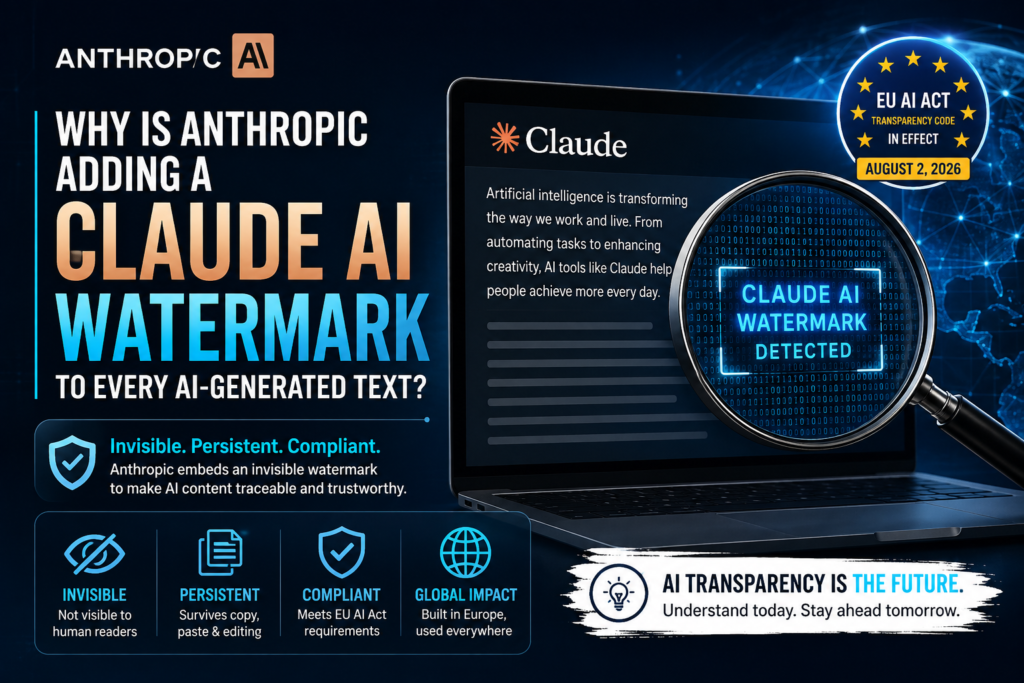
Imagine pasting a paragraph from ChatGPT or Claude into an email, only to have the recipient’s software flag it as machine-made, even after you’ve edited half the sentences. That’s the new reality Anthropic just confirmed. Anthropic will now apply an invisible Claude AI watermark to text generated by its models, a move driven directly by the European Union’s AI Act transparency rules that took effect on August 2, 2026. The company confirmed the change through an updated support page, and it affects nearly every surface where Claude produces text.
For students, freelancers, marketers, and businesses across Odisha and the rest of India who use Claude daily, this isn’t just a Europe-only story. Watermarking technology, once built, tends to become the global default, and understanding how a Claude AI watermark works is quickly becoming essential AI literacy.
What Exactly Did Anthropic Announce?
Anthropic confirmed the rollout of its Claude AI watermark through an updated support article, stating that the technology would mark both computer-generated text and files produced by its models. This isn’t a cosmetic label slapped onto the end of a response, it’s embedded directly into the output itself.
Watermark (in AI context): a hidden, machine-readable signal embedded inside AI-generated content that allows detection tools to identify the content as artificially produced. Unlike a visible “AI-generated” tag, a proper watermark survives copying, pasting, and even some editing, which makes it far harder to strip out or disguise.
Will the Claude AI watermark be visible to users? No. The watermark is embedded at the text level rather than displayed as a visible tag, meaning a reader won’t see any obvious marker in the response itself, but detection software will be able to identify it.
Anthropic explained that because the watermark is woven into the structure of the text, it travels with the content when it’s copied and pasted into another document, and it may persist even after some editing. Since the marking happens at the model level rather than the interface level, it applies no matter which Claude product generated the text in the first place.
Why Now? The EU AI Act Transparency Code Explained
The timing isn’t a coincidence. The EU AI Act’s Transparency Code requires AI companies operating in Europe to mark AI-generated or AI-edited content in a way that other systems can reliably identify.
EU AI Act Transparency Code: a regulatory framework under Article 50 of the EU AI Act requiring providers of generative AI systems to apply machine-readable marks to synthetic content. It took effect on August 2, 2026, and non-compliance can trigger fines of up to €15 million or 3% of a company’s worldwide annual turnover, whichever figure is higher.
Does this rule only affect European companies? No. Any AI provider whose tools are accessible to users in the EU falls within scope, which is why Anthropic, OpenAI, Google, Meta, Microsoft, Black Forest Labs, and Synthesia have all committed to complying with the Code, regardless of where their headquarters sit.
The regulation exists because it’s becoming genuinely difficult to tell AI-generated content apart from human-authored work. Regulators frame this as a fraud-prevention and misinformation-prevention measure, helping readers know when they’re looking at synthetic text so they can make more informed judgments about what they’re consuming.
It’s worth noting that the transparency obligations apply from day one to all in-scope systems, though a limited grace period runs until December 2026 specifically for the marking and detection requirement on generative systems that were already on the market before August 2. Content published before the August 2 deadline does not need to be retroactively labeled.
How Does the Claude AI Watermark Actually Work?
Anthropic’s approach splits into two tracks depending on content type:
- Text output: All Claude models released after August 2, 2026 automatically carry the new watermarking technology baked in, with older models set to receive support in the future.
- File output: For generated files (documents, images, and other artifacts), Anthropic is using the C2PA open standard, an industry-wide protocol for attaching verifiable provenance data to digital content.
- Persistence: The watermark is designed to survive copy-paste actions and, according to Anthropic, “may persist through some editing.”
- Scope: Watermarking applies at the model level, meaning it shows up consistently across the Claude Developer Platform, Claude.ai, Claude Code, Claude Cowork, and Claude Tag, not just one specific app.
C2PA: short for the Coalition for Content Provenance and Authenticity, this is an open technical standard that attaches cryptographically verifiable metadata to files, recording details like how content was created or edited. Anthropic is applying C2PA specifically to the files its models generate, while using its own embedded watermarking approach for plain text.
How much editing does it take to remove the Claude AI watermark? That detail hasn’t been made public yet. TechCrunch reported that Anthropic had not clarified exactly how much a user would need to rewrite or restructure AI-generated text before the watermark stops being detectable, leaving an open question for anyone relying on Claude output that later gets heavily edited by a human.
A Quick Timeline: How the EU Got Here
The Claude AI watermark didn’t appear overnight, it’s the end point of nearly a year of regulatory groundwork inside the EU AI Office.
- December 2025: The European Commission published the first draft of its Code of Practice on marking and labelling AI-generated content, including an early attempt to distinguish “AI-generated” from “AI-assisted” content.
- March 2026: A second, more streamlined draft dropped the AI-generated/AI-assisted distinction entirely, simplifying the compliance bar for providers like Anthropic.
- June 10, 2026: The Commission published the final Code of Practice.
- July 8–9, 2026: The European Commission and the AI Board formally assessed the Code as “adequate,” making it the recognized route for demonstrating compliance with Article 50 of the AI Act.
- July 20, 2026: The Commission adopted formal guidelines clarifying the scope and application of the transparency obligations.
- August 2, 2026: The transparency rules took legal effect, triggering Anthropic’s announcement.
- December 2, 2026: The grace period closes for generative AI systems that were already on the market before August 2, after this date, the marking obligation applies fully, with no transitional buffer.
Does signing the EU’s Code of Practice guarantee legal compliance? Not automatically. Signing gives companies a “presumption of conformity” and generally more favorable treatment from regulators, but it isn’t conclusive proof of compliance on its own, authorities can still request evidence. Companies that don’t sign face closer scrutiny and have to demonstrate compliance through other means, such as an independent gap analysis.
Is AI-Generated Content Now “Illegal” Without a Watermark?
This is a common misreading of the rule, so it’s worth addressing directly. The EU AI Act doesn’t ban AI-generated content, and it doesn’t say people can’t use tools like Claude, ChatGPT, or Gemini to draft text. What it requires is disclosure, AI providers must make their generated content detectable as artificial, and in specific cases (like deepfakes or AI-written text on matters of public interest), that content must also be clearly, visibly labelled for readers.
There are also built-in exceptions. The obligation doesn’t apply where an AI system performs a purely assistive editing function, like fixing grammar, without substantially changing the meaning of the original human-written input. Content that was both generated and published before August 2, 2026 also doesn’t need retroactive labeling, so older Claude conversations and previously published AI-assisted content are unaffected.
In short: the Claude AI watermark exists to make disclosure technically possible, not to police what people write with AI.
Which Claude Products Carry the Watermark?
| Claude Surface | Watermark Applies? | Notes |
| Claude.ai (web/app chat) | Yes | Applies automatically to text responses |
| Claude Developer Platform / API | Yes | Watermark is model-level, not interface-level |
| Claude Code | Yes | Extends to generated code-adjacent text |
| Claude Cowork | Yes | Covers agentic, multi-step outputs |
| Claude Tag (Slack) | Yes | Applies to text generated through tagged requests |
| Pre-August 2 model outputs | Not yet | Older models are being retrofitted over time |
Anthropic Isn’t Alone: The Industry-Wide Watermarking Shift
Anthropic’s move fits into a broader pattern of AI companies rushing to label their outputs, partly to satisfy regulators and partly to get ahead of user backlash over undisclosed AI content.
- Suno, the AI music generation platform, announced it would begin marking tracks created on its platform following a string of legal challenges from the music industry.
- Substack partnered with detection company Pangram to flag AI-generated newsletters, after CEO Chris Best publicly criticized the practice of using AI to mass-produce content without disclosure, a trend he dubbed “Claudefishing.”
- Google, Meta, Microsoft, OpenAI, Black Forest Labs, and Synthesia have all committed to adhering to the EU’s Transparency Code alongside Anthropic.
| Company | Content Type Watermarked | Primary Driver |
| Anthropic (Claude) | Text and generated files | EU AI Act Transparency Code |
| Suno | AI-generated music tracks | Legal pressure from music industry |
| Substack | AI-written newsletters (via detection, not embedded watermark) | User backlash / editorial trust |
| OpenAI, Google, Meta, Microsoft | Various AI outputs | EU AI Act Transparency Code commitment |
This convergence matters because it signals that AI watermarking is moving from “nice-to-have transparency feature” to baseline industry expectation, regardless of which country a user is writing from.
What’s the difference between embedded watermarking and third-party detection? Embedded watermarking, which is what Anthropic is doing here, builds the signal directly into the content at the point of generation, so it exists whether or not anyone chooses to check for it. Third-party detection, like Substack’s partnership with Pangram, works the opposite way, it analyzes already-published content after the fact and estimates the likelihood that it was AI-written, without relying on any signal the original AI provider planted. Embedded watermarks tend to be more reliable when they survive editing, while detection tools can, in theory, flag AI-assisted writing even from models that never watermark their output in the first place.
What This Means for Content Creators and Marketers in India
Even though the EU AI Act technically governs European users, the practical effect of a global Claude AI watermark reaches far beyond Europe. Anthropic isn’t building a Europe-only watermarking system and a separate unmarked one for everywhere else, the watermark is applied at the model level, so it travels with the output no matter where the user is located.
For India’s fast-growing base of AI-assisted content creators, students, and small teams, a few implications stand out:
- GEO and SEO content workflows that lean on AI-drafted text may increasingly need genuine human editing passes, not just cosmetic tweaks, if platforms begin using watermark-detection tools to flag AI-origin drafts.
- Freelancers and agencies submitting AI-assisted work to international clients should expect more clients to run detection checks, especially as tools like Pangram become more common.
- Students and job-seekers using Claude for assignments, cover letters, or portfolio work should understand that “invisible” doesn’t mean undetectable, watermarking exists precisely so specialized tools can catch what a human eye misses.
- Businesses publishing AI-assisted blogs or job listings (a workflow many Odisha-based tech platforms already use) may want to build a human-review layer into their process, both for quality and for future-proofing against disclosure requirements that could expand beyond the EU.
None of this means AI-assisted writing is going away, it means the writing process is shifting toward “AI draft, human refine and verify,” rather than a straight copy-paste. That’s arguably a better outcome for content quality anyway.
How can content teams prepare for a world where this kind of watermark can be detected? Preparation doesn’t require abandoning AI tools, it requires building a workflow that treats AI output as a first draft rather than a final product. A few practical steps for Odisha-based teams and students:
- Use Claude for structure and research, not final copy. Let the model handle outlines, first drafts, and fact-gathering, then rewrite meaningfully in your own voice before publishing.
- Add genuine editorial value. Insert original examples, local context, and personal analysis that a watermark-detection tool would recognize as substantively human-modified content.
- Keep a disclosure habit, not just a compliance habit. Being upfront about AI assistance, especially for public-facing content, builds more trust with readers than hoping a watermark never gets flagged.
- Watch how detection tools evolve. Services like Pangram are already being adopted by platforms such as Substack; expect similar detection layers to show up in more CMS and hiring platforms over the coming months.
- Separate research use from publishing use. Using Claude to understand a topic quickly is very different from publishing its raw output, the watermark mainly matters for the latter.
FAQ: Claude AI Watermark and the EU AI Act
Q: What is the Claude AI watermark? A: It’s an embedded, machine-readable marker that Anthropic now applies to text and files generated by Claude, allowing detection systems to identify the content as AI-generated even after it’s copied elsewhere.
Q: Why did Anthropic add a watermark to Claude’s output? A: The change is a direct response to the EU AI Act’s Transparency Code, which took effect on August 2, 2026, and requires AI companies to mark AI-generated content in a detectable way or face fines of up to €15 million or 3% of global turnover.
Q: Can the Claude AI watermark be removed by editing the text? A: Anthropic says the watermark “may persist through some editing,” but the company has not clarified exactly how much rewriting is needed to remove it entirely.
Q: Does the watermark apply to older Claude models? A: Not yet automatically, models released after August 2, 2026 have the watermarking technology built in from the start, while Anthropic has said it will extend support to older models over time.
Q: Which Claude products include this watermark? A: It applies at the model level across the Claude Developer Platform, Claude.ai, Claude Code, Claude Cowork, and Claude Tag, since it’s tied to the model itself rather than a specific app interface.
Q: Are other AI companies doing the same thing? A: Yes. Suno began watermarking AI-generated music, Substack partnered with Pangram to flag AI-written newsletters, and OpenAI, Google, Meta, Microsoft, Black Forest Labs, and Synthesia have all committed to the EU’s Transparency Code alongside Anthropic.
Keep Up With What Matters in AI
Regulatory shifts like this watermark rollout move fast, and they directly affect how students, freelancers, and businesses in Odisha should be using AI tools day to day. For more breaking AI industry analysis and practical guidance on using tools like Claude responsibly, keep exploring Kalinga.ai’s ongoing coverage, and if you’re just getting started with AI workflows, our upcoming AI training sessions in Bhubaneswar are a good next step.