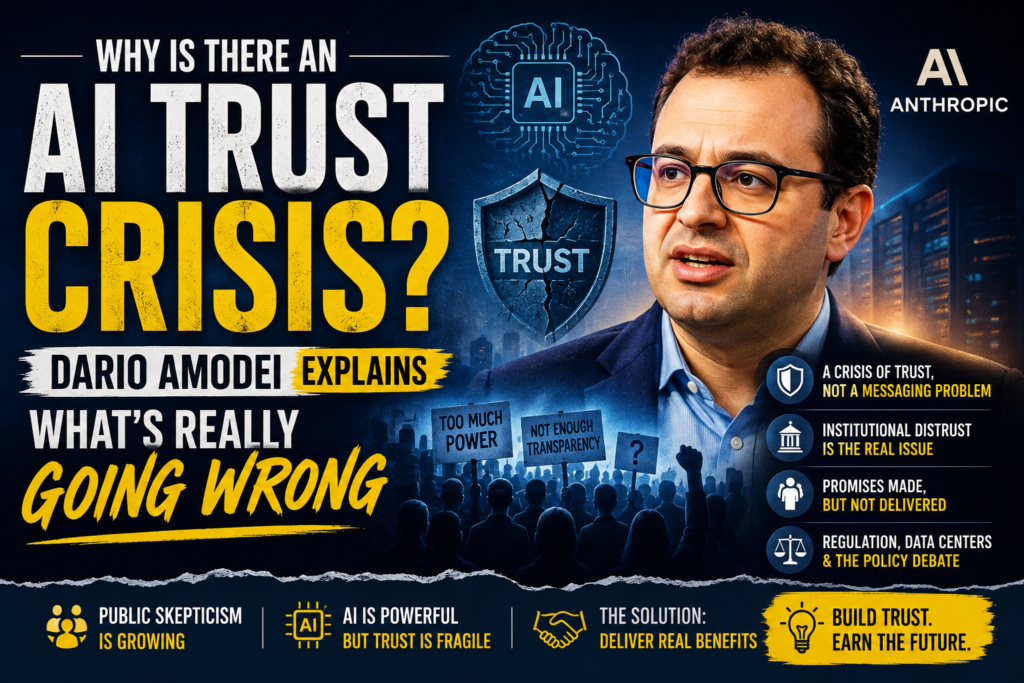
Picture this: a company builds a tool that can write your code, draft your emails, and pass medical licensing exams , yet a large chunk of the public still doesn’t trust it. That’s the exact paradox Anthropic CEO Dario Amodei tackled head-on in mid-August 2026, and his answer boils down to one phrase: this is an AI trust crisis, not a messaging problem. Amodei argues that public skepticism toward artificial intelligence has little to do with executives sounding too pessimistic, and everything to do with decades of people not trusting big institutions , companies, governments, and the tech industry alike , to act in their interest.
If you follow AI news out of Bhubaneswar, Odisha, or anywhere else in India, you’ve probably noticed this tension too: incredible product launches on one hand, and growing public unease on the other. This post breaks down what Amodei actually said, why it matters, and what it means for anyone building a career or business around AI in 2026.
What Sparked the Debate Between Dario Amodei and Gavin Baker?
The direct answer: Investor Gavin Baker publicly argued that Amodei’s repeated warnings about AI risk have fueled the backlash against the industry, particularly opposition to data centers. Amodei responded that this framing gets the cause and effect backwards.
Baker made his case both on the All-In podcast and on X, claiming Amodei has “lost the argument” on AI regulation. Baker’s core complaint was that, given Amodei is about to become CEO of “one of the most important companies in the world,” he should be a more positive advocate for the industry rather than dwelling on danger.
Baker isn’t alone in this view. Several commentators have floated the idea that AI skepticism and government pushback stem simply from people taking AI executives’ dire warnings at face value. It’s a tidy theory: scary talk creates scared voters, scared voters demand crackdowns.
Question: Did Amodei Agree His Messaging Has Been Too Negative?
No. Amodei directly disputed the idea that his messaging has been “disproportionately negative.” He said his public writing has actually been about equally balanced between risks and benefits , pointing out that he’s written one major essay on each side of the ledger. His optimistic essay, “Machines of Loving Grace,” was written specifically because he felt the broader AI industry wasn’t painting an inspiring enough picture of how the technology could improve the world.
This is a useful distinction for anyone trying to understand the AI trust crisis: Amodei isn’t denying the backlash exists. He’s disputing why it exists.
What Does Dario Amodei Mean by “Crisis of Trust”?
A crisis of trust, as Amodei frames it, is a breakdown in public confidence toward powerful institutions , not a reaction to any single company’s marketing choices. Amodei explained that ordinary people don’t trust companies, governments, or the tech industry, and tend to assume these institutions are “cooking up some new way to screw them over.” In his view, the AI backlash is simply the latest chapter in a much older story of institutional distrust, not something he or other AI leaders caused by being too candid about risk.
This reframing matters because it shifts the conversation. Instead of asking “should AI executives talk less about danger?”, Amodei is asking “why don’t people believe institutions when they talk about anything at all?” That’s a much bigger, older problem , one that predates generative AI by decades.
Trust deficit , the gap between what an institution claims about itself and what the public actually believes. In AI, this gap shows up as skepticism toward safety claims, privacy policies, and even genuinely helpful product features, because people have learned to expect a catch.
Is Amodei Just Deflecting Blame From Anthropic?
Direct answer: Not entirely , Amodei explicitly accepted a specific, sharper criticism of his own company. He said the most accurate criticism of AI companies, including Anthropic, is that they haven’t yet delivered on their big promises to benefit the world. He called that “totally on us” and said it’s the criticism people should actually be making, rather than debating messaging and marketing tactics.
He added that Anthropic is “doing our best to fix this” , a fairly candid admission for a CEO to make in a public spat. It suggests Amodei is trying to redirect the conversation away from tone-policing and toward outcomes: what has AI actually delivered for regular people so far, versus what was promised?
This ties into a pattern Kalinga.ai has tracked closely this year , the gap between AI’s technical capability and its real-world, felt benefit for students, freelancers, and small businesses in India, many of whom are still waiting to see AI translate into better jobs or income, not just flashier demos.
How Does This Connect to the Regulation Debate?
Baker’s critique wasn’t just about tone , it was also about policy. Baker accused Amodei of pushing for AI regulation despite regulation supposedly helping only the largest, best-resourced companies (a dynamic often called “regulatory capture”). Anthropic has indeed backed some regulatory measures, including a California bill requiring transparency from large AI companies, signed into law by Governor Newsom in late 2025.
Regulatory capture , a situation where regulations meant to protect the public end up primarily benefiting the largest incumbent companies, because only they have the resources to comply, effectively locking out smaller competitors. It’s a real risk in fast-moving, high-compliance-cost industries like AI, pharmaceuticals, or finance.
Question: Does Amodei Think Regulation Automatically Means Concentration of Power?
No, and he pushed back on this framing specifically. Amodei called Baker’s regulation-versus-widespread-distribution framing a “false choice.” He said there’s a common Silicon Valley shorthand equating regulation with regulatory capture and concentration of power, but he considers this an oversimplified view of the world. He pointed out that many people outside the tech bubble see regulation as something that constrains corporate power and benefits ordinary people , not something that automatically entrenches monopolies.
Amodei added nuance here too: he doesn’t fully agree with the “regulation protects ordinary people” view either. That’s precisely why, he said, Anthropic has tried to write its policy proposals carefully , aiming to slow down frontier AI companies (including itself) while giving smaller competitors more room to operate.
How Does the AI Trust Crisis Show Up in Real Life?
It’s easy to treat this as an abstract argument between a CEO and an investor on X, but the AI trust crisis has very concrete, visible symptoms. Local opposition to data centers has intensified in the US, with communities pushing back over water usage, electricity costs, and noise , long before most residents ever open an AI chatbot. Commencement speakers have reportedly learned to avoid mentioning AI altogether, a small but telling sign of how charged the topic has become in public settings.
None of this is happening in a vacuum. Amodei himself points out that this AI trust crisis is “just the latest iteration” of a much older pattern, one that has been building for decades across institutions far beyond the tech industry. That framing matters, because it means the AI trust crisis won’t be solved by a single company changing its tone, launching a friendlier ad campaign, or hiring a new communications chief.
Question: Why Do People Distrust AI Companies Specifically, Not Just Institutions in General?
AI companies face a compounded version of the general trust deficit because they combine three things people already distrust individually: large corporations, complex technology they can’t fully understand, and rapid, unregulated change. When you stack “big tech company” on top of “opaque algorithm” on top of “moves faster than laws can keep up,” you get a uniquely potent trigger for public suspicion , even before anyone considers what a specific AI company has actually done wrong.
This is worth remembering the next time an AI product launch gets a lukewarm public reception despite genuinely useful features. The skepticism often isn’t really about that specific product at all.
Anthropic’s Own Credibility Test: Watermarks and Safety Claims
Interestingly, this debate about the AI trust crisis broke out during the same week Anthropic made headlines for a different reason: rolling out watermarking on AI-generated text, a move meant to increase transparency about when content comes from an AI model rather than a human. Some users pushed back, unhappy that the watermarks could expose them for using Claude at work or in school , a small but revealing example of how transparency efforts, even well-intentioned ones, can collide with how people actually use AI in their daily lives.
That tension is a microcosm of the larger dynamic Amodei describes. Anthropic tries to build trust through visible safety and transparency measures, yet those same measures can create new friction with users who feel surveilled or penalized rather than protected. There’s no clean solution here , just a reminder that closing a trust gap is slower and messier than opening one, and that even good-faith transparency moves can be read with suspicion when institutional trust is already this low.
Table: Two Views on the AI Backlash
| Angle | Gavin Baker’s View | Dario Amodei’s View |
| Root cause of backlash | Executives’ negative messaging about AI risk | A decades-old, general crisis of trust in institutions |
| Amodei’s messaging | Disproportionately negative, “lost the argument” | Roughly balanced between risk and benefit essays |
| Regulation vs. distribution | Regulation = regulatory capture = power concentration | A “false choice” , oversimplified framing |
| Who’s responsible for fixing it | AI leaders should be more positive publicly | AI companies should actually deliver on their promises |
| Anthropic’s regulatory stance | Self-serving, favors large players | Designed to slow frontier firms, help smaller ones |
What Should You Actually Take Away From This?
If you’re building a career, business, or media platform around AI , as many readers in Odisha and across India are right now , a few practical points stand out from this exchange:
- Public trust in AI is not just a PR problem. It’s tied to broader distrust of powerful institutions, so no amount of positive messaging alone will fix it quickly.
- Delivering visible, tangible benefits matters more than tone. Amodei himself says the strongest criticism of AI companies is under-delivery, not over-warning.
- Regulation debates are more nuanced than “pro-AI vs. anti-AI.” Even AI CEOs disagree sharply on what good regulation looks like and who it actually protects.
- Watch what companies do with their policy proposals, not just what they say about risk. Amodei’s claim that Anthropic designs policy to disadvantage frontier firms (including itself) is a specific, checkable claim worth tracking over time.
- This debate is playing out publicly, in real time, on platforms like X , a reminder that AI industry disagreements are no longer confined to closed-door policy rooms.
Why This Matters for AI Learners and Businesses in India
For students and young professionals following Kalinga.ai’s coverage of the AI industry, this exchange is a useful case study in how AI leadership actually communicates in public , carefully, defensively, and with real policy stakes attached. The AI trust crisis Amodei describes isn’t unique to the US; the same skepticism shows up in India whenever a new AI tool triggers job-loss anxiety or privacy concerns. Understanding why that skepticism exists , institutional distrust built over decades, not just one CEO’s tone , is more useful than picking a side in a Twitter argument.
It’s also a reminder that credibility in AI, much like in journalism or education, is earned through delivered outcomes, not just through carefully worded essays. Anthropic’s own CEO seems to agree.
For freshers evaluating which companies to work with, follow, or build on, this exchange offers a simple filter: look past the messaging and track what an AI company actually ships, discloses, and follows through on over time. Essays and social media threads are useful for understanding how a company thinks, but they’re not a substitute for watching whether promised benefits , safer models, fairer access, real economic upside for workers , actually show up. That’s the standard Amodei set for his own industry, and it’s a fair one to hold every AI company to, whether it’s based in San Francisco or Bhubaneswar.
FAQ: AI Trust Crisis and the Amodei-Baker Exchange
What did Dario Amodei say about the AI backlash? Amodei said the AI backlash is “fundamentally a crisis of trust,” arguing that the public doesn’t trust companies, governments, or the tech industry in general, and that AI skepticism is the latest expression of that older, broader distrust rather than a reaction to his own warnings about AI risk.
Who is Gavin Baker and what did he argue? Gavin Baker is an investor who argued, on the All-In podcast and on X, that Amodei’s warnings about AI danger have helped fuel backlash against the industry, especially opposition to AI data centers, and that Amodei should be a more positive advocate for AI given his position as an incoming CEO.
Did Amodei admit his messaging was too negative? No. Amodei explicitly disagreed, saying his messaging has been roughly balanced between AI risks and benefits, citing one major essay dedicated to each side, including his optimistic essay “Machines of Loving Grace.”
What criticism of Anthropic did Amodei accept? Amodei accepted that the most accurate criticism of AI companies, including Anthropic, is that they haven’t yet delivered on their big promises to benefit the world , and said Anthropic is working to fix this.
Does Amodei support AI regulation, and why is that controversial? Anthropic has backed some regulation, including a California transparency law for large AI companies. Baker’s camp views this as self-serving because heavy regulation can favor large, well-resourced firms. Amodei disputes that regulation automatically concentrates power, calling that framing an oversimplification, and says Anthropic tries to design policy proposals that disadvantage frontier companies while helping smaller competitors.
Is the AI trust crisis unique to the United States? Amodei frames it as part of a decades-long, general decline in institutional trust rather than a US-specific or AI-specific phenomenon, though the AI backlash is its most recent, visible expression, particularly around AI data centers and corporate promises.
How does opposition to AI data centers relate to the AI trust crisis? Public pushback against AI data centers , over issues like electricity use, water consumption, and local costs , is one of the most visible signs of the broader AI trust crisis, since it reflects communities questioning whether AI’s promised benefits will actually reach them versus mainly benefiting distant corporations.
What can AI companies actually do to close the trust gap, according to Amodei? Amodei’s own answer is less about messaging and more about delivery: he says the accurate criticism of AI companies is that they haven’t yet delivered on their big promises to benefit the world, and that fixing the AI trust crisis depends on actually doing so, not on adjusting public communications.
Curious how AI regulation, trust, and industry shifts are shaping careers and business opportunities in India? Explore more AI policy and industry breakdowns on Kalinga.ai, or check out our upcoming LLM Engineering workshops for hands-on skills that go beyond the headlines.