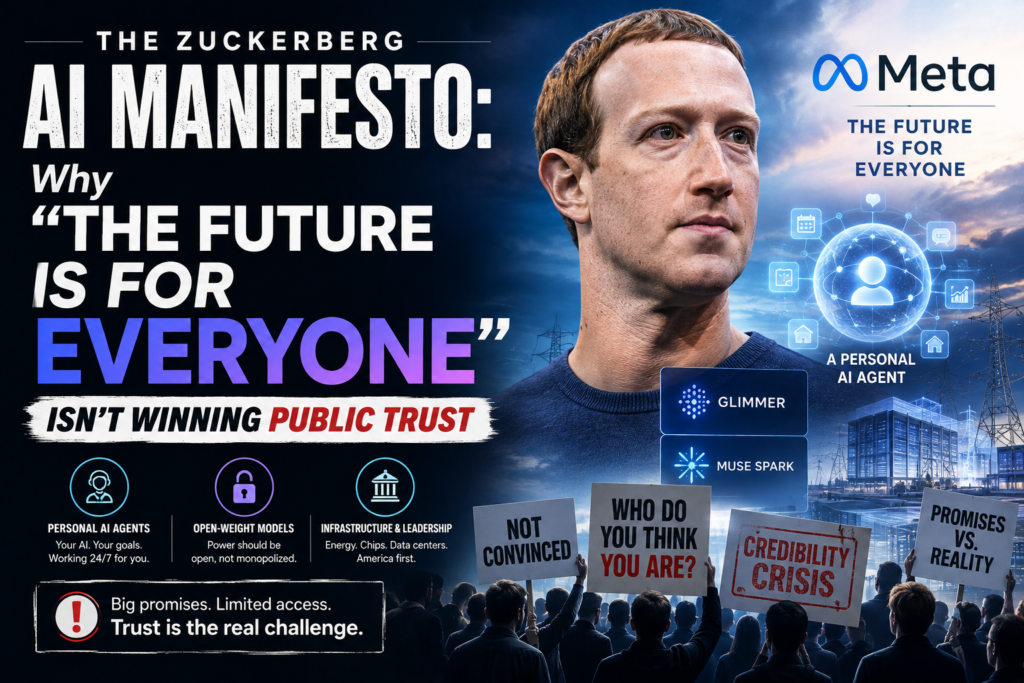
Mark Zuckerberg wants you to believe that a personal AI agent, working for you 24 hours a day, is the next great leap in human freedom. On August 10, 2026, the Meta CEO published a 6,500-word essay titled “The Future Is for Everyone: The Path to a Positive AI Future,” and within days it had become one of the most criticized pieces of writing in the AI industry’s short history. The core problem is not the technology Zuckerberg describes , it’s that almost nobody outside Meta seems to believe Meta is the company that should be building it.
This article unpacks the Zuckerberg AI manifesto, the specific promises it makes, why technology journalists and the public reacted so negatively, and how the response fits into a larger, industry-wide credibility problem that even AI leaders who are far more cautious than Zuckerberg , including Anthropic CEO Dario Amodei , are now being forced to address directly. Along the way, we’ll look at what Meta is actually shipping (the Glimmer and Muse Spark models), how that compares with the rhetoric, and what the backlash tells content strategists, marketers, and business leaders about communicating AI plans to a skeptical public.
Background: What Is the Zuckerberg AI Manifesto?
Definition and Context
The Zuckerberg AI manifesto refers to “The Future Is for Everyone,” a lengthy public essay Zuckerberg published via Meta’s corporate blog and social channels in mid-August 2026. It is the second in a loose annual series , a follow-up to a similar “Personal Superintelligence” letter from the prior year , and it lays out Zuckerberg’s philosophy for how advanced AI should be built, distributed, and governed. <cite index=”6-1″>In the letter, Zuckerberg argues that broadly distributing superintelligent AI represents both an economic opportunity and a safeguard against concentrating too much power in the hands of governments, businesses, and other institutions.</cite> <cite index=”6-1″>He frames his philosophy around individual empowerment as the source of prosperity, invention as the primary purpose of superintelligence, and balance of power as the foundation of safety.</cite>
Central to the pitch is the idea of a personal agent , an AI system tied to an individual rather than to an employer, government, or platform. <cite index=”3-1″>Zuckerberg writes that in this future, everyone will have an exceptionally capable personal agent that understands the user, their goals, and everything they care about, and that this agent will work around the clock to improve relationships, health, career, finances, home management, and hobbies.</cite>
Question → Direct Answer: What does Zuckerberg actually propose?
Q: What is Zuckerberg proposing, in concrete terms? A: Three things: (1) free or low-cost access to a personal AI agent for every Meta user, running on models like Meta’s new Glimmer system; (2) continued investment in open-weight models, which Zuckerberg frames as a check against a handful of labs monopolizing advanced AI; and (3) heavier government-industry cooperation on infrastructure , energy, data centers, and chips , to keep the U.S. ahead of China in frontier AI development.
<cite index=”9-1″>Zuckerberg’s argument is that advanced AI should not be concentrated in the hands of a few governments, corporations, or technology laboratories, and that its benefits should instead be distributed widely through free or affordable products, open-weight models, and personal assistants designed to expand individual freedom and economic opportunity.</cite> On the infrastructure side, he calls on the U.S. to accelerate its ability to build energy, data-center, and silicon capacity , a call that lands awkwardly given growing local opposition to new AI infrastructure projects across the country.
The Product Behind the Pitch: Glimmer, Muse Spark, and the Access Gap
A manifesto is only as credible as the product that backs it, and this is where the Zuckerberg AI manifesto runs into its first concrete problem. According to TechCrunch’s Equity podcast discussion of the essay, Meta’s actual personal-AI stack right now consists of two tiers. Glimmer is pitched as the everyday, always-on assistant , capable of managing a user’s schedule, drafting messages, and organizing files, reportedly able to operate with or without an internet connection. Sitting above it is Muse Spark, a more capable model that keeps a revenue channel open for Meta by serving people and companies who want to scale compute for larger projects.
The gap between the rhetoric and the rollout is immediate. As TechCrunch’s Rebecca Bellan put it during the discussion, the promise a year earlier was that this kind of personal AI would live primarily on Meta’s wearables and glasses, but “it’s not really clear what the final hardware form factor for this would be” this time around, and Zuckerberg appears to be leaving the choice of device up to the user. More tellingly, Bellan noted that when she tried to actually download Muse Glimmer onto a MacBook, she could not , the product requires specific hardware that isn’t broadly available, meaning the “for everyone” framing doesn’t yet match what a typical person can access. Fellow panelist Kirsten Korosec summarized the gap bluntly: “It’s not for everyone. Not yet.”
Question → Direct Answer: Is Meta a frontier AI lab?
Q: Does Meta compete with OpenAI and Anthropic at the frontier of AI capability? A: Not by reputation, even though it spends like one. As TechCrunch’s Anthony Ha observed on the same podcast, Meta has made “very serious investments in AI” , including widely reported efforts to pay enormous sums to recruit AI scientists , but “in terms of who we think of as the leading companies, the frontier labs, Meta doesn’t tend to come up in the conversation.” Nor does it come up as a leading consumer AI brand: people interact with Meta AI inside Instagram and Facebook, but Meta is not the company most people think of when they reach for a personal assistant.
Why the Manifesto Backfired: The Messenger Problem
The single most consistent thread across coverage of the Zuckerberg AI manifesto is that critics are not primarily objecting to the technology being described , they are objecting to the company describing it. TechCrunch AI editor Russell Brandom captured this directly in a column the manifesto’s own defenders can’t easily rebut: he wrote that the essay is “exactly why people don’t like AI.”
The argument, laid out by Bellan on Equity, traces back to Meta’s own history with a strikingly similar pitch. “You look back to the social media days, [Zuckerberg] was saying that he wants to make sure that everyone has an outlet for talking to their friends and having a social network,” Bellan said. “And what do we have instead? We have ragebaiting and advertisements, and not connection.” In other words, Zuckerberg is asking the public to trust a second grand promise from the same company whose first grand promise , connecting the world , is widely understood to have produced an attention-and-advertising economy instead.
That skepticism has concrete recent fuel. Meta’s consumer AI chatbot products have already drawn sustained scrutiny: leaked internal guidelines reported in mid-2025 showed <cite index=”4-1″>the company’s chatbots were permitted to engage in romantic-style conversations, a detail Bellan referenced on the podcast when describing Meta’s consumer AI track record as including “a lot of creepy-ass chatbots.”</cite> When a company’s most visible recent AI product history includes safety controversies, a sweeping essay about personal empowerment through AI has a much higher credibility bar to clear , and reviewers broadly agree it didn’t clear it.
Bold finding: Across nearly every major outlet that covered the manifesto , TechCrunch, The Verge, TechRadar, Futurism, Axios, and Fox Business among them , the coverage converges on the same verdict: the ideas in the essay (individual empowerment, distributed AI, open models as a check on concentrated power) are debatable but not inherently unreasonable; it is Meta’s credibility as the messenger that critics find hard to accept.
Table: How Reviewers Characterized the Manifesto
| Outlet / Voice | Core Criticism |
| TechCrunch (Russell Brandom) | The essay is “exactly why people don’t like AI” , Meta’s past promises of connection produced ragebait and ads instead |
| TechCrunch (Rebecca Bellan, Equity podcast) | Zuckerberg is positioning himself as an “anti-Dario,” but the pitch is undercut by limited hardware access and Meta AI’s chatbot controversies |
| TechRadar | The essay “reads like a desperate plea,” offering unlimited happiness while sidestepping AI’s real costs to jobs, communities, and ecosystems |
| Futurism | Calls the vision hypocritical given that Meta itself has pushed AI adoption onto employees amid layoffs and workplace morale problems |
| Axios | Frames the letter as Zuckerberg’s “clearest effort yet” to stake a policy position, while noting it arrives amid growing local backlash to AI data centers |
| AI Weekly / industry newsletters | Notes the essay is light on specifics , it doesn’t explain what “free or affordable” will actually cost or which future models stay open versus closed |
The Abstraction Problem: Two Kinds of Promises, One Kind of Skepticism
A recurring theme in the Equity podcast breakdown is that the manifesto mixes two very different types of claims, and they land with the public in very different ways. Roughly half of the essay, Ha argued, is composed of sweeping, abstract claims about unleashing “creativity and invention” , the kind of language that, precisely because it is so abstract, fails to move a skeptical reader. “If you’re skeptical about AI, none of that is going to convince you, because it seems unreal,” Ha said.
The other half is more concrete: specific descriptions of personal coaches, always-on assistants, and agents that manage schedules and relationships. Ha’s read is that this concrete material generates a mixed reaction , some elements genuinely appeal to readers, but a substantial portion do not, because they describe AI performing functions , like maintaining relationships or coaching personal growth , that many people instinctively feel should remain human.
This pattern is not unique to Zuckerberg. Ha pointed to a near-identical public reaction to comments from OpenAI CEO Sam Altman about using ChatGPT to generate podcast-style content about a child’s interests for parents to play during a school commute , a proposal that produced a viral wave of responses along the lines of “why don’t you just talk to your kid?” The pattern suggests a broader rule: the more specifically an AI company describes automating an intimate human function, the more resistance the pitch generates , regardless of which company is making the pitch.
Question → Direct Answer: Is this a Meta-specific problem or an industry-wide one?
Q: Is public skepticism toward AI manifestos limited to Zuckerberg, or is it bigger than Meta? A: It’s bigger than Meta, but Meta is experiencing an especially acute version of it. The same week the Zuckerberg letter drew criticism, Anthropic CEO Dario Amodei , often characterized as the industry’s most safety-focused major-lab leader , found himself defending his own AI messaging after investor Gavin Baker argued that Amodei’s risk warnings were themselves fueling public backlash against AI and data centers. <cite index=”12-1″>Amodei rejected that framing, arguing instead that the AI backlash reflects a deeper “crisis of trust” that has been building for decades, telling critics that ordinary people don’t trust companies, governments, or the tech industry and always suspect an ulterior motive.</cite> That two CEOs with almost opposite public postures , Zuckerberg’s boosterism versus Amodei’s caution , are each fighting distrust from different directions suggests the AI industry’s credibility problem sits above any single company’s messaging strategy.
Zuckerberg vs. Amodei: Two Theories of How AI Companies Earn Trust
TechCrunch’s Bellan described Zuckerberg’s posture in the manifesto as trying to position himself as “almost like an anti-Dario.” Where frontier labs including Anthropic have spent 2026 talking publicly about pacing development, focusing on safety, and , in Amodei’s case , <cite index=”15-1″>publishing an essay (“Policy on the AI Exponential”) that identifies cybersecurity threats, biological weapons development, loss of human control over AI systems, and fully automated research and development as specific risk categories warranting serious concern</cite>, Zuckerberg’s manifesto takes the opposite rhetorical stance: that slowing down would primarily hurt the individuals AI is supposed to empower, and that ceding ground , especially to China , is the greater danger.
<cite index=”17-1″>Amodei’s own position has shifted over time: his 2024 essay “Machines of Loving Grace” argued powerful AI could dramatically accelerate progress on diseases like cancer, while his more recent “Policy on the AI Exponential” calls for binding frontier AI regulation modeled on agencies such as the Federal Aviation Administration, including mandatory third-party testing.</cite> That evolution , from optimistic essay to a call for external oversight , is precisely the kind of self-correction that reviewers say Zuckerberg’s manifesto lacks: a specific, falsifiable account of what could go wrong and what Meta will do to prevent it, beyond generalized appeals to individual empowerment.
Table: Contrasting Public AI Postures, August 2026
| Dimension | Zuckerberg / Meta (“The Future Is for Everyone”) | Amodei / Anthropic (“Policy on the AI Exponential” and related remarks) |
| Core framing | AI as individual empowerment; concentration of power is the primary risk | AI carries specific, named risks (cyber, bio, loss of control, automated R&D) alongside benefits |
| Stance on pace | Explicitly against slowing down; frames caution as a disadvantage versus China | Has called for policies that deliberately slow down frontier labs while protecting smaller competitors |
| Regulatory posture | Calls for faster infrastructure buildout with government cooperation | Has backed binding, FAA-style third-party testing requirements |
| Public reception | Widely criticized as abstract, self-serving, and undercut by Meta’s product history | Criticized from the opposite direction , accused by some investors of fueling backlash through risk-focused messaging |
| Underlying diagnosis of backlash | Doesn’t directly address why people distrust AI companies | Explicitly diagnosed the backlash as a “crisis of trust” built over decades, not a messaging failure |
Implications: What This Means for AI Communication and Public Trust
Zuckerberg’s manifesto and the reaction to it, read alongside Amodei’s simultaneous defense of his own messaging, point to a conclusion that matters well beyond Meta: public trust in AI companies is now largely inelastic to the tone of any single company’s messaging. A more optimistic pitch (Zuckerberg’s) and a more risk-forward pitch (Amodei’s) are both running into skepticism, which suggests the deficit isn’t really about how AI leaders talk about the technology , it’s about a track record gap between promises and delivered outcomes across the industry as a whole.
For Meta specifically, several implications stand out:
- Track record now functions as a tax on new promises. Because Zuckerberg previously promised that social media would strengthen connection and instead oversaw products widely associated with engagement-driven outrage and advertising, a second sweeping promise about AI-driven empowerment starts from a credibility deficit rather than a neutral baseline.
- Product access lags the rhetoric. The manifesto describes a universal personal agent, but reviewers on the ground found the flagship Glimmer product tied to specific hardware not broadly available to ordinary consumers , undermining the “for everyone” framing at launch.
- Concrete claims about intimate human functions draw the sharpest backlash. Abstract promises about creativity and invention are largely ignored by skeptics; specific claims about AI managing relationships, coaching, or parenting-adjacent tasks generate the most visible public pushback, as seen in both the Zuckerberg reaction and the earlier Altman parenting-podcast controversy.
- Industry-wide trust problems can’t be solved by one company’s tone. Whether a CEO leans optimistic (Zuckerberg) or risk-forward (Amodei), each is fighting a version of the same skepticism , suggesting the fix lies in delivered outcomes, not messaging calibration.
- Timing amplified the scrutiny. The manifesto landed the same month as reporting on Meta’s chatbot safety controversies and amid a forthcoming film about Zuckerberg and Facebook’s early history, both of which TechCrunch’s panel noted are likely to keep reputational questions in the news cycle.
Key Takeaways
- Zuckerberg’s 6,500-word “The Future Is for Everyone” essay pitches a personal superintelligence vision built on free/affordable AI agents, continued open-weight model releases, and faster AI infrastructure buildout.
- Meta’s actual product lineup , Glimmer for everyday tasks, Muse Spark for heavier compute , currently requires specific hardware that limits real-world access, undercutting the “for everyone” claim.
- Critics, including TechCrunch’s own AI editor, argue the backlash is driven less by the ideas in the manifesto than by Meta’s history of promising connection and delivering an ad-and-engagement-driven ecosystem instead.
- The most concrete, human-relationship-adjacent claims in the essay (AI as friend, coach, or relationship manager) generate more resistance than the abstract claims about creativity and invention.
- Anthropic CEO Dario Amodei’s parallel public defense of his own AI messaging , which he frames as a “crisis of trust” rather than a tone problem , suggests the credibility gap facing AI companies extends well beyond Meta or any single communication strategy.
- For businesses and communicators watching this space, the lesson is that AI messaging is now evaluated primarily against delivered track record, not rhetorical framing.
Limitations and Open Questions
Several aspects of this story remain unresolved as of publication. Meta has not published detailed technical specifications clarifying exactly which future models will remain open-weight versus closed, nor has it detailed the actual pricing structure behind its “free or affordable” pledge , a gap flagged by industry newsletters covering the essay. It is also not yet clear what hardware Meta ultimately intends as the primary form factor for personal agents, given that the prior year’s manifesto pointed toward wearables and glasses while this year’s essay leaves the choice more open-ended. Finally, because both Zuckerberg’s optimistic framing and Amodei’s risk-focused framing are drawing criticism simultaneously, it remains genuinely contested , and likely to stay contested , whether any messaging approach can meaningfully shift public sentiment absent a longer track record of delivered products.
A note on sourcing: This analysis draws on Meta’s own published essay, direct commentary from TechCrunch journalists Anthony Ha, Rebecca Bellan, and Kirsten Korosec on the outlet’s Equity podcast, TechCrunch AI editor Russell Brandom’s published critique, and independent coverage from Axios, TechRadar, Futurism, Fox Business, and reporting on Dario Amodei’s public remarks from TechCrunch, Fortune, and other outlets , reflecting a range of editorial perspectives on the same underlying events.
FAQ
What is Mark Zuckerberg’s AI manifesto called? It is titled “The Future Is for Everyone: The Path to a Positive AI Future,” published in mid-August 2026 as a roughly 6,500-word essay on Meta’s corporate blog.
What is “personal superintelligence”? It’s Zuckerberg’s term for an AI system tied to an individual user rather than an institution , an agent meant to understand a person’s goals and work continuously on tasks ranging from scheduling to health, finances, and relationships.
What products is Meta actually shipping to support this vision? Two tiers: Glimmer, an everyday assistant for tasks like scheduling and file organization, and Muse Spark, a more powerful model aimed at heavier compute needs for individuals and businesses. Access to Glimmer currently depends on specific hardware not broadly available.
Why did people react negatively to the manifesto? Reviewers point to Meta’s history of promising social connection and instead producing an advertising- and engagement-driven ecosystem, combined with recent controversies over Meta’s AI chatbot behavior, as reasons the public is skeptical of a new sweeping promise from the same company.
How does Zuckerberg’s approach differ from Anthropic’s Dario Amodei? Zuckerberg argues against slowing AI development and frames concentrated power as the primary risk; Amodei has called for binding, FAA-style regulation of frontier AI and names specific risk categories (cybersecurity, biological weapons, loss of control, automated research) as serious concerns. Both are nonetheless facing public skepticism, from different directions.
Is Meta considered a frontier AI lab like OpenAI or Anthropic? Not by common industry framing. Despite large investments in AI talent and infrastructure, Meta is not typically named among the leading frontier labs, nor is Meta AI seen as a primary destination for personal AI assistant use compared to competitors.
Does the manifesto address AI’s risks to jobs or infrastructure backlash? It acknowledges the need for infrastructure investment and calls for government cooperation on energy and data centers, but critics say it does not substantively address community opposition to AI infrastructure or labor-market disruption in the detailed way seen in some competitors’ policy essays.
Conclusion
The response to Mark Zuckerberg’s AI manifesto shows that in 2026, an AI company’s public vision is judged less on the coherence of its ideas than on the credibility of the company delivering them. Zuckerberg’s promise of individual empowerment through personal AI agents is colliding with Meta’s own history and a broader, industry-wide crisis of trust that even more cautious voices like Dario Amodei are struggling to defuse , meaning the “future for everyone” Zuckerberg describes will likely be judged by what Meta actually ships, not by how persuasively it is written.