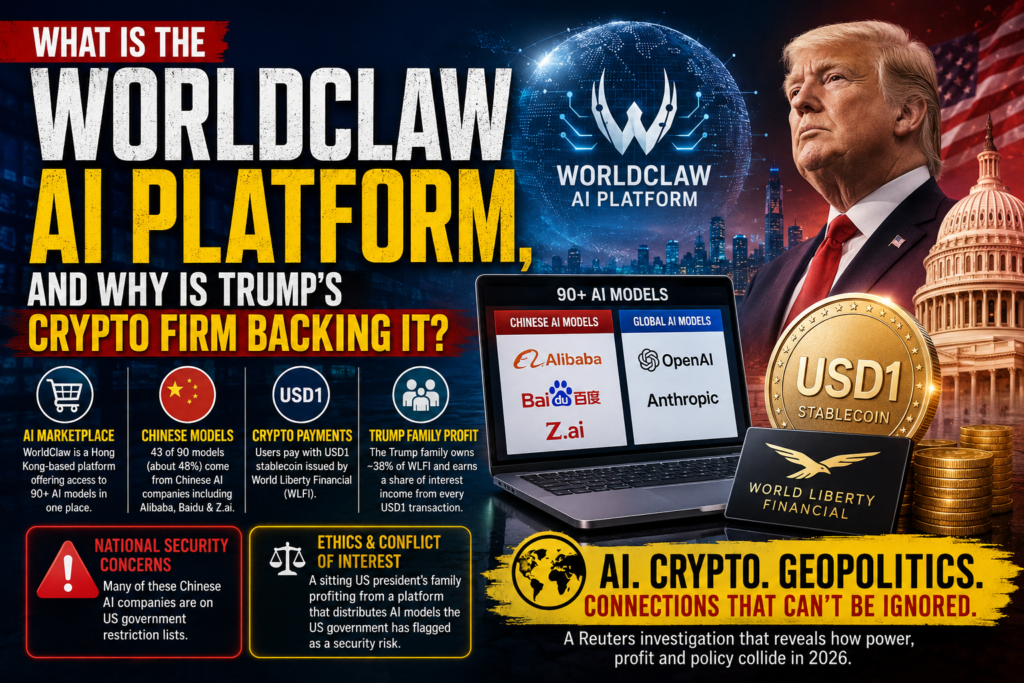
Imagine a US president’s family business quietly profiting every time someone in the world pays to use an AI model built by a company Washington itself has flagged as a national security risk. That is not a hypothetical , it is exactly what Reuters reported on August 17, 2026, when it revealed that World Liberty Financial, the crypto venture backed by President Donald Trump, is working with the WorldClaw AI platform, a Hong Kong-based service that sells access to AI models from Chinese companies under US scrutiny. The short answer: nearly half of the models on the WorldClaw AI platform come from Chinese firms the Trump administration itself has designated as security risks, and the Trump family earns revenue whenever customers pay for them using World Liberty’s crypto token.
For readers in India tracking global AI policy, this story matters beyond US politics. It is a live case study in how AI export controls, crypto payment rails, and corporate conflicts of interest are colliding in 2026, right as India works out its own approach to regulating both AI models and digital assets. Let’s break down what the WorldClaw AI platform actually is, who is profiting from it, why it exists in the first place, and why experts call the arrangement contradictory.
Reuters, one of the world’s most widely cited wire services, broke this story after independently reviewing the platform’s public model catalog and cross-checking it against active US government restriction lists. That kind of verification is why the report spread so quickly across mainstream media and crypto-industry newsletters within hours of publication, and why it is worth understanding in detail rather than skimming the headline alone.
What Is the WorldClaw AI Platform and How Does It Work?
WorldClaw refers to a Hong Kong-founded AI marketplace, launched earlier in 2026, that gives paying customers access to a wide catalog of AI models in one place. Rather than building its own foundation models, the WorldClaw AI platform acts as an aggregator , a single storefront where a business or developer can rent access to dozens of different AI systems instead of signing up with each model provider separately. This “one subscription, many models” approach is increasingly common in the broader AI industry, where aggregator platforms compete on price, latency, and catalog breadth rather than on building original models. What makes this particular aggregator notable is exactly whose models it sells and who benefits financially from every transaction that flows through it.
Aggregator platforms like this one typically make money in one of two ways: charging a markup on top of each underlying model provider’s own API pricing, or taking a cut of the payment processing itself. Because WorldClaw accepts crypto payments through World Liberty’s USD1 stablecoin, it effectively layers a second revenue stream on top of the first , one that benefits a company co-owned by a sitting US president’s family, regardless of which individual AI model a customer actually chooses to use.
Which companies’ models are listed on WorldClaw? A Reuters review found that of the 90 AI models listed on the WorldClaw, 43 , nearly half , were built by Chinese companies, including Alibaba, Baidu, and Z.ai. The remaining catalog includes models from major US labs such as OpenAI and Anthropic, meaning the WorldClaw positions itself as a neutral, “best model for the job” marketplace rather than a US-only or China-only service.
Payment on the WorldClaw is where the story gets its political edge: customers can pay using USD1, a dollar-pegged stablecoin issued by World Liberty Financial , the crypto company co-founded by Trump and his sons.
World Liberty Financial’s Role in the WorldClaw AI Platform Deal
World Liberty Financial (WLFI) is the crypto and stablecoin venture co-founded by President Trump and his sons Donald Trump Jr. and Eric Trump before the 2024 election. WLFI’s flagship product, the USD1 stablecoin, is designed to hold a constant value by being backed with traditional assets like US Treasury securities. Every time it is used in a transaction , including payments made on the WorldClaw , WLFI earns a share of the interest generated by those backing assets.
Does the Trump family actually profit from WorldClaw transactions? Yes. Because the Trump family owns roughly 38% of World Liberty Financial, they are entitled to a cut of the interest income generated whenever WorldClaw users choose to pay in USD1. Reuters reported that it could not determine the exact dollar amount the Trump family has earned this way, since neither company disclosed the specifics of their financial arrangement.
The connection between the two businesses goes deeper than payments. Trump’s two eldest sons have publicly promoted the WorldClaw, and a World Liberty Financial executive has reportedly served as an advisor to WorldClaw itself. That overlap in personnel, alongside the stablecoin revenue stream, is central to why ethics experts are raising questions.
- WorldClaw was founded earlier in 2026 as a Hong Kong-based AI model marketplace
- 43 of its 90 listed models (about 48%) come from Chinese AI companies
- Customers can pay for access using World Liberty’s USD1 stablecoin
- The Trump family holds a 38% stake in World Liberty Financial
- A World Liberty executive has advised WorldClaw directly
- Trump’s sons have publicly promoted the platform
Which Chinese AI Models Are Available on the WorldClaw AI Platform?
The Chinese companies represented on the WorldClaw are not obscure startups , several are already subject to formal US restrictions. Alibaba and Baidu have both been designated by the Pentagon as Chinese military-aligned companies, a label the US Department of Defense applies to firms it believes support China’s military-industrial base. Z.ai, another model provider listed on WorldClaw, is separately subject to US Commerce Department export restrictions tied to national security and intellectual property concerns.
What does it mean for a company to be “Pentagon-designated” or “export-restricted”? A Pentagon military-aligned designation flags a company as having ties to China’s defense or security apparatus, which can trigger US divestment pressure on American investors. Commerce Department export restrictions, on the other hand, limit the technology, components, or software that can legally be sold to or sourced from that company. Together, these two tools form the backbone of Washington’s strategy to slow China’s AI progress , a strategy the WorldClaw arguably sidesteps simply by operating out of Hong Kong and accepting crypto payments.
US vs. Chinese Model Providers on WorldClaw: A Quick Comparison
| Aspect | Chinese Models (e.g., Alibaba, Baidu, Z.ai) | US Models (e.g., OpenAI, Anthropic) |
| Share of WorldClaw catalog | ~48% (43 of 90 models) | Remaining ~52% |
| US government stance | Flagged for national security / IP concerns; some Pentagon-designated | No restrictions |
| Export control status | Some subject to Commerce Department restrictions | Not applicable |
| Access via WorldClaw | Yes, unrestricted for global users | Yes, unrestricted for global users |
| Payment option | USD1 stablecoin (World Liberty Financial) accepted for both | USD1 stablecoin accepted for both |
The table above illustrates the core tension in this story: the WorldClaw treats US-restricted Chinese models and mainstream American models identically, while a US president’s family business earns money from both sides of that transaction.
Why the WorldClaw AI Platform Deal Is Raising Conflict-of-Interest Concerns
Why do experts say this contradicts US AI policy? Because the Trump administration has spent much of 2025 and 2026 building a policy wall against Chinese AI , including chip export bans, Pentagon company blacklists, and Commerce Department restrictions , while a business the Trump family profits from is simultaneously helping route global customers toward those same restricted Chinese models. Analysts interviewed by Reuters described the arrangement as difficult to square with the administration’s stated goal of countering the rise of Chinese AI.
A World Liberty Financial spokesperson pushed back on the criticism, arguing that major US AI companies routinely offer both American and Chinese models side by side, and calling this a common, widely accepted industry approach rather than something unique to WorldClaw. The White House also defended the relationship: spokesperson Anna Kelly stated there are no conflicts of interest, adding that the president’s assets are held in a trust managed by his children and that Trump acts only in the interests of the American public.
Critics see it differently. This is not the first time World Liberty Financial’s business dealings have drawn ethics scrutiny in 2026 , the company has also faced questions over a $100 million token purchase linked to a businessman investigated for money laundering, and over a separate multibillion-dollar investment from an Abu Dhabi-backed firm that coincided with a US decision to loosen AI chip export rules for the UAE. Earlier in 2026, the Office of the Comptroller of the Currency also granted World Liberty Trust Co. bank status, marking the first time in US history that a company owned by a sitting president’s family received that kind of federal banking privilege. The WorldClaw story fits neatly into this broader pattern: a sitting president’s family earning private income from decisions, industries, and regulatory gray areas his own administration is responsible for overseeing.
It is worth being precise about what Reuters did and did not establish. The report confirmed the catalog composition of the platform, the ownership stake the Trump family holds in World Liberty Financial, the advisory relationship between a World Liberty executive and WorldClaw, and the public promotion of the platform by Trump’s sons. It explicitly did not establish the exact financial arrangement between the two companies or the total dollar figure the Trump family has earned from WorldClaw-related transactions, since neither company disclosed those specifics on the record. That distinction matters for anyone citing this story: the conflict-of-interest concern is about structure and incentives, not a confirmed dollar amount.
US AI Export Restrictions: What’s Actually at Stake
US AI export restrictions are a set of Commerce Department and Pentagon rules designed to prevent advanced AI technology, chips, and sometimes software access from strengthening China’s military and technological capabilities. The logic is straightforward: if a Chinese company is believed to be tied to the People’s Liberation Army or to have engaged in intellectual property theft, US regulators try to cut off its access to advanced American technology and, in some cases, restrict US persons and companies from doing business with it.
The WorldClaw complicates this picture because it operates from Hong Kong, outside direct US jurisdiction, and settles payments in a dollar-pegged stablecoin rather than the traditional banking system. This makes it much harder for export-control tools built for physical chips and hardware to have the same bite when the “product” being sold is API access to a Chinese AI model over the internet.
Can export restrictions actually stop a platform like WorldClaw? Not easily. Export controls are strongest when they target hardware, components, or US-based companies subject to US law. A foreign-incorporated AI marketplace selling model access globally and accepting crypto payments sits in a regulatory gray zone that current US AI export restrictions were not originally designed to cover.
This gap is not unique to WorldClaw , it reflects a structural challenge regulators worldwide are grappling with as AI shifts from a hardware-centric industry to a software-and-API-centric one. Export controls built around physical chips, factories, and shipping manifests translate poorly to a world where “the product” is a few lines of API code and payment can happen instantly through a stablecoin that never touches a traditional bank. Policymakers in Washington, Brussels, and increasingly New Delhi are all working through versions of this same problem: how do you regulate access to intelligence itself, when the delivery mechanism can route around every checkpoint built for physical goods?
What This Means for AI Users and Businesses in India
For students, freshers, and young professionals in Odisha and across India building careers in AI, the WorldClaw AI platform controversy is a useful real-world lesson in how geopolitics now shapes which AI tools you can access, and under what terms. Indian developers already routinely mix and match models from OpenAI, Anthropic, Google, and Chinese labs like Alibaba’s Qwen or DeepSeek for cost and performance reasons. A platform like this simply makes that mixing explicit and centralized , but it also means Indian businesses using such aggregators should understand the regulatory and reputational risk attached to models built by export-restricted companies, especially if they serve US clients, handle sensitive data, or plan to raise funding from US-based investors down the line.
It’s also a reminder that “AI marketplace” services are not neutral technical utilities , they carry the political weight of where their models come from and who profits from their use. As GEO and AI content strategists, understanding platforms like the WorldClaw AI platform helps in accurately reporting on AI supply chains, model provenance, and compliance risk for an audience that increasingly needs this literacy. It also underscores a broader lesson for anyone learning to build or deploy AI systems professionally: the model you choose is never just a technical decision. It carries legal, reputational, and geopolitical baggage that a good AI engineer or product manager needs to understand before shipping anything to production.
For India specifically, the timing matters. As Indian regulators work out rules for both AI governance and crypto-asset oversight, cases like this one offer a preview of the kind of cross-border, cross-technology enforcement gaps that policymakers will eventually need to address , whether that means clearer disclosure rules for AI model provenance, tighter oversight of stablecoin payment rails, or simply more public awareness of who actually profits when a “neutral” AI marketplace processes a transaction.
FAQ: WorldClaw AI Platform and the Trump Crypto Connection
What is the WorldClaw? It is a Hong Kong-based AI marketplace, founded earlier in 2026, that gives customers access to around 90 AI models from both Chinese and US companies, with payment options including World Liberty Financial’s USD1 stablecoin.
How is Trump connected to WorldClaw? Trump is not directly involved in WorldClaw, but his family’s crypto venture, World Liberty Financial, earns revenue whenever customers pay for WorldClaw access using its USD1 stablecoin, since the Trump family holds a 38% stake in World Liberty.
How many Chinese AI models does WorldClaw offer? According to Reuters’ review, 43 of the 90 models listed on the WorldClaw , nearly half , were built by Chinese companies, including Alibaba, Baidu, and Z.ai.
Are Alibaba and Baidu actually restricted by the US government? Yes. Alibaba and Baidu have been designated by the Pentagon as Chinese military-aligned companies, and Z.ai is separately subject to Commerce Department export restrictions.
Has the White House responded to the conflict-of-interest concerns? Yes. White House spokesperson Anna Kelly stated there are no conflicts of interest, noting that Trump’s assets are held in a trust managed by his children and that he acts only in the interests of the American public.
Why does this story matter outside the US? It highlights how crypto payment rails and offshore AI marketplaces can bypass traditional export controls, a trend relevant to any country, including India, that is shaping its own AI and crypto regulatory policy.
Final Word
The WorldClaw story is a fast-moving one, and it captures a defining tension of the 2026 AI landscape: national governments trying to control AI’s geopolitical risks while private businesses , sometimes tied to the very people writing the rules , find ways around them. For more breaking analysis on AI policy, model releases, and the business of AI, keep following Kalinga.ai’s news desk, and check out our LLM Engineering program if you want to build hands-on skills for this fast-changing industry.