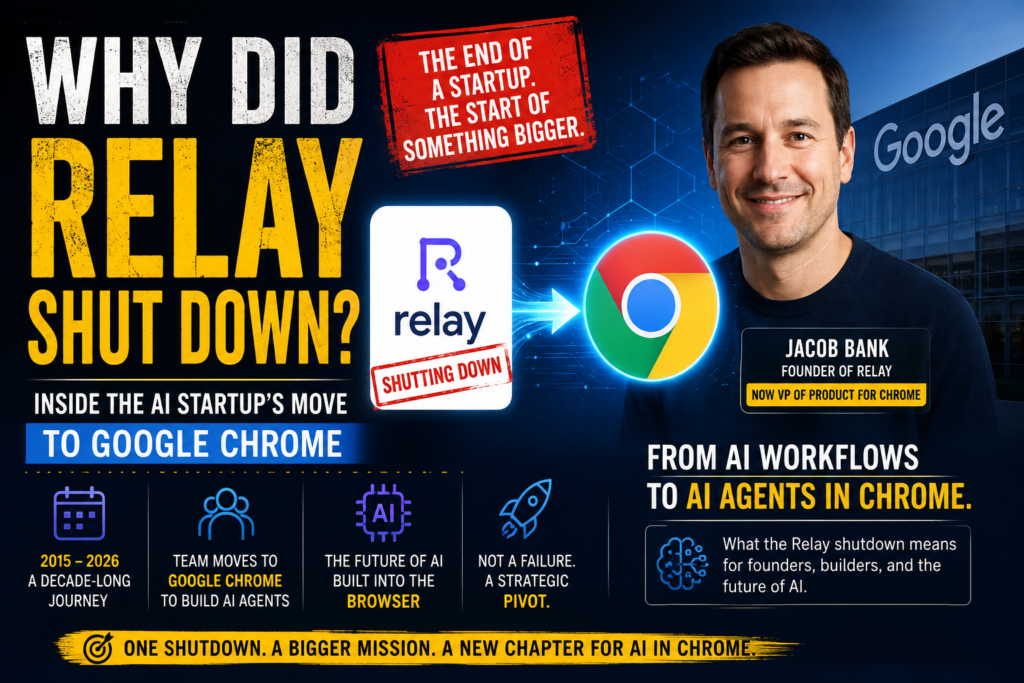
Imagine spending five years building a startup, raising serious venture backing, and positioning yourself as “the next Zapier” , only to shut the whole thing down and walk straight back into the company you left to build it. That’s exactly what happened with the Relay shutdown, and it’s one of the more revealing AI startup stories of August 2026. In short: Relay, an AI-powered workflow automation tool, is closing its doors to customers in September 2026, and its founder and several staff members are joining Google’s Chrome team to build AI agent features into the browser instead.
For anyone tracking the AI industry from Bhubaneswar to Bangalore, this closure is a useful case study in how fast the AI automation space is consolidating , and why even well-funded, well-connected founders are deciding that competing head-on with Google’s own AI ambitions isn’t worth it anymore. This post breaks down exactly what happened, why the Relay shutdown matters, and what it signals for anyone building a career or a company around AI right now.
What Is Relay, and Why Is It Shutting Down?
Relay is an AI-powered workflow automation platform, founded in 2021 by Jacob Bank with the explicit goal of becoming a modern, AI-native alternative to Zapier. Workflow automation tools like Relay let businesses connect different apps and services so that repetitive tasks , document drafting, copyediting, project management updates , happen automatically instead of manually, saving hours of routine work every week.
This wasn’t a sudden or chaotic collapse. The closure was first announced back in July 2026, and the company confirmed the final timeline in a company announcement shared on Monday, August 17, 2026. According to that announcement, free customers had already lost access to the platform as of August 15, 2026, while paying customers will lose access on September 14, 2026. That staggered timeline , cutting off free users first, then giving paying customers roughly a month more , suggests a deliberate, planned wind-down rather than an emergency shutdown.
Quick timeline of the Relay shutdown:
- 2015: Jacob Bank joins Google after his startup Timeful is acquired.
- 2021: Bank leaves Google to found Relay, aiming to build an AI-native alternative to Zapier.
- July 2026: Relay’s closure is first announced publicly.
- August 15, 2026: Free-tier customers lose access to the platform.
- August 17, 2026: Relay’s company announcement confirms the final shutdown timeline; Bank announces he is rejoining Google as VP of Product for Chrome.
- September 14, 2026: Paying customers lose access, and Relay stops operating entirely.
Question: Was Relay a failed startup? Not in the traditional “ran out of money and quietly disappeared” sense. Nothing in the reporting around this closure suggests the company was losing customers to a rival or burning through its last dollars. Instead, its founder is moving to lead AI product strategy at one of the biggest browser companies in the world. That reads less like classic startup failure and more like an acquihire-style pivot, even though the coverage doesn’t describe this as a formal acquisition of Relay as a company.
Who Is Jacob Bank, and Why Does His Move to Google Matter?
Jacob Bank’s career path is central to understanding why this shutdown is getting attention in AI and startup circles. Bank isn’t a first-time founder wandering into Google randomly , his relationship with the company goes back over a decade, and that history makes his return feel less like a retreat and more like a natural next chapter.
- Bank originally joined Google in 2015 after his previous startup, a scheduling app called Timeful, was acquired by Google.
- At Google, he held product leadership roles across Gmail, Google Calendar, and Google Chat , three of the company’s most heavily used productivity products.
- He left Google in 2021 to found Relay, aiming to build AI-driven workflow automation for businesses.
- He is now rejoining Google as VP of Product for Chrome, where he will lead both the product and developer relations teams for the browser.
Definition: What is an “acquihire-style pivot”? This is when a startup shuts down its independent operations and its leadership or team moves into a larger company, effectively transferring talent , and sometimes ideas , without the deal being reported as a formal acquisition. It’s increasingly common in the AI space, where hiring a proven product leader can be more valuable to a big company than acquiring a small, unprofitable product line outright. Relay’s closure fits this pattern closely: the product is shutting down, but the people and the thinking behind it are moving to Chrome.
Bank explained his own reasoning in a post on X, saying his career has been focused on building tools that help people accomplish more with AI without losing their personal creativity or judgment, and that joining Chrome gives him a much bigger audience to bring that work to. He also hinted that Google has “ambitious plans” for AI inside Chrome, without giving away specifics just yet , a teaser that has already generated speculation across the AI commentary space about what’s coming next.
How Does Relay’s Closure Connect to Google’s Chrome AI Strategy?
Question: Is this part of a bigger Google AI strategy? Yes, and understanding that context is what makes this closure more than just another startup obituary. This move fits into a broader pattern of Google embedding AI , specifically its Gemini models , more deeply into products people already use every single day, rather than asking users to adopt a brand-new standalone tool.
A few data points make this context clear:
- Gemini has already been integrated into Chrome, functioning as an optional in-browser AI assistant since Google rolled it out to U.S. users in September 2025 alongside early agentic browsing capabilities.
- Google’s Gemini app reportedly crossed 1 billion users, a milestone the company reported in August 2026 , a scale that very few standalone AI products, including workflow tools like Relay, could realistically hope to match on their own.
- Google’s integration of Gemini into Search has already reshaped how the broader web , including publishers relying on traditional SEO , operates, pushing many creators and businesses toward optimizing for AI-driven discovery instead of classic search rankings.
Bank himself described Chrome as “a perfect place to collaborate with agents,” signaling that Google’s next phase of AI investment in the browser will likely move beyond a simple chat assistant and toward AI agents that can actually complete tasks inside the browser , booking things, filling out forms, managing tabs, or automating repetitive web-based work on a user’s behalf. That is precisely the kind of workflow automation Relay itself was trying to build as a standalone product. Now, that same vision appears to be moving inside Chrome instead, with Bank steering it from within Google rather than competing against it from outside.
How Does This Fit the Bigger AI Automation Market?
The AI workflow automation category , tools that let non-technical users connect apps and automate multi-step processes , has been one of the hottest corners of the AI economy since ChatGPT-style tools went mainstream. Zapier popularized the “connect app A to app B” model years ago, and a wave of AI-native challengers, including Relay, tried to modernize that idea using large language models instead of rigid, rule-based triggers.
Definition: What is workflow automation? Workflow automation refers to software that performs repetitive, multi-step business tasks automatically , like moving data between apps, generating documents, or triggering notifications , without requiring a person to manually complete each step. AI-powered versions add the ability to understand instructions written in plain language and adapt to more complex, less predictable tasks than older rule-based tools ever could.
Here’s a quick comparison of how the workflow automation space has evolved, and where Relay’s closure fits into that timeline:
| Approach | Example | How It Works | Where It’s Headed |
| Rule-based automation | Classic Zapier “if this, then that” | Fixed triggers and actions between apps | Still widely used, but increasingly seen as limited |
| AI-native standalone tools | Relay (2021–2026) | LLM-powered workflows for drafting, editing, project tasks | Largely being absorbed into bigger platforms |
| Browser-embedded AI agents | Gemini in Chrome | AI assistant built directly into the browsing experience | Rapidly expanding, and now Google’s clear priority |
| Platform-level AI agents | Enterprise AI suites from OpenAI, Anthropic, Microsoft | AI agents built directly into existing productivity software | Becoming the default expectation for business software |
The pattern is hard to miss: standalone AI automation startups are finding it increasingly difficult to compete with platforms that can embed AI agents directly into tools billions of people already use , a browser, a search engine, an operating system, or an email client. That structural disadvantage, more than any single misstep by Relay’s team, appears to be the real story behind the Relay shutdown.
It’s also worth noting that Relay’s closure isn’t happening in isolation. The same week TechCrunch reported on Relay, it also covered a reported multi-billion-dollar acquisition of an AI infrastructure startup and continued scrutiny of AI-generated content and watermarking in workplaces and classrooms , a reminder that August 2026 has been an unusually active month for AI industry consolidation, funding, and policy news all at once. For anyone following AI as a beat, the Relay story is one data point in a much larger, faster-moving picture, and it’s worth watching whether more standalone AI automation startups follow the same path in the coming months.
What Should Startups and Job Seekers in India Learn From This?
For students, freshers, and young professionals building careers around AI in India, the Relay shutdown offers a few practical lessons worth sitting with rather than just reading past.
Question: Does this mean AI automation is a bad career bet? No , quite the opposite. It means the automation work itself is valuable enough that Google wants it built directly inside Chrome, one of its most important products. The skills behind Relay , building AI-driven workflows, understanding agentic AI, and designing products around large language models , are exactly the skills big platforms are actively hiring for. The lesson here isn’t “avoid AI automation,” it’s “understand where the platform layer is heading, and position your skills accordingly.”
A few concrete takeaways worth acting on:
- Big platforms are absorbing AI automation talent, not just AI models. Google didn’t need to buy Relay’s product outright , it needed people who already understood how to design AI-powered workflows well.
- Agentic AI is fast becoming the next major skill category. Being comfortable building or working with AI agents that can take multi-step actions , not just answer questions , is becoming a real differentiator in AI hiring.
- Founders and engineers with platform experience have an advantage. Bank’s prior six years at Google, followed by founding Relay, made him a far stronger hire for Chrome than a founder without that combined background would have been.
- Standalone tools built on top of a bigger platform’s core product carry real business risk. If your product’s core value can eventually be absorbed into the platform it depends on , a browser, an OS, a search engine , that’s a risk worth planning around from day one.
- Watch where the “big three” AI labs and Google are shipping agent features next. This shutdown is a strong signal that agentic browsing, not standalone automation apps, is where a large chunk of near-term AI product investment is heading.
- Keep your resume and portfolio flexible across “layers” of AI, not just one tool. Whether it’s browser agents, enterprise copilots, or workflow platforms, the underlying skills , prompt design, AI-agent architecture, evaluating LLM output , transfer across all of them.
A Simple Framework for Reading Future “AI Startup Shutdown” Stories
Stories like the Relay shutdown will likely keep happening as the AI industry matures and consolidates around a handful of dominant platforms. Rather than treating each one as an isolated surprise, it helps to ask three questions every time a well-known AI startup closes down:
- Is the team joining a bigger company, or genuinely disappearing? A founder and staff landing at a major tech company (as happened in the Relay shutdown) tells a very different story than a team quietly scattering with no next steps.
- Was the startup’s core idea validated or invalidated? In Relay’s case, Google doubling down on AI agents inside Chrome suggests the workflow-automation idea was validated , just not as a standalone company.
- What does the timeline reveal? A staggered shutdown with weeks of notice (like Relay’s) usually signals a planned transition, while an overnight closure usually signals real financial distress.
Applying this framework consistently will help you read AI industry news , whether it’s about Relay, a Bengaluru-based startup, or a Silicon Valley unicorn , with a lot more clarity than the headlines alone provide. It’s a small mental model, but it’s one that will keep being useful as more AI-native tools get absorbed into bigger platforms over the next few years.
FAQ: The Relay Shutdown and Google Chrome AI, Explained
When exactly is Relay shutting down? Free customers lost access on August 15, 2026, and paying customers will lose access on September 14, 2026. The Relay shutdown was first announced in July 2026, with final details confirmed on August 17, 2026.
Who founded Relay, and what is he doing next? Relay was founded by Jacob Bank in 2021. Following the shutdown, he is rejoining Google as VP of Product for Chrome, where he’ll lead product and developer relations for the browser.
Was Relay acquired by Google? Reporting on the closure describes the company shutting down and staff , including Bank , joining Google’s Chrome team, but it does not describe this as a formal acquisition of Relay as a company.
What did Relay actually do before it shut down? Relay was an AI-powered workflow automation platform that helped businesses streamline repetitive tasks like document drafting, copyediting, and project management , similar in spirit to Zapier, but built around large language models.
Why is Google focused on AI inside Chrome right now? Google has been steadily integrating its Gemini AI models across its products, including Search and Chrome. Gemini in Chrome launched for U.S. users in September 2025 with early agentic browsing features, and Google’s Gemini app has since surpassed 1 billion users, reflecting how central AI has become to the company’s overall strategy , and helping explain why Relay’s closure happened the way it did.
What does “agentic browsing” mean? Agentic browsing refers to AI systems inside a browser that can take actions on a user’s behalf , like filling out forms, summarizing pages, or completing multi-step tasks , rather than just answering questions in a chat window. It’s the direction Jacob Bank is expected to push Chrome toward after the Relay shutdown.
Keep Up With What’s Next in AI
Stories like the Relay shutdown move fast, and they say a lot about where AI careers, funding, and product strategy are actually headed , not just in Silicon Valley, but for anyone in India building a career around AI. If you want to build real, practical skills in AI agents and workflow automation instead of just reading about them, check out Kalinga.ai’s ongoing AI and LLM Engineering workshops for students and young professionals in Odisha.