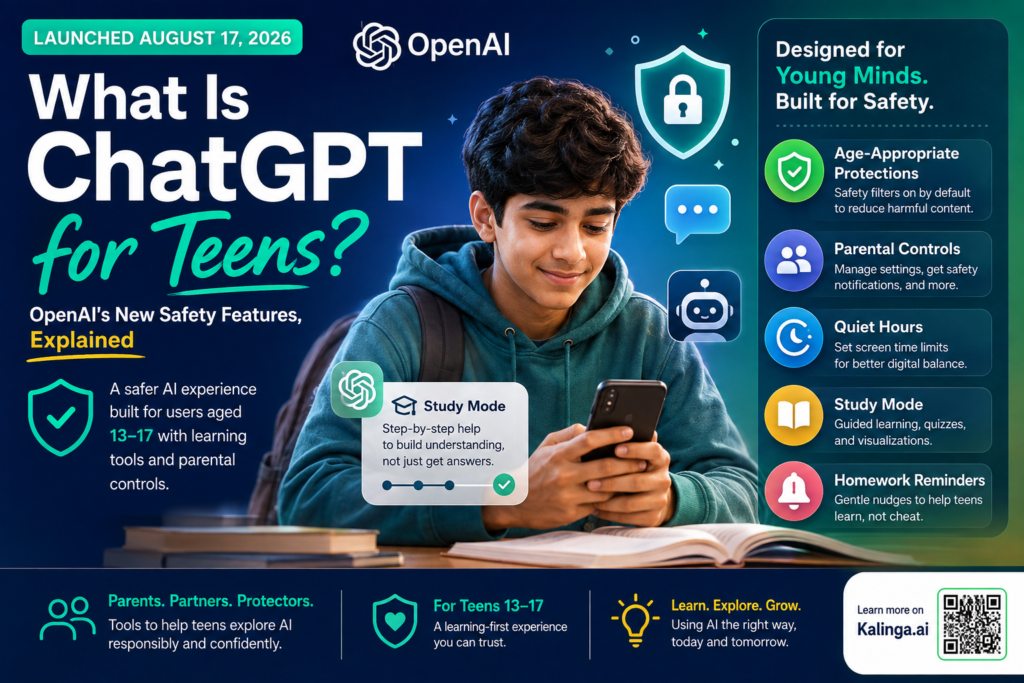
Picture a 15-year-old opening ChatGPT at 11 p.m. to ask a question they’d never ask a parent or teacher, that scenario is exactly why OpenAI built a separate product for minors. ChatGPT for Teens is a new, age-gated version of the chatbot that OpenAI launched on Monday, August 17, 2026, with built-in content safety filters, parental controls, and study tools designed specifically for users under 18. It arrives with age-appropriate protections switched on by default, a new Study Mode meant to discourage copy-paste homework cheating, and family controls that let parents set boundaries like Quiet Hours.
If you’re a student, a parent, or an educator anywhere, including here in Odisha, where AI tools have become part of everyday student life, this launch is worth understanding in detail. Below, we break down exactly what the product does, why it took OpenAI this long to build it, and what it means for how young people use AI chatbots going forward.
What Is ChatGPT for Teens?
ChatGPT for Teens is OpenAI’s dedicated version of its chatbot, built for users aged 13 to 17 and combining safety guardrails with learning-focused features. Unlike the standard adult experience, this teen-specific version applies age-appropriate content filters by default, nudges young users toward learning tools instead of quick answers, and gives parents visibility and control over how their child uses the app.
The company <cite index=”1-8″>announced the launch after numerous lawsuits over AI chatbots’ lack of safety measures, which families say led to teens’ suicides and other mental health concerns</cite>. In other words, this isn’t just a routine feature update, it’s a direct response to real, documented harm involving minors and AI chatbots, and it was built under that shadow.
Why does the distinction between a teen account and a regular account matter? Because until now, teenagers used the exact same product as adults, with no separate safeguards built around their developmental stage. This launch changes that by treating young users as a distinct category with distinct risks, distinct temptations (like using AI to finish homework), and distinct needs.
Why Did OpenAI Launch a Teen-Specific Product Now?
Has ChatGPT always had protections for teenage users? No. <cite index=”1-12″>ChatGPT first launched in late 2022 and scaled to 900 million weekly active users before meaningful safeguards designed specifically for teenage users were added</cite>. Judged against that timeline, the product is a very late addition to an app that had already become part of daily life for hundreds of millions of people, a large share of them almost certainly minors, using the same interface as their parents.
The pressure to build ChatGPT for Teens came from outside the company as much as from within it. <cite index=”1-8″>Numerous lawsuits over AI chatbots’ lack of safety measures</cite> put OpenAI under legal and public scrutiny, with families arguing that the absence of guardrails contributed to tragic outcomes for their children. That legal pressure forms the direct backdrop against which the teen product was designed and released, and it’s a large part of why the announcement reads more like risk mitigation than product innovation.
This is also why the tone of the coverage around the launch has been cautious rather celebratory. Critics have framed it not as a breakthrough, but as a years-overdue correction to a gap that should have existed from the start. A rough timeline makes the delay clear:
- Late 2022: The chatbot launches publicly with no teen-specific safety layer at all.
- 2022–2026: Adoption scales into the hundreds of millions, including large numbers of teen users, with no dedicated teen product or default protections.
- 2025–2026: Multiple lawsuits allege serious harm to teens linked to unsupervised chatbot interactions.
- August 2026: OpenAI finally launches a dedicated teen product with default safety protections, parental controls, and study tools.
What Safety Features Are Included?
What actually makes this version “safer” than the regular product? The core difference is that age-appropriate protections are switched on automatically, rather than left to the user or a parent to configure manually. <cite index=”1-16″>OpenAI says the age-appropriate protections will now be on by default, and are designed to reduce exposure to harmful or developmentally inappropriate content</cite>. That single design choice, defaults over opt-ins, is arguably the most consequential decision in the whole rollout, since most users, teens included, rarely change default settings.
The Under-18 Principles Behind the Safety Design
These defaults aren’t arbitrary. <cite index=”1-16″>The protections are based on OpenAI’s Under-18 Principles in its Model Spec, which the company says are informed by developmental science and guidance from experts</cite>. In plain terms, this means the model’s responses to a flagged teen account are shaped by rules written specifically around adolescent development, rather than simply being a lighter version of the standard adult content filter. A Model Spec, for context, is essentially a written rulebook that tells an AI system how it should behave in different situations, OpenAI has now written a version of that rulebook specifically for interactions with minors.
This matters because a generic content filter typically works by blocking keywords or flagged topics outright, which is a blunt instrument. A developmental-science-informed rulebook, by contrast, is meant to account for context, recognizing, for instance, the difference between a teen researching a sensitive topic for a school assignment and a teen in genuine emotional distress, and responding differently to each. Whether the system actually achieves that level of nuance in practice is something that will only become clear once it’s used at scale by real teenagers with real, messy, unpredictable situations.
Parental Controls and Quiet Hours
Parents and guardians aren’t left out of the equation either. <cite index=”1-17″>Parents can use family tools and parental controls, previously introduced by OpenAI, to manage settings, receive safety notifications, and set Quiet Hours, among other things</cite>. Quiet Hours is a simple but meaningful feature: it lets a parent restrict when their teen can access the app at all, closing off the late-night usage window that mental health researchers often flag as a higher-risk period for vulnerable users.
Here’s a quick summary of what the product bundles together for families:
- Age-appropriate content protections switched on by default
- Parental controls for managing account settings
- Safety notifications sent to a parent or guardian
- Quiet Hours to restrict access during certain times of day
- Study Mode that can be enabled or required by parental preference
- Homework reminders that gently redirect a teen away from cheating
How Does Study Mode Work?
Study Mode is a learning-focused setting that replaces instant answers with guided, step-by-step help. Instead of generating a finished essay or a fully solved equation on request, it walks a teen through the problem with prompts and questions, aiming to build understanding rather than simply produce output the student can copy. This is OpenAI’s direct answer to one of the most persistent criticisms of AI in education: that it makes cheating far too easy.
Does Study Mode actually stop AI-assisted cheating? It’s designed to reduce it, though it doesn’t eliminate the option entirely. <cite index=”1-3″>Study Mode and other tools are designed to encourage teen users to engage their curiosity and work through problems, not just get quick answers</cite>. <cite index=”1-4″>It gives teens guiding questions and step-by-step support to help them understand the material, and the teen experience also includes homework reminders that appear when a teen seems to be trying to cheat instead of understanding the material</cite>, pushing them toward the guided mode rather than a direct, copy-ready answer.
Beyond homework nudges, <cite index=”1-5″>the app supports quizzes and learning visualizations, along with controls that let parents or guardians decide when Study Mode is enabled by default</cite>. That last detail matters: a parent can choose to make guided learning the standard experience rather than an opt-in extra, which shifts the default behavior of the entire account for that teen, not just a single conversation.
OpenAI is also extending this education push beyond the chatbot interface itself. <cite index=”1-18″>OpenAI announced a partnership with CodeAI to help teens learn more about AI, including how it works, how to direct or question it, and how to use it responsibly</cite>, alongside its existing ChatGPT for Teachers product, which gives schools institution-managed access to AI for classroom use.
ChatGPT for Teens vs. the Standard Product vs. ChatGPT for Teachers
If you’re trying to figure out which OpenAI product actually applies to your situation, this comparison should help:
| Feature | Teen Account | Standard Account (18+) | Teacher/School Account |
| Intended user | Ages 13–17 | General public, adults | Teachers and schools |
| Safety filters | On by default | Adult defaults, adjustable | School/institution-managed |
| Parental controls | Yes, including Quiet Hours | Not applicable | Not applicable |
| Study Mode | Central feature, parent-controlled | Available as an opt-in setting | Not the primary focus |
| Cheating deterrents | Homework reminders, nudges | None built in | Institution-level oversight |
| Who manages access | Parent or guardian | Individual user | School administrator |
The clearest takeaway from this table is that the teen product isn’t simply the regular app “with a filter turned on.” It’s a differently governed experience, where a parent, not just the teen, has meaningful, ongoing control over the defaults that shape every session.
Can Teens Bypass These Safety Controls?
This is the question hanging over the entire launch, and even OpenAI’s own framing leaves room for real doubt. <cite index=”1-9″>It’s not clear how difficult it will be for teens to escape these new systems if they decide not to cooperate, since teens are famously adept at working around parental controls and other attempts to lock down digital experiences</cite>. <cite index=”1-9″>Until the teen mode is put through more real-world testing, it remains unclear how easy it will be to work around these safety measures in practice</cite>.
Should parents treat this as a complete solution on its own? Not really. Any safety layer built into a single app can potentially be sidestepped by switching to a browser, opening a different account, or simply using an entirely different AI tool that has no age gate at all. It’s best understood as one layer of protection, meant to work alongside, not replace, ongoing conversations between parents and teens about how AI fits into their daily lives.
There’s also a structural tension worth noting here: the same company stands to benefit from continued teen engagement with its product while also being the one now responsible for policing that engagement. That tension is part of why critics have described the launch as reactive rather than proactive, a response to lawsuits and mounting public pressure, rather than something built in from day one when the original chatbot first shipped.
It’s also worth being realistic about what “safety controls” can and can’t do on their own. A content filter can reduce the odds that a teen stumbles into harmful material by accident, and Quiet Hours can close off a risky late-night window. But neither feature can fully substitute for a parent or guardian who understands how their teen is actually using the tool day to day, for homework, for conversation, for advice, or sometimes all three at once. The most effective version of this rollout will likely combine the technical guardrails with ordinary household rules, the same way screen-time limits or content ratings work for any other technology.
What This Means for Students and Parents in India
For students and parents in Odisha and across India, this launch is worth watching closely for two reasons. First, AI tools are already deeply embedded in how Indian students study, revise, and, often, shortcut homework, so a product specifically aimed at reducing AI-assisted cheating is directly relevant to schools, coaching centers, and competitive-exam prep culture. Second, India has one of the largest global user bases for consumer AI tools, which means safety features rolled out for teens abroad will very likely shape the default experience Indian teens eventually get too, even before any India-specific rollout timeline is confirmed by OpenAI.
For parents, the practical takeaway is simple: there are now actual settings to configure, Quiet Hours, guided-study defaults, and safety notifications, rather than just a general assurance that “AI is being made safer” somewhere behind the scenes. For students, it’s worth understanding that Study Mode exists precisely because platforms and institutions are starting to actively detect and discourage AI-assisted cheating, not just discourage it in principle in a school handbook. Learning to use AI as a study partner rather than an answer machine is quickly becoming a genuine, testable skill, one that’s likely to matter for scholarships, admissions interviews, and workplace expectations down the line.
Schools and coaching institutes in the region may also want to get ahead of this shift rather than react to it later. A teacher who understands the difference between a student using Study Mode to work through a physics problem and a student pasting a question for an instant essay is better positioned to design assignments that AI can’t simply shortcut. Institutions that already run structured AI-literacy sessions, teaching students how these tools reason, where they fail, and when to double-check an answer, are likely to see fewer disciplinary issues around AI-assisted cheating than those that simply ban the tools outright, since outright bans are difficult to enforce once a student has a smartphone and a data connection.
Frequently Asked Questions
What is ChatGPT for Teens? It’s OpenAI’s dedicated chatbot experience for users aged 13–17, launched on August 17, 2026, with default safety protections, parental controls, and a study-focused mode meant to reduce AI-assisted cheating.
When did ChatGPT for Teens launch? OpenAI announced the product on Monday, August 17, 2026, following years of scrutiny over the safety of AI chatbots for younger users and multiple related lawsuits.
What is Study Mode? Study Mode is a feature that gives teens step-by-step guidance and questions instead of direct answers, and it includes homework reminders that redirect a teen toward learning when the system detects likely cheating behavior.
Can parents control how their teen uses the app? Yes. Parents can use family tools and parental controls to manage account settings, receive safety notifications, set Quiet Hours that restrict access at certain times, and decide whether Study Mode is on by default.
Is ChatGPT for Teens completely safe from misuse? No system is foolproof. OpenAI itself has acknowledged that it isn’t yet clear how effectively these controls will hold up once tested against real teenage behavior, since teens are often skilled at bypassing digital restrictions.
How is this different from ChatGPT for Teachers? The teen product is built for individual young users and managed by parents at home, while ChatGPT for Teachers is built for schools and managed by institutions, giving teachers and administrators oversight of classroom AI use.
Next Steps
If you’re tracking how AI safety policy and product design are evolving, especially where they intersect with education, Kalinga.ai regularly breaks down launches like this one for students, parents, and educators across Odisha. Explore our latest AI education coverage on Kalinga.ai to stay ahead of how these tools are reshaping the classroom.