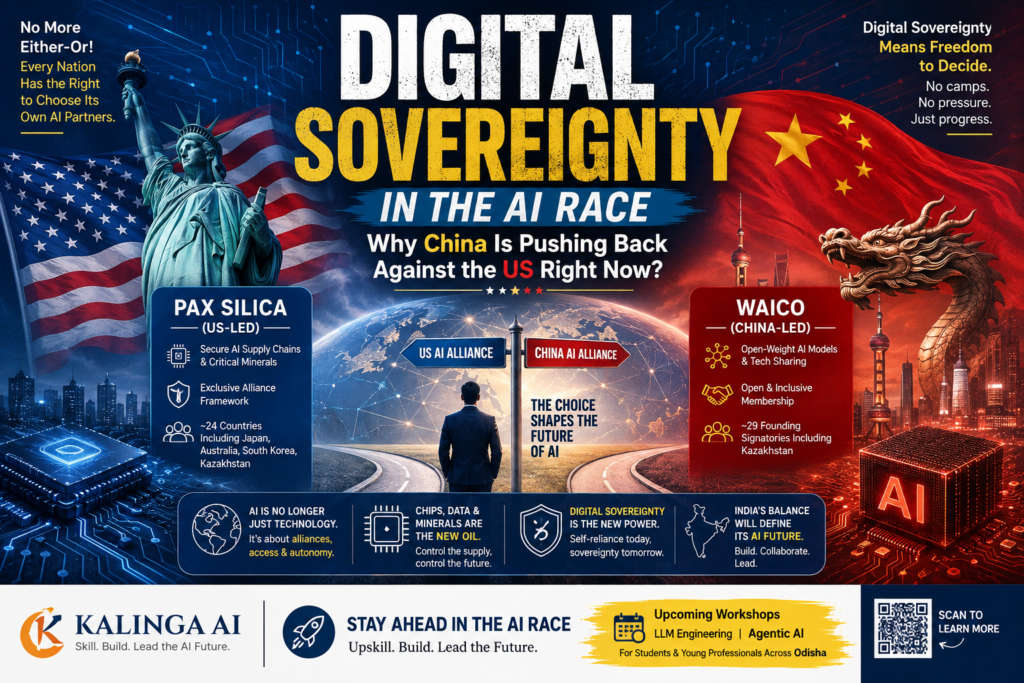
Imagine being told by one superpower that you can’t be friends with the other, that’s essentially what dozens of countries are facing in the AI race today. On August 19, 2026, China’s foreign ministry publicly invoked digital sovereignty, telling the world that every nation has the right to pick its own AI partners, after Reuters revealed that Washington was preparing to make countries choose sides between American and Chinese AI coalitions. In short: China wants the world to reject an “either-or” AI alliance system, while the US is actively building one. That single diplomatic exchange says a lot about where global AI politics is heading in late 2026, and it’s worth unpacking for anyone building a career in this industry. Digital Sovereignty in AI
What Sparked This Latest Round in the US-China AI Rivalry?
The trigger was a Reuters report about a draft US State Department letter, not a new law or treaty. According to Reuters, the US is preparing to tell 35 countries and regions that they must choose between Washington’s AI framework and Beijing’s competing one, or risk being cut out of the American-led coalition entirely.
Digital sovereignty is a nation’s right to control its own digital infrastructure, data flows, and technology partnerships without being dictated to by another country. Instead of letting a foreign government decide who a country can and can’t work with on AI, digital sovereignty means each state sets its own rules on data storage, cloud providers, chip suppliers, and international tech alliances. It has become the go-to phrase for countries, from the EU to China to India, trying to avoid over-dependence on either Washington or Beijing for their AI future.
China’s foreign ministry spokesperson Lin Jian responded directly to the US letter on Wednesday, August 19. “Each country has the right to choose its partners based on its national conditions and development needs,” Lin said at a regular briefing, adding that Beijing opposes taking sides and forming rival camps on AI.
Why does this matter beyond diplomatic statements?
Because the AI race is no longer just about who builds the best model, it’s about who controls the alliance structure around AI. Chips, critical minerals, cloud infrastructure, and open-weight models are all being folded into a bloc system, similar to Cold War-era trade blocs, and countries are being asked to formally pick a side rather than quietly hedge their bets.
What Exactly Did the US Draft Letter Say?
Reuters reported that the internal draft, prepared by the State Department, is addressed to the 35 signatories of the US “AI Opportunity Statement,” a joint declaration signed in June 2026. Many of those same countries also belong to Pax Silica, a separate US-led framework.
Here’s what the leaked draft reportedly says, in plain terms:
- Countries that sign the Pax Silica Declaration are making “a commitment,” not just a symbolic gesture, continued membership depends on not joining rival Chinese-led AI initiatives.
- The letter’s key line, reported almost identically across outlets: “To be part of everything is to be part of nothing.”
- It does not name China outright, but says membership “cannot be held alongside membership in duplicative initiatives whose expectations conflict with our own.”
- Countries are urged to “choose deliberately” rather than try to maintain ties with both AI blocs.
- A US official told Reuters the goal was to make clear that governments “can’t have it both ways,” questioning how a country can be a “trusted partner” in one AI ecosystem while joining “an initiative designed by China to advance a competing vision for AI.”
The State Department has not confirmed when, or whether, this letter will actually be sent, and declined to comment on what it called a “purportedly leaked internal document.”
Is “Digital Sovereignty” a New Idea, or an Old Term Getting a New Fight?
It’s an old term wearing a new AI-shaped costume. China’s government has used versions of this language for over a decade, President Xi Jinping called for respect of “cyber sovereignty” as far back as 2015, arguing that countries should be free to regulate their own internet the way they see fit. What’s changed in 2026 is the stakes: instead of arguing over content censorship and internet governance, the fight is now over who gets access to advanced chips, training data, and foundation models.
The European Union has been making a parallel argument for years, just with a different target. French lawmakers, for instance, have warned that without stronger domestic AI capacity, Europe risks becoming a “digital colony” dependent on both American and Chinese infrastructure. That framing shows digital sovereignty isn’t purely a China-vs-US talking point, it’s become the default vocabulary any country reaches for when it wants leverage without picking a permanent side. The difference in August 2026 is that, for the first time, a major power (the US) is reportedly trying to make hedging structurally impossible rather than just diplomatically awkward.
Is this really about technology, or is it about supply chains?
Mostly supply chains. Reuters’ reporting makes clear the US goal is to limit China’s access to the raw materials and partnerships needed to build frontier AI, not simply to police who uses which chatbot. China, meanwhile, has previously restricted exports of critical minerals it dominates, using that leverage during earlier trade disputes with Washington. Both sides are treating compute, chips, and minerals as strategic assets on par with oil or arms exports in past eras.
What Is Pax Silica, and Why Does the US Care About It So Much?
Pax Silica is a US-led framework, launched in December 2025, built to secure supply chains for AI models, semiconductors, and critical minerals. Roughly two dozen countries have joined so far, including Japan, Australia, South Korea, and, notably, Kazakhstan, a country with major reserves of the critical minerals that advanced chips depend on.
The logic behind Pax Silica is straightforward: the US wants to lock in allies on chips and minerals before China can secure the same resources, since China has previously used its near-monopoly on certain critical minerals as leverage during earlier trade disputes. Members of Pax Silica get access to shared AI investment opportunities, while the broader group of 35 “AI Opportunity Statement” signatories has agreed, more loosely, to a “common purpose” and “shared vision” on AI cooperation with Washington.
How Is China Countering This, and What Is WAICO?
China’s response goes beyond a single press briefing. In July 2026, Chinese President Xi Jinping launched the World Artificial Intelligence Cooperation Organization (WAICO), a Shanghai-based intergovernmental body promoting open-weight AI models and framing itself as a platform for Global South cooperation. Reports indicate WAICO already has around 29 founding signatories.
WAICO is China’s answer to Pax Silica: a coalition built around open-weight AI technology-sharing rather than restricted, allegiance-based access. Where Pax Silica ties membership to supply-chain security and exclusivity, WAICO leans on the appeal of free, downloadable AI models and non-Western-centric governance. Beijing has also pointed to its Position Paper on Global Cyber Governance in the Digital Intelligent Age, released in July 2026, which is explicitly organized around “respecting digital sovereignty and promoting development for all.”
Kazakhstan is currently the only country known to be part of both Pax Silica and WAICO simultaneously, and Reuters reports that this overlap has “set off alarm bells in Washington”, which is a big part of why the draft letter exists in the first place.
Pax Silica vs WAICO: Comparing the Two Competing AI Blocs
| Feature | Pax Silica (US-led) | WAICO (China-led) |
| Launched | December 2025 | July 2026 |
| Core focus | Chip and critical-mineral supply chains, AI model security | Open-weight AI models, Global South cooperation |
| Membership style | Exclusive, reportedly incompatible with rival blocs | Open, framed around national self-determination |
| Known members/signatories | ~24 countries, incl. Japan, Australia, South Korea, Kazakhstan | ~29 founding signatories, incl. Kazakhstan |
| Underlying pitch | Secure, trusted AI supply chain with the US | Non-aligned, sovereignty-respecting AI development |
| Countries in both | Kazakhstan (only known case so far) | Kazakhstan (only known case so far) |
This table captures why the current standoff matters: it’s not just rhetoric, it’s a structural choice countries are being asked to make about their entire AI supply chain and diplomatic posture.
Where Does India Stand in This Digital Sovereignty Standoff?
This is the part that matters most for readers in India. India signed both the Pax Silica Declaration and the India-US Joint Statement on AI Opportunity Partnership at the AI Impact Summit in New Delhi in February 2026, which India’s External Affairs Ministry called a “milestone” in India-US relations. At the same time, some reporting lists India among the broader set of countries that have engaged with China’s WAICO framework alongside allies like Japan, Australia, South Korea, and the UK.
Is India being forced to choose sides in the AI race? As of the latest reporting, no. India is not named in Reuters’ coverage as a country specifically targeted by the draft US letter, and the immediate pressure appears aimed at signatories with more ambiguous dual memberships, like Kazakhstan. Still, as the US pushes toward an exclusivity model, India’s position as a fast-growing AI market with deep ties to both the US tech ecosystem and its own domestic compute ambitions puts it squarely in the middle of this debate.
This dual engagement is exactly the kind of position the US letter appears designed to discourage going forward, even if India isn’t currently in the crosshairs. India’s strategy so far has looked less like picking a side and more like keeping options open: signing onto the US-led supply chain framework for chips and minerals while staying engaged with a China-led body built around open-weight model access and Global South outreach. That’s a sensible hedge for a country still building out its own compute base, India’s IndiaAI Mission and domestic GPU procurement efforts are explicitly aimed at reducing dependence on any single foreign supplier, which is itself a form of the same principle both the US and China are now fighting over.
Could India eventually face the same pressure Kazakhstan is facing? It’s possible but not confirmed. If Washington does formalize an exclusivity requirement and extends it beyond the current 35 signatories, any country engaging meaningfully with both Pax Silica and WAICO could come under similar scrutiny. For now, India’s scale and strategic importance to both Washington and Beijing likely make it a harder country to pressure than a smaller, resource-rich state like Kazakhstan.
Why should Indian AI students and professionals care about this? Because supply-chain alliances directly shape which chips, cloud platforms, and open-weight models will be cheapest and most accessible to build on in India over the next few years. A world split into rigid AI blocs changes hiring patterns, GPU access, and which foundation models Indian startups can legally and practically deploy.
How Are Other Countries Reacting to the US-China AI Split?
Beyond India, the picture is mixed. Reports on Latin American signatories show a similar hedging pattern: Argentina, Chile, Costa Rica, El Salvador, and Panama signed both the June AI Opportunity Statement and the Pax Silica Declaration, while Brazil went the other way, becoming a founding WAICO member in July 2026 without signing either US document. That split runs straight through Mercosur, South America’s major trade bloc, and touches decisions as concrete as data-center locations, cloud vendor selection, and 5G equipment sourcing.
Close US allies like Japan, Australia, and South Korea are firmly inside the Pax Silica camp, while countries positioning themselves as neutral, resource-rich middle powers, Kazakhstan being the clearest example, are trying to keep a foot in both camps for now. The pattern that’s emerging is that resource-rich and strategically important nations feel the most pressure to formally align, while larger economies like India, with more leverage of their own, have more room to engage both sides without immediate consequence.
Why This Fight Over Digital Sovereignty Matters for Your AI Career
A few practical reasons this geopolitical story isn’t just background noise for anyone working in or entering the AI field in India:
- Compute access could get political. If supply chains fragment further, GPU and cloud availability may increasingly depend on which bloc your country or employer aligns with.
- Open-weight models are becoming a geopolitical tool, not just a technical choice. China’s push behind open-weight AI through WAICO is partly a soft-power play, understanding this helps you evaluate model choices with clearer eyes.
- Enterprise AI vendors will face compliance questions tied to sovereignty. Companies operating across US- and China-aligned markets may need separate data governance strategies.
- Policy fluency is now a career asset. Employers increasingly value AI professionals who understand not just the technology but the trade, chip, and data-sovereignty forces shaping where AI investment flows.
- India’s own digital sovereignty push (data localization, sovereign compute, domestic LLM efforts) will likely accelerate as it tries to avoid over-reliance on either bloc.
Frequently Asked Questions
What does “digital sovereignty” mean in the context of AI? Digital sovereignty means a country’s right to independently control its own data, digital infrastructure, and AI partnerships without being pressured into an exclusive alliance by another nation. China invoked this principle on August 19, 2026, in response to reported US pressure on 35 countries to pick an AI bloc.
What did China’s foreign ministry actually say about the US letter? Spokesperson Lin Jian said China opposes taking sides and forming camps in the AI race, stating that “each country has the right to choose its partners based on its national conditions and development needs.”
What is Pax Silica? Pax Silica is a US-led framework launched in December 2025 to secure supply chains for AI models, semiconductors, and critical minerals, with roughly two dozen member countries including Japan, Australia, and South Korea.
What is WAICO? WAICO, the World AI Cooperation Organization, is a China-led intergovernmental body launched by President Xi Jinping in July 2026, promoting open-weight AI models and framing itself around each country’s right to independently govern its own technology future.
Has India been asked to choose between the US and China on AI? Not according to current reporting. India has signed both the Pax Silica Declaration and the India-US AI Opportunity Partnership, and is not named as a specific target of the draft US letter, though it remains engaged with the broader Global South-facing WAICO ecosystem.
Why is Kazakhstan mentioned so often in this story? Kazakhstan is currently the only country confirmed to have joined both Pax Silica and WAICO, making it the clearest example of the “dual membership” problem the US letter is reportedly trying to close off.
Keep Up With the AI Race, One Story at a Time
Chip alliances, open-weight model politics, and sovereignty debates like this one will only get more relevant as AI reshapes global trade and career opportunities. If you want to build the skills to actually work with the AI systems at the center of this rivalry, explore Kalinga.ai’s upcoming LLM Engineering and Agentic AI workshops designed for students and young professionals across Odisha.