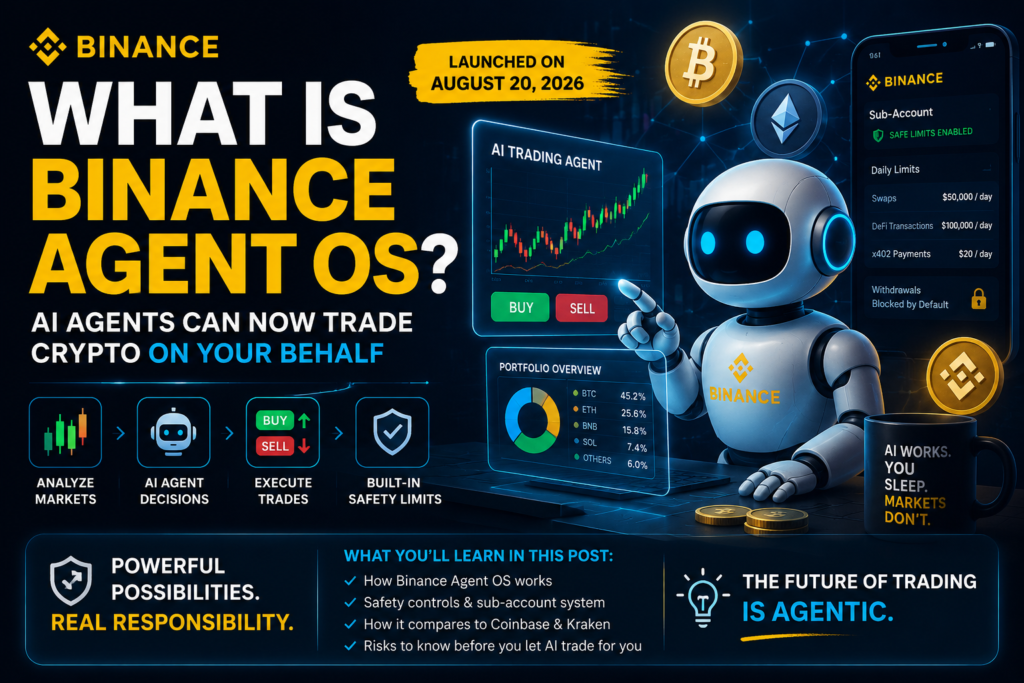
Imagine waking up to find your crypto portfolio rebalanced overnight, not by you, but by an AI agent that watched the market while you slept. That’s no longer a thought experiment. Binance Agent OS, launched on August 20, 2026, is a new platform that lets AI agents built on tools like ChatGPT, Claude Code, and Cursor analyze markets and execute real trades for users, according to TechCrunch reporting by Jagmeet Singh. In short, Agent OS turns your favorite AI assistant into a semi-autonomous trader, but the guardrails around it are largely something you have to build yourself.
For students and young professionals in Odisha and across India who are watching both the AI boom and the crypto market closely, this launch is a big deal. It’s one of the clearest real-world signs yet that AI agents are moving from “answering your questions” to “acting with your money.” This post breaks down exactly what Agent OS is, how it works, what safety controls exist, how it compares to rivals like Coinbase and Kraken, and what you should know before letting an AI agent anywhere near your trading account.
What Is Binance Agent OS and Why Does It Matter?
Binance Agent OS is a platform that connects AI applications and agents directly to Binance’s trading infrastructure, letting them view market data, check account information, and place trades on a user’s behalf. It was introduced by Binance, which is the world’s largest crypto exchange with more than 300 million registered users, marking one of the biggest mainstream pushes yet to bring autonomous AI into real financial decision-making.
Agent OS isn’t a single tool, it’s a bundle of existing and new infrastructure stitched together. According to the report, it brings together Binance APIs, the Binance Wallet Agentic Hub, the Binance x402 transaction verification and payment facilitator API, and Binance Skill Hub, alongside newly added support for the Model Context Protocol (MCP).
Question: What can Agent OS actually do for a trader? Once connected, an AI agent running on Agent OS can pull live market data, review your account balances and positions, and place buy or sell orders, either with your approval each time or fully autonomously, depending on how you configure it. The platform also works with tools including OpenAI’s ChatGPT and Codex, Anthropic’s Claude Code, and Cursor, so developers and everyday users aren’t locked into a single AI ecosystem.
This matters because it signals a shift in how ordinary retail investors, not just hedge funds with custom trading bots, could interact with crypto markets. If Agent OS works as intended, a student who understands prompt engineering but not high-frequency trading could theoretically set up an agent to monitor Bitcoin volatility and react faster than they ever could manually.
How Binance Agent OS Works Under the Hood
To understand why Agent OS is significant, it helps to understand the plumbing that makes it possible.
Model Context Protocol (MCP) is an open standard that lets AI applications connect to external tools and data sources in a structured, secure way. Instead of every company building a custom integration for every AI tool, MCP acts like a universal adapter, an AI agent that “speaks MCP” can plug into any service, including Binance, without bespoke code for each connection. This is why Agent OS can work across ChatGPT, Claude Code, and Cursor simultaneously instead of supporting just one AI provider.
Binance built Agent OS on top of tools it already had. The Binance Wallet Agentic Hub lets agents interact with on-chain wallets and decentralized finance (DeFi) protocols, while the x402 transaction verification and payment facilitator API lets agents send and settle payments programmatically. Through Binance’s x402 integration, agents can send and settle payments, while its Agentic Wallet allows them to interact with tokens and decentralized-finance protocols.
Question: Does Agent OS give AI agents unlimited access to a user’s funds? No. Access has to be explicitly configured by the user, and Binance has built specific limits into the wallet side of the system. Regular swaps are capped at $50,000 a day, DeFi transactions have a default $100,000 daily limit, and x402 payments are limited to $20 a day, according to the company. These are default ceilings, not suggestions, an agent physically cannot move more than that through those specific channels in a day.
The Sub-Account System: Binance’s Core Safety Mechanism
The centerpiece of how Binance Agent OS keeps agents contained is something most crypto traders are already familiar with: sub-accounts.
- Users assign an AI agent to a dedicated sub-account rather than their main trading account.
- Each sub-account can be configured for specific activities only, such as spot trading or futures trading.
- Withdrawals from those sub-accounts are blocked by default, according to Binance vice president of product Jeff Li, which prevents an agent (or an attacker who compromises it) from simply draining funds out of the exchange.
- Users decide whether the agent needs approval for every single order, or can trade autonomously once permissions are set.
- Binance does not impose a separate cap on how much an AI agent can trade or lose within exchange trading, so the amount you deposit into the sub-account effectively becomes the maximum possible loss.
As Li put it in the TechCrunch interview, “Instead of total freedom, we put the power in users’ hands to give them the granular access control of what they can do through the agent.” The philosophy is clear: Agent OS provides the rails, but the user decides how fast the train is allowed to go.
How Binance Agent OS Keeps AI Trading Agents in Check, And Where the Gaps Are
This is the part every prospective user should read twice. Agent OS is explicit that responsibility for controlling an AI agent’s behavior sits mostly with the user, not the exchange.
Question: Can Binance see why an AI agent decided to make a particular trade? No, and this is one of the more important limitations to understand. Li said the reasoning behind an agent’s action happens outside Binance’s systems, either on the user’s computer or within their chosen AI application, telling TechCrunch, “We really cannot see the reasoning of what the user’s action is.” That means Binance can observe the trades an agent executes, but it has no visibility into whether the agent’s decision came from sound analysis, bad data, or manipulation.
This creates a real blind spot. If an AI agent’s judgment is skewed by a compromised data feed, a hallucinated market signal, or a prompt injection attack, a technique where malicious instructions are hidden inside content an AI reads, tricking it into taking unintended actions, Binance’s systems have no way to catch that in real time. The exchange only sees the resulting trade, not the reasoning that produced it.
Question: What happens if an AI agent gets compromised or manipulated? Binance’s answer, again, points back to the sub-account structure as the primary defense. Li pointed to the sub-account as the main line of defense when asked what would happen if an agent were manipulated through a prompt-injection attack or otherwise compromised. In other words, the blast radius of a compromised agent is limited to whatever funds you chose to put into that specific sub-account, nothing more, nothing less.
It’s also worth noting that Binance said its existing security, risk-control, and anti-money-laundering policies for subaccount APIs apply to Agent OS at launch, meaning this isn’t a parallel, less-regulated system, it inherits the compliance framework Binance already runs for its regular API users.
Here’s a quick summary of where control actually sits in Agent OS:
- Fund exposure control → User (via how much is deposited into the sub-account)
- Withdrawal permission → Binance (blocked by default)
- Trade approval workflow → User (manual approval or full autonomy, user’s choice)
- Reasoning/decision transparency → Neither party fully, it happens inside the third-party AI tool
- Compliance and anti-money-laundering checks → Binance (existing policies extended to Agent OS)
- Protection from prompt injection or manipulation → User, mitigated only by sub-account isolation
Binance Agent OS vs. Rival Agentic Trading Platforms
Agent OS didn’t arrive in a vacuum. Rival crypto exchanges have been moving in the same direction, using MCP and other developer tools to give AI applications direct access to market data and trading systems. Here’s how the major players stack up.
| Platform | Launch | Core Mechanism | Key Safety Control | Notable Limit |
| Binance Agent OS | August 2026 | MCP + APIs + Agentic Wallet | Sub-accounts, withdrawals blocked by default | No agent-specific trading cap; wallet swaps capped at $50K/day |
| Kraken CLI | March 2026 | Open-source command-line tool with built-in MCP server | Command-line permissioning | Executes spot and futures trades via CLI |
| Coinbase for Agents | June 2026 | Direct agent-to-account connection | User-set limits | Trading, payments, and workflows within user-defined boundaries |
| OKX Agent Trade Kit | Earlier 2026 | Open-source MCP toolkit | Developer-configured permissions | Agentic trading enabled platform-wide |
A few things stand out from this comparison. First, every major exchange is converging on MCP as the connective tissue between AI agents and trading infrastructure, this is quickly becoming the industry standard, not a Binance-only bet. Second, none of these platforms remove user responsibility entirely; they all shift the burden of setting sensible limits onto the person deploying the agent. Agent OS stands out mainly for the scale of its user base and the breadth of tools it bundles together, wallet, payments, MCP, and trading, under one roof.
What This Trend Means for AI Agents Handling Real Money
Agent OS is a symptom of a much bigger shift happening across the AI industry in 2026: the move from conversational AI to agentic AI, systems that don’t just respond to prompts but take multi-step actions in the real world, often with financial or operational consequences.
Agentic AI is a term for AI systems designed to autonomously plan and execute tasks, like researching a topic, booking a service, or in this case, trading crypto, rather than simply generating text in response to a question. The expansion of agentic AI into financial infrastructure means the stakes of an AI “mistake” go up considerably; a wrong answer in a chatbot is embarrassing, but a wrong trade executed autonomously can cost real money instantly.
Li said Agent OS was Binance’s “first step” toward giving developers a platform to build AI-powered applications that can act across crypto and traditional markets, which suggests this is the beginning of a much longer roadmap, not a one-off feature. Expect more exchanges, brokers, and possibly Indian fintech platforms to experiment with similar agentic access as MCP adoption spreads.
For students and early-career professionals building skills in AI, this is exactly the kind of real-world use case worth studying closely, it combines prompt engineering, API integration, risk management, and security thinking (like defending against prompt injection) into one live system.
Question: Is agentic AI trading legal for retail investors in India? Crypto trading itself is not illegal in India, though it remains subject to taxation under Section 115BBH of the Income Tax Act and reporting requirements from the Financial Intelligence Unit. Agent OS does not change the underlying regulatory status of crypto trading, it changes who (or what) is clicking the buy and sell buttons. Indian users experimenting with AI-driven trading should treat the tax and compliance obligations exactly as they would for manual trades, since automation doesn’t create a regulatory exemption.
It’s also worth zooming out on why exchanges are racing toward this model at all. Agentic trading tools reduce the friction between “having an idea” and “acting on it”, an agent watching on-chain data or news sentiment around the clock can react in seconds where a human trader might take hours to notice a pattern. That speed is exactly why the safety architecture matters so much: the same automation that helps a disciplined trader execute a well-tested strategy can just as easily amplify a bad one, faster than a human would ever let it run unchecked.
Should You Use Binance Agent OS? A Practical Risk Checklist
Before connecting any AI agent to a trading account, on Agent OS or any similar platform, work through this checklist:
- Start with a small sub-account balance. Since Agent OS doesn’t cap agent trading losses separately, your deposit is your real risk ceiling.
- Keep withdrawals blocked unless you have a specific, well-understood reason to enable them.
- Require manual approval for trades initially, and only move to full autonomy once you trust the agent’s behavior over time.
- Understand what data your AI tool is reading. Prompt injection risks come from agents processing untrusted content (like a scraped webpage or a malicious document), so know your agent’s data sources.
- Never share API keys or account credentials outside Binance’s official Agent OS flow.
- Treat this as an experiment, not a set-and-forget system, check in on agent activity regularly rather than assuming the sub-account structure alone will catch every problem.
- Remember Binance cannot see agent reasoning, so you are the only line of defense against a poorly reasoned or manipulated decision.
FAQ: Binance Agent OS and AI Agent Trading
What is Binance Agent OS? Binance Agent OS is a platform launched by Binance that connects AI applications and agents, including tools like ChatGPT, Claude Code, and Cursor, to Binance’s trading infrastructure, letting them analyze markets, view account data, and execute trades on a user’s behalf.
Is Agent OS safe to use? Agent OS includes safety features like sub-accounts with withdrawals blocked by default and existing anti-money-laundering and risk-control policies, but Binance itself says users hold most of the responsibility for setting limits and monitoring agent behavior, since it cannot see an agent’s underlying reasoning.
Can an AI agent on Agent OS lose all my money? An agent can only lose what you deposit into its assigned sub-account, since Binance does not set a separate trading loss cap for exchange trading, the sub-account balance itself is the practical limit, and withdrawals from that sub-account are blocked by default.
Which AI tools work with Agent OS? At launch, Agent OS works with tools including OpenAI’s ChatGPT and Codex, Anthropic’s Claude Code, and Cursor, in addition to any AI application built to support the Model Context Protocol (MCP).
How is Agent OS different from Coinbase for Agents or Kraken CLI? All three let AI agents trade crypto through MCP-based connections, but they differ in packaging: Agent OS bundles trading, wallet, and payment access under one system; Coinbase for Agents focuses on account-linked trading, payments, and workflows within user-set limits; and Kraken CLI is an open-source, command-line-first tool for spot and futures trading.
Does Binance monitor what an AI agent is thinking before it trades? No. Binance can only see the trades an agent executes, not the reasoning behind them, since that reasoning happens inside the user’s chosen AI application or on their own computer, outside Binance’s systems.
Keep Learning About Agentic AI in Finance
Binance Agent OS is a preview of how fast AI agents are moving from answering questions to managing real money, and understanding platforms like this is becoming a genuinely useful skill for anyone building a career around AI. If you want to go deeper into how agentic AI systems, MCP, and AI safety concepts like prompt injection actually work, explore more breakdowns like this one on Kalinga.ai.