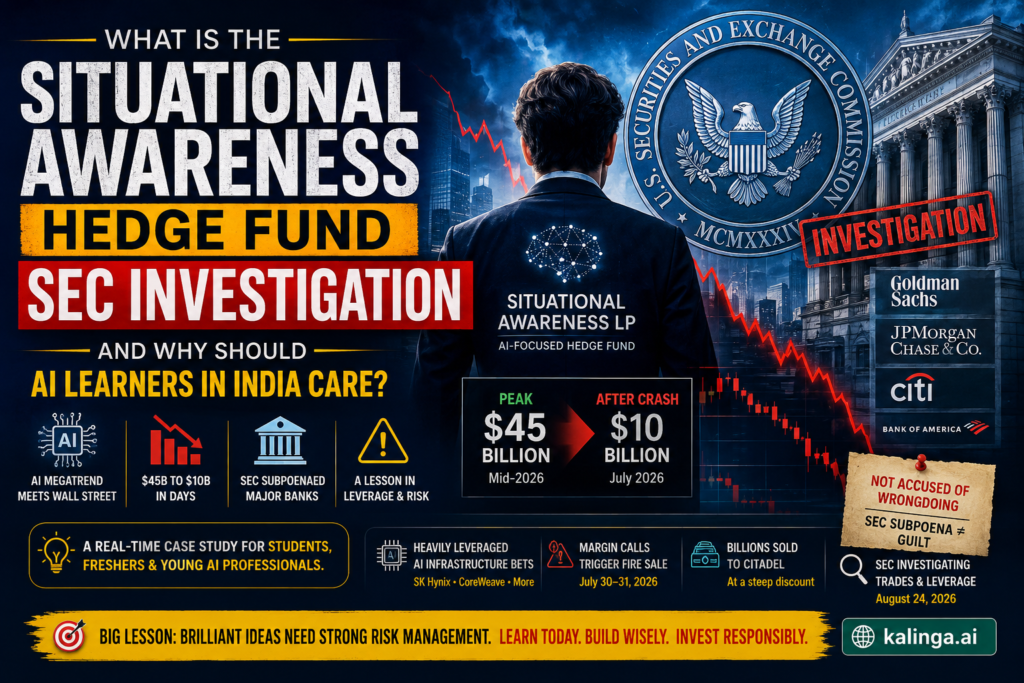
Imagine turning a 165-page essay into a $45 billion hedge fund in under two years, and then watching most of it vanish in a matter of days. That is exactly what happened to Leopold Aschenbrenner’s AI-focused fund, Situational Awareness, and it is now the center of the Situational Awareness hedge fund SEC investigation. In short: the U.S. Securities and Exchange Commission (SEC) has subpoenaed the major Wall Street banks that financed and traded with the fund, seeking records on its trades and its use of borrowed money, after the fund’s dramatic near-collapse in July 2026.
For students, freshers, and young AI professionals in Odisha and across India, this isn’t just Wall Street drama. It’s a real-time case study in what happens when brilliant technical insight meets poor risk management, a lesson worth understanding whether you’re building a career in AI, fintech, or just trying to make sense of the AI boom’s headlines.
What Exactly Is Situational Awareness (the Hedge Fund)?
Situational Awareness LP is an AI-focused hedge fund founded in mid-2024 by Leopold Aschenbrenner, a former OpenAI researcher on the company’s now-disbanded “Superalignment” safety team. A hedge fund is a privately managed investment pool that uses aggressive strategies, including borrowed money, to try to generate outsized returns for wealthy investors and institutions, unlike a typical mutual fund aimed at retail savers.
Aschenbrenner named the fund after his own viral 2024 essay series, also titled “Situational Awareness,” which argued that artificial general intelligence (AGI) was arriving faster than most people realized and would require a massive build-out of chips, data centers, memory, and electricity. He built his entire investment thesis around that essay: bet heavily on the companies powering the AI infrastructure boom.
Who backed Situational Awareness? Early investors reportedly included Stripe co-founders Patrick and John Collison, former GitHub CEO Nat Friedman, investor Daniel Gross, and quantitative trading firm Jane Street. The fund grew from roughly $225 million at launch in late 2024 to somewhere between $30 billion and $45 billion in assets under management by mid-2026, depending on the source and the exact reporting date, an extraordinary growth curve for a fund barely two years old.
Definition: What Is Leverage, and Why Does It Matter Here?
Leverage is the practice of using borrowed money to increase the size of an investment bet beyond what your own capital would normally allow. If you have $1 and borrow $3 more to invest $4 total, you’re using 4x (400%) leverage.
Leverage magnifies gains when you’re right, but it magnifies losses just as fast when you’re wrong, because you still owe the borrowed money regardless of how your bet performs. Situational Awareness reportedly used leverage as high as 400%, meaning a relatively modest market dip could turn into a fund-threatening crisis almost overnight. That is precisely what happened in July 2026.
The Timeline: How a $45 Billion AI Bet Nearly Imploded
Understanding the Situational Awareness hedge fund SEC investigation requires understanding what came before it. Here’s the sequence of events, based on reporting from CNBC, Bloomberg, Reuters, and The New York Times:
- Mid-2024: Aschenbrenner leaves OpenAI and launches Situational Awareness LP with around $225 million, built around his AGI infrastructure thesis.
- Through June 2026: The fund posts massive returns, reportedly around 439% net gains since inception, with some snapshots showing year-to-date returns above 147%. Assets under management balloon toward $30–45 billion.
- Early July 2026: Situational Awareness is near its peak, holding concentrated, leveraged positions in AI infrastructure names like SK Hynix (memory chips) and CoreWeave (AI cloud computing), while also holding bearish bets against software companies like Adobe.
- Late July 2026: A sharp downturn in AI and semiconductor stocks triggers margin calls, demands from lenders that the fund put up more cash or collateral to cover its leveraged positions. Losses mount rapidly.
- July 30–31, 2026: Unable to meet the margin calls, Situational Awareness is forced into a fire sale, offloading its entire public equities portfolio, reportedly around $10–16 billion in positions, to Ken Griffin’s Citadel at a steep discount. Assets under management fall from roughly $45 billion to about $10 billion in a matter of days.
- August 24, 2026: The New York Times reports that the SEC has subpoenaed the banks that handled the fund’s trading and lending, including Goldman Sachs, JPMorgan, Citigroup, and Bank of America, seeking details on trade timing and communications about leverage. This is the SEC investigation that TechCrunch and other outlets are now covering.
Has Situational Awareness been accused of wrongdoing? No. Multiple reports, including TechCrunch’s, explicitly note that Situational Awareness has not been accused of any wrongdoing, and that an SEC subpoena does not automatically mean a firm is a target of enforcement action.
Why Is the SEC Investigating Situational Awareness?
What is the SEC actually looking for? According to The New York Times’ reporting (via TechCrunch, Reuters, and Fortune), the SEC’s subpoenas focus on two things: the precise timing of Situational Awareness’s trades around the margin calls, and the fund’s communications with its lenders about how much leverage it was taking on. Banks were also instructed to preserve all related records.
This kind of inquiry is a routine part of how the SEC operates. The SEC (Securities and Exchange Commission) is the U.S. government agency responsible for regulating securities markets and protecting investors from fraud and manipulation. When a high-profile fund posts dramatic gains and then an equally dramatic collapse, it is standard practice for the SEC to examine what happened, not necessarily because misconduct is suspected, but because concentrated, leveraged losses of this size can carry systemic risk for the broader financial system.
Question: Does an SEC Subpoena Mean Situational Awareness Did Something Wrong?
Not necessarily. Reuters and Fortune both reported that a regulatory inquiry does not automatically lead to enforcement action, and that requesting information from banks does not imply any firm is the direct target of an investigation. Situational Awareness itself released a statement saying scrutiny of high-profile, high-return, high-drawdown funds is “to be expected,” and that it would “cooperate to the fullest extent with any regulatory request.”
Still, the Situational Awareness hedge fund SEC investigation is significant because it is one of the first major regulatory examinations of a fund built almost entirely around the AI infrastructure trade, and its outcome could shape how leveraged AI-focused funds are scrutinized going forward.
Who Is Leopold Aschenbrenner?
Leopold Aschenbrenner is a German-born AI researcher and investor who graduated as valedictorian from Columbia University at age 19 before joining OpenAI’s Superalignment team, a group focused on ensuring advanced AI systems remain safe and controllable. He was fired from OpenAI in April 2024 over an alleged information leak, which he has disputed.
Later that year, he published “Situational Awareness,” a sprawling essay that became required reading across Silicon Valley for its argument that AGI was closer than most policymakers and technologists believed, and that this would trigger enormous demand for compute, chips, and energy. He then turned that thesis directly into a hedge fund bearing the same name, a rare and risky move for someone with, by most accounts, no prior professional experience managing outside capital. Critics have also pointed to his early career stint at FTX, the collapsed crypto exchange run by Sam Bankman-Fried, as a red flag that drew added scrutiny once the fund ran into trouble.
Situational Awareness’s Bet vs. a Typical Diversified Fund
To understand why this collapse happened so fast, it helps to compare Situational Awareness’s approach to how a more conventional, diversified investment fund typically operates.
| Factor | Situational Awareness (as reported) | Typical Diversified Fund |
| Investment thesis | Concentrated, single-theme bet on AI/AGI infrastructure | Spread across sectors, geographies, and asset classes |
| Leverage used | Reportedly up to 400% (4x borrowed capital) | Typically minimal or no leverage |
| Manager experience | First-time fund manager, no prior asset-management track record | Usually years of prior portfolio-management experience |
| Volatility exposure | High, concentrated bets amplified by leverage | Lower, diversification cushions single-sector shocks |
| Response to a downturn | Forced fire sale under margin calls | Gradual rebalancing, smaller drawdowns |
| Regulatory attention after losses | Now subject to an SEC investigation | Lower likelihood of triggering a dedicated probe |
This table illustrates a core lesson in both finance and AI investing: conviction in a technology thesis and prudent risk management are two entirely different skills, and having one does not guarantee the other.
What Does This Mean for AI Investing and the Broader AI Trade?
Is this a sign the AI boom is over? Not according to most analysts. CNBC’s Jim Cramer, for instance, described the forced selling as potentially “a clearing event” that could signal a bottom for the AI trade rather than the start of a broader collapse. What the Situational Awareness episode does highlight is the risk baked into leveraged, single-theme bets on any fast-moving technology trend, AI included.
Why does this matter if you’re not a Wall Street trader? Because the same pattern, huge conviction in a technology’s future, paired with insufficient risk controls, shows up constantly in career decisions, startup bets, and personal investing, not just hedge funds. A few practical takeaways for anyone tracking the AI industry from India:
- Being right about a trend doesn’t protect you from short-term timing risk. Aschenbrenner may ultimately be correct that AGI-driven infrastructure demand will keep growing, but his fund still nearly collapsed because of how the bet was structured.
- Leverage changes the entire risk equation. A 400% leveraged position can be wiped out by a market move that a comfortably diversified portfolio would barely notice.
- Regulatory scrutiny follows visibility. The more prominent and fast-growing a fund, company, or individual becomes, the more attention, including from regulators, it eventually attracts.
- “No wrongdoing” and “under investigation” can both be true at once. It’s important to read financial and tech news carefully; an SEC subpoena is an information request, not a verdict.
- AI infrastructure remains a real, ongoing trend, even when individual bets built around it go badly, chips, data centers, and power demand haven’t disappeared just because one fund overextended itself.
Frequently Asked Questions
What is the Situational Awareness hedge fund SEC investigation about? The SEC has subpoenaed major Wall Street banks, including Goldman Sachs, JPMorgan, Citigroup, and Bank of America, that worked with the AI-focused hedge fund Situational Awareness, seeking records on the timing of its trades and its communications about leverage, following the fund’s near-collapse in July 2026.
Who founded Situational Awareness, and why is it named that? Leopold Aschenbrenner, a former OpenAI Superalignment researcher, founded the fund in 2024 and named it after his own widely read essay, “Situational Awareness,” which argued that AGI-driven demand for compute and infrastructure was underestimated.
How much money did Situational Awareness lose? Reports vary on exact figures, but the fund’s assets under management fell from a peak of roughly $45 billion to around $10 billion within days in late July 2026, after margin calls forced it to sell its entire public equities portfolio to Citadel at a discount.
Has Situational Awareness been accused of any wrongdoing? No. Multiple outlets, including TechCrunch and Reuters, report that Situational Awareness has not been accused of wrongdoing, and that an SEC subpoena to related banks does not necessarily mean the fund itself is a target of enforcement action.
What caused the fund’s near-collapse in the first place? A downturn in AI and semiconductor stocks in July 2026, combined with the fund’s extremely high leverage (reportedly up to 400%), triggered margin calls that forced Situational Awareness to liquidate its leveraged public stock positions rapidly and at a loss.
What is a margin call, in simple terms? A margin call happens when a lender demands that a leveraged investor add more cash or collateral because their existing positions have dropped in value, reducing the safety cushion behind the borrowed money. If the investor can’t meet the call, the lender can force a sale of assets to cover the debt, which is what happened to Situational Awareness.
Following stories like the Situational Awareness hedge fund SEC investigation is a great way to build real-world understanding of how AI, markets, and regulation intersect, the same critical-thinking skills we build into our AI and tech learning tracks at Kalinga.ai. If you’re a student or young professional in Odisha looking to go deeper into applied AI and industry trends, explore our workshops and resources at Kalinga.ai.