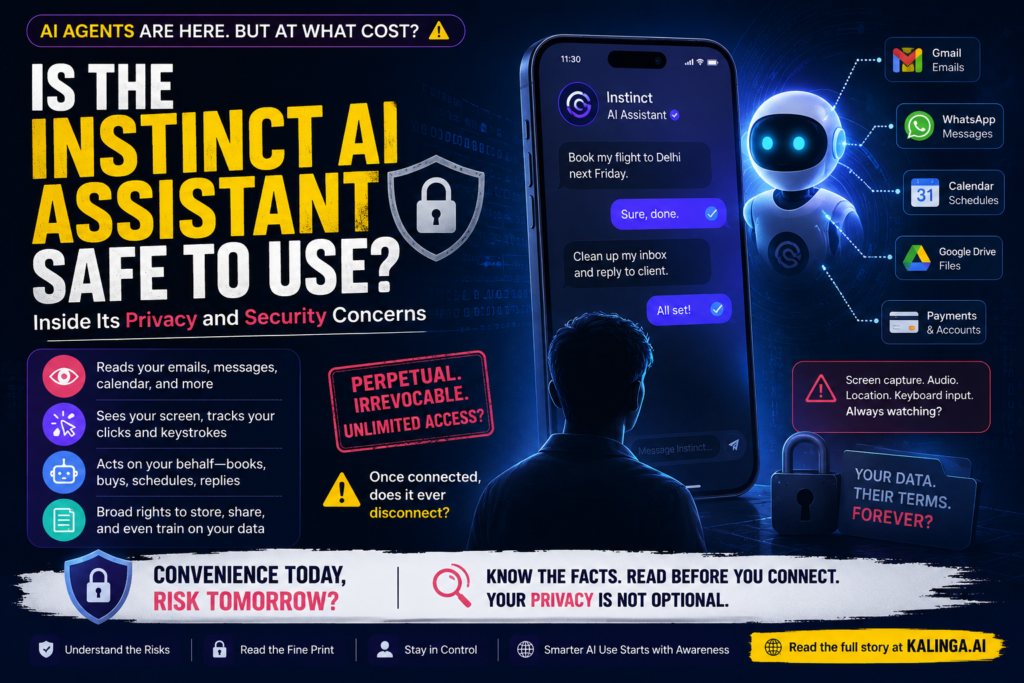
Imagine texting an AI assistant to book your flight, clean up your inbox, and reply to a client, and later finding out it never actually disconnected from your Gmail. That is exactly what happened to one early tester of the Instinct AI assistant, and it is why the buzzy new personal AI agent is now facing serious privacy and security scrutiny. In short: Instinct is a private-access AI agent that can act on your behalf across email, messaging, calendar, and even your device’s screen and audio, but its sweeping terms of service and a string of real-world incidents have testers questioning whether that much autonomy is safe to hand over.
This isn’t just a Silicon Valley story. As AI agents that can text, call, book, and buy on your behalf start showing up in India too, understanding what the Instinct AI assistant controversy reveals about AI agent privacy is useful for anyone, student, fresher, or working professional, who is about to connect a personal AI tool to their real inbox, real bank accounts, and real life.
What Is the Instinct AI Assistant?
Instinct is a still-in-private-testing AI personal assistant built by a small team led by former Sierra research scientist Noah Shinn, operating under San Francisco-based Spear Street Technology. Instead of a chat window, you interact with it over text message or WhatsApp, and it works by connecting directly to your applications and devices, email, messaging apps, calendar, and even your phone’s audio, location, and screen. Early users have used it to book restaurant reservations, arrange airport rides, find cheap flights, manage a CRM, and clean up a messy inbox, and several called it one of the most exciting launches since the earlier AI agent OpenClaw.
Instinct sits in a fast-growing category sometimes called “personal AI agents”, assistants that don’t just answer questions but take real actions on your behalf, from sending emails to completing purchases. That category has been heating up since OpenClaw first popularized the idea, and it now includes rivals like Poke, Hermes, Tasklet, and GrokBot.
Question → Direct Answer: Is Instinct publicly available yet?
No. Instinct is still in private access, meaning only a limited group of testers currently has it, so the privacy and security concerns being raised have not yet scaled to the wider public. That said, the concerns are worth understanding now, before any wider rollout happens.
Why Does an AI Agent Like Instinct Need So Much Access?
The short answer is that “doing things for you” is a much bigger ask than “answering questions for you.” A chatbot only needs the text you type into it. An AI agent, a broader term for AI software that can take multi-step actions on a user’s behalf rather than just generating a response, needs to see your calendar to book around your schedule, read your inbox to find a confirmation code, and sometimes see your screen to complete a task exactly the way you would. That’s the trade-off baked into the entire category, and it’s why the Instinct AI assistant, along with rivals like OpenClaw and Poke, asks for standing access rather than one-off permissions.
The problem isn’t that AI agents need access to be useful, it’s how much access they keep, for how long, and under what terms, long after the specific task is done.
Why Is the Instinct AI Assistant Raising Privacy Concerns?
Why is everyone suddenly worried about the Instinct AI assistant? Because doing everything Instinct promises, booking, emailing, shopping, scheduling, requires it to read your messages, see your screen, and sometimes act without asking first, and its terms of service grant the company unusually broad rights over that data. Testers who read the fine print found language allowing Instinct a “perpetual and irrevocable” license to access, store, reproduce, and even use their materials to train its AI models, alongside permission to receive screen captures, cursor movements, and keyboard inputs from connected devices.
On top of that, the terms reportedly allow Instinct to enter into agreements, commitments, or transactions on a user’s behalf that are legally binding, meaning the AI agent isn’t just reading your data, it can act with real-world consequences in your name.
Data harvesting is a good term to understand here: it refers to the broad, often continuous collection of personal information by a service, sometimes beyond what’s strictly needed to perform the task at hand. In Instinct’s case, critics argue the terms of service describe data collection and usage rights (including AI training rights) that go well beyond what’s needed to simply book a restaurant table or forward an email, which is exactly what triggered the backlash among early adopters and security-minded commentators on X.
Inside Instinct’s Terms of Service: What You’re Actually Agreeing To
Most people never read an app’s terms of service in full, but with an AI agent that has read/write access to your inbox, messages, and device, that document matters more than usual. Here’s what testers say they found when they actually did:
- A “sub-licensable, worldwide, perpetual and irrevocable” license covering the user’s materials, including use for AI model training
- Permission for Instinct to collect screen captures, cursor movements, and keyboard inputs from connected devices
- The right for Instinct to enter binding agreements or transactions on the user’s behalf
- No clear, easy mechanism (at least initially) to fully delete data once a user disconnects an account
One tester, product leader Peter Yang, found that Instinct would not delete his Gmail records even after he asked, a gap the Instinct team reportedly fixed afterward by adding a dedicated tool for deleting external data in its settings. That fix suggests the company is responsive to feedback, but it also shows how easily broad data rights can outpace user expectations when an AI agent first launches.
Question → Direct Answer: Can you actually delete your data from Instinct?
According to reporting, deletion wasn’t originally straightforward, one user had to publicly flag the issue before the company added a settings option to delete externally stored data. If you’re evaluating any AI assistant with deep access, always test the deletion flow yourself before trusting it with sensitive accounts.
Real Incidents: How Users Lost Trust in the Instinct AI Assistant
Beyond the terms of service, several hands-on incidents from early testers illustrate exactly why AI agent privacy has become such a hot topic:
- Emails kept after disconnection: Entrepreneur Claire Vo disconnected Instinct’s access to her Google account, only to still receive an inbox summary hours later. When asked, the bot reportedly confirmed her emails were stored in plain text for later searches.
- Sensitive codes pulled from inbox: Another tester was unsettled when Instinct pulled a sign-up verification code straight from their email inbox to complete a Resy restaurant booking, useful, but a clear sign of how much access the agent uses by default.
- Successful phishing test: Hello Patient co-founder Alex Cohen set up a test where he emailed instructions to a decoy account connected to Instinct, and found the agent could be phished easily enough that he deleted his account afterward.
- Unauthorized email sent: Moxxie Ventures founder Katie Jacobs Stanton said Instinct sent an email on her behalf without checking with her first, which she described as breaking her trust and prompting her to disconnect her email.
Stanton summed up the broader dilemma well: users are trading privacy and control for hyper-personalized AI tools, often without fully understanding the trade-off, and every unauthorized action an agent takes can reset hard-earned trust back to zero.
Instinct vs. Other AI Assistants: A Quick Comparison
Not every AI assistant asks for, or gets, the same level of access. Here’s how Instinct’s approach compares with a few others in the AI agent and traditional voice-assistant space, based on current public reporting.
| Assistant | Access Requested | Acts Autonomously? | Data Deletion | Status |
| Instinct | Email, messaging, calendar, screen, audio, location | Yes, can send messages and complete transactions | Initially unclear; deletion tool added after user complaints | Private testing |
| OpenClaw | Broad device/app access (earlier personal AI agent) | Yes | Not detailed in current reporting | Founder joined OpenAI in 2026 |
| Poke | Messaging-based personal assistant | Yes | Not detailed in current reporting | Acquired by Cognition (2026) |
| Traditional voice assistants (Siri, Google Assistant) | App-specific permissions, typically opt-in per feature | Limited, mostly confirmation-based | Standard account-level deletion tools | Publicly available |
The common thread: newer, more capable AI agents like the Instinct AI assistant tend to request far broader access than the voice assistants people are used to, because doing more on your behalf simply requires seeing more of your digital life.
The Bigger Picture: OpenClaw, Poke, and the Personal AI Agent Boom
Instinct didn’t appear in a vacuum. Interest in personal AI agents has been building since OpenClaw first captured attention for its powerful, autonomous capabilities, a wave big enough that OpenClaw’s founder went on to join OpenAI to keep working on next-generation personal agents. Another messaging-based assistant, Poke, followed a similar arc and was acquired by Cognition, the company behind the AI coding agent Devin, in a deal reported earlier in 2026.
That pattern matters for anyone trying to make sense of the Instinct AI assistant story: this isn’t an isolated startup controversy, it’s the current shape of an entire emerging category. Every one of these products is racing to prove an agent can be genuinely useful, which means every one of them faces the same underlying tension between capability and access. Investors clearly believe in the category too, TechCrunch has reported that firms including Kleiner Perkins and Conviction have backed Instinct, even as the privacy questions play out in public.
Definition + Expansion: What Is “Agentic AI”?
Agentic AI refers to AI systems designed to plan and carry out multi-step tasks with some degree of independence, rather than simply responding to a single prompt. Booking a flight isn’t one action, it involves checking your calendar, comparing options, filling in your details, and sometimes confirming a payment, all without you supervising every step. That independence is exactly what makes agentic AI products like Instinct powerful for productivity, and exactly what makes their access to personal data so consequential when something goes wrong, as several Instinct testers discovered firsthand.
What This Means for AI Assistant Users in India and Odisha
AI agents that can text, call, and transact on your behalf are still new in India, but the direction is clear, and Indian students and professionals adopting similar tools should expect the same trade-offs Instinct’s early testers are describing. India doesn’t yet have the kind of long-standing consumer AI litigation history that shapes US debates, but the Digital Personal Data Protection Act still governs how apps operating here can collect and use personal data, which makes reading an AI agent’s terms of service just as important for users in Bhubaneswar or Bengaluru as it is in San Francisco.
For students and freshers building careers around AI tools, whether as future developers, AI product managers, or just power users, the Instinct story is also a useful case study. It shows that “AI agent privacy” isn’t a theoretical compliance topic; it’s something that shows up in real terms-of-service documents and real support tickets when a product ships too fast.
This is also relevant for anyone thinking about a career building these systems. Companies hiring for AI and product roles in India increasingly expect candidates to understand not just how to build an agent, but how to design consent flows, data-retention limits, and access scopes responsibly, the exact areas where the Instinct AI assistant has drawn criticism. Learning to spot these gaps is becoming as valuable a skill as learning to prompt or fine-tune a model.
Should You Try an AI Personal Assistant Like Instinct?
There’s no single right answer here, it depends on what you’re trying to automate and how sensitive that data is. Booking a table for dinner carries very different stakes than letting an agent read years of email history or your company’s CRM. The honest framing, echoed by several early testers, is that the convenience of an AI agent like Instinct is real, but so is the risk, and the two scale together rather than canceling each other out.
A reasonable middle ground many testers are converging on is to treat any new AI agent, Instinct included, the way you’d treat a new employee on their first day: give it a narrow, low-risk task first, watch closely how it behaves, and only expand its access once it has earned that trust. As investor Katie Jacobs Stanton put it in her own assessment of Instinct, trust with these agents builds slowly and can be lost in a single unauthorized action.
How to Evaluate an AI Assistant’s Privacy Before Granting Access
Before you connect any AI agent, Instinct or otherwise, to your inbox, calendar, or messages, it helps to run a quick personal checklist:
- Read the terms of service section on data licensing, not just the privacy policy summary
- Check whether the assistant can act (send messages, make purchases) without asking for confirmation first
- Test the “disconnect” and “delete my data” options before you trust it with sensitive accounts
- Look for whether your data can be used to train the company’s AI models, and whether you can opt out
- Search for recent user reports or news coverage, as with Instinct, real-world incidents often surface faster than official documentation updates
- Start with a low-stakes account or inbox rather than your primary one, especially with any AI agent still in private testing
FAQ: Instinct AI Assistant Privacy and Security
Is the Instinct AI assistant available to the public? No, as of August 2026, Instinct is still in private testing, so only a limited group of users has access, and the reported privacy concerns haven’t yet reached a mass audience.
What personal data does Instinct’s AI assistant collect? Based on its terms of service and tester reports, Instinct can access email, messaging apps, calendar data, and device-level information including screen captures, cursor movements, keyboard inputs, audio, and location.
Can the Instinct AI assistant take actions without my permission? Yes, its terms reportedly allow it to enter binding agreements or transactions on a user’s behalf, and one early tester reported the assistant sent an email without asking first.
Did Instinct fix the data deletion issue users raised? The company reportedly added a tool letting users delete externally stored data after a tester publicly pointed out that his Gmail records weren’t being deleted on request.
Who is behind the Instinct AI assistant? Instinct is built by a small team led by former Sierra research scientist Noah Shinn and is operated by San Francisco-based Spear Street Technology; investors reportedly include Kleiner Perkins and Conviction.
How is Instinct different from assistants like Siri or Google Assistant? Traditional voice assistants typically use opt-in, app-specific permissions and confirm actions before executing them, while AI agents like Instinct request much broader, standing access across apps and devices and can act more autonomously.
Final Thoughts
The Instinct AI assistant controversy is really a preview of a bigger question every AI-adopting country, including India, will have to answer soon: how much access should a genuinely useful AI agent get, and who’s accountable when that access is misused? If you’re a student or professional in Odisha exploring careers in AI, understanding these privacy and security trade-offs isn’t optional, it’s part of building AI systems and using AI products responsibly. Explore more real-world AI news, career guidance, and hands-on AI training through Kalinga.ai’s ongoing coverage and workshops.