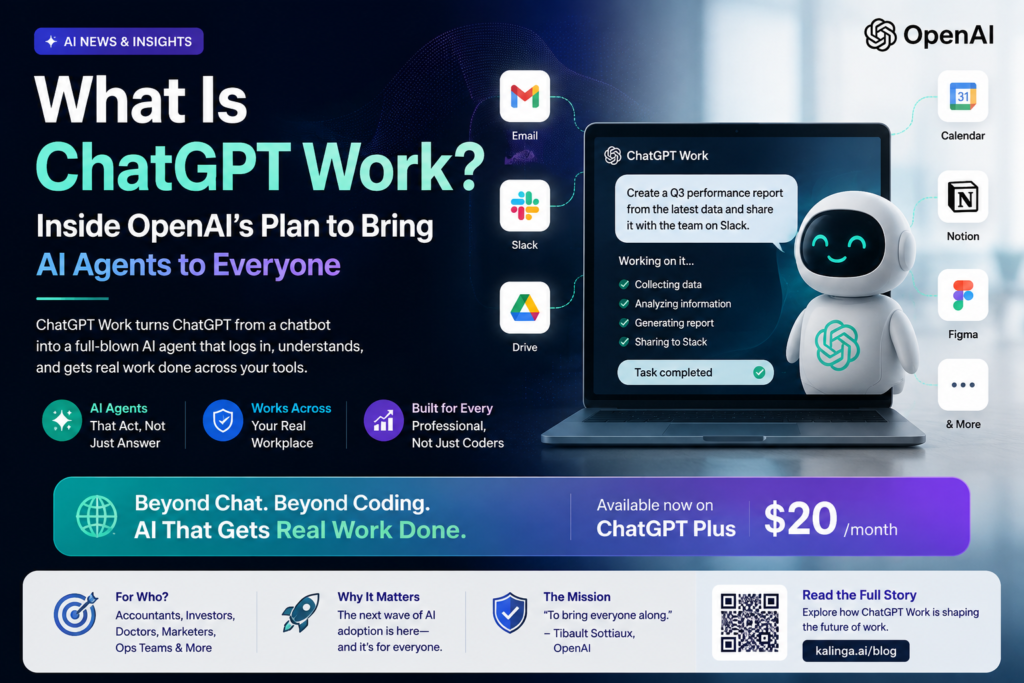
Imagine an AI that doesn’t just answer your questions but actually logs into your inbox, your Slack, and your Google Calendar, and does the task for you. That’s not a thought experiment, it’s ChatGPT Work, OpenAI’s push to turn ChatGPT from a chatbot into a full-blown AI agent for non-engineers. According to a detailed TechCrunch report published on August 24, 2026, ChatGPT Work is OpenAI’s biggest bet on making agentic AI, AI that completes multistep tasks on its own, useful for accountants, investors, doctors, marketers, and basically anyone whose job runs through a computer, not just software developers.
For students, freshers, and young professionals in Odisha and across India tracking where AI careers and tools are headed, ChatGPT Work is worth understanding closely. It signals where OpenAI, and the broader AI industry, thinks the next wave of adoption will come from, and it explains why terms like “AI harness” and “agentic AI” are about to become as common in job descriptions as “Excel” and “PowerPoint.”
What Is ChatGPT Work, Exactly?
ChatGPT Work is OpenAI’s agentic product aimed at non-engineering professionals, a modified version of the company’s Codex coding tool, repackaged so accountants, ops teams, and knowledge workers can get the same “does the task, not just answers the question” functionality that software engineers already enjoy from AI coding agents. It was released last month (relative to the report) and is available on OpenAI’s lowest ChatGPT subscription tier, priced at $20 a month.
The expansion matters because coding has been the one place where AI agents have clearly proven their worth, but that’s still a small slice of all professional work. OpenAI’s own marketing frames the ambition plainly: a world where AI goes beyond answering questions to helping everyone turn their biggest ideas into reality. Tibault Sottiaux, who leads OpenAI’s core product work including Work, put it more bluntly to TechCrunch: “It’s the very mission of OpenAI—to bring everyone along.”
What does ChatGPT Work actually do differently from regular ChatGPT? Regular ChatGPT mostly answers questions inside a chat window. ChatGPT Work is connected, with permission, to your real digital workspace: email, Slack, cloud drives, Notion, Figma, calendars, and other SaaS tools. Instead of telling you how to build a report, it can go build the report, pull the data, and drop it wherever you need it.
Why OpenAI Is Betting Big on AI Agents Beyond Coding
The commercial logic behind ChatGPT Work is straightforward: agents that work for longer stretches burn through more tokens (units of text an AI model processes), which makes them more lucrative for OpenAI on a per-user basis. Reaching professions beyond software engineering isn’t just nice to have, it’s necessary for AI labs to justify the enormous cost of training and running these models.
There’s also competitive pressure. Vertical-specific AI startups like Harvey (built for law) and Clay (built for sales) have been chasing the same customers with a model-agnostic approach, meaning they plug in whichever AI model performs best at any given time rather than betting on one lab. Industry analyst Christian Catalini captured the stakes on a16z’s blog: if the big AI labs can’t quickly get hold of the “key complementary assets” needed to scale AI in the real world, the value will simply accrue somewhere else in the stack.
How many people are actually using agentic AI at work right now? Not many, according to an OpenAI-backed study cited in the report. In June, 98% of OpenAI’s own employees were using Codex internally, but only 17% of organizational (business) subscribers and less than 1% of individual ChatGPT subscribers were using the agentic coding tool. That massive gap between internal and external adoption is exactly the problem ChatGPT Work is trying to solve.
Sottiaux frames the bet this way: “The more value and the more utility that we generate for users, the more they will be willing to also pay for some part of that utility… You sit there and you’re like, ‘of course I want to pay $20 bucks a month for this,’ because the value that you get is so much more.”
What Is an AI “Harness” and Why It Matters for ChatGPT Work
Harness is the technical term engineers use for the software layer wrapped around an AI model that decides what information the model sees, which tools it’s allowed to use, and how it presents its answers back to the user. Think of the model itself as the engine and the harness as everything else in the car, the dashboard, the steering wheel, the safety systems that make the raw power usable and safe.
For software developers, a simple command-line interface (CLI) was enough to change how code gets written, because developers are comfortable typing commands into a terminal. But as the report notes, “most people aren’t using CLIs; there’s a reason Windows replaced DOS.” Building an agent for accountants or doctors means designing a harness that works in “the messy world of your life and your tools and websites that were built in 1995 and never updated,” as OpenAI’s Andrew Ambrosino, lead engineer for the desktop app, told TechCrunch.
This is precisely why ChatGPT Work exists as a separate product rather than just a smarter prompt box: the harness, buttons, permission dialogs, project selectors, plugin menus, is what makes agentic AI usable by people who aren’t going to learn a coding tool first.
Why does OpenAI still add “unnecessary” buttons if the model can just be asked directly? Because discoverability still matters at this stage of AI adoption. Ambrosino explained that some OpenAI employees internally argue buttons are pointless if users can simply type a request. His team’s response: “We push back on that, because it’s very early. Discoverability matters in this phase, and at some point we won’t have the button.” He compares this to skeuomorphism, the old design trick of making a calculator app look like a physical calculator to ease the transition to digital tools.
Even with all that design work, ChatGPT Work’s own numbers show the gap it still has to close: OpenAI wouldn’t break out separate figures for Work versus Codex, but the combined app is used by about 20 million people, compared to the more than one billion users OpenAI says prompt ChatGPT online.
ChatGPT Work vs Claude Cowork vs OpenAI Codex
Since ChatGPT Work sits in the same category as Anthropic’s Claude Cowork and OpenAI’s own Codex, it helps to see how the three compare on what the TechCrunch report actually documents.
| Feature | ChatGPT Work | Claude Cowork | OpenAI Codex |
| Built for | Non-engineering professionals (finance, ops, comms, etc.) | Non-developer knowledge work | Software engineers |
| Price | $20/month (OpenAI’s lowest tier) | Not detailed in the report | Included in Codex plans |
| Interaction style | “Magic box”, aims to just do the task autonomously | Back-and-forth, presents options before acting | Originally built for near-full autonomy, later added more interaction |
| Reported user base | ~20 million (combined with Codex) | Not disclosed in the report | More popular by download until April 2026; Codex has since taken a slight lead |
| Design philosophy | Skeuomorphic buttons to aid discoverability | Iterative check-ins, continual updates | Shifted from full autonomy to more human interaction over time |
Ethan Mollick, a Wharton School professor who studies AI tools at work, summed up the philosophical split well, writing that “ChatGPT tends to want to do magic & just do it for you, while Claude does comparisons & shows them, repeatedly asking for input & feedback and doing A & B tests.” OpenAI’s Sottiaux disagrees with the caution: “We definitely see that the world seems to be ready” for the more autonomous, conversational approach.
Real-World Use Cases: What Can ChatGPT Work Actually Do?
The report describes several concrete tasks people are already handing to ChatGPT Work:
- Weekly metrics reports, OpenAI employees use it to auto-generate recurring business reports.
- Spreadsheet-based planning tools, turning raw spreadsheets into working planning dashboards.
- Investment memos, venture capitalists use agents to assemble communications and analysis about companies into memos.
- Auto-updating dashboards, the TechCrunch reporter had it build a financial-analysis dashboard for publicly traded companies he covers.
- Data extraction across apps, pulling a child’s oddly formatted preschool calendar out of an email and correctly populating Google Calendar.
- Personal planning, OpenAI CEO Sam Altman has reportedly used it to plan his own vacations.
- Chart generation from conversations, one OpenAI engineer asked it to review a Slack thread about an engineering problem and “make some charts,” and got back a set of genuinely useful plots.
Akshay Nathan, who leads OpenAI’s product engineering team, explained the underlying idea: “There is a deluge of information for the average worker… We’re actually quite limited by our ability to parse everything that’s available to us, and then take action on it.” ChatGPT Work, in this framing, is less a chatbot upgrade and more an attempt to build a true digital personal assistant, in the same space as Claude Cowork and Perplexity’s AI browsing agent.
Challenges: Why Mainstream AI Agent Adoption Is Still Hard
The TechCrunch reporter’s own hands-on testing surfaced several rough edges that explain why agentic AI hasn’t gone mainstream yet, even with a product as polished as ChatGPT Work:
- Confusing permissions, trying to grant only “read” access to a cloud drive repeatedly failed; a mobile dialog eventually explained that only full access would work.
- Split settings across apps, many important controls exist only on the web app, forcing users to work in both the web and mobile apps simultaneously.
- Odd feature gaps, ChatGPT Work can create new calendar events but cannot create new calendars entirely.
- “Effort level” confusion, unless you manually set the reasoning effort to high, the results can be, in the words of AI early adopters cited in the piece, like working with “the worst intern you’ve ever worked with.” Joe Gershenson, engineering lead for OpenAI’s harness, admitted this isn’t intuitive yet: “there are things that we can do better to help them get the right level of reasoning… Watch this space.”
- Hard-to-evaluate output, unlike code, which either works or doesn’t, a good business strategy, presentation, or sales pitch is much harder to judge automatically, making it harder for OpenAI to know when an agent is actually doing good work.
- Real cost surprises, the reporter used more than 80 million tokens in four days on the $20/month plan, which he calculated cost OpenAI roughly $65 to serve, over 3x the subscription price for four days of casual use. Sottiaux responded by pointing to a recent 80% price cut on OpenAI’s Luna model and said efficiency work is ongoing.
To figure out what tasks are actually worth building for, OpenAI leans on a benchmark called GDPVal, drawn from 44 occupations and hundreds of knowledge-work tests, supplemented with real user feedback and OpenAI employees’ own usage patterns as an informal signal.
Why the Underlying “Harness” Debate Matters More Than the App
There’s a deeper technical argument playing out behind ChatGPT Work’s design, tied to what AI researchers call the “bitter lesson”, the repeated finding that a better general-purpose model tends to beat clever, narrow engineering tricks over time. Gershenson, who leads OpenAI’s harness team, put it directly: “You could get good results in the short term by adding a whole bunch of extras, if and thens and tools, but… the next model is going to come out in a couple of months and make that obsolete.”
That view isn’t universal, though. Benchmarks from companies like Composio and Databricks show that different harness-and-model combinations produce meaningfully different results even on identical tasks. Databricks specifically found that Pi, an open-source harness built by a company called Earendi, outperformed Codex while running the same underlying GPT model. Pi’s creator, Mario Zechner, argues that big labs push their own harnesses mainly to lock in users: “They need to own the entire stack; otherwise, they just become a model provider.” He also points out a real limitation of today’s agents: “Everything is coding agent shaped… the reason is that they only have training data for coding agent tasks.” Decisions in fields like management, where outcomes only show up months later, simply aren’t captured in the kind of quick back-and-forth data that trains these agents well.
What ChatGPT Work Means for Students and Professionals in India
For Kalinga.ai’s audience, students, freshers, and early-career professionals across Odisha and India, the ChatGPT Work story is a preview of where employers’ expectations are heading. The skill gap OpenAI is racing to close inside its own walls (98% internal adoption vs. under 1% for individual subscribers) is the same skill gap that will show up in Indian workplaces over the next few years: knowing how to direct an AI agent, set up permissions safely, and judge its output will matter as much as knowing how to use a spreadsheet does today.
Whether the agent in question is ChatGPT Work, Claude Cowork, or something built on an open harness like Pi, the underlying skill, agentic AI literacy, is transferable. That’s exactly the gap AI-education platforms in India are trying to close before it becomes a hiring bottleneck.
FAQ: Common Questions About ChatGPT Work
Is ChatGPT Work available in India? The TechCrunch report doesn’t specify country-level availability. ChatGPT Work is described as available on OpenAI’s lowest ChatGPT subscription tier at $20/month; readers should check OpenAI’s official pricing and availability pages for the most current regional details.
How much does ChatGPT Work cost? According to the report, ChatGPT Work is available on OpenAI’s lowest ChatGPT subscription tier, priced at $20 a month, the same entry-level price as standard ChatGPT Plus.
Is ChatGPT Work the same as OpenAI Codex? Not exactly. ChatGPT Work is described as a modified version of Codex, OpenAI’s coding-focused agent tool, adapted so non-engineers, like finance, communications, and operations teams, can use similar agentic capabilities without needing to understand code.
What is an “AI harness” in simple terms? An AI harness is the software layer around an AI model that controls what information the model can see, which tools it’s allowed to use, and how its answers get shown to the user. It’s the difference between a raw AI model and a usable product.
How does ChatGPT Work compare to Claude Cowork? Both are agentic products aimed at non-developer knowledge workers, connecting AI models to real workplace tools like email and calendars. The report notes a philosophical difference: ChatGPT Work aims for a more autonomous “magic box” experience, while Claude-based tools have historically favored more back-and-forth interaction, presenting options before acting.
Why hasn’t agentic AI adoption spread beyond software engineers yet? The TechCrunch report points to several reasons: confusing permission setups, output that’s harder to evaluate than code (a good sales pitch isn’t as clearly “right” or “wrong” as working software), unintuitive “effort level” settings, and real cost overruns relative to subscription prices.
Keep Up With Where AI Careers Are Headed
Agentic AI tools like ChatGPT Work are reshaping what “AI-ready” means for the next generation of Indian professionals, not just prompting a chatbot, but directing an AI agent through real workflows. If you want to build that kind of hands-on, job-ready AI skill set, explore Kalinga.ai’s AI training programs and workshops designed for students and young professionals across Odisha and India.