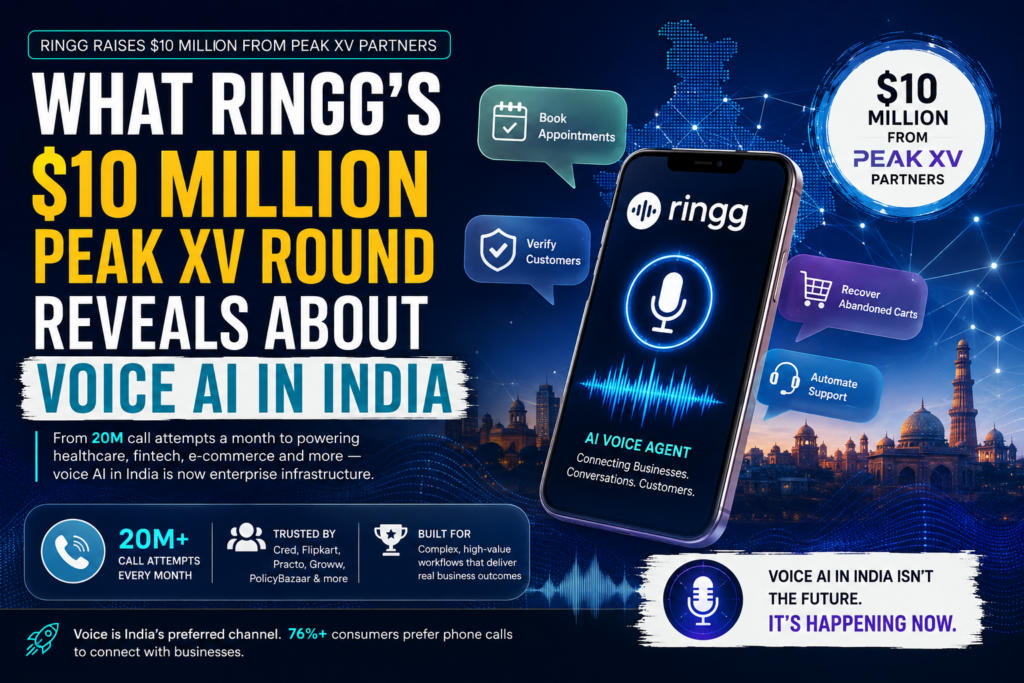
Picture a healthcare app booking follow-up visits across 1,200 clinics without a single human on the phone, that’s already happening in India today. Ringg, a Bengaluru-based startup, just raised $10 million from Peak XV Partners as an extension of its Series A, taking its total round to $15.5 million, and the deal is one of the clearest signals yet that voice AI in India has moved from novelty to serious enterprise infrastructure. The bet, backed by real usage numbers, is that companies across India will keep replacing manual call center work with AI voice agents that can book appointments, verify customers, and recover abandoned carts at scale.
This matters far beyond one startup’s cap table. Voice AI in India sits at the intersection of a massive phone-first consumer base, a crowded and fast-consolidating startup landscape, and a hiring market that’s actively looking for people who understand how these systems are built and deployed. If you’re a student, fresher, or young professional trying to figure out where AI careers in India are actually headed, this funding round is a useful case study.
What Is Ringg and Why Did Peak XV Just Back It Again?
Ringg is an enterprise voice AI company that builds automated voice agents capable of handling business calls, from customer support to appointment scheduling, without a human agent on the line. The startup didn’t start out this way. It began as DesiVocal, a text-to-speech company, before its founders realized that training their own speech models from scratch was too expensive to be a standalone business.
That pivot up the stack, from raw speech models to full voice AI agents for enterprises, is what eventually attracted investors. Indian fintech Cred became Ringg’s first customer, and the client list has since grown to include Flipkart, Practo, Groww, and PolicyBazaar. Today, Ringg processes 20 million call attempts a month, a scale that helps explain why Peak XV Partners chose to double down rather than wait for a fresh priced round.
Why does the funding matter for voice AI in India specifically? Because it confirms that investors see enterprise voice automation as a durable, high-volume category in the Indian market, not a short-lived pandemic-era experiment. Peak XV’s Rishen Kapoor pointed to Ringg’s technical depth, the fact that it started as a research lab building its own models, as the reason the company can now handle complex, “hard-won” enterprise workflows instead of just simple outbound calling.
How Big Is the Opportunity for Voice AI in India Right Now?
Question: Why is voice still the preferred channel for Indian consumers? Because phone calls remain deeply embedded in how Indians expect to interact with businesses. According to a Truecaller study, more than 76% of consumers in India prefer talking to businesses over a phone call rather than chat, email, or app-based support. That single data point is arguably the biggest reason voice AI in India has become such a hot investment category in 2026.
Voice AI is a broad term for artificial intelligence systems that can understand spoken language, generate natural-sounding speech, and carry on a conversation to complete a task, booking an appointment, verifying a customer’s identity, or answering a support query. In India’s case, voice AI in India isn’t just about convenience; it’s about matching automation to a market where hundreds of millions of people are far more comfortable speaking than typing, especially outside major metros.
That preference creates a genuinely large addressable market. Every bank, e-commerce company, healthcare app, and insurance provider that wants to reduce call center costs while keeping the phone-first experience customers expect has to solve this problem somehow, and that’s exactly the wedge Ringg and its competitors are chasing.
From DesiVocal to Ringg: A Pivot That Shaped the Product
Ringg’s origin story is a useful lesson in how AI startups in India are evolving their strategies. Co-founder Siddharth Tripathi told TechCrunch that the company’s early bet on high-volume, low-complexity use cases, outbound calling, lead qualification, loan collection, turned out to be a weak long-term strategy.
Question: Why did Ringg move away from simple, high-volume calling use cases? Because those use cases aren’t “sticky”, meaning customers don’t stay locked in, since any competitor offering a slightly lower price can win the account. Tripathi explicitly said this dynamic turns the business into “always going to be a price game,” which is a dangerous place to compete from a margin standpoint.
So Ringg shifted toward more complex, harder-to-replicate workflows: appointment booking for healthcare clinics, abandoned-cart recovery for e-commerce, and onboarding or KYC (“know your customer”) checks for fintech apps, tasks that require more judgment and integration depth, and are therefore harder for a rival to copy overnight. This is precisely the kind of strategic pivot that’s becoming a recurring theme across voice AI in India: move from being a cheap utility to owning a valuable, complex outcome.
What Enterprise Use Cases Is Ringg’s Voice AI Powering Today?
Ringg’s current product spans several concrete, high-stakes workflows rather than generic call automation. Its expansion beyond pure phone calls is also worth noting, since voice calls still make up over 70% of Ringg’s business, but the company has begun branching into chat, WhatsApp, and even browser-based support automation for clients like Shell.
Here’s a snapshot of where Ringg’s voice AI is actually deployed:
- Healthcare appointment booking: Ringg’s voice agent runs across 1,200 clinics for the healthcare app Practo, helping patients book visits and follow up after appointments.
- E-commerce recovery: Automated outreach to recover abandoned shopping carts, a use case aimed at revenue recovery rather than cost-cutting.
- Fintech onboarding and KYC: Voice-driven identity verification and onboarding checks for financial apps, an area where accuracy and compliance both matter.
- Multichannel support: Chat and WhatsApp automation alongside voice, plus browser-based support automation for select enterprise clients.
- Legacy outbound use cases: Lead qualification and loan collection calling continue, though the company has deliberately deprioritized them as its core growth driver.
This range illustrates a broader shift happening across voice AI in India: the market is moving away from single-channel, single-task bots toward what Tripathi described as “a platform for agents that bring outcomes or get things done,” rather than narrowly defined voice bots.
Who Else Is Building Voice AI in India?
Voice AI in India is a genuinely crowded field, and Ringg’s funding round is best understood in the context of a layered competitive stack: model makers that build the underlying speech technology, orchestration platforms that route tasks between models, and application-layer companies that own the actual customer relationship and outcome.
| Company | Layer in the Stack | Focus Area |
| Ringg | Orchestration + application | Enterprise voice agents for healthcare, fintech, e-commerce |
| Sarvam | Model maker | India-focused foundation models, reached unicorn status via a $234M round |
| Smallest.ai | Model maker | Ultra-fast, human-sounding voice AI models |
| Deepgram | Model maker | Speech recognition infrastructure, global player active in India |
| ElevenLabs | Model maker | Voice generation and cloning, globally used speech models |
| Cartesia | Model maker | Efficient voice AI models designed to run in constrained environments |
| Bolna / Blue Machines | Orchestration | Competing directly with Ringg’s layer of the stack |
| Gnani / Arrowhead | Application (sector-focused) | Voice AI concentrated specifically on finance workflows |
Question: Does owning the underlying AI model actually matter if you’re an orchestration company? According to Peak XV’s Rishen Kapoor, yes, Ringg’s technical depth from building its own speech recognition and generation models is what lets it execute complex, high-value workflows like merchant onboarding and multi-level (L1/L2) customer support with consistency, rather than stitching together third-party APIs. Tripathi has said Ringg would eventually like to own the full voice stack, including infrastructure and deployment, but for now that remains too costly, so the company operates as an orchestration layer that routes tasks to different models depending on the use case.
This layered structure is exactly why so many companies can claim to be “voice AI in India” players simultaneously, they’re often not competing at the same level of the stack at all.
How Is Ringg Positioning Itself Globally From India?
Most of Ringg’s customers are based in India, with a smaller footprint in the Middle East and the U.S. Rather than chase direct sales to American enterprises, the company’s strategy is to partner with Global Capability Centers (GCCs), offshore hubs that multinational companies increasingly rely on for back-office and customer support work.
GCC stands for Global Capability Center, an offshore unit that a multinational company sets up in a country like India to handle functions such as IT support, finance, HR, or customer service. Global Capability Centers have grown rapidly across Bengaluru, Hyderabad, and Pune over the past several years, and Ringg’s plan is to sell automation capacity to these centers alongside their existing human support teams, rather than trying to replace them outright with a direct-to-enterprise sales motion in the U.S.
This GCC-first strategy is a notable data point for how voice AI in India is being commercialized: instead of a straightforward SaaS export model, companies like Ringg are embedding themselves into India’s existing offshore services ecosystem.
What Does This Mean for Students and Job Seekers in India?
Ringg currently has 40 employees, with more than 15 hired in just the last three months, a hiring pace that reflects how quickly the company is scaling after this raise. The roles it’s actively recruiting for are worth paying attention to if you’re mapping out a career in applied AI.
- Forward-deployed engineers: Roles that blend technical implementation skills with product management, essentially engineers who work directly with enterprise clients to customize and deploy the voice AI system.
- Applied researchers: Positions focused specifically on bringing down the cost of running Ringg’s speech models, a core technical challenge across nearly every voice AI in India company.
- Adjacent skill areas: Given the company’s multichannel expansion into chat and WhatsApp automation, familiarity with conversational AI design and workflow orchestration is increasingly valuable, not just pure model training.
For students and freshers in Odisha and across India, this is a reminder that the fastest-growing AI jobs aren’t always at the foundation-model layer. A huge amount of hiring demand sits in the orchestration and application layers, companies like Ringg that need people who can combine AI fluency with product thinking, domain knowledge (healthcare, fintech, e-commerce), and the ability to work directly with enterprise clients.
Is This Part of a Bigger Funding Wave in Indian AI?
Ringg’s raise doesn’t exist in isolation, it’s one data point in a broader surge of capital flowing into voice AI in India and adjacent categories through 2026. Sarvam became one of India’s newest AI unicorns with a $234 million round, while Smallest.ai raised $13 million to build faster, more human-sounding voice models. Globally, Deepgram raised $130 million at a $1.3 billion valuation, and ElevenLabs closed a $500 million round at an $11 billion valuation, both signals that speech and voice technology are attracting serious late-stage capital, not just early experimentation money.
Question: Why are investors so focused on voice AI in India specifically, rather than text-based chatbots? Because voice solves a distribution problem that text-based AI simply can’t in the Indian market. With over three-quarters of consumers preferring phone-based interactions, a voice-first product meets people where they already are, instead of asking them to adopt a new interface like a chat widget or an app. That’s a structural advantage that’s hard to replicate through marketing alone, and it’s why investors like Peak XV are willing to back the same company twice within a single year.
There’s also a consolidation dynamic worth understanding. As Ringg’s own trajectory shows, moving from a text-to-speech model builder (DesiVocal) to an orchestration and application company, many voice AI in India startups are being forced to pick a lane. Building foundation models is capital-intensive and increasingly dominated by well-funded specialists like Sarvam and Smallest.ai. That’s pushing newer entrants and pivoting startups toward the orchestration and application layers, where owning the customer relationship and the business outcome, not the underlying model, is what actually captures long-term value.
For anyone tracking the Indian AI sector as a whole, that’s the pattern to watch: money is increasingly rewarding companies that can prove measurable business outcomes (patients booked, carts recovered, KYC checks completed) rather than companies that simply claim technical sophistication. Ringg’s pivot away from “high-volume, low-complexity” calling toward outcome-based enterprise workflows is a case study in that exact shift, and it’s likely to shape how the next wave of voice AI in India startups position themselves to investors.
FAQ: Ringg, Peak XV, and Voice AI in India
How much funding did Ringg raise from Peak XV Partners? Ringg raised $10 million from Peak XV Partners as an extension of its Series A round, bringing the total Series A funding to $15.5 million after an earlier $5.5 million raise earlier in 2026.
What industries does Ringg’s voice AI serve? Ringg’s enterprise clients span healthcare (Practo), fintech (Cred, Groww, PolicyBazaar), and e-commerce (Flipkart), covering use cases like appointment booking, KYC onboarding, and abandoned-cart recovery.
Is voice AI in India limited to phone calls? No. While voice calls still account for over 70% of Ringg’s business, the company has expanded into chat, WhatsApp, and browser-based support automation, reflecting a broader industry shift toward multichannel AI agents.
How many call attempts does Ringg process each month? Ringg processes 20 million call attempts a month, a scale the company points to as evidence that demand for automated voice interactions in India continues to grow.
Who are Ringg’s main competitors in voice AI in India? Ringg competes with orchestration-focused startups like Bolna and Blue Machines, while model makers such as Sarvam, Smallest.ai, Deepgram, ElevenLabs, and Cartesia operate at a different layer of the same voice AI stack, and sector-focused players like Gnani and Arrowhead concentrate on finance.
What career opportunities does the growth of voice AI in India create? Companies like Ringg are hiring forward-deployed engineers and applied researchers focused on reducing model costs, signaling strong demand for professionals who can pair AI skills with product thinking and domain expertise, not just core model research.
What Should You Actually Watch Next?
If you’re following voice AI in India as a market rather than just a single funding headline, a few signals are worth tracking over the coming months. First, watch whether Ringg’s GCC-partnership strategy actually converts into meaningful international revenue, since selling automation capacity alongside human teams inside Global Capability Centers is a fundamentally different playbook than direct enterprise sales abroad. Second, watch the model-layer consolidation, with well-capitalized players like Sarvam, Smallest.ai, Deepgram, ElevenLabs, and Cartesia all competing to be the default speech engine, it’s likely that some orchestration companies currently building their own models, including Ringg, may eventually choose to license rather than build everything in-house.
Third, and most relevant if you’re early in your career, keep an eye on which companies in this space are hiring for hybrid roles rather than pure research positions. Ringg’s own hiring pattern, forward-deployed engineers who combine technical skill with client-facing product work, is likely to repeat across the sector as voice AI in India companies move from pilots to full enterprise deployments. That shift rewards people who understand both the technology and the business workflow it’s replacing, which is a very different skill set than pure model training.
Where to Go Next
If stories like Ringg’s funding round make you want to actually understand how voice AI agents, orchestration layers, and enterprise AI workflows are built in practice, that’s exactly the kind of hands-on skill Kalinga.ai’s AI training programs are designed to teach students and young professionals across Odisha. Explore Kalinga.ai’s workshop offerings to start building applied AI skills rather than just reading about them.