AI is no longer just answering questions. It is starting to do the work.
For years, businesses adopted artificial intelligence primarily through chatbots, recommendation engines, predictive analytics, and generative AI tools. Employees used AI to write emails, create content, summarize documents, generate code, and analyze information.
But 2026 is bringing a significant shift.
The conversation is moving from “What can AI tell me?” to “What can AI do for me?”
This is where Agentic AI is becoming one of the most important trends in artificial intelligence.
Recent enterprise research shows that AI agents are moving into real workflows, particularly in software development and other knowledge-work functions. McKinsey’s 2026 global survey found that 40% of respondents from organizations with more than $1 billion in annual revenue reported scaling AI agents, compared with 27% the previous year.
What Is Agentic AI?
Traditional generative AI primarily responds to prompts.
You ask a question, and it generates an answer.
An AI agent goes a step further.
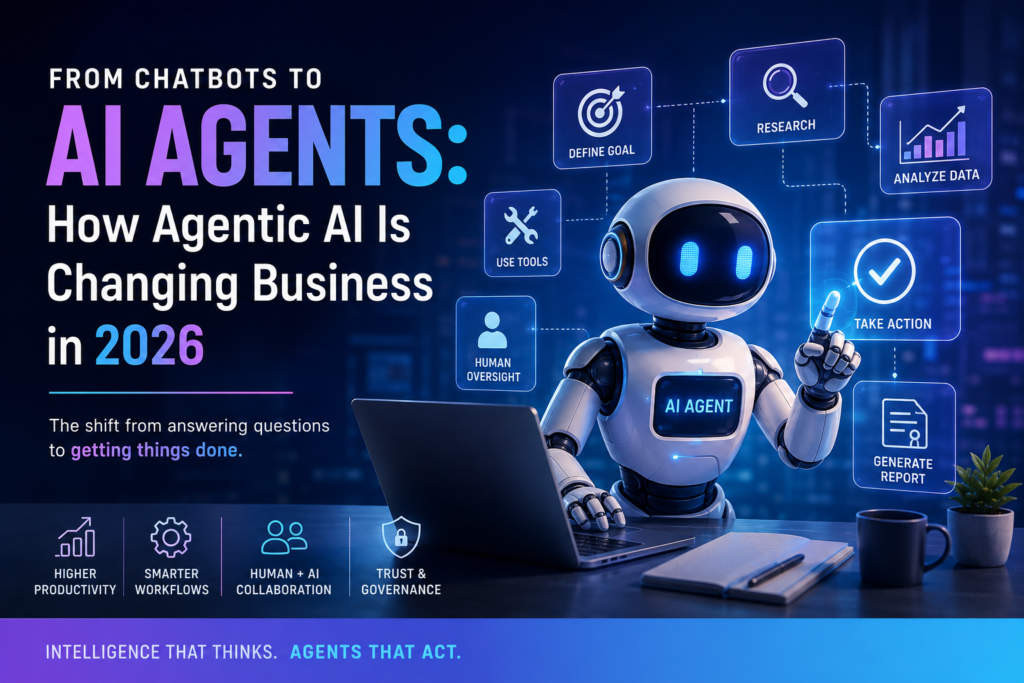
An Agentic AI system can understand an objective, break it into smaller tasks, decide which tools or information it needs, execute actions, evaluate results, and continue working toward the desired outcome.
For example, instead of asking an AI:
“Write a sales report.”
You could give an AI agent a broader objective:
“Analyze this month’s sales data, identify underperforming segments, compare them with last month, prepare a report, and highlight the actions our sales team should take.”
The difference is significant.
The first is AI assistance.
The second is AI execution.
The Shift From Copilots to Digital Workers
The first wave of workplace AI was largely based on the copilot model.
AI sat alongside employees and helped them work faster.
It could:
- Draft emails
- Summarize meetings
- Generate presentations
- Write code
- Analyze documents
- Research topics
- Create marketing content
Agentic AI introduces another model: delegation.
Instead of performing every step manually, an employee can give an agent a goal and allow it to perform multiple steps.
OpenAI’s latest enterprise research describes this transition as a movement from assistance toward delegation, with agents increasingly being given the context and tools required to complete substantive tasks.
This could fundamentally change how organizations think about software.
Why Agentic AI Is Trending in 2026
Several developments are accelerating the adoption of AI agents.
1. AI Can Execute Multi-Step Tasks
Modern AI systems are becoming better at reasoning through complex workflows.
An agent can potentially:
- Understand a business objective
- Search relevant information
- Analyze data
- Make a decision
- Use external software
- Produce an output
- Ask for human approval when required
This makes AI considerably more useful than a standalone chatbot.
2. AI Agents Are Moving Into Enterprise Workflows
AI agents are no longer limited to experimental projects.
Organizations are exploring them across:
- Software development
- Marketing
- Sales
- Customer support
- Recruiting
- Finance
- Legal operations
- Research
- IT operations
- Data analysis
OpenAI’s enterprise data, for example, shows substantial growth in agentic coding usage across functions such as legal, sales, recruiting and marketing.
Google is also pushing deeper into industry-specific agents. In August 2026, the company introduced Gemini Enterprise for Legal, designed to support legal workflows using AI agents and integrations with legal software and data platforms.
The broader pattern is clear: AI is moving from general-purpose assistance toward industry-specific execution.
3. AI Agents Are Starting to Use Computers
One of the most interesting developments is computer-use AI.
Instead of simply generating text, AI systems can increasingly interact with digital interfaces.
That means an AI agent could potentially:
- Open a website
- Read information
- Fill out forms
- Move information between applications
- Work with spreadsheets
- Navigate dashboards
- Perform repetitive browser tasks
This brings AI closer to becoming a digital employee rather than simply a digital consultant.
However, computer-use systems still face reliability, security and privacy challenges, particularly when they are given access to sensitive systems or data.
4. AI Agents Are Learning to Work With Other AI Agents
The next stage could be even more interesting.
Imagine a business workflow involving multiple specialized agents:
Marketing Agent → Research Agent → Content Agent → Design Agent → Analytics Agent
Instead of one AI trying to do everything, different agents could specialize in different tasks.
This is creating demand for standards that allow AI agents to communicate with one another.
For example, Google’s Agent2Agent (A2A) protocol is being developed as an open communication standard for AI agents, with the goal of improving interoperability between agents built by different providers.
This could eventually lead to something resembling a digital organization, where specialized AI systems collaborate to complete business processes.
What Could This Mean for Businesses?
The biggest opportunity isn’t simply reducing the amount of work employees do.
It is redesigning how work gets done.
Consider a digital marketing agency.
A traditional workflow might look like:
Client → Account Manager → Research → Content Writer → Designer → Ads Manager → Analyst
An agentic workflow could potentially become:
Client Objective → AI Orchestrator → Specialized Agents → Human Approval → Execution → Analytics
The AI could coordinate research, content generation, campaign analysis and reporting while humans focus on strategy, creativity, client relationships and decision-making.
This doesn’t necessarily mean replacing the team.
It means giving the team digital leverage.
The Rise of AI-Powered Business Operations
Agentic AI could eventually become an operational layer across an organization.
Imagine an AI system that monitors your CRM.
A new lead arrives.
The agent could:
- Analyze the lead
- Research the company
- Identify the decision-maker
- Score the opportunity
- Prepare a personalized outreach message
- Update the CRM
- Assign the lead to the appropriate salesperson
- Schedule a follow-up
- Notify the sales team
A human could remain responsible for approving important actions while AI handles the repetitive operational work.
This is where Agentic AI becomes much more powerful than a chatbot.
But There Is a Major Problem: Trust
The more autonomy we give AI, the more important control becomes.
An AI that generates an incorrect paragraph is inconvenient.
An AI that sends an incorrect email, changes a financial record, deletes data, or makes an unauthorized purchase is a much bigger problem.
That’s why the future of enterprise AI will not simply be about building smarter models.
It will be about building safer AI systems.
Organizations need:
- Permission controls
- Human approval checkpoints
- Audit trails
- Data access policies
- Monitoring
- Security controls
- Clear accountability
- Reliable evaluation systems
Human-in-the-loop workflows are becoming increasingly important because AI can handle speed and scale while humans retain responsibility for judgment and high-impact decisions.
AI Governance Will Become a Competitive Advantage
As companies deploy more autonomous systems, AI governance will move from being an IT concern to a business priority.
Organizations will need to answer questions such as:
What can an AI agent access?
What decisions can it make independently?
When must a human approve an action?
What happens if the agent makes a mistake?
How is sensitive customer data protected?
These aren’t theoretical questions anymore.
They will become part of everyday AI operations.
The Cost of Intelligence Is Also Changing
Another important trend is the growing focus on the economics of AI.
Running autonomous agents can require significantly more computation than simple chatbot interactions because agents may perform multiple reasoning and tool-use steps.
This means companies will increasingly need to balance:
Performance + Speed + Cost + Security
One emerging approach is AI model routing—selecting different models depending on the complexity, cost and requirements of each task.
Recent industry reporting suggests businesses are increasingly exploring model routing to reduce costs and dependence on a single frontier model provider.
In practical terms, a company may not need its most expensive AI model for every task.
A simple task can use a smaller model.
A complex reasoning task can use a more capable model.
An AI system can decide which is appropriate.
Will AI Agents Replace Jobs?
This is probably the most debated question.
The more realistic answer is that AI will change tasks before it completely replaces occupations.
Some repetitive activities are likely to become increasingly automated.
But human capabilities such as:
- Leadership
- Strategic thinking
- Relationship building
- Creativity
- Judgment
- Negotiation
- Accountability
- Emotional intelligence
remain extremely important.
The organizations that benefit most may not be those that simply replace people with AI.
They may be those that redesign jobs around human + AI collaboration.
What Businesses Should Do Now
Companies don’t need to deploy dozens of autonomous agents tomorrow.
A better approach is to start with a clearly defined workflow.
Step 1: Identify repetitive work
Look for processes involving repetitive research, data entry, reporting, classification or communication.
Step 2: Select one high-value workflow
Don’t try to automate the entire organization immediately.
Choose one process where AI can produce measurable value.
Step 3: Keep humans involved
Start with approval-based automation.
Let AI perform the work, but keep humans responsible for important decisions.
Step 4: Measure ROI
Track:
- Time saved
- Cost reduction
- Revenue generated
- Error rates
- Employee productivity
- Customer satisfaction
Step 5: Expand gradually
Once one workflow is reliable, connect it with other systems and processes.
The objective should not be “We use AI.”
The objective should be:
“AI is improving a measurable business outcome.”
The Future: From AI Tools to AI-Native Companies
The biggest change may happen when businesses stop thinking about AI as another software subscription.
Instead, AI becomes part of the company’s operating model.
Employees could have specialized AI agents.
Departments could operate with AI-driven workflows.
Software applications could communicate with autonomous agents.
Customers could interact with AI systems capable of solving problems rather than simply answering questions.
And businesses could increasingly operate as human-led, AI-augmented organizations.
That is the real promise of Agentic AI.
Final Thoughts
The AI race is no longer only about who has the smartest model.
It is increasingly about who can turn intelligence into execution.
Chatbots showed businesses how AI could communicate.
Generative AI showed how AI could create.
Reasoning models showed how AI could solve more complex problems.
Agentic AI is showing how AI could actually get things done.
The companies that prepare for this transition early will have an opportunity to redesign their workflows, reduce operational friction and create new ways of serving customers.
But the winners won’t necessarily be the companies that automate everything.
They will be the companies that understand what should be automated, what should remain human, and how the two can work together effectively.
The future of AI isn’t simply artificial intelligence.
It is intelligent execution.