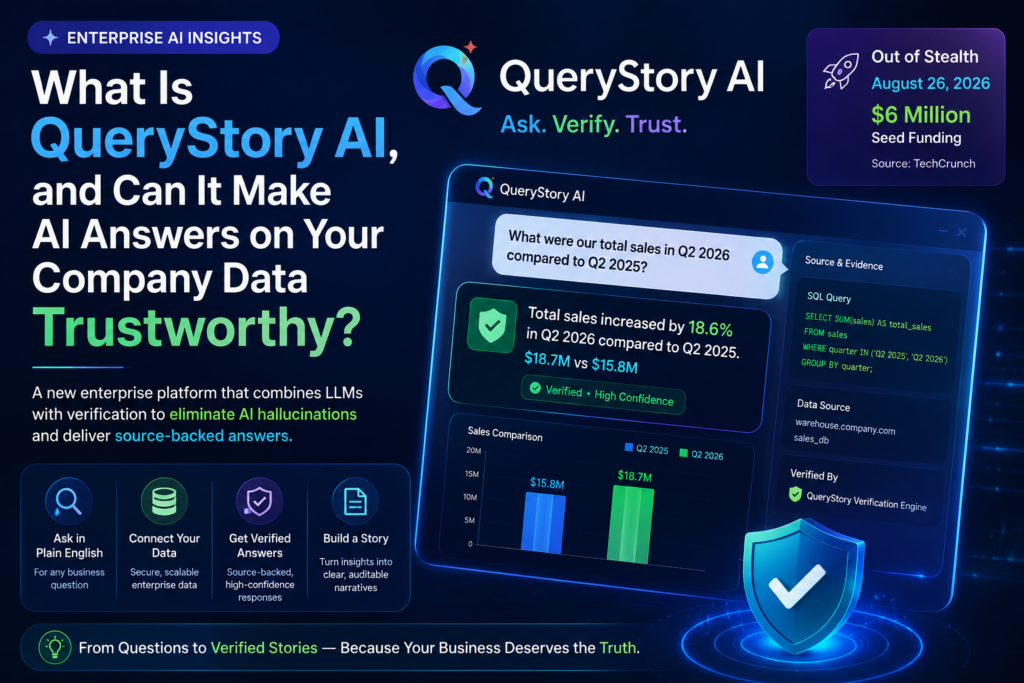
Imagine asking an AI chatbot a question about your company’s sales numbers and getting a confident, well-written answer, that turns out to be wrong. QueryStory AI is a new enterprise startup built to fix exactly that problem. It combines large language models (LLMs, the AI systems behind tools like ChatGPT and Claude) with cybersecurity-style verification methods so that when an AI gives a business an answer, that answer comes with proof of how it got there.
QueryStory came out of stealth mode on August 26, 2026, backed by $6 million in seed funding, according to TechCrunch. For students and young professionals in Odisha and across India who are trying to understand where enterprise AI is headed, QueryStory is a useful case study, it shows exactly why “AI hallucination” (when an AI confidently states something false) is such a big problem for businesses, and what founders are doing to solve it.
What Is QueryStory and Why Did It Launch Now?
QueryStory is an AI-powered data analytics platform built for large enterprises that manage big, proprietary databases. In simple terms: it lets non-technical decision-makers, like sales heads or operations managers, ask questions about their company’s data in plain English and get back verified, source-backed answers instead of a black-box AI guess.
The company was founded by Shapor Naghibzadeh, who serves as CEO. He is joined by CTO Stanley Yang, a former Google colleague who was also lead engineer at EvolutionIQ, and CPO David Glusic, a veteran of Accenture, according to TechCrunch’s reporting. Naghibzadeh’s background is notable: he learned the value of verified knowledge while working as a Google sysops engineer in 2009, when he helped investigate “Operation Aurora,” a China-backed cyberattack on Google. That experience in tracing digital evidence through complex networks shaped how he thinks about AI and truth today.
Why did QueryStory launch now? Because 2025 and 2026 have been the years enterprises moved from experimenting with AI chatbots to actually trying to run business operations through them, and quickly discovered that general-purpose AI tools aren’t built for the accountability that regulated, high-stakes industries need. Naghibzadeh spent years after Google building cybersecurity data tools, including co-founding Chronicle, a startup incubated in Google’s X Labs in 2016. Last year, he realized the same “verify everything” approach used in cybersecurity investigations could be applied to business analytics, and QueryStory was born.
Who Is QueryStory’s Money Coming From?
QueryStory raised its $6 million seed round in late 2025 from Brightmind Ventures and New York Life Ventures, at a reported $60 million valuation, per TechCrunch. That’s a fairly rich valuation for a seed-stage company, which signals investors see strong demand for “trustworthy AI” tools among large enterprises.
The Real Problem: Why Enterprise AI Answers Are Hard to Trust
AI hallucination is when a large language model generates an answer that sounds confident and coherent but is factually wrong or made up. This happens because LLMs predict likely-sounding text rather than checking facts against a verified source by default. In a casual chat, a hallucination might just be annoying, but inside a company’s financial dashboard or sales report, it can lead to real, costly business decisions based on false information.
Why don’t enterprises fully trust chatbot answers on their own company data? Because when hundreds or thousands of employees each query an AI system separately, they get slightly different “versions of the truth,” with no central place to verify where an answer came from. Naghibzadeh described this to TechCrunch as a “huge sprawl of content” that never ties back cleanly to the underlying data.
This is what Brightmind Partners’ Tayler Sipperly meant when he told TechCrunch that “AI is more brittle than people realize when it comes to building things that have to be durable and have large-scale businesses relying upon them.” A chatbot answer that looks polished in a Slack message is very different from an answer a CFO can defend to auditors or regulators. That gap, between a plausible-sounding AI answer and a verifiable one, is exactly the market QueryStory is targeting.
Brittle AI, in this context, means an AI system that works fine for simple or one-off tasks but breaks down or becomes unreliable when used repeatedly at scale, under real business pressure, over a long period. A single AI-generated chart for a school project can afford to be slightly wrong. A quarterly business review used to make million-rupee (or million-dollar) decisions cannot.
How QueryStory Works: Turning Raw Queries Into a Verified “Story”
The company’s name is a direct clue to its design philosophy. “You get this pattern of an investigation, you ask a bunch of questions of the data, and after you have been able to ask a number of questions, you assemble that together into a narrative,” Naghibzadeh told TechCrunch. “That became the genesis for the name QueryStory.”
In a live demo shared with TechCrunch, QueryStory was given a database of space activity, the kind of data used to track what companies like SpaceX are doing in orbit. The platform produced a full visualization and dashboard in a few hours, a task that had previously taken a developer several weeks by hand. Alongside the analysis, QueryStory displayed a confidence indicator, a visible score or signal showing how sure the AI system was about its own conclusions, and why.
What is a confidence indicator, and why does it matter? A confidence indicator is a transparency feature that shows users how reliable an AI-generated answer is likely to be, rather than presenting every answer with the same false certainty. For a sales manager deciding whether to trust an AI-generated revenue forecast, seeing “this analysis has high confidence because it’s based on verified, complete data” versus “this has lower confidence due to missing records” is the difference between using the tool responsibly and being misled by it.
QueryStory also automatically surfaces the underlying SQL queries (the technical commands used to pull data from a database) behind every answer, so a human reviewer can check the logic before it’s trusted. TechCrunch reported that one tech executive described manually asking Claude Cowork to show its SQL queries before sending them to a data analyst for review, QueryStory is designed to make that verification step automatic rather than something a user has to remember to request.
Key features of the QueryStory platform, based on TechCrunch’s reporting, include:
- Automated dashboards and visualizations built from a company’s existing databases in hours, not weeks.
- A confidence indicator attached to every AI-generated analysis, showing why the system believes its conclusions are accurate.
- Visible SQL queries behind each answer, so technical staff can audit the AI’s logic.
- Flagging and human review workflows, letting users send an analysis to a colleague for sign-off, with that review recorded inside the platform.
- Model-agnostic architecture, meaning QueryStory isn’t locked into one AI provider and currently uses leading frontier-lab models.
QueryStory vs. General-Purpose AI Tools: What’s the Difference?
A common question for anyone learning about enterprise AI is how a specialized platform like QueryStory differs from just using ChatGPT, Gemini, or Claude directly on company data. The table below breaks down the core differences based on TechCrunch’s reporting.
| Feature | QueryStory | General AI Chat Tools (e.g., standard LLM chat UI) |
| Primary audience | Enterprises with large, proprietary databases | Individual users and general business tasks |
| Answer transparency | Shows a confidence indicator and underlying SQL queries | Often gives a final answer without showing its work |
| Human review process | Built-in flagging and recorded sign-off workflow | Usually manual, outside the AI tool |
| Business model | Not based purely on token/compute consumption | Often priced by usage, tokens, or compute |
| Content sprawl | Centralizes analysis so it ties back to source data | Each user’s chat is siloed, creating scattered “versions of the truth” |
| Model dependency | Model-agnostic, can switch underlying AI models | Tied to one company’s specific model |
This comparison matters because it reflects a broader trend in enterprise AI: purpose-built tools that wrap LLMs with verification, audit trails, and domain-specific guardrails are emerging as a category distinct from general-purpose AI assistants, even though, under the hood, they may still rely on the same frontier models from major AI labs.
Why QueryStory’s Business Model Is Also Part of the Pitch
Does QueryStory make money by selling AI usage, like tokens or compute? No, Naghibzadeh has been explicit that QueryStory intentionally avoids a consumption-based pricing model tied to tokens, storage, or compute. Instead, the company positions itself as selling trust in the answers it produces, and the business value that trust creates, rather than selling raw AI horsepower.
“The thing that we are selling is the trust in the answers, right?” Naghibzadeh told TechCrunch. “Our whole goal is giving the CFO the ability to understand ‘what is this thing going to cost?'” This distinction matters because it directly addresses a criticism often aimed at AI-native software: that companies building on top of frontier models are incentivized to push customers toward heavier, more expensive AI usage, whether or not it’s actually needed.
Early customer feedback echoes this framing. Tim Del Bello, a partner at New York Life Ventures who invested in and personally uses QueryStory, told TechCrunch the product was built for decision-makers who need ground truth from complex data sources but lack a dedicated data science or BI (business intelligence) team, especially in highly regulated industries where an unverifiable AI answer simply isn’t good enough.
What This Means for Students and Professionals in India
For readers in Odisha and across India building careers in tech, analytics, or AI-adjacent fields, QueryStory’s story highlights a hiring and skills trend worth watching closely. Companies are increasingly looking for people who understand both AI capabilities and AI limitations, not just how to prompt a chatbot, but how to evaluate whether an AI-generated answer can actually be trusted for a business decision.
A few practical takeaways for early-career professionals:
- Learn to question AI outputs, not just use them, understanding concepts like hallucination, confidence scoring, and source verification is becoming a genuine workplace skill.
- SQL and basic data literacy still matter, even AI-native platforms like QueryStory surface raw queries for human review, so foundational database skills remain valuable.
- “AI trust” and “AI governance” roles are emerging, as more enterprises adopt AI for regulated or high-stakes work, roles focused on auditing, reviewing, and governing AI outputs are likely to grow.
- Watch the enterprise AI funding space, a seed-stage company reaching a $60 million valuation with $6 million raised shows investors are betting heavily on “trustworthy AI” as its own category, separate from the foundation model race.
FAQ: Common Questions About QueryStory AI
What is QueryStory used for? QueryStory is used by large enterprises to analyze proprietary databases through natural-language questions, producing dashboards, visualizations, and business narratives that include a confidence indicator and visible SQL queries so the answers can be verified before being acted on.
Who founded QueryStory? QueryStory was founded by CEO Shapor Naghibzadeh, alongside CTO Stanley Yang and CPO David Glusic. Naghibzadeh previously co-founded the cybersecurity data startup Chronicle within Google’s X Labs in 2016.
How much funding has QueryStory raised? QueryStory raised a $6 million seed round in late 2025 from Brightmind Ventures and New York Life Ventures, at a reported $60 million valuation, according to TechCrunch.
How is QueryStory different from using ChatGPT or Claude directly on company data? QueryStory adds a transparency and verification layer on top of AI models, including a confidence indicator, visible SQL queries, and built-in human review workflows, that general-purpose AI chat tools typically don’t provide by default, and it avoids a pure pay-per-token business model.
Is QueryStory tied to one specific AI model? No. QueryStory is designed to be model-agnostic, meaning it can work with different large language models rather than being locked to a single AI provider, though it currently relies mainly on frontier-lab models.
Why does “AI trust” matter so much for enterprises specifically? Because enterprise decisions, financial reporting, regulatory compliance, operational planning, carry real costs when they’re wrong. An AI answer that looks confident but can’t be traced back to verified data creates risk that individual consumer AI use cases usually don’t face.
Curious how tools like QueryStory reflect the bigger shift toward trustworthy, verifiable AI in the enterprise? Explore more AI industry breakdowns and beginner-friendly explainers on Kalinga.ai to stay ahead of where the AI job market in India is heading.