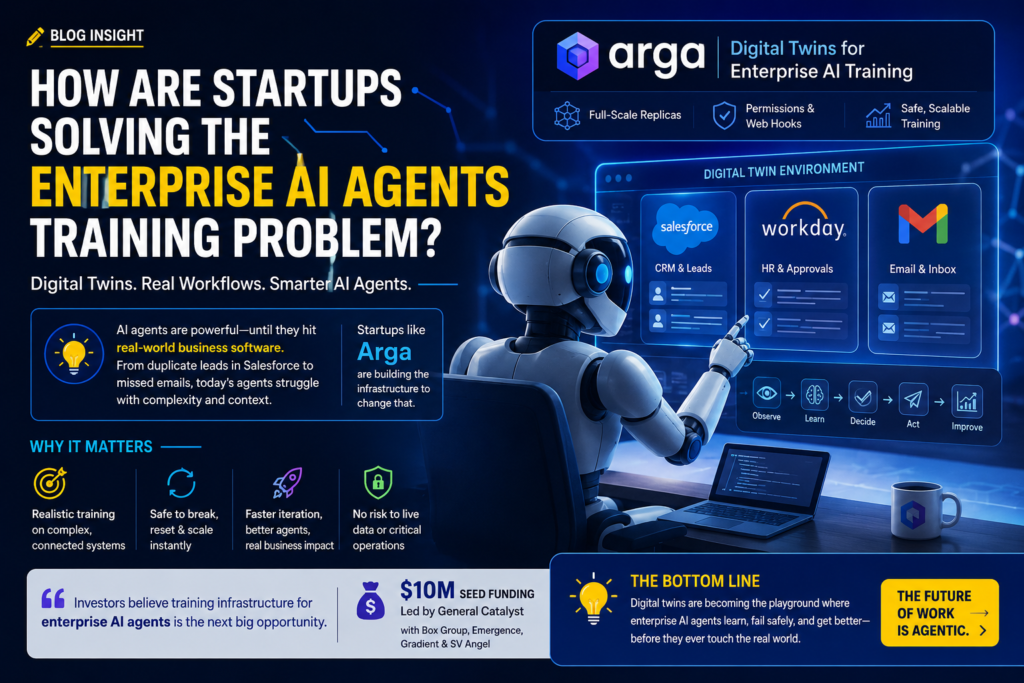
Imagine an AI agent that can write flawless code in seconds but completely fumbles a simple task in Salesforce, like figuring out whether two leads from different sales reps are actually the same company. That’s the exact problem a new wave of startups is racing to fix, and training enterprise AI agents properly, on realistic, repeatable versions of business software, is turning out to be the missing piece. A Bhubaneswar-based fresher trying to break into AI product roles should care about this shift, because it’s reshaping what “AI skills” even means for real jobs.
This piece breaks down why enterprise AI agents are struggling in business software, how a startup called Arga is trying to close that gap, and what this trend means for anyone building a career around AI in India.
What’s the Actual Problem With Training Enterprise AI Agents?
AI agents are software programs that can autonomously complete multi-step tasks, like booking a meeting, updating a CRM record, or replying to an email, without a human clicking through every step. That sounds simple in a demo, but real workplaces are messy: the same customer might show up in Salesforce and HubSpot at once, and an agent has to reason about which record is real, whether an email was already sent, and who should get it.
Why do enterprise AI agents struggle more than coding AI tools? Because business software like Salesforce, Workday, and email clients doesn’t offer the same testing infrastructure that coding tools have, making it far harder to train enterprise AI agents at scale through trial and error.
According to TechCrunch, Arga’s CEO and co-founder Philip Li illustrates the challenge with a scenario where a prospective client creates a lead in Salesforce while a colleague reaches out separately through HubSpot. Li poses the core test for any capable agent: “Can the agent correctly identify that these two are the same company? Are they able to check whether or not they’ve only sent the email once? Are they able to identify who to send the email to out of the two opportunities?” This kind of ambiguity is exactly where today’s AI agents still fall short, and it’s why specialized training environments have become such a hot area for startup investment in 2026. TechCrunchTechCrunch
Meet Arga: A Startup Building Digital Twins for AI Agent Training
Arga is a startup that builds full-scale replicas of enterprise software so enterprise AI agents can be trained and tested safely at scale. Instead of offering just a bare-bones API to poke at, Arga builds training environments for enterprise software like Salesforce, Workday, and email clients, recreating each program’s structure closely enough that an agent’s behaviour inside it maps to how it would behave in the real tool. TechCrunch
How is Arga’s approach different from typical AI testing tools? Where most testing setups only provide a stateless API endpoint, Arga builds a full-scale digital twin of the program, effectively cloning the entire software with permission systems and web hooks intact, producing what the company calls a more robust way to train enterprise AI agents across multiple connected systems at once. TechCrunch
Arga just backed this vision with real money. TechCrunch reported that the company had raised $10 million in a seed funding round that was led by General Catalyst, with participation from Box Group, Emergence, Gradient and SV Angel. That’s a meaningful seed round in 2026’s AI infrastructure market, and it signals investors believe training infrastructure for enterprise AI agents is as valuable as the agents themselves. TechCrunch
Digital twin is a virtual, fully functional replica of a real software system that behaves the same way the original does, right down to permissions and integrations. Think of it as a flight simulator for pilots, except instead of training humans to fly planes, it trains AI agents to navigate Salesforce dashboards, Workday approvals, or a cluttered email inbox. Because the replica is fully controlled by the company running it, engineers can reset it instantly, break it on purpose, or run thousands of copies in parallel, something you simply cannot do with a live production CRM that real employees depend on.
Why Can’t You Just Use Reinforcement Learning Directly on Salesforce?
Reinforcement learning (RL) is a training method where a system tries a task repeatedly, gets rewarded for successful attempts, and gradually learns which strategies work best. It’s the same broad idea used to teach a dog tricks through treats, except here the “dog” is an AI model and the “treats” are numerical rewards. RL has been central to recent leaps in AI coding tools, precisely because coding gives engineers an easy way to test outcomes.
Why doesn’t RL work well for enterprise AI agents today? Because live enterprise software has no simple “undo” button, so training an agent the normal RL way, by running a scenario thousands of times, is nearly impossible without breaking real business data.
TechCrunch’s reporting is blunt about this bottleneck: “There’s no easy way to ‘reset’ a system like Salesforce or Outlook when you need to run the same scenario again, much less clone it.” That single constraint is the reason enterprise AI agents lag behind coding-focused AI systems in reliability, even though both rely on the same underlying model architectures. TechCrunch
This gap even has a name in AI circles. The article frames Arga’s work as a way to close “the reinforcement gap” between coding and other business applications, a concept TechCrunch had covered in an earlier explainer. Because AI coding tools have advanced so quickly partly due to sophisticated existing tools for deploying, reversing, and analyzing new code, it has been much easier to set up reinforcement learning environments for programming tasks than for, say, correctly routing a customer support ticket. The bet behind Arga and similar startups is that once equivalent infrastructure exists for business software, enterprise AI agents could improve just as fast as coding AI has. TechCrunchTechCrunch
How Arga’s Digital Twin Environments Actually Work
Arga’s method borrows an idea from automotive safety testing. The company recreates enterprise software “the way a crash test dummy is supposed to stand in for a person”, giving engineers a stand-in that behaves realistically without any risk to the real system. Because Arga controls the environment completely, the resulting recreation is simple to reset or modify, which is exactly the capability that live enterprise software lacks. TechCrunchTechCrunch
This matters because most real jobs aren’t confined to one app. A recruiter might work across an applicant tracking system, email, and a scheduling tool in the same ten minutes. Arga’s platform is built with this in mind: the company can run many environments at once to train agents on the complex interactions between different programs, with the broader goal of replicating a person’s full work environment, with specific tasks overlapping across different programs and knowledge systems. TechCrunchTechCrunch
Here’s a quick breakdown of how this training loop generally works for enterprise AI agents:
- Clone the software, Arga builds a functional replica of tools like Salesforce, Workday, or an email client, permissions and webhooks included.
- Run the scenario repeatedly, Because the clone can be reset instantly, the same task (like matching duplicate leads) can be tested thousands of times.
- Reward correct behaviour, Successful strategies (correctly identifying duplicate records, avoiding double emails) are reinforced, similar to standard RL.
- Test across connected systems, Multiple digital twins run together so agents learn to handle tasks that span more than one app.
- Deploy with more confidence, Enterprises get agents that have already been stress-tested on realistic, messy scenarios before touching live data.
Why Investors Are Betting Big on This Category
General Catalyst’s managing director Yuri Sagalov, who also leads the firm’s seed investing program, explained the thinking behind backing Arga. He told TechCrunch, “I think that a lot of the economic value from agents is from using business applications.” He added that a repeatable sandbox environment is very important, and much more important with agents than it was with humans. TechCrunchTechCrunch
That last point is worth sitting with. Human employees can learn from a single mistake and generalize; enterprise AI agents currently need to see a scenario play out correctly many times before the behaviour reliably sticks. That’s precisely why testing infrastructure, not just bigger models, is becoming the bottleneck investors are racing to fund in 2026.
Comparing Approaches to Training Enterprise AI Agents
| Approach | How It Works | Best For | Key Limitation |
| Direct RL on live software | Agent practices directly on production tools like Salesforce | Small-scale, low-risk tasks | Can’t reset system; risks real data; hard to scale |
| Stateless API testing | Agent calls software APIs in isolation, no full state tracking | Simple, single-step tasks | Misses permissions, webhooks, cross-app complexity |
| Digital twin environments (Arga’s model) | Full clone of software with permissions and integrations intact | Complex, multi-app enterprise workflows | Requires significant engineering to build each clone |
| Coding-focused RL environments | Uses existing deploy/test/rollback tooling built for software engineering | AI coding assistants | Doesn’t transfer well to non-coding business apps |
This comparison shows why enterprise AI agents built for business software need a fundamentally different training approach than coding assistants, since the underlying tooling for testing and resetting environments simply didn’t exist for tools like Workday or Outlook until startups like Arga started building it.
What This Means for Students and Professionals in India
For students and young professionals in Odisha and across India eyeing AI-adjacent careers, this trend points to a growing category of jobs that isn’t just “prompt engineering” or “model training.” Companies building enterprise AI agents need people who understand business workflows in Salesforce, Workday, HR systems, and CRMs well enough to design realistic test scenarios for AI. That’s a blend of domain knowledge and AI literacy, not pure coding skill, and it’s a real opening for freshers who understand how Indian enterprises actually use this software day to day.
It’s also a signal about where hiring demand may shift. As enterprise AI agents get better at handling ambiguous, cross-application tasks, roles in sales operations, HR administration, and customer support may increasingly involve working alongside agents rather than performing every step manually. Understanding how these systems are trained, and where they still fail, is a genuine edge for anyone job-hunting in 2026’s AI-heavy market.
FAQ: Training Enterprise AI Agents
What are enterprise AI agents?
Enterprise AI agents are AI systems designed to autonomously complete multi-step business tasks across software tools like Salesforce, Workday, or email, rather than just answering questions in a chat window.
Why is it hard to train enterprise AI agents compared to coding AI?
Because business software like Salesforce or Outlook can’t easily be reset or cloned the way code repositories can, making the large-scale trial-and-error training that works well for coding assistants much harder to apply to enterprise apps.
What is a digital twin in the context of AI agent training?
A digital twin is a fully functional replica of real software, permissions, webhooks and all, that lets engineers test and reset scenarios for enterprise AI agents without touching live production data.
How much funding has Arga raised, and who invested?
Arga raised $10 million in a seed funding round led by General Catalyst, with participation from Box Group, Emergence, Gradient and SV Angel. TechCrunch
What is the “reinforcement gap” mentioned in relation to enterprise AI agents?
It refers to the difference in how fast AI systems improve at coding versus other tasks, largely because coding already has mature tools for deploying, testing, and reversing changes, tools that don’t yet fully exist for most business software.
Will enterprise AI agents replace jobs in sales, HR, or support?
Current reporting suggests enterprise AI agents are still learning to handle ambiguous, cross-application tasks reliably, so the more likely near-term shift is agents handling routine steps while people manage exceptions, oversight, and judgment calls.
Keep Exploring AI Careers and Trends With Kalinga.ai
If this breakdown of enterprise AI agents got you curious about how AI infrastructure trends translate into real career opportunities, explore more explainers and workshop updates on Kalinga.ai to stay ahead of the curve.