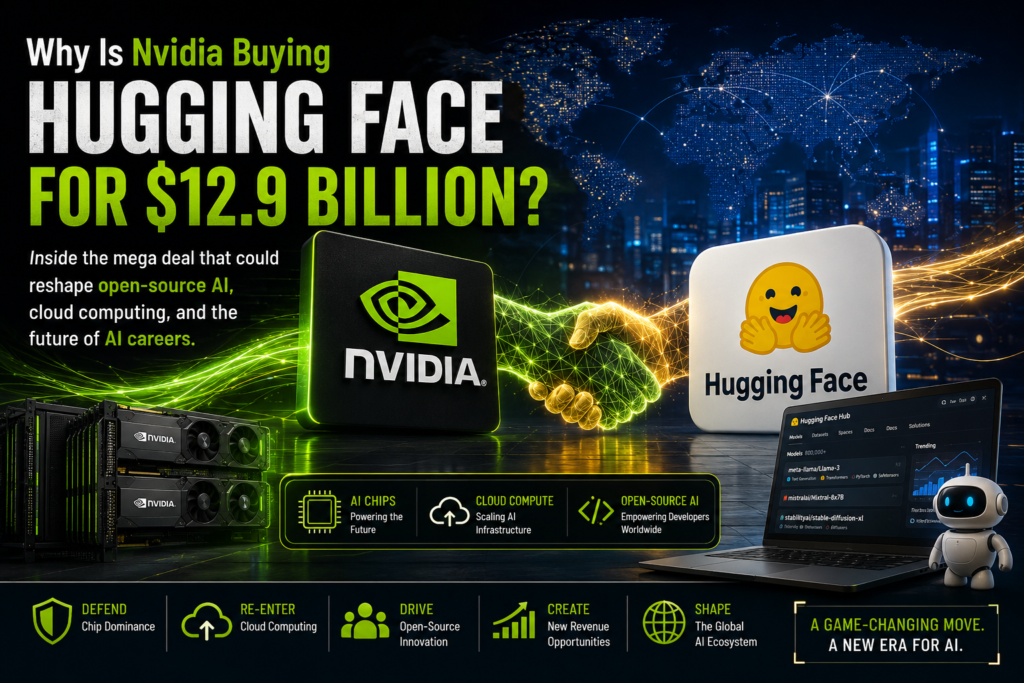
Imagine the world’s biggest chipmaker quietly writing a check bigger than the GDP of some small countries, just to own the platform where developers download free AI models. That’s essentially what’s happening with the Nvidia Hugging Face acquisition: Nvidia has reportedly agreed to buy Hugging Face, the popular open-source AI hub, for $12.9 billion, according to The Information, which cited a source familiar with the matter. The deal isn’t signed yet, and other reports say talks could still fall apart, but if it closes, it would let Nvidia protect its AI chip empire and re-enter the cloud computing business in one move.
For students, freshers, and young professionals tracking AI careers in India, this isn’t just Silicon Valley gossip. Hugging Face is the platform many AI/ML learners already use daily to download and fine-tune models. Understanding the Nvidia Hugging Face acquisition helps you read the bigger picture of where the global AI industry, and the jobs inside it, are heading.
This piece breaks down what’s actually confirmed about the Nvidia Hugging Face deal, why Nvidia wants Hugging Face badly enough to pay roughly triple its 2023 valuation, how the acquisition fits into a wider pattern of AI infrastructure consolidation, and what it could mean if you’re building a career around AI in India.
What Exactly Is Being Reported About the Nvidia Hugging Face Acquisition?
Nvidia’s reported offer. Nvidia has agreed to buy Hugging Face for $12.9 billion, The Information reported, citing a source familiar with the matter. Business Insider, which first reported over the weekend that Hugging Face was fielding takeover interest, said late Wednesday that talks, which would value the company at more than $13 billion, had not yet produced a signed agreement and could still fall through.
Neither Nvidia nor Hugging Face has publicly confirmed the deal. TechCrunch reported that it reached out to both companies for comment and neither had responded, noting that Nvidia’s silence is notable because the company has historically moved quickly to correct reports it considers inaccurate.
Question: Is the Nvidia Hugging Face acquisition officially confirmed? No. As of this reporting, the deal is based on sourced reports from The Information and Business Insider, not an official announcement from either company. The talks reportedly value Hugging Face at more than $13 billion, but the agreement could still collapse before signing.
A Quick Primer: What Is Hugging Face?
Hugging Face is an open-source AI platform, founded in 2016, where developers share, download, and fine-tune machine learning models. Think of it as a cross between GitHub and an app store, but for AI models instead of software code. It hosts hundreds of thousands of open-weight models, datasets, and tools that developers worldwide, including many in India, use to build AI applications without training models from scratch.
Hugging Face became the default meeting point for the open-source AI community largely because it made it easy to publish, discover, and download models with just a few lines of code. That popularity is exactly what makes it valuable in the context of the Nvidia Hugging Face acquisition, it’s not just a company Nvidia would be buying, it’s the distribution channel through which a huge share of the world’s open-source AI activity already flows.
A Brief Timeline of the Nvidia-Hugging Face Talks
The Nvidia Hugging Face acquisition story didn’t come out of nowhere. Business Insider first reported over the weekend that Hugging Face was fielding takeover interest. That reporting was followed within days by The Information’s report that Nvidia had agreed to the $12.9 billion deal, citing a source familiar with the matter, though Business Insider’s follow-up said the talks had not yet produced a signed agreement and could still fall apart.
This is also not the first time Nvidia has tried to get closer to Hugging Face. Nvidia previously offered Hugging Face a $500 million investment in late 2025 that would have valued the company at $7 billion, an offer Hugging Face turned down. That earlier rejection makes the current, much larger Nvidia Hugging Face acquisition talks even more notable: it suggests something has changed in how Hugging Face’s leadership is thinking about independence versus partnership.
Why Does Nvidia Want to Buy Hugging Face?
Question: What’s Nvidia’s real motive behind the Hugging Face acquisition? The core reason is defensive: Nvidia wants to protect its dominance in AI chips at a time when its biggest customers are trying to reduce their dependence on it. A strong open-source AI ecosystem keeps more of the market reliant on Nvidia hardware, even as closed AI labs build alternatives.
Here’s the deeper logic behind the Nvidia Hugging Face acquisition:
- Chip dependency is under threat. OpenAI, Google, Amazon, and Anthropic are all reportedly building their own AI chips to lessen reliance on Nvidia’s hardware, even as Nvidia keeps up an aggressive chip-release schedule.
- Open-source AI keeps customers on Nvidia hardware. A thriving open-source ecosystem gives companies alternatives to closed AI labs, and those alternatives still need Nvidia chips to run, which is also why Nvidia has already poured tens of billions of dollars into building its own open-source AI models.
- Geopolitical pressure on open-weight models. Washington officials have reportedly weighed restrictions on open-weight AI models after Chinese labs like Moonshot AI released systems such as Kimi K3 that matched leading U.S. models on benchmarks at a much lower cost, raising competitive and national-security concerns in Washington.
- Hugging Face’s CEO was already aligned with Nvidia. Clem Delangue, Hugging Face’s CEO, has spent much of the year publicly siding with Nvidia’s open-source push. He signed a letter, alongside Nvidia CEO Jensen Huang and 24 other companies, urging the U.S. government to support open models rather than restrict them, and has publicly warned that China is “clearly dominating” open-source AI.
- A comeback in cloud computing. Nvidia reportedly scaled back its own DGX Cloud business about a year ago. Owning Hugging Face, which already helps developers rent computing power to run AI models, could give Nvidia a way back into the cloud market without rebuilding from scratch.
- A financial safety net. Nvidia has promised to help cover tens of billions of dollars in cloud computing deals for its customers. If those customers don’t use all the capacity they’ve signed up for, Nvidia could get stuck holding it, and owning Hugging Face would let it resell that unused capacity to Hugging Face’s own customer base.
Should We Be Surprised Hugging Face Is Selling?
Question: Was a Hugging Face sale to Nvidia predictable? Not entirely surprising, given how publicly aligned Hugging Face’s leadership has already been with Nvidia’s open-source strategy this year. Hugging Face CEO Clem Delangue has repeatedly used public platforms to make the case for open-weight AI, often echoing arguments Nvidia itself has been making in Washington.
In an appearance on CBS’s “Face the Nation” earlier this month, Delangue said Hugging Face used an Nvidia-modified version of a Chinese open-source model to defend itself after a cyberattack, and he pointed to a recent letter, signed by Nvidia CEO Jensen Huang and 24 other companies, including Hugging Face, urging the U.S. government to support open models rather than restrict them. In a separate CNBC interview in late July, Delangue made similar points while warning that China is “clearly dominating” open-source AI. That level of public alignment between Hugging Face and Nvidia’s policy positioning is part of why the Nvidia Hugging Face acquisition talks feel, in hindsight, like a natural next step rather than a sudden pivot.
How Much Is Hugging Face Actually Worth, and Why the Jump?
Definition + Expansion: Valuation. A company’s valuation is the estimated total worth of a business, usually based on what investors are willing to pay for a stake in it. Hugging Face’s valuation has moved dramatically in just three years, a sign of how fast the AI infrastructure market is repricing.
Here’s how Hugging Face’s value has changed over time:
| Event | Approximate Valuation | Year |
| Series D funding round (led by Salesforce Ventures, with GV, IBM Ventures, Nvidia) | $4.5 billion | 2023 |
| Rejected Nvidia investment offer | $7 billion | Late 2025 |
| Reported Nvidia acquisition talks | $12.9–$13+ billion | 2026 |
Hugging Face raised $235 million in that 2023 round. It later turned down a $500 million investment offer from Nvidia that would have valued it at $7 billion, with Hugging Face reportedly saying it didn’t want a dominant investor that could sway its decisions, according to the Financial Times. A buyout is structurally different from taking one giant backer, since an acquisition doesn’t carry the same risk of ceding control while being pressured to keep growing under a single investor’s terms.
Question: Is Hugging Face profitable enough to justify a $12.9 billion price tag? Not yet, but it’s close. Hugging Face was recently generating about $150 million a year in revenue, up from roughly $100 million just two months earlier, and Delangue told TechCrunch last month the company was getting “close to profitability.” Even so, a price near $13 billion represents a massive revenue multiple for a company of this size.
How Does This Fit Into a Bigger Pattern of AI Infrastructure Consolidation?
The Nvidia Hugging Face acquisition doesn’t exist in isolation, it’s part of a broader wave of AI infrastructure consolidation happening across the industry in 2026. Just weeks earlier, payments company Stripe reportedly agreed to acquire OpenRouter, an AI model-routing startup, for more than $7 billion, a huge jump from OpenRouter’s $1.3 billion valuation in its Series B round back in May.
Definition + Expansion: AI infrastructure consolidation. This term describes the trend of large tech companies buying up the smaller platforms, tools, and marketplaces that sit “in between” AI models and the developers who use them. Instead of just building better chips or models, companies are now acquiring the distribution layer, the hubs, gateways, and marketplaces, to control how AI gets deployed. The Nvidia-Hugging Face and Stripe-OpenRouter deals both fit this pattern, and more such acquisitions are likely as AI infrastructure competitors get pulled into larger outfits.
| Deal | Buyer | Target | Reported Price | What It Controls |
| Nvidia–Hugging Face | Nvidia | Hugging Face | $12.9 billion | Open-source model hub + cloud compute access |
| Stripe–OpenRouter | Stripe | OpenRouter | $7+ billion | AI model routing/gateway layer |
What Could Go Wrong With the Nvidia Hugging Face Deal?
No deal at this size is guaranteed to close. Business Insider’s reporting explicitly noted that the talks had not yet produced a signed agreement as of Wednesday night and could still fall apart before finalization. Large acquisitions like this typically face regulatory review, especially given growing global scrutiny of Nvidia’s market power in AI chips, so even a reported agreement can take months to actually close, if it closes at all.
There’s also the open question of how Hugging Face would operate inside Nvidia. Part of what made Hugging Face valuable to the open-source community was its position as a neutral, independent hub not owned by any single AI lab or chipmaker. Some developers and companies could view an Nvidia-owned Hugging Face differently, even if Nvidia keeps the platform technically open. How Nvidia handles that trust question after the Nvidia Hugging Face acquisition closes, if it does, will likely shape how enthusiastically the developer community continues to use the platform.
What Does This Mean for AI Learners and Professionals in India?
If you’re a student or early-career professional in Odisha or elsewhere in India learning AI/ML, the Nvidia Hugging Face acquisition is worth watching for a few practical reasons:
- Hugging Face’s tools may get tighter integration with Nvidia hardware and cloud services, which could shape which skills (like CUDA optimization or Nvidia-specific deployment tools) become more valuable for AI engineering roles.
- Open-source AI is becoming more strategically important, not less. Big companies are paying billions to control open-model ecosystems, which signals continued strong demand for engineers who understand open-weight models, not just closed APIs.
- Infrastructure and MLOps roles are gaining importance. As AI infrastructure consolidation accelerates, companies need people who understand model deployment, cloud compute allocation, and open-source model fine-tuning, skills taught in practical AI/LLM engineering programs.
- The India talent pipeline benefits from a stronger open-source ecosystem, since open models are typically cheaper and more accessible for Indian startups and students to experiment with compared to closed, subscription-gated AI systems.
Whatever happens with the final terms, the Nvidia Hugging Face acquisition talks are a useful case study for anyone trying to understand how the AI industry actually makes money, not just through flashy model releases, but through control of chips, cloud compute, and the platforms developers rely on every day.
Nvidia vs. Hugging Face vs. Stripe-OpenRouter: A Quick Comparison
| Factor | Nvidia–Hugging Face Deal | Stripe–OpenRouter Deal |
| Primary motive | Protect chip dominance + re-enter cloud | Expand payments company into AI infrastructure |
| Reported deal value | $12.9 billion | $7+ billion |
| Target’s core business | Open-source model hosting hub | AI model routing/gateway service |
| Confirmed by companies? | Not yet (as of this report) | Reportedly agreed |
| Strategic angle | Open-source AI + compute resale | Model-agnostic AI access for developers |
FAQ: Nvidia Hugging Face Acquisition
How much is Nvidia paying for Hugging Face? Nvidia has reportedly agreed to pay $12.9 billion for Hugging Face, according to The Information. Other reports put the valuation at more than $13 billion, though the deal hadn’t been formally signed as of this writing.
Has Nvidia officially confirmed the Hugging Face acquisition? No. Both Nvidia and Hugging Face declined to comment when TechCrunch reached out, and the reports are based on sources familiar with the matter rather than an official statement.
Why didn’t Hugging Face accept Nvidia’s earlier offer? Hugging Face turned down a $500 million investment from Nvidia in late 2025 that would have valued it at $7 billion, reportedly because it didn’t want a dominant single investor who could influence its decisions. An outright acquisition is structurally different from taking on one large investor.
Is Hugging Face profitable? Not fully, but it’s close. The company was recently generating about $150 million a year in revenue, up from around $100 million two months earlier, and its CEO said it was nearing profitability.
How does this connect to Nvidia’s cloud computing business? Nvidia scaled back its own DGX Cloud unit about a year ago. Owning Hugging Face, which already helps developers rent compute power to run AI models, could give Nvidia a way back into the cloud market, and a way to resell unused cloud capacity it’s committed to covering for other customers.
What’s driving the broader wave of AI infrastructure acquisitions in 2026? Growing competitive and national-security concerns around open-weight AI models, combined with big tech companies wanting more control over the “middle layer” of AI distribution, are pushing acquisitions like Nvidia-Hugging Face and Stripe-OpenRouter, as major players consolidate the infrastructure that sits between AI models and end users.
In short, the Nvidia Hugging Face acquisition is as much a story about chips and cloud compute as it is about open-source AI models, and it’s a pattern worth watching closely over the next few months.
Keep Up With the Stories Shaping AI Careers
The Nvidia Hugging Face acquisition is a reminder that open-source AI is becoming a serious battleground for the world’s biggest tech companies, and that matters for anyone building an AI career in India. Explore Kalinga.ai’s AI/LLM engineering workshops to build hands-on, job-ready skills in the open-source tools shaping this industry.