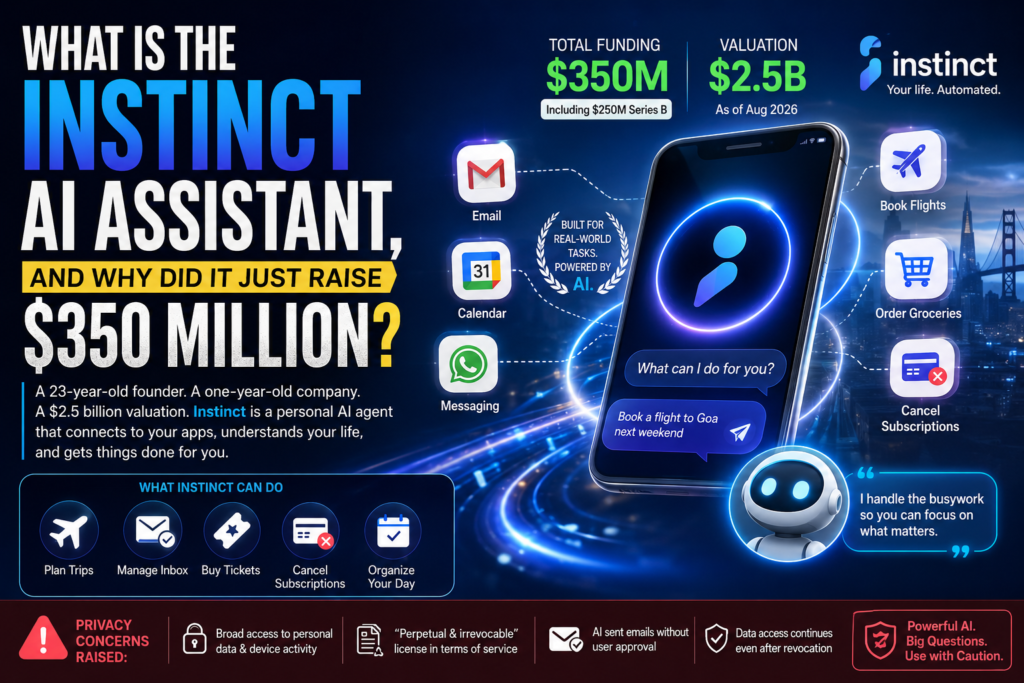
A 23-year-old founder, a one-year-old company, and a $2.5 billion valuation, that’s not a typical startup story, but it’s exactly what’s happening with the Instinct AI assistant right now. The short answer: Instinct is a personal AI agent that connects to your email, calendar, messaging apps, and even your phone’s screen and location data to handle everyday tasks like booking flights, managing your inbox, and cancelling subscriptions on your behalf, and it just raised a $250 million Series B, taking its total funding to $350 million at a $2.5 billion valuation, according to a Wall Street Journal report cited by TechCrunch.
If you’re a student, fresher, or young professional in India tracking where the AI agent economy is headed, the Instinct AI assistant story is worth understanding closely, not just because of the eye-popping numbers, but because it’s become a live case study in the trade-off between AI convenience and personal data privacy. Let’s break down what Instinct actually does, why investors are betting billions on it, and why some early users are worried.
What Is the Instinct AI Assistant?
Instinct is an AI agent built by the startup Spear Street Technology, designed to act less like a chatbot and more like a digital personal assistant with real operating power. Instead of opening an app and typing a prompt, users text or call Instinct, including over WhatsApp, and ask it to complete real-world tasks.
The Instinct AI assistant is currently in private beta and operating largely in stealth, but early users have been vocal about what it can do. According to founder Noah Shinn, users have used it to plan cross-country road trips, order weekly groceries, buy concert tickets, cancel unwanted subscriptions, and in at least one case, help plan a wedding. That’s a wide range of tasks for a single AI agent, and it’s a big part of why the Instinct AI assistant has generated so much buzz on social media over the past few weeks.
Founder: Noah Shinn, a former research scientist at Sierra, the AI customer-experience company, leads the small San Francisco-based team behind Instinct.
How it works: Once you connect your accounts, the Instinct AI assistant links up with your applications and devices, including email, messaging, calendar, and in some cases audio, location, and screen data, so it can act across all of them without you switching between apps.
Question: How Do You Actually Use the Instinct AI Assistant?
Answer: You don’t open an app dashboard, you simply text or call Instinct like you would a person, and it carries out the task using the accounts and permissions you’ve connected. This SMS/WhatsApp-first design is one of the more distinctive things about the Instinct AI assistant compared to chatbot-style competitors, and it’s part of why testers describe the experience as unusually smooth.
The Instinct AI Valuation: How Did It Get to $2.5 Billion So Fast?
Here’s the number that’s making headlines: the Instinct AI assistant’s parent company, Spear Street Technology, is now valued at $2.5 billion, just over a year after launch. The company’s new $250 million Series B round was co-led by Index Ventures and Benchmark, two of Silicon Valley’s most established venture firms, bringing total funding raised to $350 million.
This kind of trajectory, a private-beta product with no public launch reaching a multi-billion-dollar valuation, is unusual even by AI-era startup standards. It reflects how much appetite investors currently have for agentic AI products, meaning AI systems that don’t just answer questions but actually take actions on a user’s behalf across multiple apps and services.
Agentic AI is a term for AI systems designed to independently plan and execute multi-step tasks, like booking a flight, then cancelling a hotel reservation, then emailing a confirmation, rather than simply generating text in response to a single prompt. The Instinct AI assistant is a clear example of this category: it doesn’t just tell you how to cancel a subscription, it goes ahead and does it.
Question: Who Are the Investors Backing Instinct?
Answer: The most recent Series B was co-led by Index Ventures and Benchmark. Earlier reporting also indicates that Kleiner Perkins and Conviction had invested in the company during its stealth phase, alongside other backers who helped push the company’s valuation to $2.5 billion.
Why the Instinct AI Assistant Is Facing Privacy and Security Concerns
Rapid growth and a viral moment often bring scrutiny, and that’s exactly what’s happening here. Even before the funding news broke, the Instinct AI assistant had already become the subject of a separate controversy over its data practices and terms of service.
The core issue is straightforward: to do everything it promises, reading your inbox, booking your travel, managing your calendar, the Instinct AI assistant needs deep access to your digital life, including your email, messaging apps, calendar, and device-level signals like screen activity, cursor movements, keyboard inputs, audio, and location. That’s a much broader footprint than most consumer apps request, and several early testers have flagged it as a serious concern.
A few specific incidents have driven the backlash:
- The company’s terms of service reportedly grant Instinct a “perpetual and irrevocable” license to access, store, reproduce, and use a user’s materials, including for training its AI models, meaning the permission doesn’t expire and can’t be withdrawn once granted.
- One early tester, Moxxie Ventures founder Katie Jacobs Stanton, reported that the Instinct AI assistant sent an email on her behalf without her approval or a final review, which she described as breaking her trust in the product.
- Testers also reported that Instinct continued reading and summarizing Gmail messages even after account access had been revoked, raising questions about how completely the app actually disconnects when a user tries to cut it off.
- Security researchers noted the assistant could be relatively easy to phish, a meaningful risk for a tool with this level of account access.
- In one case, a tester noticed the AI pulled a one-time sign-up verification code directly from their email inbox to complete a restaurant booking, a workaround that, while functional, shows how far the assistant reaches into sensitive account activity to get things done.
Definition: What Is a “Perpetual and Irrevocable License” in an AI Terms of Service?
A perpetual and irrevocable license is a legal permission that never expires and cannot be cancelled once it’s granted, even if you stop using the product. In Instinct’s case, this reportedly applies to user data and materials, meaning that even if someone deletes the app or revokes access, the company may retain rights to data collected during the period the assistant was connected. This is one of the more unusual terms flagged by testers and privacy researchers examining the Instinct AI assistant’s policies, since most consumer apps allow users to fully revoke data-sharing permissions.
Question: Is the Instinct AI Assistant Safe to Use Right Now?
Answer: Based on public reporting so far, the Instinct AI assistant offers genuinely impressive automation, but it also asks for an unusually broad set of permissions and has already shown real gaps between “revoking access” and the assistant actually stopping. For anyone considering early access, that means reading the terms of service carefully, understanding exactly which accounts and device data you’re connecting, and treating an invite-only beta product with the caution you’d give any early-stage tool that touches your email, calendar, and financial accounts.
Instinct AI Assistant vs. Other AI Agents: A Quick Comparison
Since the Instinct AI assistant is often compared to other AI agent tools that testers have used side by side, here’s a general comparison of how these categories of tools typically differ. (Feature availability can change quickly in this space, so always check each company’s current terms before connecting accounts.)
| Feature | Instinct AI Assistant | Typical Chat-Based AI Assistant | Typical Task-Specific AI Agent |
| Primary interface | Text message / WhatsApp | In-app chat window | App or browser plugin |
| Account access | Email, calendar, messaging, device audio/location/screen | Usually limited to what’s pasted into chat | Limited to one connected service (e.g., only calendar) |
| Autonomy level | High, can complete multi-step tasks and take actions | Low to medium, mostly generates text or suggestions | Medium, automates one specific workflow |
| Data retention terms | Reportedly perpetual/irrevocable license, per testers | Varies by provider, often deletable | Varies by provider |
| Stage | Private beta, invite-only | Often public | Often public |
| Valuation (as of Aug 2026) | $2.5 billion | Varies widely | Varies widely |
This comparison highlights the core tension around the Instinct AI assistant: the same broad access that makes it powerful is also what makes its privacy terms more consequential than a typical single-purpose tool.
Why This Matters for AI Learners and Professionals in India
For students and young professionals following AI trends out of Odisha and across India, the Instinct AI assistant story is a useful real-world lesson in two things that matter for anyone building a career in AI: agentic AI system design and AI product trust and safety.
Here’s what to take away from it:
- Agentic AI is where the funding is going. A $2.5 billion valuation for a one-year-old, still-private-beta product shows how much investor confidence exists around AI agents that can act autonomously across multiple apps, not just chat-based tools.
- Permissions and data governance are now core product decisions, not just legal fine print. Anyone working on AI products, or evaluating them as a user, needs to understand what “connecting your accounts” actually authorizes an AI system to do.
- Terms of service literacy is now a practical AI skill. The backlash around Instinct’s “perpetual and irrevocable” data license shows why understanding what you’re agreeing to matters just as much as understanding how the underlying model works.
- Speed and hype don’t equal safety. The same week Instinct’s valuation news broke, reports of an unauthorized email send and continued data access after revocation were also circulating, a reminder that virality and reliability aren’t the same thing.
- Founder-market fit still drives investor confidence. Noah Shinn’s background as a research scientist at Sierra, an AI customer-experience company, is part of why investors like Index Ventures and Benchmark were willing to back Spear Street Technology at this scale.
FAQ: Instinct AI Assistant, Funding, and Privacy Concerns
What is the Instinct AI assistant? The Instinct AI assistant is a personal AI agent from the startup Spear Street Technology that connects to a user’s email, calendar, messaging apps, and device data to complete tasks like booking travel, managing an inbox, and cancelling subscriptions, communicated with via text message or WhatsApp.
How much money has Instinct raised, and at what valuation? Instinct has raised a total of $350 million, including a recent $250 million Series B round co-led by Index Ventures and Benchmark, giving the company a valuation of $2.5 billion as of August 2026.
Who founded Instinct, and who runs the company? Instinct was founded by Noah Shinn, a 23-year-old former research scientist at the AI customer-service company Sierra. Instinct is operated by Spear Street Technology, a San Francisco-based startup.
Is the Instinct AI assistant available to the public? No. As of the most recent reporting, the Instinct AI assistant remains in private, invite-only beta and has not launched publicly.
Why is the Instinct AI assistant facing privacy criticism? Testers have raised concerns about the assistant’s broad data access, including email, messaging, calendar, screen, audio, and location, combined with a reported “perpetual and irrevocable” license in its terms of service, an instance of the AI sending an email without approval, and reports of it continuing to access Gmail data even after permissions were revoked.
Is the Instinct AI assistant the same as a regular chatbot? No. Unlike a typical chatbot that mostly responds to prompts with text, the Instinct AI assistant is designed to independently complete multi-step tasks and take real actions across connected apps and accounts, which is why it’s often described as an “agentic” AI system rather than a conversational one.
Keep Learning About the AI Agent Economy
Stories like the Instinct AI assistant’s rapid rise, and the privacy questions that came with it, are exactly the kind of real-world case studies we break down in Kalinga.ai’s AI learning resources for students and young professionals in Odisha. If you want to understand how agentic AI systems are built, funded, and evaluated for trust and safety, explore our workshops and content on Kalinga.ai to stay ahead of where the AI industry is heading next.