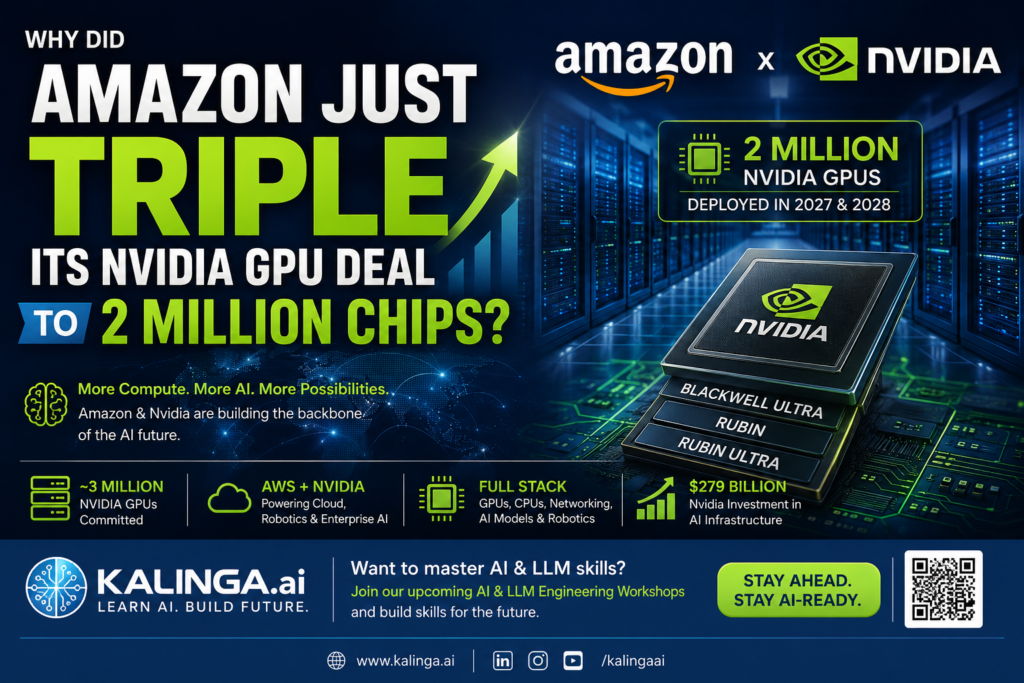
Picture a data center so hungry for computing power that a company has to place its second giant chip order in under half a year, that’s exactly what happened this week. On August 26, 2026, Amazon and Nvidia announced an expanded partnership built around this Nvidia GPU deal, adding another 2 million Nvidia GPU chips to Amazon Web Services (AWS) data centers over 2027 and 2028. The short answer: Amazon needs vastly more AI computing capacity than it expected just five months ago, and Nvidia is positioning itself as the backbone of that buildout, not just as a chip vendor, but as a full-stack AI infrastructure partner.
For students and young professionals in Odisha and across India tracking the AI industry, this Nvidia GPU deal is one of the clearest signals yet of how fast enterprise AI demand is scaling, and why chip supply chains, cloud infrastructure, and AI careers are becoming tightly linked. Let’s break down what was actually announced, why it matters, and what it means for the AI job market back home.
What Exactly Did Amazon and Nvidia Announce?
Question: What is the core of this new Nvidia GPU deal? Amazon agreed to deploy an additional 2 million Nvidia GPU chips across AWS data centers, arriving in 2027 and 2028. This comes on top of the more than 1 million Nvidia GPUs Amazon had already agreed to deploy starting earlier in 2026, effectively tripling the scale of Amazon’s Nvidia chip commitment within roughly five months.
GPU (Graphics Processing Unit) is a specialized processor originally built for rendering images, now the workhorse chip for training and running AI models because it can perform thousands of calculations in parallel. Unlike a regular CPU that handles tasks one after another, a GPU processes many small operations simultaneously, which is exactly what training a large language model or running an AI chatbot at scale requires. This is why every major AI company, from OpenAI to Anthropic to Indian AI startups renting cloud GPUs, is racing to secure GPU capacity.
The chips involved in this new Nvidia GPU deal aren’t Nvidia’s older hardware, they include the newer Blackwell Ultra, Rubin, and Rubin Ultra GPU families, Nvidia’s most advanced AI accelerators designed specifically for frontier-scale AI training and inference workloads. Neither company disclosed exact financial terms, but given typical GPU unit costs, industry estimates put the value of this expanded arrangement at tens of billions of dollars.
Why Is Amazon Buying So Many Nvidia Chips, So Fast?
Question: What’s driving Amazon to triple its GPU order in under half a year? Nvidia said plainly that “demand has exceeded expectations” since the earlier 1-million-GPU agreement was signed. Both companies pointed to surging demand from startups, large enterprises, AI research labs, and even government customers as the reason for accelerating the buildout.
This pattern reflects a broader trend across the AI infrastructure industry in 2026: cloud providers keep underestimating how much compute their customers will actually need. AWS, Microsoft Azure, and Google Cloud are all in a race to avoid being compute-constrained, because every GPU shortage translates directly into lost revenue from customers who can’t get the capacity they want. For a company like Amazon, over-ordering GPU capacity is a much safer bet than under-ordering it.
- The original AWS-Nvidia deal (more than 1 million GPUs) was announced roughly five months before this expansion.
- The new deal adds another 2 million Nvidia GPU chips on top of that.
- Combined, that’s close to 3 million Nvidia GPUs committed to AWS in under a year.
- The expansion was announced during Nvidia’s quarterly earnings call, not as a standalone press release, a sign of how central this deal is to Nvidia’s growth story.
What’s Inside the Expanded Amazon-Nvidia Partnership?
Question: Is this just about buying more chips? No, this Nvidia GPU deal extends well beyond raw chip purchases. Nvidia is embedding more of its technology stack directly into AWS infrastructure, and the partnership now touches robotics, enterprise AI tools, and networking hardware.
Nemotron models, Nvidia’s family of open AI models, will now be served on Amazon Bedrock (AWS’s managed foundation model platform) and Amazon SageMaker (its managed machine learning service). This means AWS customers building AI applications will be able to access Nvidia’s own models directly through AWS’s existing tools, rather than sourcing them separately.
On the robotics side, AWS said it plans to adopt Nvidia’s full “physical AI” stack, which includes four components:
- Omniverse, Nvidia’s simulation and digital twin platform for modeling real-world environments.
- Cosmos, a world model platform used to train AI systems on how physical environments behave.
- Isaac, Nvidia’s robotics development platform for building and testing robot software.
- Jetson, compact computing hardware that powers robots and edge AI devices, including a newly announced entry-level version aimed at more accessible robotics deployment.
Amazon plans to use this stack to power its fleet of warehouse robots, tying the Nvidia GPU deal directly into Amazon’s logistics operations, not just its cloud business. Nvidia also confirmed it will send an unspecified number of its new Vera CPUs to AWS, some paired with Rubin GPUs, others deployed standalone, as part of the same agreement.
Is Amazon Also Building Its Own AI Chips? Trainium vs. Nvidia GPUs
Question: Why would Amazon buy millions of Nvidia GPUs while also developing competing chips? Because the two efforts serve different purposes. Amazon has been building its own custom silicon, mainly Trainium chips for AI training and inference, and Graviton CPUs for general server workloads, specifically to reduce its dependence on Nvidia and control costs at massive scale. But Amazon still needs Nvidia’s most advanced GPUs for cutting-edge AI workloads that its own chips can’t yet match, which is why both strategies run in parallel.
Trainium is Amazon’s own chip line built as a direct alternative to Nvidia’s H100 and Blackwell chips for deep learning workloads. AWS’s AI chief, Peter DeSantis, has said Amazon is even in talks to sell Trainium chips to other companies for use in their own data centers, turning Amazon from a pure Nvidia customer into a potential competitor. Amazon has said its custom chip business crossed a $25 billion annualized revenue run rate, backed by $225 billion in total commitments from AI labs including Anthropic and OpenAI.
Here’s how the two approaches compare for a company like Amazon:
| Factor | Nvidia GPUs (Blackwell Ultra, Rubin) | Amazon Trainium / Graviton |
| Primary use | Frontier-scale AI training & inference | Cost-optimized AI training & general compute |
| Who builds it | Nvidia (external vendor) | Amazon (in-house, Arm-based for Graviton) |
| Ecosystem maturity | Extremely mature; industry-standard software (CUDA) | Growing; increasing adoption via AWS commitments |
| Strategic role for Amazon | Access to the most advanced AI hardware available | Reduces vendor dependence, controls long-term costs |
| Customer base | AWS, Microsoft, Google, Oracle, SpaceX AI, and others | Currently mostly internal AWS use, expanding to external sales |
This dual-track approach, buying record volumes of Nvidia GPUs while simultaneously scaling a competing chip line, shows just how large and diversified AI infrastructure spending has become. Even as Amazon builds alternatives, it still recognizes that Nvidia remains, in the words of the current market consensus, the dominant player in AI chips.
It’s worth noting that this isn’t a one-off arrangement, the Nvidia GPU deal structure (multi-year, multi-billion-dollar, spanning both hardware and software) has become the template for how every major cloud provider now negotiates with Nvidia. Microsoft, Google, and Oracle have all struck similarly structured agreements in 2026, and each new Nvidia GPU deal tends to be measured against the size and scope of the last one. That’s part of why this expanded Amazon agreement drew so much attention: it reset expectations for what “large” looks like in cloud AI infrastructure.
Nvidia’s Blockbuster Earnings: What the Numbers Say
Question: How is Nvidia performing financially alongside this deal? Nvidia reported $96.2 billion in revenue for the quarter, beating analyst estimates, with data center revenue alone hitting $89 billion, up 117% year-over-year. Nvidia expects revenue to climb further, forecasting $108 billion for the next quarter, partly fueled by its next-generation Rubin GPUs, which began production shipments this quarter.
To secure the supply chain behind all of this, Nvidia has committed $279 billion toward manufacturing and supply capacity for current and future data-center chips, a sharp jump from $119 billion the previous quarter. That figure includes $92 billion in planned spending for the rest of the current fiscal year and another $87 billion earmarked for fiscal year 2028.
Nvidia CEO Jensen Huang framed the moment around what he called “profitable tokens”, the idea that more available compute directly translates into more useful AI output and, in turn, more revenue across the industry. His argument, as reported by TechCrunch, is that as long as AI systems keep generating economically valuable work, companies will keep leaning into infrastructure spending rather than pulling back.
Beyond AWS, Nvidia’s Vera CPUs are expected to reach what CFO Colette Kress described as every major hyperscaler, neocloud provider, AI lab, and system OEM, with early shipments already going to lead partners including Oracle and SpaceX AI. That breadth matters: it shows this Nvidia GPU deal with Amazon isn’t an isolated arrangement but part of a much larger pattern of Nvidia embedding itself across the entire AI infrastructure landscape.
What Does This Mean for India’s AI Talent and Job Market?
Question: Why should students and professionals in Odisha and India care about a US cloud-chip deal? Because AI infrastructure spending at this scale directly shapes where AI jobs, cloud capacity, and skill demand show up next, including in India’s fast-growing tech and GCC (Global Capability Center) ecosystem. When AWS, Microsoft, and Google pour tens of billions of dollars into GPU capacity, a meaningful share of that capacity gets routed toward serving global enterprise customers, including Indian IT services firms and GCCs that increasingly run AI workloads on AWS infrastructure.
This Nvidia GPU deal also reinforces a skills signal that matters for Indian students: demand is rising not just for AI model-building skills, but for people who understand AI infrastructure, cloud platforms like AWS Bedrock and SageMaker, GPU-based compute economics, and how enterprises deploy AI at scale. Roles in cloud AI engineering, MLOps, and AI infrastructure management are becoming just as valuable as pure model-development roles, particularly for freshers entering India’s IT and AI services sector.
It’s also worth understanding why deals like this Nvidia GPU deal ripple outward rather than staying contained to Amazon and Nvidia’s balance sheets. When a hyperscaler commits tens of billions of dollars to GPU capacity, it triggers a chain reaction: chip manufacturers ramp up production, data-center construction accelerates, power and cooling infrastructure gets built out, and cloud pricing eventually shifts based on available supply. Each of those downstream effects creates jobs, from electrical engineers building data centers to cloud consultants helping enterprises migrate workloads onto that new capacity.
A few practical takeaways for anyone building an AI career in India right now:
- Cloud AI platforms matter as much as models. Familiarity with AWS Bedrock, SageMaker, or equivalent tools on Azure and Google Cloud is increasingly a hiring differentiator.
- Infrastructure literacy is now a career asset. Understanding what GPUs, CPUs, and accelerators actually do, and why companies are spending billions on them, helps in interviews and on the job.
- India’s GCC and cloud ecosystem benefits indirectly. As hyperscalers expand GPU capacity globally, Indian teams supporting AI operations, deployment, and enterprise integration are likely to see rising demand.
- Chip-level knowledge is becoming relevant even for software roles. Recruiters increasingly value candidates who can speak intelligently about compute costs and hardware trade-offs, not just algorithms.
Comparing the Big Cloud-Chip Players in 2026
| Company | Chip Strategy | Notable 2026 Move |
| Amazon (AWS) | Buys Nvidia GPUs at massive scale + builds Trainium/Graviton in-house | Expanded Nvidia GPU deal to ~3 million total GPUs committed |
| Nvidia | Supplies GPUs, CPUs, networking, and software across nearly all major clouds | $279B committed to supply/manufacturing capacity |
| Microsoft | Heavy Nvidia GPU buyer, also developing custom AI chips | Continues large-scale Azure AI infrastructure expansion |
| Uses Nvidia GPUs alongside in-house TPUs | Balances TPU investment with Nvidia partnerships |
How Does This Compare to Past AI Chip Agreements?
Question: Is this the biggest Nvidia GPU deal ever announced? It’s among the largest publicly confirmed GPU commitments from a single hyperscaler to date, though Nvidia has struck comparably large agreements with other major cloud and AI players throughout 2026. What makes this particular Nvidia GPU deal stand out isn’t just the 2-million-chip volume, it’s the speed at which it followed the previous 1-million-GPU commitment, and the breadth of technology bundled alongside the hardware.
Earlier in 2026, AWS and Nvidia had already deepened their collaboration through the initial GPU agreement, described publicly as a move to “accelerate AI from pilot to production.” Five months later, that framing already looks conservative. The jump from roughly 1 million to 3 million total committed GPUs in under half a year suggests that even sophisticated infrastructure planners inside Amazon underestimated how quickly enterprise AI adoption would scale in 2026, a pattern playing out across the industry, not just at AWS.
Frequently Asked Questions
How many Nvidia GPUs is Amazon buying in total? Combining the earlier 2026 agreement (more than 1 million GPUs) with this new expansion (2 million more GPUs), Amazon has committed to roughly 3 million Nvidia GPUs for AWS data centers, arriving between 2026 and 2028.
What Nvidia GPU models are included in this deal? The deal includes Nvidia’s Blackwell Ultra, Rubin, and Rubin Ultra GPUs, Nvidia’s newer, more powerful chip families built for advanced AI training and inference workloads.
Is this Nvidia GPU deal only about chips? No. Alongside GPUs, the partnership covers Nvidia’s networking hardware, Vera CPUs, Nemotron open models on AWS Bedrock and SageMaker, and Nvidia’s physical AI stack (Omniverse, Cosmos, Isaac, Jetson) for Amazon’s robotics operations.
Why is Amazon also building its own AI chips if it’s buying so many Nvidia GPUs? Amazon’s Trainium and Graviton chips are designed to reduce dependence on Nvidia and control long-term infrastructure costs, while Nvidia GPUs remain necessary for the most advanced AI workloads that Amazon’s in-house chips can’t yet fully replace.
How much money is Nvidia investing to support demand like this? Nvidia has committed $279 billion toward securing supply and manufacturing capacity for current and future data-center chip production, up from $119 billion the previous quarter.
Does this deal affect AI hiring or opportunities in India? Indirectly, yes. Expanded AWS-Nvidia infrastructure supports the cloud platforms Indian GCCs, IT services firms, and startups increasingly build on, which raises demand for cloud AI, MLOps, and infrastructure-aware talent in India’s job market.
Keep Up With the AI Infrastructure Race
Deals like this Nvidia GPU deal move fast, and understanding the infrastructure behind AI, not just the models, is becoming essential for anyone building a career in this space. If you’re a student or young professional in Odisha looking to build practical, job-ready AI skills, check out Kalinga.ai’s upcoming AI and LLM engineering workshops to go deeper into how modern AI infrastructure actually works.