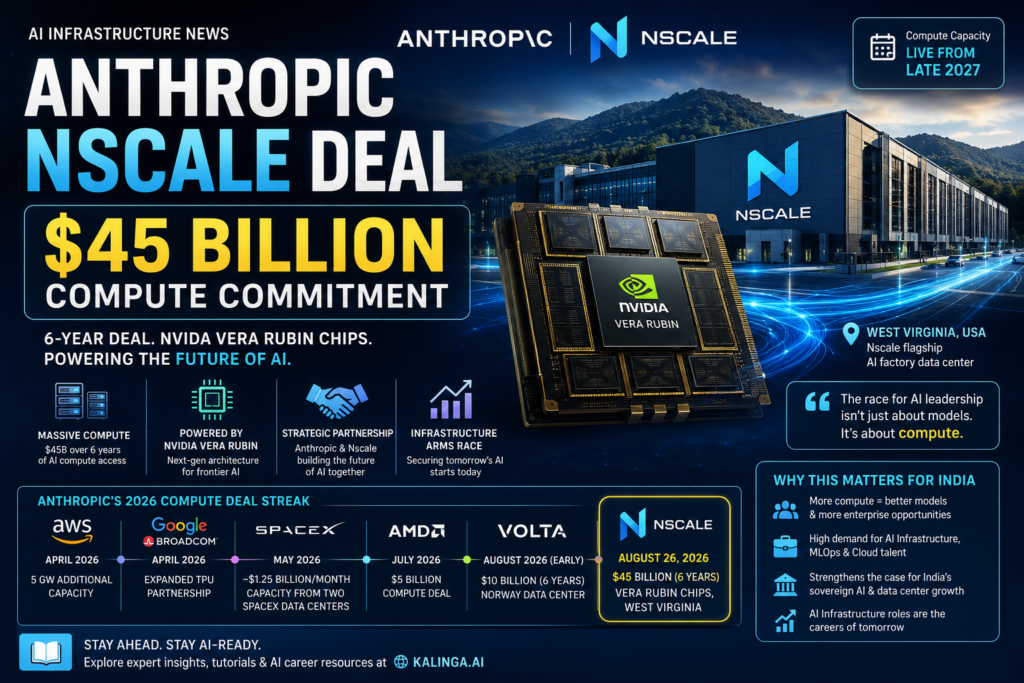
Imagine signing a shopping bill worth more than the GDP of a small country, just for computing power. That’s essentially what happened when Anthropic, the AI lab behind Claude, agreed to the Anthropic Nscale deal, a six-year, roughly $45 billion agreement to rent AI computing capacity from British infrastructure company Nscale. The deal, reported by Bloomberg and confirmed to TechCrunch by a source familiar with the matter, will supply Anthropic with compute powered by Nvidia’s new Vera Rubin chip system, starting in late 2027, from Nscale’s flagship data center in West Virginia.
If that sounds like a lot of money for server rentals, it is, and that’s exactly the point. The Anthropic Nscale deal is the latest, and one of the largest, in a string of mega compute agreements Anthropic has signed in under a year. For students and young professionals in India tracking the AI industry, this deal is a useful lens into how frontier AI labs actually operate behind the chatbot interface: not just as software companies, but as buyers of eye-watering amounts of physical infrastructure.
What Exactly Did Anthropic Agree To With Nscale?
What is the Anthropic Nscale deal in simple terms? It’s a long-term compute-rental contract: Anthropic pays Nscale roughly $45 billion over six years to access AI computing power from Nscale’s West Virginia data center, built around Nvidia’s Vera Rubin chip architecture, with capacity expected to come online in late 2027.
Nscale itself is a relatively young company, founded only in 2024, but it has moved fast. It has already struck infrastructure deals with major players including Microsoft, and operates what it calls its flagship “AI factory” data center in West Virginia, USA. Landing a $45 billion commitment from one of the world’s most closely watched AI labs is a major validation of Nscale’s ability to build and operate compute at scale.
Definition: What Is “AI Compute”?
AI compute refers to the specialized hardware, mainly high-performance chips called GPUs (Graphics Processing Units) or custom AI accelerators, needed to train and run large language models like Claude, ChatGPT, or Gemini. Training a frontier AI model requires thousands of these chips running in parallel for weeks or months inside massive data centers, consuming enormous amounts of electricity in the process. Running the model afterward (called “inference,” or answering user queries) also needs dedicated compute, just at a smaller scale per request. This is why AI labs like Anthropic don’t just write code, they need to secure physical chips, data center space, and power, often years in advance, which is exactly what deals like the Anthropic Nscale deal are designed to lock in.
Why Is Anthropic Spending So Much on Compute?
Why does Anthropic need $45 billion of compute from a single supplier? Anthropic is racing to keep pace with rivals, primarily OpenAI, in building and running increasingly large and capable models. More compute means the ability to train bigger models, serve more users, and support new products, and locking in supply years ahead protects Anthropic from chip shortages and price spikes later.
The AI industry is currently in what can only be described as an infrastructure arms race. Every major lab, Anthropic, OpenAI, Google, Meta, is trying to secure as much compute capacity as it can, as early as it can, because the chips and data centers needed to train next-generation models take years to build and are in extremely high demand. Bold takeaway: the Anthropic Nscale deal isn’t an isolated event, it’s part of a pattern.
Anthropic’s Compute-Buying Streak: A Timeline
Over roughly the past eight months, Anthropic has signed a remarkable sequence of compute deals:
- April 2026: Expanded its partnership with Amazon, gaining access to an additional 5 gigawatts of compute capacity.
- April 2026: Expanded its relationship with Google and Broadcom, adding more custom AI chip (TPU) power.
- May 2026: Entered a large computing deal with SpaceX, drawing capacity from two SpaceX data centers, reportedly worth $1.25 billion a month.
- July 2026: Signed a $5 billion compute-related deal with chipmaker AMD.
- August 2026 (early): Signed a $10 billion, six-year deal with AI cloud startup Volta (founded just in January 2026) for compute from a Norway data center.
- August 26, 2026: Signed the $45 billion Anthropic Nscale deal, its largest single compute commitment yet, spanning six years.
Laid end to end, that’s tens of billions of dollars committed in less than a year, a scale of spending that would have seemed almost unbelievable for an AI company just a few years ago. It underlines how central raw computing power has become to competing in the AI race, alongside model quality and research talent.
What Makes Nvidia’s Vera Rubin Chips Different?
What is Nvidia’s Vera Rubin system? Vera Rubin is Nvidia’s newest chip architecture, described as combining six different chips working together, and is considered the current cutting edge of AI chip design. It’s the successor generation to Nvidia’s earlier Blackwell chips and is built specifically to handle the scale of training and running frontier AI models more efficiently.
For readers less familiar with chip generations: think of each new Nvidia architecture as a significant leap in how much AI computation you can pack into the same power and space budget. Labs like Anthropic want early access to the newest architecture because it typically means faster training times, lower cost per unit of computation, and the ability to run larger models economically. That’s a major reason the Anthropic Nscale deal specifically ties its capacity to Vera Rubin hardware rather than older chip generations.
How Do Compute Deals Like This Actually Work?
What does Anthropic actually get for $45 billion? Anthropic isn’t buying chips outright or building its own data center, it’s signing a long-term rental agreement for guaranteed access to compute capacity that Nscale builds, owns, and operates. This “compute-as-a-service” model has become the standard way frontier AI labs secure the hardware they need without taking on the enormous capital cost of constructing data centers themselves.
Definition: What Is a “Compute-as-a-Service” Deal?
Compute-as-a-service is an arrangement where an infrastructure provider builds and operates data centers filled with AI chips, then sells or leases access to that capacity to AI labs on a subscription or capacity-reservation basis. Instead of Anthropic spending years and tens of billions constructing its own facilities, Nscale takes on that construction and operational risk, while Anthropic locks in guaranteed access, much like a company leasing office space instead of constructing a headquarters. This model lets AI labs scale their compute footprint faster than they could by building everything in-house, though it also means committing to very large multi-year financial obligations, as the Anthropic Nscale deal illustrates.
Under this structure, the Anthropic Nscale deal spans six years, with capacity flowing from Nscale’s West Virginia data center once it’s operational in late 2027. That lead time, over a year between signing and going live, is typical for deals this size, since data centers of this scale require substantial construction, power infrastructure, and chip installation before they can run production AI workloads.
The Bigger Picture: Why the AI Industry Is in a Compute Arms Race
Is Anthropic the only AI company signing giant compute deals? No, the Anthropic Nscale deal is part of an industry-wide pattern. Google, OpenAI, and Meta are all pursuing similarly aggressive compute acquisition strategies, reflecting a broader belief across the AI industry that whoever controls the most usable compute will have an edge in building the next generation of frontier models.
This race has several drivers worth understanding:
- Model scale keeps growing. Each new generation of frontier AI models tends to require significantly more compute to train than the last, pushing labs to secure ever-larger reserves of chips and power.
- Chip supply is constrained. Advanced AI chips like Nvidia’s Vera Rubin system are expensive and slow to manufacture, so early, large commitments help labs jump the queue ahead of competitors.
- Data centers take years to build. Physical infrastructure, power substations, cooling systems, networking, can’t be conjured overnight, so labs sign contracts years before they actually need the capacity, exactly as Anthropic has done with Nscale for 2027 delivery.
- Diversification reduces risk. By spreading commitments across multiple providers, Nscale, Volta, AMD, SpaceX, Amazon, Google/Broadcom, Anthropic avoids depending too heavily on any single supplier, protecting itself against outages, price hikes, or delays from one partner.
For context on scale: the Anthropic Nscale deal’s $45 billion figure, spread across six years, works out to roughly $7.5 billion a year from this one contract alone, on top of everything else Anthropic has already committed to in 2026.
Comparing Anthropic’s Major 2026 Compute Deals
| Deal Partner | Announced | Approx. Value / Scale | Key Detail |
| Nscale | August 2026 | ~$45 billion (6 years) | Vera Rubin chips, West Virginia data center, live late 2027 |
| Volta | August 2026 | $10 billion (6 years) | Norway data center, startup founded Jan 2026 |
| AMD | July 2026 | $5 billion | Chip-related compute partnership |
| SpaceX | May 2026 | ~$1.25 billion/month | Capacity from two SpaceX data centers |
| Amazon | April 2026 | 5 GW additional capacity | Expansion of existing partnership |
| Google/Broadcom | April 2026 | Not disclosed | Expanded TPU-based compute relationship |
This table makes one thing clear: the Anthropic Nscale deal is by far the largest single figure on this list, roughly 4.5 times the size of the Volta deal and nine times the AMD deal, a signal of just how aggressively Anthropic is scaling for the next phase of AI development.
Why This Matters for Students and Professionals in India
Does a compute deal in West Virginia affect the Indian AI job market? Indirectly, yes. Massive compute buildouts by labs like Anthropic fuel demand for AI infrastructure engineers, MLOps specialists, and AI application developers globally, including at Indian IT services firms and GCCs (Global Capability Centers) that support these labs’ cloud and enterprise ecosystems.
India doesn’t yet host the kind of frontier-scale data centers involved in the Anthropic Nscale deal, but the ripple effects are real:
- Cloud and enterprise demand: As Anthropic’s Claude models get more compute, they can serve more enterprise customers, including Indian companies building AI features on top of Claude via API.
- Talent pipeline: Global compute expansion increases demand for engineers who understand AI infrastructure, not just model usage, a skill gap Indian AI education programs are increasingly targeting.
- Sovereign AI conversations: Deals of this scale renew debate in India about building domestic AI compute capacity and data center infrastructure, rather than depending entirely on US-based hyperscalers.
- Career signal: The scale of spending signals that AI infrastructure roles (chips, data centers, cloud) are likely to remain in high demand for years, alongside AI application and prompt engineering roles.
What This Means for Claude Users and Enterprises
Will the Anthropic Nscale deal make Claude better or faster? Over time, likely yes. More compute capacity generally translates into an AI lab’s ability to train more capable models, serve more concurrent users without slowdowns, and support more enterprise-scale deployments, though users won’t see any direct impact from this specific deal until its capacity comes online in late 2027.
For businesses evaluating whether to build on Claude’s API or compete for enterprise AI contracts, deals like the Anthropic Nscale deal are also a signal of long-term commitment. A lab willing to commit $45 billion six years into the future is signaling confidence that demand for its models, and the enterprise revenue to support that spending, will keep growing. That’s relevant context for Indian enterprises and startups deciding which AI provider to build their products around, since compute stability affects everything from API pricing to service reliability down the line.
Are There Risks or Criticism Around Deals Like This?
Is there a downside to Anthropic’s compute-buying spree? Some industry analysts have raised concerns about the sustainability of AI infrastructure spending across the sector, questioning whether the revenue AI labs currently generate justifies commitments of this size, and whether a slowdown in AI demand could leave both labs and infrastructure providers overexposed.
There are a few recurring concerns worth understanding as a student of the industry:
- Circular financing concerns: Some of these compute deals involve complex financial relationships between chipmakers, cloud providers, and AI labs, which critics argue could inflate perceived demand.
- Energy demands: Data centers of this scale consume enormous amounts of electricity, raising questions about power grid strain and environmental impact in host regions like West Virginia.
- Concentration risk: Newer infrastructure providers like Nscale (founded in 2024) and Volta (founded in January 2026) are relatively unproven at this scale, meaning execution risk is real even as capital commitments grow.
- Return on investment: With multiple labs signing tens of billions in compute contracts, some observers question whether current AI product revenue can keep pace with infrastructure spending long-term.
None of this means the Anthropic Nscale deal is unsound, it simply reflects the reality that the AI industry is currently making infrastructure bets on a timeline of years, based on expectations of future demand that haven’t fully played out yet.
Frequently Asked Questions
What is the Anthropic Nscale deal worth? The Anthropic Nscale deal is valued at approximately $45 billion over six years, according to a source who spoke to TechCrunch and reporting from Bloomberg, which first broke the story.
Who is Nscale? Nscale is a British AI infrastructure company founded in 2024 that provides AI compute capacity through data centers, including a flagship facility in West Virginia. It has previously partnered with companies including Microsoft.
When will the compute from the Anthropic Nscale deal go live? The compute capacity from the deal is expected to start powering Anthropic’s services in late 2027.
What chips will power the Anthropic Nscale deal? The deal will use Nvidia’s Vera Rubin chip system, a new architecture that combines six chips and is considered Nvidia’s most advanced design to date.
Is the Anthropic Nscale deal Anthropic’s biggest compute deal? Among the individually disclosed deals reported in 2026, including agreements with Volta ($10B), AMD ($5B), SpaceX (~$1.25B/month), Amazon (5GW), and Google/Broadcom, the Anthropic Nscale deal at $45 billion is the largest single figure disclosed so far.
Why are AI labs like Anthropic spending so much on compute right now? AI labs are in an intense competitive race to train larger, more capable models and serve growing numbers of users. Because chips and data centers take years to plan and build, labs like Anthropic, OpenAI, Google, and Meta are locking in multi-year compute supply deals well ahead of when they’ll actually need the capacity.
Final Thoughts
The Anthropic Nscale deal is a striking reminder that the AI race isn’t just being fought in research papers and product launches, it’s being fought in gigawatts, chip architectures, and multi-billion-dollar infrastructure contracts. For anyone building a career in AI, understanding this infrastructure layer is just as important as understanding how to prompt a model well.
Want to go deeper into how AI infrastructure, compute economics, and model training actually work? Explore Kalinga.ai’s AI learning tracks and workshops designed for students and professionals across Odisha and India who want to understand the full AI stack, not just the chat window.