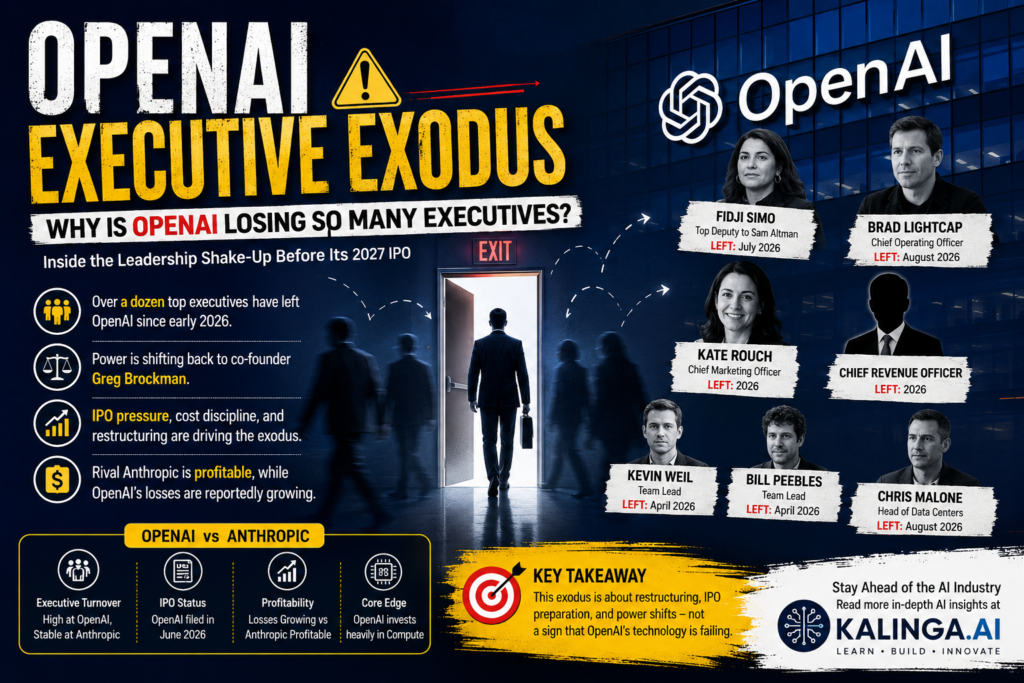
Imagine a company that just shipped one of the most capable AI models on the market, added 15 million new subscribers in two months, and quietly filed paperwork to go public, and yet, more than a dozen of its top executives have walked out the door in under eight months. That is exactly the situation at OpenAI right now, and it has a name: the OpenAI executive exodus. In short, the OpenAI executive exodus is being driven by a mix of internal reorganization, IPO-related cost discipline, and a power shift back toward co-founder Greg Brockman, not, as some assume, a sign that the company’s technology is failing.
If you are a student, fresher, or young professional tracking the AI industry out of Odisha or anywhere else in India, this story matters more than it looks. Executive churn at the world’s most-watched AI lab tells you something about how AI companies are maturing, how leadership works in fast-scaling tech firms, and what skills will matter as these companies prepare for public markets. It’s also a preview of the kind of organizational change happening across the wider AI sector, from Bengaluru startups to Bhubaneswar-based teams building on top of frontier models. Let’s break down the OpenAI executive exodus in plain language.
A frontier lab is industry shorthand for a company building the most advanced, largest-scale AI models available, think OpenAI, Anthropic, or Google DeepMind. Frontier labs sit at the cutting edge of AI research and compute spending, which is exactly why leadership stability inside one of them, or the lack of it, becomes global tech news.
What Is the OpenAI Executive Exodus?
The OpenAI executive exodus refers to the wave of senior leadership departures at OpenAI since the start of 2026, involving more than a dozen high-ranking executives across product, operations, revenue, marketing, and infrastructure teams. This is not a single resignation or a one-off scandal, it is a sustained pattern, month after month, of C-suite and VP-level exits at a company that is simultaneously scaling its product and preparing for a stock market debut.
To put the OpenAI executive exodus in context, this is the kind of turnover you would expect during a merger, a crisis, or a founder-CEO conflict. OpenAI is technically none of those things, it just released GPT-5.6, one of its most efficient models yet, and its desktop app for agentic coding and workplace tasks is growing fast. That contrast between product momentum and leadership instability is exactly why the OpenAI executive exodus has become such a widely discussed story in tech media, as reported by TechCrunch.
Who Has Left OpenAI in 2026?
Here is a scannable list of the key departures that make up the OpenAI executive exodus, based on reporting from TechCrunch:
- Fidji Simo, stepped down from her role as CEO Sam Altman’s top deputy (No. 2 executive) in July 2026
- Brad Lightcap, the company’s longtime chief operating officer, left in August 2026 to start something new
- A chief revenue officer, departed, with OpenAI hiring a replacement as the shake-up continued
- Kate Rouch, chief marketing officer, exited the company
- Kevin Weil and Bill Peebles, team leads who exited in April 2026 as OpenAI continued shedding side projects
- Chris Malone, head of data centers, left last week after joining in March 2024, in one of the more unexpected exits of the OpenAI executive exodus
This list reflects departures reported since the turn of the year, including Altman’s top deputy, the chief operating officer, a chief revenue officer, the chief marketing officer, and several different team leads. Most recently, Chris Malone, the company’s head of data centers, left the company last week after joining in March 2024.
Why Are OpenAI Executives Leaving?
Why are so many executives leaving OpenAI? There is no single cause. Some departures have been tied to health issues, while others followed a reorganization as Altman worked to cut expensive “side projects” and focus on revenue-generating work. The OpenAI executive exodus, in other words, is a mix of personal circumstances and deliberate corporate restructuring, not a single crisis event.
That said, one departure stood out for a different reason. Malone’s exit is notable because OpenAI’s core edge over rivals like Anthropic or SpaceX is its investment in compute, and the company told TechCrunch his departure came from a reorganization of the infrastructure team, now led by vice president Sachin Katti and reporting to president Greg Brockman. When a senior leader suddenly finds himself several rungs further down the reporting chain, an exit becomes far less surprising, and this is a recurring theme across the OpenAI executive exodus.
The Greg Brockman Power Shift
Greg Brockman is OpenAI’s co-founder and president; he built much of the company’s early infrastructure but was stripped of most day-to-day management duties back in 2019, when Altman took over as CEO. Understanding Brockman’s arc is essential to understanding the OpenAI executive exodus, because his rising influence appears to be reshaping who reports to whom across the entire company.
According to Karen Hao’s book “Empire of AI,” Brockman played a disruptive role at OpenAI after losing management responsibilities, his work on projects like GPT-4 was undeniably valuable, but he also stoked internal rivalries that helped trigger the 2023 boardroom crisis in which Altman was briefly ousted as CEO. Brockman then took a short sabbatical in 2024 before returning to the company.
Is Greg Brockman now OpenAI’s most powerful executive besides Altman? The evidence suggests yes. Today, both the infrastructure and product teams report to Brockman, and Thibault Sottiaux, who leads OpenAI’s API and app offerings, told TechCrunch that “everyone reports to Greg at the end of the day.” That single line captures the real story behind the OpenAI executive exodus: as Brockman’s authority expands, executives who once had direct lines to Altman are finding their roles restructured, and some are choosing to leave rather than adapt.
The IPO Pressure Cooker
The OpenAI executive exodus is also unfolding against the backdrop of a looming stock market debut. In June 2026, OpenAI confidentially filed going-public disclosures with the U.S. Securities and Exchange Commission (SEC), a step that would give the capital-hungry frontier lab access to public markets, but also means disclosing its financials around the same time as rival Anthropic, which is pursuing its own public debut.
That comparison is not flattering on every metric. Anthropic is reportedly on track for its first profitable quarter, while OpenAI is reportedly seeing its losses grow alongside its revenue. OpenAI’s IPO isn’t expected until 2027, even though the average company that files confidentially usually reaches the trading floor within about five months of filing, for comparison, SpaceX went public in under two months after its confidential filing.
Is the IPO timeline connected to the OpenAI executive exodus? Almost certainly. Altman’s own public comments about a difficult past twelve months, combined with the internal reorganization, fit a narrative that OpenAI overextended itself with its IPO filing and is now restructuring to boost revenue and cut costs. A leaner executive bench with clearer, revenue-focused reporting lines is a classic pre-IPO move, and it is a major reason the OpenAI executive exodus has accelerated rather than slowed down in recent months.
The 2023 Boardroom Crisis That Set the Stage
To fully understand this leadership shake-up, it helps to rewind to 2023. Brockman’s relationship with day-to-day management has not been a straight line, and that history is directly relevant to what is happening now.
What was “the Blip” at OpenAI? It is the nickname given to the chaotic November 2023 episode when OpenAI’s board briefly ousted Sam Altman as CEO before reinstating him days later, amid intense employee and investor pushback. According to Karen Hao’s book “Empire of AI,” Brockman’s undeniable contributions to projects like GPT-4 came alongside internal rivalries he helped seed, and those tensions were part of what triggered the 2023 crisis.
That history matters for two reasons. First, it shows Brockman has always been closer to the center of OpenAI’s power struggles than his official title suggested, even during years when he held fewer formal management responsibilities. Second, it means the current consolidation of authority under Brockman is not entirely new territory for OpenAI’s board or its senior team, it is, in some ways, a return to a dynamic the company has navigated before, just without the public drama of a boardroom coup this time around.
A Familiar Pattern: Founders, Then Scalers, Then Founders Again
Founder-to-operator transition is a well-known startup lifecycle stage: a company’s original founders build the product, then bring in experienced operating executives to scale the business and prepare it for public markets. This pattern shows up across the tech industry, and it helps explain a subtler layer of the OpenAI executive exodus.
There was a clear sense of this dynamic when OpenAI brought in now-departed executives like Fidji Simo and Kevin Weil, both veterans of multiple tech businesses, and the same dynamic appears to be playing out in reverse as Brockman’s influence grows again. Before OpenAI, Brockman was best known for building out Stripe’s business operations, and internally for championing the company’s go-to-market efforts. In other words, the OpenAI executive exodus may partly reflect a swing back toward founder-led operations at exactly the moment the company needs to tighten its business fundamentals.
OpenAI vs. Anthropic: Leadership and IPO Snapshot
The following table places the OpenAI executive exodus in context against its closest frontier-lab rival, based on details reported by TechCrunch.
| Factor | OpenAI | Anthropic |
| Recent executive turnover | Over a dozen senior departures since early 2026 (the OpenAI executive exodus) | Not reported as experiencing comparable turnover |
| IPO status | Confidentially filed with the SEC in June 2026; debut not expected until 2027 | Also reportedly planning a public debut |
| Profitability | Reportedly seeing losses grow alongside revenue | Reportedly nearing its first profitable quarter |
| Core competitive edge | Heavy investment in compute and data center infrastructure | Not detailed in this report |
| Leadership structure | Power increasingly consolidated under president Greg Brockman | Not detailed in this report |
This side-by-side view shows why the OpenAI executive exodus is being read as more than internal drama, it is happening at precisely the moment investors will be comparing OpenAI’s financial discipline against Anthropic’s. When two rival frontier labs are both racing toward public markets, every leadership decision, cost cut, and reporting-line change gets read as a signal to future shareholders, which is part of why a story about departing executives has attracted so much attention well beyond the tech press.
What the OpenAI Executive Exodus Means for AI Careers in India
For students and young professionals in Odisha and across India tracking the AI industry, the OpenAI executive exodus is a useful case study, not just distant corporate news. A few takeaways are worth carrying into your own career planning:
- Product success and organizational stability are different things. A company can ship a strong model like GPT-5.6 and grow its user base while still going through significant leadership turbulence. Don’t assume a hot product means a stable employer.
- Pre-IPO companies restructure aggressively. As firms prepare for public markets, expect flatter reporting lines, sharper revenue focus, and less tolerance for “side projects”, a pattern visible throughout the OpenAI executive exodus.
- Infrastructure and compute roles are becoming more strategically important, not less, even when the people leading them change. India’s own growing data center and AI infrastructure sector mirrors this trend.
- Founder influence can resurge even after founders step back from management, as Brockman’s example shows, operational power in tech companies is rarely permanent in either direction.
- Watch reporting structures, not just headlines, when evaluating any AI employer, who reports to whom often explains departures better than press releases do.
- Compute and data center expertise travels well. As Indian companies and global firms expand AI infrastructure investment in the country, the same infrastructure and operations skills that mattered to OpenAI’s data center team are increasingly in demand locally.
- Learn to read a company’s growth story critically. Subscriber growth and model releases are only part of the picture; revenue, profitability, and leadership stability tell the rest of the story, and employers increasingly expect analysts and product hires to understand both.
This kind of leadership turbulence is not unique to OpenAI, it is a recurring feature of high-growth tech companies moving from founder-led experimentation toward disciplined, investor-ready operations. For anyone building a career in AI, product management, or tech operations, learning to read these signals early is a genuinely useful, transferable skill, and it is exactly the kind of real-world context that separates a resume built on tutorials from one built on industry fluency.
Understanding episodes like this one gives Indian AI learners a more realistic picture of how frontier AI labs actually operate behind the scenes of flashy model launches.
FAQ: OpenAI Executive Exodus
What is the OpenAI executive exodus? It refers to the departure of more than a dozen senior OpenAI executives since the start of 2026, spanning operations, revenue, marketing, product, and infrastructure roles, amid internal reorganization and IPO preparation.
Who are the most notable executives who left OpenAI? Notable departures include Fidji Simo (Sam Altman’s top deputy), Brad Lightcap (chief operating officer), Kate Rouch (chief marketing officer), a chief revenue officer, team leads Kevin Weil and Bill Peebles, and Chris Malone (head of data centers).
Why is Chris Malone’s departure significant? Because OpenAI’s biggest competitive edge over rivals is its investment in compute infrastructure, and Malone led data centers, his exit followed a reorganization that placed the infrastructure team several levels below president Greg Brockman.
Is the OpenAI executive exodus linked to the company’s IPO plans? Yes. OpenAI confidentially filed for an IPO with the SEC in June 2026, and the ongoing reorganization appears aimed at boosting revenue and cutting costs ahead of a public listing expected in 2027.
Is Greg Brockman taking more control at OpenAI? It appears so. Both the infrastructure and product teams now report to Brockman, and a senior colleague has said that effectively everyone at the company reports to him at the end of the day.
Does the OpenAI executive exodus mean OpenAI is struggling? Not necessarily. The company’s latest model and consumer app are both growing quickly; the exodus reflects internal restructuring and IPO-driven cost discipline rather than product failure.
Keep Learning About the AI Industry with Kalinga.ai
The OpenAI executive exodus is a reminder that following AI isn’t just about tracking new models, it’s also about understanding the people and business decisions shaping the industry. If you want to build real, job-ready AI skills while staying on top of stories like this, explore Kalinga.ai’s AI training programs and workshops designed for students and young professionals across Odisha and India.