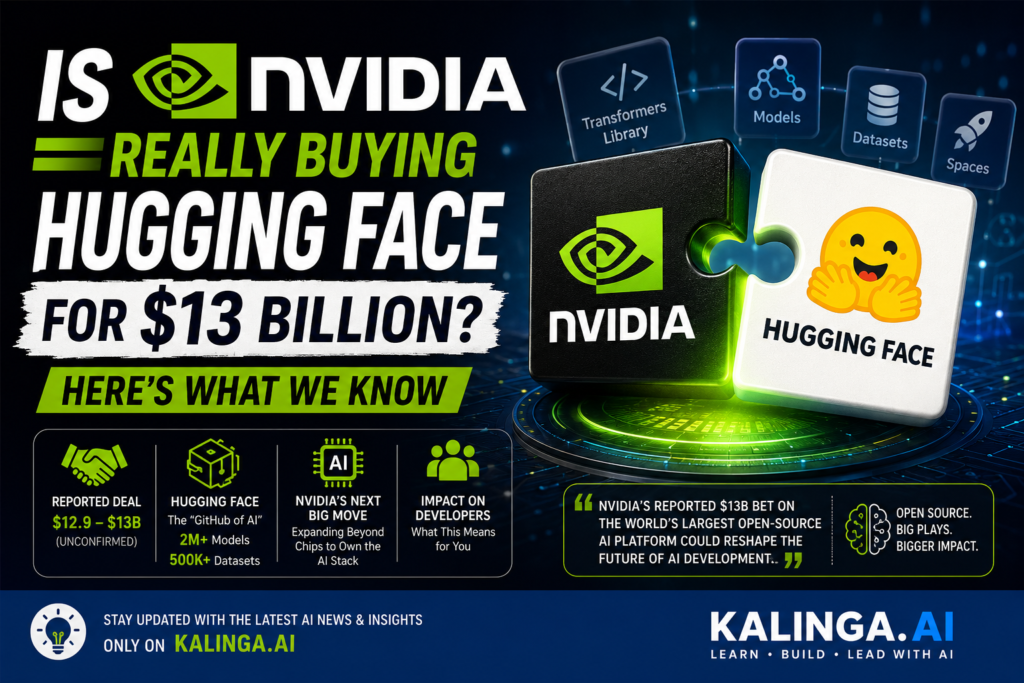
Imagine the world’s most valuable chipmaker buying the “GitHub of AI”, that’s essentially what’s unfolding right now. According to multiple reports on August 27, 2026, the Nvidia Hugging Face acquisition is reportedly close to becoming reality, with Business Insider valuing the deal at over $13 billion and The Information putting the final figure at $12.9 billion. If confirmed, this would be Nvidia’s biggest AI-software bet yet, and it would hand the company direct ownership of the platform millions of developers use every day to build, share, and deploy AI models.
Neither Nvidia nor Hugging Face has officially confirmed the transaction as of this writing. But the reporting is consistent enough, from Business Insider, The Information, Bloomberg, and CNBC, that the Nvidia Hugging Face acquisition is being treated across the tech press as a near-done deal. Here’s a full breakdown of what’s happened, why it matters, and what it could mean if you’re a student, developer, or working professional following the AI industry out of Odisha or anywhere else in India.
What Exactly Happened With the Nvidia Hugging Face Deal?
Nvidia has reportedly held serious talks to acquire Hugging Face, the open-source AI platform, in a transaction that could value the startup at more than $13 billion. Business Insider first reported the talks on Thursday, August 27, 2026, citing a person familiar with the matter, while The Information separately reported that Nvidia had already agreed to buy Hugging Face for $12.9 billion.
Business Insider vs. The Information, what’s the difference? Business Insider’s sourcing describes this as an active, unfinished negotiation that “could” value Hugging Face above $13 billion. The Information’s report is more definitive, describing an already-agreed price of $12.9 billion. CNBC noted it could not independently verify either figure, and both Nvidia and Hugging Face declined to comment when contacted by reporters. In other words, the Nvidia Hugging Face acquisition is real enough to be reported by three major outlets, but the ink isn’t dry yet.
Here’s the timeline of events as reported so far:
- Talks began after Hugging Face drew interest from another suitor. The Information reported that deal discussions started once Hugging Face received acquisition interest from a separate company, which appears to have accelerated the process.
- Hugging Face had already been shopping itself around. Business Insider reported the previous week that Hugging Face was working with a bank to gauge interest from potential bidders.
- The talks became public on August 27, 2026, just one day after Nvidia posted strong quarterly earnings that pushed its shares up roughly 4% in after-hours trading.
- A final agreement has not been publicly confirmed, and reports note the deal could still fall through before signing.
Why Is Nvidia Buying Hugging Face?
Nvidia wants to own more of the AI software stack, not just the chips underneath it. A fund manager at Eonopolis Exponential Technologies, quoted by CNBC, described Nvidia as fundamentally a “platform-based” company that is trying to be present at every layer, from energy and hardware to foundational models and applications. Hugging Face, as the central hub where open-source models and datasets are shared, fits neatly into that vertical stack.
There’s also a strategic neutrality angle. Nvidia has repeatedly signaled it doesn’t want to pick sides between closed-source and open-source AI models, it wants its GPUs to be the default choice regardless of which model architecture wins. Owning Hugging Face, the world’s largest home for open-source models, would put Nvidia at the center of that ecosystem rather than just supplying the hardware underneath it.
Nvidia’s relationship with Hugging Face isn’t new. In 2023, Nvidia participated in a Series D funding round that valued Hugging Face at roughly $4.5 billion. According to a Financial Times report cited by Gizmodo, Nvidia later tried to invest $500 million on its own toward the end of 2025, which Hugging Face reportedly turned down at the time, partly because the startup didn’t want a single dominant investor influencing its direction. Less than a year later, the price tag has nearly tripled to the $12.9–13 billion range now being reported.
Nvidia’s AI Acquisition Spree: A Timeline
The potential Nvidia Hugging Face acquisition doesn’t exist in isolation, it’s the latest move in an unusually aggressive run of AI-related deals by Nvidia over roughly the past 12 months.
| Company / Deal | Type | What It Reportedly Adds to Nvidia | Reported Value |
| Groq | Licensing deal | Fast AI chip/inference technology | ~$20 billion licensing deal |
| Kumo | Acquisition (June 2026) | Foundation model startup capabilities | Not publicly disclosed |
| ShedMD | Acquisition | AI/healthcare-adjacent technology | Not publicly disclosed |
| Illumex | Acquisition | Data/AI infrastructure technology | Not publicly disclosed |
| Hugging Face (reported) | Acquisition talks | Open-source AI model hub, developer community | ~$12.9–13 billion (reported, unconfirmed) |
Nvidia also disclosed on Wednesday, August 26, 2026, the day before the Hugging Face news broke, that it has $18 billion committed to equity investments for the remainder of the year, underlining just how much capital the company is deploying across the AI ecosystem right now.
What Is Hugging Face, and Why Does Everyone Call It “The GitHub of AI”?
Hugging Face is an open-source AI platform, often nicknamed the “GitHub of AI,” where developers and researchers host, share, and download pre-trained machine learning models, datasets, and demo applications. Founded in 2016 in New York by French entrepreneurs Clément Delangue, Julien Chaumond, and Thomas Wolf, the company originally built a chatbot app for teenagers before pivoting in 2018–2019 toward open-source machine learning tools.
That pivot turned out to be the right call. The Hugging Face Hub now hosts well over two million AI models, hundreds of thousands of datasets, and a large library of interactive demo apps called “Spaces,” used by everyone from solo students to major research labs. Its flagship Transformers library gives developers a single, unified way to load and run thousands of different AI models, for text, images, audio, and more, often in just a few lines of code, without having to build anything from scratch.
Why does a platform like this matter to a chipmaker? Because every model downloaded, fine-tuned, or deployed from Hugging Face eventually needs to run on some kind of processor, and Nvidia would very much like that processor to be one of its own GPUs. Owning the distribution layer where developers discover and download models gives Nvidia enormous influence over how the broader AI developer community works, well beyond just selling them chips.
How Would This Deal Change the AI Landscape?
If the Nvidia Hugging Face acquisition closes, what actually changes for the industry? The most immediate shift would be structural: one of the AI industry’s most important “neutral” infrastructure providers would come under the ownership of the world’s dominant AI chipmaker. That raises real questions about whether Hugging Face can remain equally welcoming to Nvidia’s GPU rivals, such as AMD and Intel, once it’s part of Nvidia’s corporate family.
| Aspect | Hugging Face as an Independent Company | Hugging Face Under Nvidia (If Deal Closes) |
| Perceived neutrality | Seen as vendor-neutral hub for all hardware/model types | Could raise concerns about favoring Nvidia hardware |
| Funding & resources | Relied on venture rounds (e.g., 2023 Series D at $4.5B) | Access to Nvidia’s much larger balance sheet |
| Strategic direction | Independent roadmap, open-core business model | Likely integration with Nvidia’s software/hardware stack |
| Developer trust | Historically resisted a single dominant investor | Will need to actively reassure open-source community |
| Market position | Central but standalone hub for open-source AI | Anchor asset in Nvidia’s five-layer AI stack (per Jobe, CNBC) |
Beyond neutrality concerns, a completed deal would also deepen Nvidia’s push into what analysts describe as a “five-layer” AI stack, spanning energy, hardware, foundational models, platforms, and applications, rather than leaving Nvidia purely as a hardware supplier sitting beneath everyone else’s software.
What This Means for Students and Developers in Odisha and India
For AI learners and early-career developers, this kind of consolidation is worth watching closely, even if it feels like a story about billion-dollar boardrooms far removed from a classroom in Bhubaneswar. Hugging Face’s tools, Transformers, Datasets, and Spaces, remain some of the most widely used, beginner-friendly resources for anyone learning to build with AI models, and that’s unlikely to disappear overnight even if ownership changes.
A few practical takeaways for students and young professionals tracking this story:
- Open-source AI tooling isn’t going away, but ownership consolidation is worth monitoring, pricing, access policies, or hardware-optimization choices could shift over time.
- Big acquisitions like this validate open-source AI as a serious business, not just a hobbyist community, a useful data point if you’re weighing career paths in AI.
- Nvidia’s aggressive buying spree (Groq, Kumo, ShedMD, Illumex, and now possibly Hugging Face) signals where the AI industry’s capital is flowing, largely toward companies that control developer infrastructure, not just end-user apps.
- Skills in the Hugging Face ecosystem (Transformers library, model fine-tuning, dataset handling) remain highly transferable, regardless of who eventually owns the platform.
Is the Nvidia Hugging Face Deal Actually Confirmed?
No, as of this writing, the deal has not been officially confirmed by either company. Nvidia and Hugging Face have not responded publicly to requests for comment, and reports themselves note that the talks, while advanced, could still collapse before a formal agreement is signed. Readers should treat the $12.9–13 billion figures as reported estimates from sources familiar with the discussions, not confirmed, audited numbers.
FAQ: Nvidia Hugging Face Acquisition
Is Nvidia buying Hugging Face? Nvidia has reportedly held serious talks to acquire Hugging Face, with Business Insider and The Information both reporting on the discussions on August 27, 2026. Neither company has officially confirmed a signed deal, and the reports note negotiations could still fall through.
How much is the Nvidia Hugging Face deal worth? Reported figures vary slightly: Business Insider’s sourcing suggests a valuation of more than $13 billion, while The Information reported a more specific, already-agreed figure of $12.9 billion. Both numbers remain unconfirmed by the companies involved.
What is Hugging Face used for? Hugging Face is an open-source AI platform where developers host, share, and download pre-trained machine learning models, datasets, and demo apps. Its Hub hosts millions of models and hundreds of thousands of datasets, and its Transformers library is one of the most widely used tools for working with AI models in just a few lines of code.
Why would Nvidia want to own an open-source AI platform? Nvidia has been expanding well beyond chip manufacturing into the broader AI software stack, including foundational models and developer platforms. Owning Hugging Face would give Nvidia direct influence over the ecosystem where developers discover and deploy AI models, reinforcing demand for Nvidia hardware across the open-source AI community.
Has Nvidia made other AI acquisitions recently? Yes. Over roughly the past year, Nvidia has acquired foundation model startup Kumo, along with ShedMD and Illumex, and struck a reported $20 billion licensing deal with AI chip startup Groq. Nvidia also said it has $18 billion committed to equity investments for the remainder of 2026.
Will Hugging Face still be free and open-source if Nvidia buys it? This hasn’t been addressed publicly by either company, since the deal itself is unconfirmed. Hugging Face’s core model, free access to its Hub, model downloads, and datasets, has historically been central to its identity, but any changes to that approach under new ownership would depend on decisions neither company has announced yet.
Want to actually build with the tools at the center of this story? Kalinga.ai runs hands-on AI and LLM training for students and young professionals across Odisha, a good next step if stories like the Nvidia Hugging Face acquisition make you want to understand the technology, not just the headlines.