Who’s Behind Ox Alpha? What We Actually Know About the Mystery AI Model
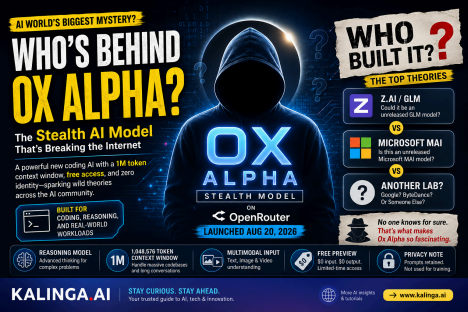
File Name: ox-alpha-ai-model-mystery.jpg
Title: Ox Alpha AI Model Mystery Explained
Caption: Who really built Ox Alpha? Explore the clues, competing theories, and hidden story behind the AI model taking the tech world by storm.
Description: A dramatic landscape poster featuring a mysterious hooded AI figure representing Ox Alpha, surrounded by digital code, question marks, and bold technology-inspired graphics. The design highlights the key theories surrounding its anonymous creator,including Z.ai/GLM and Microsoft MAI,alongside its coding focus, 1-million-token context window, and OpenRouter availability, making it visually relevant to the article’s investigation into who built the stealth AI model.
Alt Text: Ox Alpha AI model poster featuring a mysterious figure and theories about its anonymous creator.
Planned Structure
● H2: Ox Alpha: What Is the Mysterious AI Model?
○ H3: What OpenRouter confirms
○ H3: Why the model attracted attention
● H2: Who Is Behind Ox Alpha? The Short Answer
○ H3: The Z.ai/GLM theory
○ H3: The Microsoft MAI theory
○ H3: Other theories circulating online
● H2: Why People Think Ox Alpha Could Come From Z.ai
● H2: Why Microsoft’s MAI Models Entered the Conversation
● H2: Ox Alpha vs. the Leading Origin Theories
● H2: What Makes Ox Alpha So Interesting to Developers?
● H2: What Is Confirmed,and What Is Still Speculation?
● H2: Why the Anonymous Provider Matters
● H2: What Happens Next for Ox Alpha?
● H2: FAQ About Ox Alpha
Focus Keywords
1. Primary keyword: Ox Alpha
2. Secondary keyword: Ox Alpha AI model
3. Secondary keyword: OpenRouter stealth model
4. Secondary keyword: Z.ai GLM
5. Secondary keyword: Microsoft MAI
Ox Alpha: Who Actually Built the Mysterious AI Model?
What if a powerful coding AI suddenly appeared for free, offered a 1-million-token context window, and nobody would say who built it?
That is essentially what happened with Ox Alpha, a mysterious reasoning model that appeared on OpenRouter on August 20, 2026. The direct answer is surprisingly simple: no company has publicly confirmed that it built Ox Alpha. OpenRouter lists the model under “Stealth” and
explicitly says it was developed and operated by an anonymous third-party provider,not by OpenRouter itself.
That lack of attribution has triggered a guessing game across AI communities. The strongest theories have included China’s Z.ai and its GLM family, Microsoft’s unreleased MAI models, and several other major AI labs.
But there is an important distinction between evidence and internet detective work: as of August 24, 2026, the identity of the organization behind Ox Alpha remains unconfirmed.
Ox Alpha: What Is the Mysterious AI Model?
Ox Alpha is an anonymous reasoning model available through OpenRouter, designed for coding, sustained agentic work, complex reasoning, and production workloads. OpenRouter currently lists it as stealth/ox-alpha, with a 1,048,576-token context window and support for text, image, and video input.
The model became particularly interesting because it was initially offered at $0 for both input and output tokens during its preview. Its maximum output is listed at 131,072 tokens, giving developers unusually large space for long coding or agentic tasks.
Definition + Expansion: What Is a “Stealth Model”?
A stealth model is an AI model whose provider intentionally withholds its identity, usually during an early preview or testing period.
In this case, “stealth” is not simply a nickname invented by users. OpenRouter’s own provider page says the model is developed and operated by a third-party provider that has chosen to remain anonymous during the preview. OpenRouter also makes clear that it only routes requests and is not the model’s developer, owner, or provider.
That distinction matters because some online discussions have incorrectly treated OpenRouter as the company behind the model. OpenRouter is effectively the distribution layer here, while the actual model provider remains hidden.
What does OpenRouter officially say about Ox Alpha?
OpenRouter says the model is a reasoning system built for coding, long-horizon software engineering, complex reasoning, and workflows combining text with visual context. It also states that prompts and completions are retained by the anonymous provider but are not used for training, according to the current Stealth Model terms.
So, the official record tells us quite a lot about what Ox Alpha is designed to do, but almost nothing about who created it.
Who Is Behind Ox Alpha? The Short Answer Nobody outside the anonymous provider can currently prove who built Ox Alpha.
The most discussed possibility has been Z.ai, the Chinese AI company behind the GLM family. Another theory has pointed toward Microsoft’s MAI models, while other discussions have mentioned companies such as Google, ByteDance, Xiaomi, Tencent, and MiniMax.
However, these theories should not be presented as established facts.
A useful way to understand the situation is to divide the evidence into three categories:
● Confirmed: Ox Alpha exists and is hosted through OpenRouter under an anonymous “Stealth” provider.
● Observed: Developers have reported similarities between Ox Alpha and other AI models based on behavior, tokenization, error patterns, and testing.
● Speculated: Those similarities identify the organization that built Ox Alpha. The first two categories are evidence. The third is still a hypothesis.
Is Z.ai behind Ox Alpha?
Possibly, but there is no public confirmation from Z.ai.
The Z.ai theory became prominent because members of the AI community reported similarities between Ox Alpha’s behavior and the GLM family. Some discussions have focused particularly on GLM 5.3, while other analyses have suggested a related or unreleased GLM variant.
That theory gained traction because model fingerprints can sometimes reveal clues about an AI system’s family. Tokenizer behavior,the way a model breaks text into smaller units,can sometimes be particularly informative.
But a fingerprint is not a corporate signature.
A model could share technical characteristics with another model because it comes from the same family, uses related training methods, incorporates similar data, or has been adapted by another organization. Therefore, even convincing technical similarities do not automatically prove that Z.ai operates the service.
Could Microsoft be behind Ox Alpha?
Microsoft’s MAI models are another theory, but the evidence has not established a Microsoft connection.
Some reporting initially suggested that Ox Alpha might be connected to an unreleased Microsoft AI model. However, later discussion weakened confidence in that explanation as different technical clues appeared to point in different directions.
This is a useful lesson when following AI rumors: the first plausible explanation is rarely the final one.
The anonymous provider has not publicly identified itself as Microsoft, and Microsoft has not publicly claimed Ox Alpha.
Why People Think Ox Alpha Could Come From Z.ai The Z.ai hypothesis is interesting because the mystery is not happening in isolation.
Chinese AI laboratories have increasingly produced models capable of competing with systems from major U.S. technology companies. That has made the possibility of an unreleased Chinese model appearing through an anonymous preview particularly believable to AI enthusiasts.
What evidence points toward the GLM family?
Community researchers have reported similarities involving tokenization, vocabulary, error behavior, and model responses. Some users testing the model have specifically argued that its behavior resembles GLM systems.
One community analysis went further, arguing that Ox Alpha’s tokenizer and video-token behavior could be consistent with the GLM family. But that same analysis explicitly treated the connection as an inference rather than vendor-confirmed evidence.
That distinction is crucial.
Question → Direct Answer: Does a GLM-like fingerprint prove that Z.ai built Ox Alpha? No. It makes Z.ai a plausible hypothesis, but it does not establish ownership or authorship.
The internet often compresses “this looks like GLM” into “this is GLM.” Those statements are very different.
Why would a company hide a model’s identity?
There are several possible strategic reasons an AI developer might run an anonymous preview:
● Testing a model before an official launch
● Measuring real-world developer behavior
● Collecting feedback without creating launch expectations
● Avoiding attention from competitors
● Experimenting with pricing or infrastructure
● Testing a model under a different brand
● Evaluating demand before revealing the product
None of these explanations has been confirmed as the reason for Ox Alpha’s anonymity.
Still, the format is strategically useful. A company can expose a model to thousands of developers while delaying the branding, positioning, and commercial decisions that usually accompany a public launch.
Why Microsoft’s MAI Models Entered the Conversation
Microsoft is another logical candidate because the company has invested heavily in developing and deploying its own AI models.
The MAI theory emerged after analysts and publications examined technical characteristics of Ox Alpha and compared them with Microsoft’s emerging model efforts. One report initially suggested evidence for a GLM connection but later updated its discussion to include the possibility of an unreleased Microsoft MAI model.
The problem is that the available clues have not converged on a single answer. What is the biggest problem with the Microsoft theory?
There is no first-party confirmation linking Microsoft to Ox Alpha, and competing technical interpretations remain active.
This is why responsible reporting should describe Microsoft MAI as a theory, not an identity. The same applies to Z.ai.
The mystery exists precisely because the provider has withheld the information that would turn these theories into facts.
Ox Alpha vs. the Leading Origin Theories
Theory Why people suspect it What is missing
Z.ai / GLM Reported tokenizer, vocabulary, behavior and error-pattern similarities
Microsoft MAI Possible technical similarities and Microsoft’s ability to fund large-scale AI
infrastructure
No public confirmation from Z.ai
No public confirmation from Microsoft
Google /
Gemini
ByteDance / Seed
Other
Chinese labs
Some users explored similarities in model behavior and self-identification
Large AI infrastructure and ability to operate major model previews
China’s growing frontier-model ecosystem and previous anonymous-model speculation
No reliable public evidence establishing a Gemini
connection
No distinctive public fingerprint tying Ox Alpha to Seed
No verified provider identity
The table illustrates the central point: the theories are much easier to list than to prove.
Some online discussions have even proposed combinations of organizations or less obvious model families. But every additional theory needs evidence, and speculation can quickly outrun what the model itself reveals.
What Makes Ox Alpha So Interesting to Developers?
The identity mystery would probably not have become such a big story if the model were ordinary.
Instead, developers quickly became interested in its capabilities and unusually generous preview access.
OpenRouter currently lists a 1,048,576-token context window, which is roughly one million tokens of information that can potentially be provided to the model within a single context. It also lists support for text, image, and video input.
For coding agents, that matters.
A coding agent is an AI system that can work through a software task over multiple steps, often reading files, reasoning about a codebase, generating changes, running tools, and responding to failures.
A large context window can make it easier to keep more of a large repository, conversation, logs, or task history available to the model.
Why does the 1-million-token context window matter?
It gives developers much more room for long-running tasks, large codebases, documents, and multimodal workflows.
That does not automatically make a model better. Context capacity and reasoning quality are separate characteristics.
A model can have a huge context window and still perform poorly on a particular coding problem. Conversely, a smaller model can sometimes outperform a larger-context system when the task is tightly scoped.
Ox Alpha also attracted attention because of its price
During the preview, Ox Alpha was listed at $0 for input and output on OpenRouter. OpenCode also promoted free access and described its route as having generous limits and claimed capacity of 100 trillion tokens per day. That 100-trillion-token figure comes from OpenCode’s own promotional material, not from OpenRouter’s model record, so it should not be treated as an independently verified capacity figure.
That combination,large context, multimodal input, reasoning, coding capabilities, and free access,is what turned a relatively obscure model listing into a developer-community event.
What Is Confirmed,and What Is Still Speculation? The easiest way to avoid getting lost in the Ox Alpha mystery is to separate facts from theories. Confirmed facts
● Ox Alpha appeared on OpenRouter on August 20, 2026.
● Its model identifier is stealth/ox-alpha.
● OpenRouter describes it as a reasoning model for coding, agentic work, and production workloads.
● The listed context window is 1,048,576 tokens.
● The model accepts text, image, and video input and produces text output. ● OpenRouter says the actual provider is an anonymous third party.
● OpenRouter says it is not the developer, owner, or provider of the model. ● The model was available free during its preview period.
Not confirmed
● Z.ai built Ox Alpha.
● Ox Alpha is an unreleased GLM model.
● Microsoft built Ox Alpha.
● Ox Alpha is an unreleased MAI model.
● Google, ByteDance, Xiaomi, Tencent, or another named AI company built it. ● Any community benchmark definitively establishes Ox Alpha as the best coding model.
That final point deserves attention because community benchmark results can be useful without being equivalent to formal evaluations.
For example, one GitHub project reported 66 solved tasks out of 113 on a DeepSWE run, while noting tool-call format failures as part of the evaluation. Another Reddit user reported a 28% Pass@1 result on 175 LiveCodeBench v6 problems under a specific testing setup. Those results come from independent community experiments and should not be treated as official benchmark scores for the model.
Why the Anonymous Provider Matters
There is a bigger issue beneath the fun of guessing the model’s identity: data governance.
When developers use a free AI model, they may naturally assume that “free” means the same privacy conditions as a familiar commercial AI service.
It does not.
Should developers send sensitive code to Ox Alpha?
They should be cautious and check the current provider terms before sending proprietary, confidential, or sensitive material.
OpenRouter’s listing says prompts and completions are retained by the provider and are not used for training, but the actual provider remains anonymous.
For students experimenting with a small coding project, that may be less concerning.
For a company working with customer information, unreleased source code, credentials, internal documents, or intellectual property, the situation is very different.
The important question is not simply “Who built Ox Alpha?”
It is also:
“Who receives the data when I use it?”
That is one reason the model’s anonymity matters beyond the AI-community guessing game. What Should Developers Do Before Using Ox Alpha?
If you’re a student, fresher, developer, or AI enthusiast curious about trying the model, experimentation can be useful,but treat the preview like an experiment rather than a production dependency.
A sensible approach is:
1. Read the current provider terms before sending important data.
2. Avoid API keys, passwords, private credentials, and confidential source code. 3. Test the model on non-sensitive coding tasks first.
4. Compare the same task across several established models.
5. Record the exact date and model version because preview behavior can change. 6. Treat community benchmarks as signals, not absolute rankings.
7. Do not build a business-critical workflow around an anonymous preview without understanding its availability and data policies.
This is especially important because free access can disappear quickly.
SiliconANGLE reported that OpenRouter’s free access was expected to run through August 24, while OpenCode’s own launch messaging described a week-long period from August 20. The different timelines illustrate why developers should verify the live terms rather than assuming that a preview will remain free indefinitely.
What Happens Next for Ox Alpha?
The most interesting outcome would be an official reveal.
If Ox Alpha turns out to be a new model from Z.ai, Microsoft, or another major AI company, the anonymous preview will look like an unusual pre-launch strategy.
If it comes from a smaller or previously unknown organization, the story becomes even more interesting.
And there is another possibility: the provider may simply choose not to reveal itself. Will we eventually know who built Ox Alpha?
Maybe,but there is no guarantee that the provider will publicly disclose its identity.
AI models can sometimes be identified through technical fingerprints, leaked documentation, infrastructure clues, model behavior, or later official announcements. But none of those methods guarantees a definitive answer.
The safest conclusion today is therefore also the simplest:
Ox Alpha is a real, unusually capable-looking AI model distributed through OpenRouter, but its creator remains officially anonymous.
The Z.ai/GLM explanation is one of the strongest theories circulating, while Microsoft’s MAI models represent another prominent possibility. Neither has crossed the line from speculation to confirmed fact.
Why the Ox Alpha Mystery Matters Beyond One AI Model The story is bigger than one mysterious model.
The AI industry is moving toward a world where models can be distributed through aggregators, coding agents, developer platforms, and third-party infrastructure without the branding experience users normally associate with a major technology company.
That creates a new kind of AI marketplace.
A developer may interact with a model without knowing exactly which organization trained it, where it was trained, how it was fine-tuned, or who operates the inference infrastructure.
That can accelerate experimentation,but it also makes transparency more important.
Ox Alpha shows both sides of the trend: developers get access to powerful new technology quickly, while the lack of a public identity makes it harder to evaluate provenance, accountability, and long-term availability.
For students and young professionals entering AI, that is a useful lesson. Don’t just ask, “How good is this model?”
Ask who made it, what data terms apply, where your data goes, how reproducible the results are, and whether the service can be trusted for your particular workload.
The mystery surrounding Ox Alpha may eventually be solved. But the questions it raises about AI transparency are likely to remain.
FAQ: Ox Alpha
What is Ox Alpha?
Ox Alpha is a reasoning-focused AI model available through OpenRouter and designed for coding, sustained agentic work, complex reasoning, and production workloads. OpenRouter currently lists a 1,048,576-token context window and multimodal input covering text, images, and video.
Who created Ox Alpha?
The creator of Ox Alpha has not been publicly confirmed. OpenRouter lists it under the “Stealth” provider and says an anonymous third-party provider developed and operates the model during its preview. OpenRouter says it is not the model’s developer, owner, or provider.
Is Ox Alpha made by Z.ai?
There is no official confirmation that Z.ai built Ox Alpha. Developers and analysts have reported similarities with the GLM family, which has made Z.ai one of the leading theories, but those observations do not prove the model’s origin.
Is Ox Alpha a Microsoft MAI model?
That is another unconfirmed theory. Some reporting and community analysis have considered a connection to Microsoft’s MAI models, but Microsoft has not publicly identified Ox Alpha as one of its models.
Why is Ox Alpha called a stealth model?
It is called a stealth model because its provider has deliberately chosen to remain anonymous during the preview. OpenRouter uses the “Stealth” provider designation and states that the third-party provider has not disclosed its identity.
Is Ox Alpha free?
Ox Alpha was offered free through OpenRouter during its preview period, with OpenRouter listing $0 input and output pricing. The exact duration and access conditions can change, so developers should check the live listing rather than assuming free access will continue.
The Bottom Line
So, who’s behind Ox Alpha? Nobody can say with certainty yet. Z.ai’s GLM family is a leading theory, Microsoft MAI is another, and several other labs have been mentioned,but no public evidence currently turns any of those guesses into a confirmed identity.
For now, the most defensible description is simply this: Ox Alpha is an anonymous third-party AI model distributed through OpenRouter, and its real creator remains a mystery.
If you’re exploring AI development, the more useful takeaway may be to watch how the model performs, how its data terms evolve, and whether its provider eventually steps forward,not just which company wins the guessing game.
SEO Title:
Ox Alpha: 7 Powerful Clues Behind the Mystery AI Model
Meta Description: Ox Alpha is a mysterious AI model with an anonymous creator. Explore the Z.ai, Microsoft MAI theories and what’s actually confirmed. Read more.
URL Slug: ox-alpha-ai-model