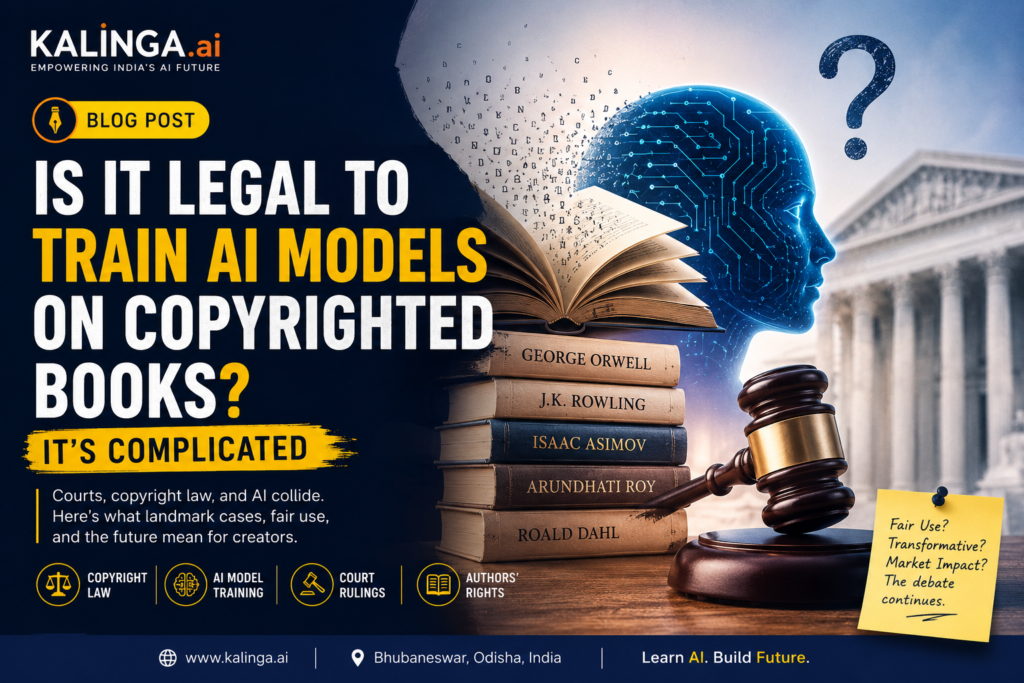
File Name: ai-training-copyrighted-books-guide.jpg
Title: AI Training Copyrighted Books Explained
Caption:
Can AI learn from copyrighted books legally? Explore the copyright rules, landmark court cases, and the fair-use debate shaping the future of AI.
Description:
This landscape editorial graphic visualizes the complex relationship between AI training and copyrighted books, featuring an AI-generated profile, open books, a courtroom, and a judge’s gavel. The visual highlights key themes from the article—including copyright law, AI model training, court rulings, fair use, and authors’ rights—helping readers quickly understand why the legal answer remains complicated.
Alt Text:
AI training copyright debate with books, AI model, courtroom, and gavel illustrating copyright law questions.
Planned structure:
- Why training AI on copyrighted books is legally complicated
- What copyright law actually protects
- How fair use changes the answer in the U.S.
- What recent U.S. AI copyright cases have decided
- Why lawful access to books matters
- What India’s copyright law says about AI training
- What the 2026 ANI v. OpenAI ruling means
- How AI training differs from AI-generated content
- What students, creators, and AI users should know
- FAQ
Focus keywords:
- Primary keyword: AI training copyright
- Secondary keywords: copyrighted books and AI, AI copyright law, fair use AI training, AI and copyright in India
- LSI/long-tail keywords: can AI companies train on copyrighted books, is AI training fair use, copyright law for AI models in India, can ChatGPT use copyrighted books
You give an AI chatbot a question about a novel, and it seems to know exactly what you mean. But what happens when the AI company had to process millions of books to become that capable in the first place?
The short answer is that AI training on copyrighted books is not automatically legal or illegal. In the U.S., courts have reached different conclusions depending on how copyrighted works were obtained, why they were used, how the resulting AI product competes with the original works, and whether the use qualifies as fair use. In India, a July 24, 2026 Delhi High Court ruling found, on a prima facie basis, that OpenAI’s use of ANI’s copyrighted material to train ChatGPT could fall within the Copyright Act’s fair-dealing exception. (Indian Kanoon)
So if you’ve been wondering whether AI companies can simply copy a library of copyrighted books and use it to build an AI model, the honest answer is: it depends,and the legal battle is still being written.
Why Is AI Training Copyright So Complicated?
Imagine an AI company wants to build a large language model, or LLM. An LLM is an AI system trained on enormous amounts of text so it can recognize patterns in language and generate responses.
To train such a model, developers need data. That data can include websites, books, articles, research papers, code and other written material. The legal question is whether processing and copying copyrighted material during that process violates the copyright owner’s exclusive rights.
Question → Direct Answer: Is copying a copyrighted book for AI training automatically copyright infringement?
No. The act of copying can potentially implicate copyright, but whether the overall use is lawful depends on the applicable legal exception or defense, such as fair use in the U.S. or fair dealing under India’s Copyright Act.
That’s why the phrase AI training copyright doesn’t have one universal yes-or-no answer.
Definition + Expansion: What is AI training?
AI training is the process of exposing an AI model to large datasets so it can learn statistical and semantic patterns that help it perform tasks.
For a language model, training does not work exactly like a person sitting down and memorizing every book in a library. The model learns relationships between words, concepts and patterns in its training data. However, the technical process can still involve making copies or storing copyrighted works, which is precisely where copyright law enters the picture.
The distinction between learning from a work and copying the work has become one of the central issues in AI copyright litigation.
What Does Copyright Actually Protect?
Copyright gives creators certain exclusive rights over their original works. For books, that generally includes rights connected with reproduction, distribution and other uses covered by the relevant copyright statute.
But copyright does not mean that every use of a copyrighted work requires permission.
This matters because copyright systems also contain exceptions designed to balance creators’ rights with research, education, criticism, innovation and public access.
In the U.S., one of the most important exceptions is fair use. India’s legal framework uses the concept of fair dealing, which is related but not identical.
Question → Direct Answer: Does owning a copyright mean an author can control every use of their book?
No. Copyright is a powerful legal right, but it is subject to statutory limitations and exceptions. Courts therefore have to examine the specific use rather than simply asking whether the underlying material was copyrighted.
That distinction becomes especially important with AI because the technology creates uses that lawmakers could not have anticipated when older copyright rules were written.
How Does Fair Use Apply to AI Training in the U.S.?
U.S. fair use is not a blanket permission slip for AI companies.
Section 107 of the U.S. Copyright Act identifies four factors courts consider:
- Purpose and character of the use, including whether it is commercial and whether it is transformative.
- Nature of the copyrighted work.
- Amount and substantiality of the portion used.
- Effect on the potential market for the copyrighted work.
Courts balance these factors rather than applying a simple mathematical formula.
Question → Direct Answer: Is AI training automatically “transformative”?
No. A use can be transformative in some circumstances, but courts look at the actual purpose and character of the secondary use. Commercial AI development and potential market competition can weigh heavily in the analysis.
The recent cases show just how fact-specific this question is.
The Anthropic case
One of the most closely watched U.S. cases involved Anthropic and authors whose books were used in connection with training its AI models.
In 2025, Judge William Alsup ruled that Anthropic’s use of copyrighted books for training its LLMs was fair use. But the judge separately found problems with Anthropic’s acquisition and storage of books obtained from pirate or “shadow” libraries. (Justia Law)
That distinction is crucial.
Training use and unlawful acquisition are not necessarily the same legal question.
In other words, a court can conclude that a particular use of copyrighted material is fair while still finding that the way the company obtained or stored copies of those works violated copyright.
That distinction became even more significant in July 2026, when a federal judge approved a $1.5 billion settlement involving Anthropic and authors and publishers. Reuters reported that the settlement concerned allegations involving copyrighted books and that the earlier court ruling had found the training use fair but the downloading of pirated books unlawful. (Reuters)
The settlement therefore should not be simplified to “a court ruled AI training is illegal.” It did not.
What does the Anthropic example teach us?
It highlights a fundamental principle:
The legal status of AI training can depend not only on what the AI company does with copyrighted material, but also on where the material came from and what copies the company keeps.
For AI companies, data provenance,the history of where training data came from,can therefore be a major legal issue.
Why the Ross Intelligence Case Matters
Another important case involved Thomson Reuters and Ross Intelligence.
Ross wanted to build an AI-powered legal research product. It allegedly used Thomson Reuters’ copyrighted Westlaw headnotes to help develop a competing legal research tool.
In February 2025, Judge Stephanos Bibas ruled against Ross on fair use. He concluded that Ross’s use was commercial and not sufficiently transformative because it used Thomson Reuters’ material to develop a competing legal research product. The court also emphasized the potential market impact. (Justia Law)
Question → Direct Answer: Why is the Ross case important for AI training copyright?
Because it shows that courts may look closely at whether an AI system is effectively being built as a substitute for the copyrighted work or service.
The case is not a direct ruling on every form of generative AI training. In fact, Judge Bibas specifically noted that the case before him involved non-generative AI. But the reasoning demonstrates why commercial competition and market substitution can matter enormously.
The court later certified key questions for interlocutory appeal, including the fair-use issue, noting that there was substantial ground for disagreement about the legal questions involved. (Justia Law)
So again, there is no universal rule saying “AI training is fair use” or “AI training is infringement.”
What About Meta’s Use of Copyrighted Books?
Meta’s case provides another useful example.
In June 2025, Judge Vince Chhabria ruled in favor of Meta in a lawsuit brought by authors who argued that Meta had unlawfully trained its AI models on their books.
The judge found that Meta’s use qualified as fair use on the record presented in that particular case. But the ruling was narrower than a simple declaration that all AI training is lawful. (Justia Law)
The judge explained that the authors had not provided meaningful evidence that Meta’s training had caused or was likely to cause the kind of market dilution they were claiming.
This is an important lesson for anyone following AI copyright law:
A company winning one fair-use case does not necessarily establish a universal legal rule for every AI model, dataset or copyrighted work.
The facts matter.
A simple comparison
| Case | Copyrighted material | Main issue | Outcome/significance |
| Bartz v. Anthropic | Books | AI training and acquisition of books | Training use was found fair use; pirated-book acquisition/storage raised separate liability |
| Kadrey v. Meta | Books | LLM training | Meta won fair-use judgment on the evidentiary record |
| Thomson Reuters v. Ross | Westlaw headnotes | Competing legal AI product | Court rejected Ross’s fair-use defense |
| ANI v. OpenAI | News content | AI training under Indian law | Delhi High Court found training use prima facie protected by fair dealing |
| Thaler v. Perlmutter | AI-generated artwork | Copyrightability of AI-generated work | Court addressed the human-authorship requirement |
The comparison shows why saying “courts have decided AI copyright” is misleading. Different courts are answering different questions under different legal systems and factual records.
Why the Source of Training Data Matters
Here’s a scenario that makes the issue easier to understand.
Suppose an AI company legally buys a collection of books from publishers. It then uses those books in an AI-training process.
Now imagine another company downloads millions of unauthorized copies of books from a pirate library and stores them permanently.
Both companies might say: “We used the books to train AI.”
Legally, however, those situations can be very different.
Question → Direct Answer: Can an AI company avoid copyright problems simply by saying the books were used for training?
No. The purpose of training is only one part of the legal analysis. The method of obtaining the works, the nature of the copying, storage practices, downstream uses and market effects can all matter.
The Anthropic litigation illustrates this distinction particularly well. The court’s treatment of training and the unlawful acquisition of books were separate issues. (Justia Law)
For AI developers, a responsible data pipeline therefore needs more than just a giant dataset. It needs a defensible answer to a basic question:
Where did this data come from?
What Does Indian Copyright Law Say About AI Training?
This is where things get especially interesting for students and professionals in India.
India does not simply copy the U.S. fair-use system. Section 52 of the Copyright Act, 1957 contains specific exceptions for certain forms of fair dealing, including private or personal use, research, criticism, review and reporting of current events. The Copyright Office’s official explanation confirms these statutory exceptions. (Copyright Office of India)
For years, there was uncertainty about how those provisions should apply to large-scale AI training.
Then came a significant development.
The 2026 ANI v. OpenAI ruling
On July 24, 2026, the Delhi High Court issued a major ruling in litigation between news agency ANI and OpenAI.
ANI alleged that OpenAI used its copyrighted news content to train ChatGPT without authorization. OpenAI disputed the claims.
Justice Amit Bansal examined whether the storage and use of ANI’s literary works for AI training could fall within Section 52(1)(a) of India’s Copyright Act.
The court took a three-part approach to assessing fair dealing:
- Whether the copyrighted material was being used for AI training.
- Whether the use created economic competition or actual or potential harm to the copyright owner’s legitimate commercial interests.
- Whether the AI system served broader public interests such as technological innovation, education, research and dissemination of knowledge.
On that prima facie assessment, the court found that OpenAI’s training use fell within the research-related exception and did not amount to copyright infringement. (Indian Kanoon)
But there is an important catch
The ruling should not be read as “Indian law now says all AI training is legal.”
It was an interim ruling in a specific dispute and was based on the facts and evidence before the court. Legal analysis of AI training in India is still developing, and the case can have further proceedings or appellate scrutiny.
The distinction matters because India’s Copyright Act does not simply use the American four-factor fair-use framework.
The Delhi High Court itself recognized that Indian courts do not have one universally applicable test for fair dealing and instead examined purpose, fairness, economic impact and public interest in the particular case. (Indian Kanoon)
Question → Direct Answer: Does the ANI ruling mean Indian AI companies can freely train on any copyrighted book?
No. The ruling provides significant legal guidance, but it does not create a blanket license to copy every copyrighted work for every AI purpose.
For example, an AI company using material exclusively for model training may present a different legal case from a company storing copyrighted books in a permanent library, redistributing them, or generating outputs that substantially reproduce protected expression.
U.S. Fair Use vs. Indian Fair Dealing
The terms sound similar, but students should not treat them as interchangeable.
| Feature | U.S. fair use | Indian fair dealing |
| Main legal framework | Section 107, U.S. Copyright Act | Section 52, Copyright Act, 1957 |
| Approach | Four statutory factors | Specific statutory exceptions plus fairness analysis |
| Transformative use | Important in U.S. case law | Not automatically imported as the U.S. test |
| Commercial use | Relevant | Can be relevant to fairness and statutory purpose |
| Market impact | Major consideration | Also relevant to fairness and legitimate interests |
| AI training | Multiple cases with different outcomes | 2026 Delhi HC ruling provides significant early guidance |
| Legal certainty | Still developing | Still developing |
This is why an American court decision cannot simply be copied into an Indian legal argument.
The Indian Copyright Act has its own statutory language, and Indian courts must interpret that language within India’s legal framework. (Indian Kanoon)
What Does “Transformative” Actually Mean?
The word transformative appears constantly in discussions about AI copyright.
In simple terms, a transformative use changes the purpose or character of a copyrighted work rather than merely repackaging it.
But transformation is not a magic word.
Question → Direct Answer: If an AI model changes a book into numerical data, does that automatically make the copying transformative?
No. Courts examine what the defendant actually did with the copyrighted material and what purpose the copying served.
The Ross case demonstrates this point. The court rejected the argument that intermediate copying automatically made Ross’s use transformative because the copied material was used to build a competing legal research product. (Justia Law)
The broader lesson is simple: technical transformation and legal transformation are not necessarily the same thing.
Turning text into tokens, vectors or other machine-readable representations does not by itself settle the copyright question.
What About AI-Generated Books and Articles?
There is another copyright question that is easy to confuse with AI training.
Suppose an AI model was trained using millions of books. A user then asks it to write a new story.
There are at least two separate legal questions:
- Was the copyrighted material lawfully used to train the model?
- Is the resulting AI-generated work itself protected by copyright?
Those questions should not be treated as the same dispute.
In the U.S., the human-authorship requirement has become important in determining whether AI-generated material can receive copyright protection. In Thaler v. Perlmutter, the court addressed a work generated entirely by AI and the requirement that copyright protection be tied to human authorship.
Question → Direct Answer: If AI training is lawful, does that mean every AI-generated output is copyrightable?
No. The legality of training and the copyrightability of an AI-generated output are separate legal questions.
This distinction matters for students and creators because using an AI tool does not automatically tell you who owns copyright in the final work.
Why Market Harm Could Become the Biggest Issue
If you strip away the technical jargon, much of the AI copyright debate comes down to a familiar question:
Does the new technology undermine the market that copyright law is supposed to protect?
Consider a hypothetical.
A publisher sells textbooks for ₹1,000 each. An AI company trains a model on those books and creates a competing service that gives students detailed textbook-like explanations without requiring them to purchase the books.
The copyright argument becomes more complicated than simply saying, “The AI learned from the textbook.”
The court may need to ask whether the AI product competes with the original market, whether consumers are substituting the AI service for the copyrighted work, and whether the copyright owner has a legitimate market for licensing the material.
The U.S. cases show courts wrestling with precisely these questions. In Ross, competition with Westlaw weighed strongly against fair use. In Meta, the authors’ failure to present meaningful evidence of market dilution contributed to Meta’s victory on the record before the court. (Justia Law)
India’s ANI ruling also considered whether OpenAI’s use would cause economic competition or prejudice ANI’s legitimate commercial interests. (Indian Kanoon)
Does AI Training Replace Reading?
This is one of the most interesting conceptual debates.
Judge Alsup’s reasoning in the Anthropic litigation treated the model’s training process, in important respects, as more analogous to learning from works than reproducing them for consumers. The judge found the training use fair while separately addressing the unlawful acquisition and storage of pirated books. (Justia Law)
But copyright owners argue that AI systems are different from human readers because AI models can be deployed commercially at enormous scale and can generate content that potentially competes with human creators.
That disagreement explains why the legal debate is not simply:
“Humans can read books, so AI can read books.”
The harder question is what legally happens when machine-scale copying, commercial AI development and potentially competing outputs are combined.
What Should AI Companies Do While the Law Is Unclear?
Legal uncertainty does not mean companies have no practical options.
A responsible AI developer can reduce risk by paying attention to data provenance, licensing and model behavior.
Key practices include:
- Track where training data comes from.
- Prefer legitimately obtained datasets where possible.
- Maintain records of licenses and permissions.
- Separate training data from permanently retained content where appropriate.
- Test models for memorization and verbatim reproduction.
- Assess whether outputs could substitute for the original works.
- Monitor copyright litigation and regulatory developments.
- Obtain specialist legal advice for high-risk datasets or commercial products.
None of these steps guarantees immunity from litigation.
But they can make the difference between an AI company being able to explain and defend its data practices and one being unable to answer the most basic questions about its training corpus.
What Should Students, Writers and Young Professionals Know?
You don’t need to become a copyright lawyer to understand the practical implications.
If you’re studying AI, building an app, writing content or working with generative tools, keep these principles in mind.
1. Copyright does not disappear because AI is involved
A book remains copyrighted simply because an AI system processes it.
2. Training is legally different from reproducing
An AI model learning patterns from a work and an AI system outputting large portions of that work raise different legal questions.
3. Fair use is not universal
A U.S. fair-use ruling does not automatically determine what is lawful in India.
4. The source of data matters
Legitimate acquisition and piracy can create very different legal risks.
5. Market competition matters
If an AI product directly substitutes for or competes with the market for copyrighted works, that can become highly significant.
6. The law is still evolving
The 2025–2026 cases are important pieces of a much larger legal puzzle, not the final answer.
So, Is It Legal to Train AI Models on Copyrighted Books?
Here’s the answer worth remembering:
Training AI models on copyrighted books can be lawful in some circumstances, but copyright law does not provide AI companies with a blanket permission to copy any book for any purpose.
In the U.S., recent cases have produced different outcomes. Anthropic and Meta obtained favorable rulings on specific AI-training issues, while Ross lost its fair-use defense in a case involving a competing legal research product. (Justia Law)
In India, the July 24, 2026 ANI v. OpenAI ruling represents an important development: the Delhi High Court found, on a prima facie basis, that OpenAI’s use of ANI’s literary works for LLM training could qualify as fair dealing under Section 52 of the Copyright Act. (Indian Kanoon)
But that does not mean the copyright debate is over.
The biggest unresolved questions include how courts should evaluate commercial AI training, market substitution, licensing markets, copyrighted books obtained without authorization, memorization and outputs that reproduce protected expression.
And because AI technology is evolving faster than legislation and judicial precedent, today’s answer may not be the final answer.
What Does This Mean for the Future of AI?
The real battle may not be about whether AI is allowed to “read” copyrighted works.
It may be about how AI companies obtain those works, what they do with them, whether the resulting systems compete with creators, and who should be compensated when copyrighted material becomes part of the AI economy.
That creates a difficult balancing act.
Copyright law is designed to encourage people to create. AI developers argue that large-scale access to information is essential for technological innovation. Courts now have to decide where those interests meet.
For students and young professionals entering AI, this is more than a legal curiosity. Understanding AI training copyright can help you make better decisions about datasets, content creation, AI products and intellectual property.
The safest takeaway is simple: don’t assume that “AI training” automatically makes copying lega,and don’t assume that using copyrighted material automatically makes AI training illegal.
The facts matter.
Frequently Asked Questions
Is it legal to train AI on copyrighted books?
It can be legal in some circumstances, but there is no blanket rule permitting all AI training on copyrighted books. Courts consider factors such as the purpose of the use, the source and acquisition of the works, market effects, and applicable copyright exceptions. Recent U.S. cases have reached different outcomes depending on those facts. (Justia Law)
Is AI training considered fair use in the United States?
AI training is not automatically fair use in the United States. Some courts have found particular AI-training uses to be fair use, including rulings involving Anthropic and Meta, while another court rejected a fair-use defense in the Thomson Reuters v. Ross case involving a competing legal research product. (Justia Law)
Can AI companies use pirated books for training?
Pirated acquisition of copyrighted books can create separate copyright liability even when the underlying AI-training use is found to be fair. The Anthropic litigation illustrates this distinction: the court found the training use fair but separately found Anthropic’s acquisition and storage of books from pirate libraries unlawful, leading eventually to a $1.5 billion settlement approved in July 2026. (Justia Law)
Can AI companies train on copyrighted content in India?
India’s legal position is developing, and a major July 2026 Delhi High Court ruling found, prima facie, that OpenAI’s training of LLMs on ANI’s copyrighted literary works could fall within Section 52’s fair-dealing exception. The ruling was based on the particular dispute and does not establish that every form of AI training on every copyrighted work is automatically lawful. (Indian Kanoon)
Does India’s AI copyright law use the same four-factor test as the U.S.?
No. India’s Copyright Act contains specific fair-dealing exceptions under Section 52, and Indian courts do not simply apply the U.S. four-factor fair-use test. In the ANI case, the Delhi High Court considered purpose, economic competition or harm, and broader public interest in assessing fairness. (Copyright Office of India)
Is AI-generated content automatically protected by copyright?
No. The legality of using copyrighted works for AI training and the copyrightability of AI-generated output are separate questions. In the U.S., courts have emphasized the importance of human authorship when determining whether an AI-generated work qualifies for copyright protection.
The Bottom Line
AI training copyright is complicated because copyright law was not designed around today’s large-scale generative AI systems. Courts are now deciding whether existing principles can accommodate AI training while preserving incentives for authors, publishers and other creators.
For now, the most accurate answer is not “yes” or “no.”
It’s “sometimes, depending on the facts, the jurisdiction and how the copyrighted material is obtained and used.”
If you’re building an AI project, creating content or simply trying to understand where the technology is heading, keeping up with these cases may be just as important as learning how the models themselves work.
Want to go deeper? Explore Kalinga.ai’s AI and technology explainers to understand the legal, technical and career implications of the AI boom.
Meta Description:
Is AI training on copyrighted books legal? Explore U.S. fair use, India’s 2026 ruling, AI copyright cases and what creators need to know.
URL Slug:
ai-training-copyright