File Name: samsung-electronics-shares-investor-reaction.jpg
Title: Samsung Electronics Shares Slide After Payout Plan
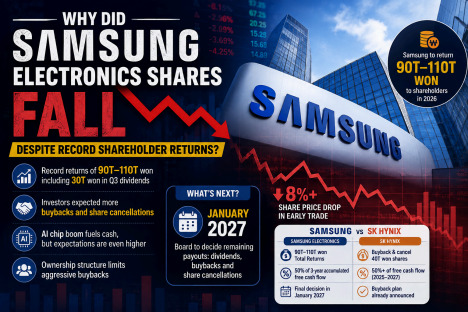
Caption: Samsung’s record shareholder returns failed to satisfy investors as expectations for bigger buybacks sent its shares sharply lower.
Description: The landscape infographic combines Samsung’s corporate headquarters, a falling stock-market chart, and key figures highlighting the company’s 90–110 trillion won shareholder-return plan and 8%+ early-trade share decline. Supporting panels explain investor concerns over buybacks, share cancellations, Samsung’s ownership structure, and the planned January 2027 decision, making the visual directly relevant to the article’s analysis of Samsung’s capital-return strategy.
Alt Text: Samsung Electronics shares fall over 8% as investors react to its record shareholder-return plan.
A record payout sounds like great news for investors—so why did Samsung Electronics shares fall more than 8% in early trading on August 24? The answer is that investors were not simply looking at the size of the payout; they were looking for a larger buyback commitment and clearer plans for returning Samsung’s AI-driven cash gains to shareholders.
Samsung Electronics said it expects to return 90 trillion won to 110 trillion won ($65 billion to $80 billion) to shareholders this year, including 30 trillion won in third-quarter cash dividends. Yet the announcement disappointed some investors because much of the remaining capital may go toward dividends rather than share buybacks and cancellations.
That reaction helps explain an important stock-market lesson: a company can announce a record shareholder payout and still see its stock fall if investors expected an even stronger capital-return strategy.
Planned H2/H3 Structure
1. Why Samsung Electronics shares fell after the payout announcement
2. What Samsung’s record shareholder-return plan actually includes
3. Why investors wanted more share buybacks
4. Samsung vs. SK Hynix: Why the comparison matters
5. How Samsung’s ownership structure complicates buybacks
6. What AI has to do with Samsung’s cash returns
7. What the market is watching next
8. What this means for investors and students
9. FAQ
10. Bottom line
Focus Keywords
● Primary keyword: Samsung Electronics shares
● Secondary keywords: Samsung shareholder returns, Samsung stock, Samsung buyback, AI chip boom
● LSI/Long-tail keyword: Samsung Electronics share price fall, Samsung dividend and buyback plan, Samsung vs SK Hynix shareholder returns, Samsung AI cash flow
Why Did Samsung Electronics Shares Fall After the Record Payout Announcement?
Question → Direct Answer: Why did Samsung Electronics shares fall despite a record shareholder-return plan?
Samsung Electronics shares fell because investors believed the company’s planned returns were smaller than expected in composition and lacked enough clarity around share buybacks and cancellations. While the overall 2026 return could reach 110 trillion won, investors had hoped Samsung would direct more of its AI-fueled cash generation toward actions that could provide more direct support to the stock price.
This distinction is important. Investors do not judge a shareholder-return announcement only by asking, “How much money is being returned?” They also ask, “How is that money being returned?”
Samsung’s plan includes dividends, potential share buybacks and share cancellations. But analysts expected a stronger commitment to buybacks, particularly because cancelling shares can reduce the number of shares outstanding and potentially increase the value represented by each remaining share.
The market reaction was therefore less about Samsung failing to return capital and more about Samsung returning capital differently from what some investors expected.
The broader market was also under pressure. SK Hynix fell 2.5%, while the benchmark KOSPI index declined 3.1% during the reported trading session. Samsung Life and Samsung Fire also dropped sharply, falling 9.9% and 8%, respectively.
That context matters because Samsung’s decline was not happening in complete isolation. However, analysts specifically pointed to the structure and clarity of Samsung’s capital-return plan as a reason for the disappointment.
What Is Samsung’s Record Shareholder-Return Plan? Definition + Expansion: Shareholder returns
Shareholder returns are the ways a company distributes value or cash back to investors, commonly through dividends, share buybacks and share cancellations.
Samsung said its shareholder returns for the year would total 90 trillion won to 110 trillion won, making the plan roughly five times the company’s previous record-high returns from 2020. The company also said 30 trillion won would be paid as cash dividends in the third quarter.
Under Samsung’s existing 2024–2026 shareholder-return policy, the company remains committed to returning 50% of accumulated free cash flow over the three-year period to
shareholders. Free cash flow broadly refers to cash generated by a company after the spending required to maintain and operate its business.
So at first glance, the numbers appear extremely positive.
A return of up to 110 trillion won is enormous. But the market’s reaction shows that investors were focused on the details behind that headline figure.
Question → Direct Answer: Is Samsung actually reducing shareholder returns?
No. Samsung’s announced plan represents a record level of shareholder returns. The disappointment came because investors expected more of that capital to be used for buybacks and cancellations, which could provide a more direct mechanism for supporting the share price.
This is one reason the Samsung Electronics shares reaction may initially seem counterintuitive.
A record dividend or capital-return figure does not automatically mean investors will buy the stock. Investors also consider whether the announced strategy is better, worse or simply different from what was already priced into expectations.
Why Did Investors Want More Share Buybacks?
One of the biggest issues in the announcement was the absence of a detailed, aggressive buyback plan.
Investors had reportedly been looking for a larger portion of Samsung’s capital returns to come through share buybacks. A buyback occurs when a company uses its cash to purchase its own shares from the market. The company can then hold or cancel those shares.
Share cancellations can be particularly important because they permanently reduce the number of shares outstanding.
Definition + Expansion: Share cancellation
Share cancellation means permanently removing repurchased shares from circulation, reducing the company’s total number of outstanding shares.
For investors, fewer outstanding shares can mean that each remaining share represents a larger proportion of the company. That is why investors sometimes view buybacks and cancellations as a more direct way to support shareholder value than simply receiving cash dividends.
Samsung’s announcement said its board would decide on the remaining payouts in January 2027, considering cash dividends, share buybacks and share cancellations.
That future decision is important because the company has not completely ruled out buybacks. The issue is that investors wanted greater clarity sooner.
Question → Direct Answer: Why do buybacks matter so much to Samsung investors?
Buybacks can directly reduce the number of shares in circulation and potentially support the value of remaining shares. Investors therefore wanted a clearer commitment to buybacks and cancellations rather than having most of the remaining capital potentially distributed through dividends.
Analyst Kim Soo-hyun of DS Investment & Securities estimated that Samsung’s remaining 60 trillion won to 80 trillion won could be used mainly for dividends, with approximately 10 trillion won to 20 trillion won potentially allocated to buybacks and cancellations.
That expectation helps explain why the market reaction was more negative than the headline payout number might suggest.
Samsung vs. SK Hynix: Why the Comparison Matters Samsung was not the only major South Korean chip company responding to investor pressure.
Samsung and rival SK Hynix had both announced significant shareholder-return plans following growing pressure from investors to distribute more of the gains generated by the artificial-intelligence boom.
But the two companies’ approaches were different.
SK Hynix said it would buy back and cancel 40 trillion won of treasury shares and allocate more than 50% of free cash flow generated between 2025 and 2027 toward shareholder returns.
Samsung, meanwhile, maintained its existing commitment to return 50% of free cash flow accumulated during its three-year policy period.
Factor Samsung Electronics SK Hynix
Total announced return
90T–110T won More than 50% of specified free cash flow
Cash dividends 30T won in Q3 Not specified in supplied report
Buyback plan Greater detail expected later 40T won buyback and cancellation
Existing policy 50% of three-year accumulated free cash flow
More than 50% of 2025–2027 free cash flow
Investor concern Buyback clarity Already announced direct buyback/cancellation
Next major decision
January 2027 Buyback/cancellation plan already announced
The comparison is revealing because investors were not simply evaluating Samsung in isolation. They were also comparing its capital-allocation strategy with that of another major South Korean semiconductor company.
Analyst Sohn In-joon of Eugene Securities said Samsung had not mentioned raising its existing shareholder-return policy or announced a treasury-share cancellation plan similar to SK Hynix’s.
That difference likely contributed to the pressure on Samsung Electronics shares.
How Samsung’s Ownership Structure Complicates Buybacks
There is another layer to the story that is easy to miss: Samsung’s ownership structure. Definition + Expansion: Ownership structure
Ownership structure describes who owns a company’s shares and how much of the company different shareholders or affiliated entities control.
Samsung’s major affiliates, including Samsung Life and Samsung Fire, already have significant ownership interests. According to the supplied Reuters report, a large-scale buyback could create regulatory complications if those affiliates’ combined ownership were pushed above a 10% regulatory limit.
That means Samsung cannot necessarily approach buybacks as simply as another company might.
If Samsung purchases a large number of its own shares, the relative ownership percentage of other shareholders can change. That could potentially create problems for affiliated companies that are subject to ownership restrictions.
As a result, Samsung may have to balance two competing goals:
● Returning more capital to shareholders
● Managing the regulatory consequences of its ownership structure
This helps explain why a company can have substantial cash available but still face constraints over how that cash should be distributed.
Question → Direct Answer: Why can’t Samsung simply use most of its cash for buybacks?
Samsung’s ownership structure creates additional regulatory considerations. Large-scale buybacks could potentially push the combined ownership of Samsung Life and Samsung Fire above regulatory limits, requiring those affiliates to sell shares to remain below the threshold.
That complication makes Samsung’s capital-return strategy more complex than the headline payout number suggests.
What Does AI Have to Do With Samsung’s Shareholder Returns?
The bigger economic story behind the announcement is the AI boom.
Demand for chips used in artificial-intelligence systems has helped drive record-breaking profits across parts of the semiconductor industry. Investors increasingly expect chip companies to return some of those gains to shareholders.
Samsung is therefore dealing with a familiar challenge for companies benefiting from a sudden technology boom.
When profits rise sharply, shareholders often begin asking what management intends to do with the additional cash.
Should the company:
1. Invest more in factories and technology?
2. Build cash reserves?
3. Pay higher dividends?
4. Buy back shares?
5. Cancel treasury shares?
6. Combine several of these strategies?
Samsung’s announcement shows that capital allocation has become a major part of the AI investment story.
The semiconductor boom is no longer only about who can sell the most chips. Investors are also watching what companies do with the cash generated by that demand.
Question → Direct Answer: Does the AI boom guarantee higher Samsung stock returns?
No. Strong AI-related demand can improve a company’s financial position, but stock performance also depends on investor expectations, capital allocation, valuation, competitive conditions and broader market sentiment. Samsung’s recent share-price reaction demonstrates that even record shareholder returns can disappoint when they fall below investor expectations.
That distinction is especially useful for students and new investors to understand.
Good company performance and good stock performance are related, but they are not identical.
A business can report strong results while its shares decline if investors had expected even better results.
The same principle applies to shareholder returns.
What Are Investors Watching Next?
The next major date highlighted by the announcement is January 2027.
Samsung said its board will decide the remaining payouts then, considering cash dividends, share buybacks and share cancellations.
That means investors will likely continue watching how Samsung ultimately divides its remaining capital-return pool.
Morgan Stanley described the situation as “big capital returns, slightly below expectations” and said investors would need to monitor Samsung’s next capital-return framework, which will take effect next year.
Several factors are therefore worth watching.
1. The final mix of dividends and buybacks
The headline return range is already large, but the eventual breakdown could matter just as much.
2. Treasury-share cancellations
Investors may pay close attention to whether Samsung ultimately cancels a meaningful amount of treasury shares.
3. The next capital-return framework
Samsung’s current policy covers 2024–2026, making the next framework particularly important for investors evaluating the company’s longer-term approach to shareholder returns.
4. AI-driven cash generation
The semiconductor industry’s ability to sustain strong cash generation will influence how much capital Samsung can return while continuing to invest in its business.
5. The competitive position of Samsung and SK Hynix
The contrast between the two companies’ shareholder-return strategies shows that investors may continue comparing how South Korea’s leading chip companies respond to the AI boom.
What Does the Samsung Share Price Fall Mean for Investors?
For investors, the immediate lesson is not that Samsung’s business suddenly became weak.
The supplied Reuters report instead points toward a more specific issue: investor expectations around capital returns were higher than what Samsung announced in terms of buybacks and cancellations.
This distinction matters because stock markets are forward-looking.
If investors expected a bigger buyback, they may have already incorporated that expectation into their decisions. When the actual announcement falls short, the stock can react negatively—even if the company is still returning an enormous amount of money.
That is why beginners should be careful when interpreting headlines such as “record shareholder returns.”
A better set of questions is:
● How large is the total payout?
● How much is being paid as dividends?
● How much is going toward buybacks?
● Will repurchased shares be cancelled?
● When will the company make its remaining decisions?
● What are investors expecting compared with what management announced? ● How sustainable are the company’s cash flows?
These questions provide a more complete picture than looking at the headline number alone.
Why Samsung Electronics Shares Could Remain Sensitive to Capital-Return Decisions
Samsung Electronics shares are likely to remain sensitive to capital-return announcements because investors are evaluating the company in an environment where semiconductor profits are benefiting from powerful AI-related demand.
When a company’s cash generation increases, investors naturally start asking how that cash will be deployed.
Samsung has committed to returning 50% of accumulated free cash flow under its current three-year policy. That provides a framework, but investors still care about the precise mechanisms used to deliver those returns.
Dividends and buybacks both return money to shareholders, but they work differently.
A dividend sends cash directly to shareholders who own the stock. A buyback uses company cash to purchase shares, while a subsequent cancellation can reduce the total number of shares outstanding.
Neither approach is automatically superior in every situation.
The key question is whether management’s chosen approach matches the company’s financial position, investment needs, ownership structure and shareholder expectations.
Samsung’s case is particularly interesting because it demonstrates how capital allocation can become a market-moving event in its own right.
What Students Can Learn From Samsung’s Stock Reaction
This story offers several useful lessons for students, freshers and young professionals trying to understand how financial markets work.
Lesson 1: Record numbers can still disappoint
A company can announce its largest-ever shareholder return and still face a stock decline if investors expected more.
Lesson 2: Expectations matter
Markets respond not only to what happens but also to how the result compares with expectations.
Lesson 3: Dividends and buybacks are different
Both return capital, but their effects on shareholders and the company’s share structure are different.
Lesson 4: Corporate structure matters
Samsung’s affiliated ownership structure creates constraints that can influence capital-allocation decisions.
Lesson 5: AI affects more than technology companies
The AI boom is influencing semiconductor demand, company cash generation and investor expectations around shareholder returns.
Lesson 6: Stock prices do not move on one metric
Samsung’s decline occurred alongside a broader fall in the KOSPI and declines in other semiconductor and Samsung-affiliated stocks.
For anyone learning about markets, this is a useful reminder to examine the entire context rather than attributing every price move to a single number.
The Bigger Picture: Samsung’s Record Payout Is Still Significant
It would be misleading to interpret the market reaction as evidence that Samsung’s shareholder-return plan is insignificant.
It is the opposite.
Samsung’s planned 90 trillion won to 110 trillion won in shareholder returns represents an extraordinary amount of capital and is approximately five times its previous record-high returns from 2020.
The disagreement is primarily about how that money is returned.
Investors wanted greater clarity around buybacks and cancellations. Samsung said its board will consider those options alongside dividends when it determines the remaining payouts in January 2027.
That leaves the market with an important unanswered question: Will Samsung’s next capital-return decisions close the gap between what management plans to return and what investors expect?
For Samsung Electronics shares, that question could remain more important than the headline size of the payout itself.
FAQ
Why did Samsung Electronics shares fall more than 8%?
Samsung Electronics shares fell more than 8% in early trading after investors viewed the company’s record shareholder-return plan as smaller than expected in terms of buybacks and lacked sufficient clarity about share cancellations.
How much is Samsung planning to return to shareholders?
Samsung said it expects shareholder returns of 90 trillion won to 110 trillion won ($65 billion to $80 billion) this year, including 30 trillion won in third-quarter cash dividends.
Why did investors want Samsung to buy back more shares?
Investors wanted a larger share of Samsung’s capital returns to come through buybacks because repurchasing and potentially cancelling shares can provide more direct support to the value of the remaining shares.
How is Samsung’s plan different from SK Hynix’s?
SK Hynix said it would buy back and cancel 40 trillion won of treasury shares and allocate more than 50% of its free cash flow generated between 2025 and 2027 toward shareholder returns. Samsung maintained its existing 50% free-cash-flow return policy and did not announce a comparable treasury-share cancellation plan at the time of the report.
When will Samsung decide on its remaining shareholder payouts?
Samsung said its board will decide on the remaining payouts in January 2027, with cash dividends, share buybacks and share cancellations among the options under consideration.
Does Samsung’s ownership structure affect its buyback plans?
Yes. Samsung’s ownership structure can complicate buybacks because large purchases of its own shares could potentially push the combined ownership of Samsung Life and Samsung Fire above regulatory limits, requiring those affiliates to sell shares to remain below the threshold.
The Bottom Line
Samsung is returning a record amount of money to shareholders, but the market wanted more aggressive buybacks and clearer plans for share cancellations. The reaction to Samsung Electronics shares shows why investors evaluate not just how much cash a company returns, but also how, when and why it returns that cash.
For readers learning about markets, Samsung’s announcement is a useful real-world example of how AI-driven profits, shareholder expectations, corporate ownership structures and stock-market sentiment can collide in a single decision.
Meta Description: Samsung Electronics shares fell despite record returns. Learn why investors wanted bigger buybacks and what Samsung’s AI cash boom means.
URL Slug: samsung-electronics-shares-shareholder-returns