File Name: uber-fine-automated-driver-suspensions-gdpr.jpg
Title: Uber Fine Over Automated Driver Suspensions
Caption:
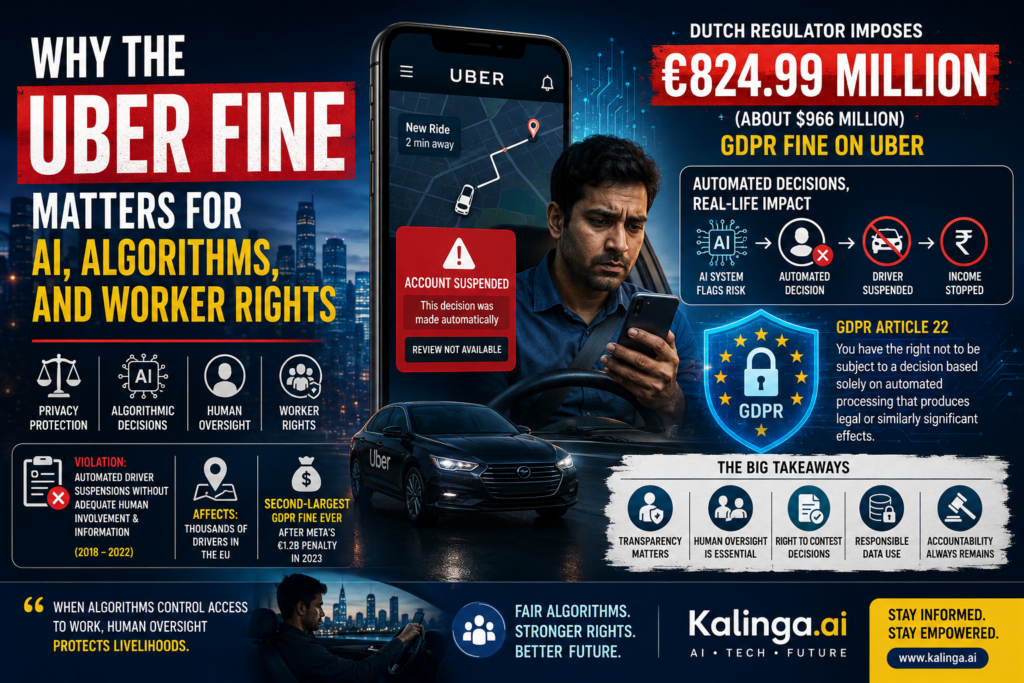
Uber’s nearly €825 million GDPR fine puts automated driver suspensions, algorithmic decision-making, and human oversight under the spotlight.
Description:
This landscape poster visually represents the Uber fine over automated driver suspensions, combining a ride-hailing interface, AI algorithm graphics, a driver profile marked for review, and GDPR/privacy symbols. The design highlights the central issue of the article: how automated systems can affect workers’ livelihoods and why human oversight and accountability matter.
Alt Text:
Uber fine over automated driver suspensions highlights GDPR privacy concerns, AI decisions, and human oversight.
Planned structure:
● Why the Uber fine is so significant
● What triggered the €825 million penalty
● How automated driver suspensions worked
● What GDPR Article 22 means
● Why human oversight matters
● Uber’s response and appeal
● How the case affects gig workers and AI platforms
● Uber’s previous Dutch privacy fines
● What companies can learn from the decision
● What this means for India and digital workers
● FAQ
Focus keywords:
● Primary keyword: Uber fine
● Secondary keywords: automated driver suspensions, GDPR automated decisions, Uber driver privacy, algorithmic decision-making
● LSI/Long-tail keywords: Uber €825 million fine, GDPR Article 22 Uber, automated decisions affecting workers, human oversight in AI decisions
Why the Uber Fine Matters for AI, Algorithms, and Worker Rights
Imagine opening your work app one morning and discovering that you cannot log in, cannot accept a ride, and cannot earn money,all because an algorithm flagged your account.
That is at the center of the Uber fine, in which the Dutch Data Protection Authority imposed a penalty of €824.99 million (about $966 million) over automated decisions affecting Uber drivers. The regulator said Uber violated Europe’s General Data Protection Regulation (GDPR) by making significant decisions about drivers through automated systems without adequate human involvement and information. (CNIL)
The Uber fine is not simply another privacy penalty against a major technology company. It raises a much bigger question for the AI era: When an algorithm can affect someone’s income, should a human have the final say?
For students entering AI, software, data science, HR technology, fintech, or the gig economy, this question is increasingly important.
Because the same basic technology that helps a company detect fraud can also determine whether someone gets to work tomorrow.
Why the Uber Fine Is Such a Big Deal
The headline number is difficult to ignore: €824.99 million.
The Dutch Data Protection Authority, known as the AP, announced the penalty on August 21, 2026, saying Uber had committed serious infringements by using automated systems to temporarily or permanently deactivate driver accounts in circumstances including suspected fraud and low customer ratings. (Dutch Data Protection Authority)
Reuters reported that the penalty is the second-largest ever issued under the GDPR, behind the €1.2 billion penalty imposed on Meta in 2023. (Reuters)
But the size of the Uber fine is not the only reason the case matters.
The more important issue is what the regulator believes happened behind the scenes. Uber’s systems were not merely recommending that someone look at a driver’s account.
According to the Dutch regulator, automated processes themselves made decisions that could block drivers from the platform, meaning those drivers could no longer accept rides and generate income.
That is a very different category of algorithmic decision.
Definition + Expansion: Automated decision-making
Automated decision-making is a process in which technology makes a decision about an individual without human involvement. Under GDPR rules, this becomes especially significant when the decision has legal effects or similarly significant consequences for the person involved.
For example, an algorithm recommending that a customer-support employee review a driver’s account is not necessarily the same thing as an algorithm automatically suspending that driver.
The first is decision support.
The second can become automated decision-making with a direct impact on someone’s livelihood.
And that distinction sits at the heart of the Uber case.
Question → Direct Answer: Why is the Uber fine so large?
The penalty concerns automated decisions that the Dutch regulator says significantly affected drivers, including the ability to work and earn income. The regulator concluded that Uber’s systems made certain deactivation decisions without the required human involvement and that drivers were not adequately informed about the automated decision-making. (CNIL)
What Actually Happened to Uber Drivers?
The case began with complaints from drivers in France.
According to France’s data protection regulator CNIL, a collective complaint was filed in 2020 by the Ligue des droits de l’Homme on behalf of more than 170 Uber drivers, and the complaint was supplemented in 2021. The issues included information provided to drivers, international data transfers, and automated decisions involving temporary or permanent account disconnections. (CNIL)
The Dutch regulator became responsible for the investigation because Uber’s main European establishment is in the Netherlands.
The case covered historical practices from the period between 2018 and 2022, according to Reuters and the Dutch authorities. (Reuters)
The technology was being used in situations such as suspected fraud.
For instance, drivers could be flagged when Uber’s systems concluded that something unusual had happened, such as suspected unnecessary detours or trips that were allegedly accepted without an intention to complete them.
The regulator’s concern was not that Uber used software to identify potentially problematic behavior.
It was what happened after the software made the assessment.
According to the Dutch authority, some account deactivations occurred without human intervention.
The regulator specifically said that temporary deactivations related to suspected fraud and temporary or permanent deactivations related to low customer ratings constituted automated individual decisions because of the absence of human intervention. (CNIL)
The crucial distinction
There is nothing inherently illegal about using algorithms to identify patterns. A ride-hailing platform handles enormous amounts of data.
It would be difficult to manually inspect every trip, route, rating, payment and account interaction.
Algorithms can help detect unusual behavior much faster than humans.
The legal question is different:
Should the algorithm itself have the power to impose a major consequence on a person? That is where privacy law enters the picture.
What Does GDPR Say About Automated Decisions?
The General Data Protection Regulation, or GDPR, is the European Union’s major data-protection framework.
It governs how organizations process personal data and gives individuals rights over how information about them is collected, used and evaluated.
One of its most relevant provisions here is Article 22, which addresses automated individual decision-making.
The rule gives individuals the right not to be subject to decisions based solely on automated processing when those decisions produce legal effects or similarly significant effects. There are exceptions, but safeguards can include human intervention, the ability to express a point of view, and the ability to contest the decision. (EUR-Lex)
Definition + Expansion: GDPR Article 22
GDPR Article 22 protects people from certain significant decisions being made about them solely by automated processing. It does not mean every algorithmic decision is prohibited, but it places restrictions and safeguards around high-impact automated decisions.
That distinction is important.
GDPR does not say:
“Companies cannot use algorithms.”
Instead, the framework asks companies to consider the consequences of automated decisions and the rights of the people affected.
Consider a simple recommendation system.
Netflix recommends a movie.
A shopping website recommends shoes.
A music app suggests a playlist.
Those decisions may influence your choices, but they generally do not prevent you from earning your livelihood.
Now imagine an algorithm decides:
● You cannot work.
● Your account is suspended.
● Your access to a platform is removed.
● Your income suddenly stops.
The stakes are much higher.
Question → Direct Answer: Does GDPR ban all automated decisions?
No. GDPR Article 22 restricts certain decisions made solely through automated processing when they have legal or similarly significant effects, while allowing specific exceptions subject to conditions and safeguards. (EUR-Lex)
That nuance is essential when discussing the Uber fine.
The issue is not simply “algorithm bad, human good.”
The issue is how much authority an automated system has over a person’s life.
Why Human Oversight Matters
Suppose an algorithm detects that a driver has taken an unusually long route. That could mean fraud.
But it could also mean:
● A road was blocked.
● The driver followed a temporary diversion.
● GPS data was inaccurate.
● A passenger requested a different route.
● The system misunderstood the trip.
● Some other unusual circumstance occurred.
An algorithm sees patterns.
It does not automatically understand context.
That is why human oversight can matter.
A person reviewing the case can potentially examine additional information and ask whether the automated conclusion makes sense.
The European Commission explains that individuals affected by qualifying automated decisions can have rights including human intervention, the ability to express their point of view and the ability to contest the decision, depending on the circumstances and applicable exception. (European Commission)
Human oversight does not mean humans must do everything This is where the debate gets more interesting.
Imagine an AI system processes one million transactions and flags 5,000 as potentially fraudulent.
Nobody expects a human to manually inspect every transaction from the beginning. Automation is valuable precisely because it handles scale.
A better model can be:
Algorithm detects → Human reviews → Company decides → Person can challenge The concern arises when the system becomes:
Algorithm detects → Algorithm decides → Person loses access
That difference can look small on a flowchart.
For the person whose income disappears, it can be enormous.
Question → Direct Answer: Why can’t companies simply use AI to make faster decisions?
They can use AI and algorithms for many purposes, but high-impact automated decisions may trigger additional legal safeguards. Under GDPR, certain decisions with significant effects cannot simply be delegated entirely to automated processing without satisfying the relevant legal conditions and protections. (EUR-Lex)
Uber Disputes the Regulator’s Characterization The Uber fine does not represent an uncontested account of what happened. Uber strongly disagrees with the decision and has said it will appeal.
According to Reuters, Uber argued that most driver suspensions were brief, that permanent deactivations did not occur without human review, and that drivers could appeal decisions. The company called the penalty disproportionate. (Reuters)
The Dutch regulator, however, reached a different conclusion about historical practices.
It said some drivers were permanently deactivated without human intervention, including in connection with low customer ratings. (The Guardian)
Reuters also reported that Uber said only 126 drivers in Europe were deactivated because of low customer ratings in 2021, one reason the company considers the fine disproportionate. (The Guardian)
This dispute matters because the case is still subject to appeal.
A regulatory penalty is significant, but it is not necessarily the final word on every factual or legal question.
A useful way to understand both sides
Issue Dutch regulator’s position Uber’s position
Automated decisions
Permanent deactivation
Some significant decisions were made automatically
Some occurred without human involvement
Current policies include human review
Uber disputes that permanent deactivation was automated
Driver safeguards Inadequate in the regulator’s view Drivers can challenge decisions
Historical period Practices covered events from 2018–2022
Company says the policies were discontinued years ago
Penalty €824.99 million Uber considers it disproportionate Next step Regulatory decision issued Uber plans to appeal
The table also illustrates why headlines such as “Uber’s algorithm fired drivers” can oversimplify the case.
The exact legal and factual questions will continue to be tested through the appeals process.
The Uber Fine Is Really About Accountability There is a philosophical question hiding underneath the legal one:
Who is responsible when software makes a decision?
Imagine a manager fires an employee.
Nobody says, “The attendance system fired them.”
The manager used information from the system, but the organization remains responsible for the decision.
The same logic becomes harder when algorithms operate at massive scale. If a system automatically blocks thousands of accounts, who owns the decision? The engineers?
The product team?
The compliance department?
The executive team?
The company?
The algorithm?
The answer cannot simply be “the computer did it.”
Software does not create corporate policies by itself.
Humans choose the data.
Humans define the rules.
Humans select thresholds.
Humans decide what consequences follow a particular score.
Humans deploy the system.
And humans decide whether the system is allowed to operate without intervention. This is why algorithmic accountability is becoming such an important concept. Definition + Expansion: Algorithmic accountability
Algorithmic accountability means ensuring that organizations remain responsible for the decisions and consequences produced by automated systems. It involves understanding how systems operate, monitoring their outcomes, identifying errors, and providing mechanisms for human review and appeal.
For young professionals entering AI-related careers, this is becoming a practical skill rather than an abstract ethical debate.
A machine-learning engineer may build the model.
A product manager may define how it is used.
A lawyer may determine regulatory requirements.
A policy team may create safeguards.
And a customer-support team may handle appeals.
The technology works only when all those pieces fit together.
Why the Uber Case Matters for Gig Workers Gig workers are particularly exposed to algorithmic management.
In a traditional workplace, workers usually know who their manager is.
There may be a supervisor.
There may be an HR department.
There may be formal procedures for disciplinary action.
In a platform economy, many decisions can happen through software.
An app can determine:
● Which jobs you see.
● How jobs are prioritized.
● Whether unusual activity is flagged.
● Whether incentives are offered.
● Whether an account is restricted.
● Whether access to the platform continues.
That creates a new kind of workplace power.
The worker may never speak to the person,or even team,that made the decision. And the worker may not know what information triggered it.
That is why the Uber fine has implications beyond Uber.
The same questions can apply to delivery platforms, freelance marketplaces, online labor platforms and other businesses where algorithms manage large numbers of workers.
Question → Direct Answer: Why does this matter beyond Uber drivers?
Because algorithmic management is increasingly used across digital work platforms, making questions about transparency, human review, data accuracy and appeals relevant to many types of workers.
The broader lesson is simple:
If software controls access to income, software governance becomes a worker-rights issue.
Uber’s Previous Dutch Privacy Fines Make the Case Even Bigger
The latest Uber fine is also part of a longer regulatory relationship between Uber and Dutch privacy authorities.
The CNIL says Dutch authorities previously imposed a €10 million fine in December 2023 concerning failures to inform drivers and a €290 million fine in July 2024 concerning transfers of driver data outside the European Union. (CNIL)
The three matters originated from complaints involving the same broader group of drivers, according to PersonalData.io and reporting cited in the supplied article.
That creates an important pattern.
Privacy regulation is not always about one isolated technical mistake.
A company can face scrutiny over multiple parts of its data practices:
How data is collected → How data is transferred → How data is analyzed → How decisions are made
The final step is arguably the most consequential.
Data about a worker can be collected legitimately.
It can be stored securely.
It can even be analyzed for fraud prevention.
But when that analysis directly affects someone’s ability to earn money, additional questions arise.
What Companies Can Learn From the Uber Fine The biggest lesson for businesses building AI systems is not “never automate.” That would be impractical.
The lesson is to automate carefully when the consequences are high. A company designing a high-impact algorithm should consider at least these questions:
● What decision is the system actually making?
● How serious are the consequences for the individual?
● Is the decision fully automated or human-assisted?
● Can a qualified human meaningfully override the system?
● Does the person know automation is being used?
● Can the person challenge the outcome?
● Can inaccurate data be corrected?
● Are there documented reasons for the decision?
● Is the system regularly audited for errors?
● Who inside the organization is ultimately accountable?
These questions are useful even outside Europe.
A responsible AI system should not be designed around accuracy alone.
A model can be highly accurate on average and still produce devastating outcomes for individual people.
Imagine a fraud-detection system that is correct 99% of the time.
That sounds excellent.
But if the remaining 1% represents thousands of people, someone needs a way to identify and correct those mistakes.
What This Means for AI Students and Future Tech Professionals
If you’re studying computer science, artificial intelligence, data science or software engineering, the Uber fine offers an important career lesson.
Technical ability is no longer enough.
Knowing Python, machine learning, cloud computing or large language models is valuable. But the systems you build will operate inside legal, social and economic environments. A recommendation engine can influence what people see.
A hiring algorithm can influence who gets interviewed.
A credit system can influence who gets financing.
A fraud system can influence who keeps an account.
A workplace platform can influence who gets paid.
The more powerful the decision, the more important governance becomes. A useful career checklist
When designing or evaluating an AI system, ask:
1. What data does it use?
Understand where the information comes from and whether it is accurate. 2. What does the model predict?
A prediction is not automatically a decision.
3. What happens after the prediction?
This is often where risk increases.
4. Who can override the system?
A human reviewer should have genuine authority where required,not simply click “approve.” 5. Can the affected person challenge the outcome?
Appeals are particularly important for high-impact decisions.
6. Can the organization explain what happened?
A system that cannot be meaningfully audited can become difficult to govern.
The Uber fine shows why these questions should be part of product development from the beginning rather than added after a regulator arrives.
Why the Case Matters in India Too
The Uber fine was issued by a European regulator under European privacy law, but Indian technology professionals should pay attention.
India has its own evolving data-protection framework, and Indian companies increasingly build products that operate internationally.
More importantly, Indian workers are also part of a rapidly expanding digital and platform economy.
Ride-hailing.
Food delivery.
E-commerce.
Freelancing.
Online services.
These businesses rely heavily on data and automated systems.
The European case therefore offers a useful global lesson: the more an algorithm affects a person’s livelihood, the more carefully its design and governance need to be considered.
For Indian developers and startup founders, this is particularly relevant when building products for international markets.
A system designed for a global customer base cannot assume that every jurisdiction treats automated decision-making in exactly the same way.
Legal requirements differ.
Privacy expectations differ.
Worker protections differ.
And regulatory scrutiny is evolving.
That means responsible product development increasingly requires collaboration between engineers, lawyers, policy experts and business teams.
The Bigger AI Lesson: Automation Is Not the Same as Accountability
There is an easy temptation in AI discussions to frame everything as a battle between humans and machines.
That’s not really what this case is about.
Algorithms can be extremely useful.
They can process huge volumes of data.
They can detect patterns faster than humans.
They can identify suspicious activity.
They can reduce repetitive administrative work.
The problem begins when an organization treats automation as a way to escape responsibility.
If a human makes a bad decision, we know whom to question.
If a machine makes the decision, the organization still has to answer for how that machine was designed and deployed.
That is the deeper significance of the Uber fine.
The question isn’t:
“Can algorithms make decisions?”
They already do.
The question is:
“Which decisions should algorithms be allowed to make alone?”
That is a much harder question.
And it is one that regulators, companies, engineers and workers will be answering for years.
Frequently Asked Questions
What is the Uber fine in 2026?
The Uber fine is an €824.99 million penalty imposed by the Dutch Data Protection Authority on Uber over automated decisions affecting drivers. The regulator said Uber violated GDPR rules by making significant automated decisions without adequate human involvement and information. (CNIL)
Why did Uber receive an €825 million GDPR fine?
Uber received the penalty because the Dutch regulator concluded that its systems automatically deactivated some driver accounts in situations including suspected fraud and low customer ratings, with insufficient human intervention and information for affected drivers. Uber disputes parts of the regulator’s findings and plans to appeal. (CNIL)
Does GDPR prohibit companies from using automated decisions?
No. GDPR does not prohibit all automated decision-making. Article 22 restricts certain solely automated decisions that have legal or similarly significant effects, while allowing specific exceptions subject to legal conditions and safeguards. (EUR-Lex)
Why is human oversight important in automated decisions?
Human oversight provides an opportunity to review automated decisions, identify errors, consider context and allow affected people to challenge significant outcomes. GDPR Article 22 includes safeguards such as human intervention and the ability to express a point of view and contest certain automated decisions. (EUR-Lex)
Did Uber agree with the Dutch regulator?
No. Uber strongly disagreed with the penalty and said it plans to appeal. The company said its current policies include human reviews and opportunities for drivers to challenge suspensions, while the Dutch regulator’s decision concerns historical practices. (Reuters)
Why does the Uber case matter for AI?
The case demonstrates that companies can face major legal consequences when automated systems make high-impact decisions about individuals. It highlights the importance of transparency, human oversight, accountability, accurate data and appeal mechanisms when AI or algorithms affect people’s livelihoods.
The Bottom Line
The Uber fine is ultimately about much more than an €825 million penalty.
It is about what happens when an algorithm moves from making predictions to making decisions.
Using software to flag suspicious activity is one thing.
Using that software to decide whether someone can continue earning money is another.
That distinction will become increasingly important as AI moves into hiring, lending, insurance, healthcare, education, customer service and workplace management.
For future engineers and technology professionals, the lesson is worth remembering: An algorithm may make the decision, but a company still has to own the consequences.
The future of AI will not be shaped only by how intelligent our systems become. It will also be shaped by how responsibly we allow those systems to make decisions about real people.
For more practical explainers on AI, technology, privacy and the rules shaping the digital economy, keep exploring Kalinga.ai.
Meta Description:
Uber faces an €825M GDPR fine over automated driver suspensions. Learn what the case means for AI, privacy, workers and human oversight.
URL Slug:
uber-fine-automated-driver-suspensions