File Name: linkdaze-smart-calendar-household-organizer.jp
Title: Linkdaze Smart Calendar Household Organizer
Caption:
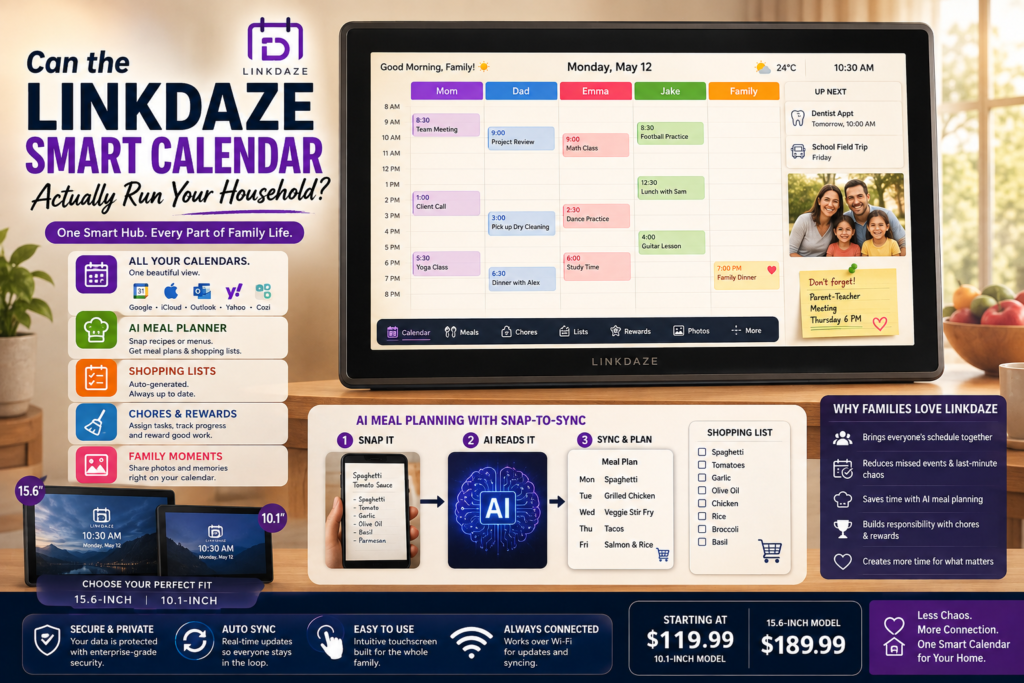
Meet the Linkdaze smart calendar—a shared household hub that brings schedules, meals, chores, shopping lists, and family life together in one place.
Description:
This landscape poster showcases the Linkdaze smart calendar as a household organization hub, featuring a large touchscreen calendar, color-coded family schedules, AI meal planning, Snap-to-Sync, shopping lists, chores, and family photos. The visual highlights Linkdaze’s key benefits and 10.1-inch and 15.6-inch models, making it relevant to the article’s focus on smarter, simpler household organization.
Alt Text:
Linkdaze smart calendar displays family schedules, AI meal planning, chores, shopping lists, and household tasks.
Planned structure:
● Why household calendars are becoming digital
● What the Linkdaze smart calendar is and who it is for
● How Linkdaze combines multiple calendars
● AI meal planning and “Snap-to-Sync” explained
● Chores, rewards, shopping lists, and family organization
● Linkdaze vs. traditional calendars and competitors
● Pricing, subscription model, and value
● Who should consider Linkdaze?
● Limitations and what to consider before buying
● How students and roommates can use it
● FAQ
Focus keywords:
● Primary keyword: Linkdaze smart calendar
● Secondary keywords: Linkdaze calendar, smart family calendar, digital household calendar, AI meal planner
● LSI/Long-tail keywords: Linkdaze smart calendar review, Linkdaze calendar features, smart calendar for families, AI meal planning calendar
The family calendar used to be a piece of paper stuck to the refrigerator, but when everyone’s schedule lives in a different app, the real problem is no longer remembering events,it is getting everyone on the same page.
The Linkdaze smart calendar takes a different approach: instead of functioning as a digital version of a wall calendar, it is designed as a shared household command center for schedules, chores, meals, shopping lists, and more. According to the TechCrunch report supplied for this article, Linkdaze supports calendars from Google, iCloud, Outlook, Yahoo, and Cozi, while its AI meal planner can turn photographed recipes or school lunch menus into digital meal plans and shopping lists.
That combination makes Linkdaze interesting beyond busy families.
For parents, it can bring multiple schedules together. For roommates, it can coordinate chores and shared responsibilities. For students and young professionals, it can become a physical reminder for interviews, assignments, meetings, deadlines, and everyday tasks.
The bigger idea is simple: your calendar should not only tell you where you need to be,it should help you manage everything that needs to happen around you.
What Is the Linkdaze Smart Calendar?
Definition + Expansion: What is the Linkdaze smart calendar?
The Linkdaze smart calendar is a touchscreen digital calendar designed to organize an entire household rather than just one person’s schedule. It combines multiple calendars with household-management features such as chores, rewards, meal planning, shopping lists, and family photos.
That distinction is important.
Most calendar apps are built around an individual user. You open your phone, check your appointments, add a meeting, and move on. Household organization is messier because several people may be using different calendars, devices, and services at the same time.
One family member might live inside Google Calendar.
Another might use Apple’s calendar.
Someone else could rely on Outlook.
And a family may already use Cozi for household organization.
The Linkdaze smart calendar attempts to bring those separate schedules into one physical display.
According to the supplied TechCrunch report, Linkdaze launched in December 2025 and is available in 15.6-inch and 10.1-inch models.
That physical format is part of the appeal.
Instead of checking a smartphone notification and immediately getting distracted by social media, messages, or other apps, you can look at a shared screen mounted somewhere visible in the home.
The refrigerator, kitchen wall, entrance hallway, or another common area suddenly becomes the household’s information hub.
Why a physical calendar still matters
Digital calendars have one obvious weakness: they are often hidden inside personal devices.
A parent may have a schedule on their phone that a child never sees. A roommate might update a shared Google Calendar, but someone else forgets to check it. A partner may have appointments stored in an entirely different ecosystem.
A physical display changes that behavior.
The schedule becomes part of the environment.
You don’t have to remember to open an app just to see what is happening today. Question → Direct Answer: Is Linkdaze just a digital wall calendar?
Not really. Its calendar is the foundation, but Linkdaze is designed as a broader household-management system that combines schedules with chores, rewards, meal planning, shopping lists, and other organizational tools.
That is what separates it from simply putting an old tablet on the wall and opening a calendar app.
How Linkdaze Brings Different Calendars Together One of the strongest features of the Linkdaze smart calendar is its calendar compatibility. According to the supplied TechCrunch report, Linkdaze can synchronize calendars from:
● iCloud
● Outlook
● Yahoo
● Cozi
This matters because families rarely use one technology platform consistently.
One person may be heavily invested in Apple’s ecosystem while another uses Android and Google services. A parent might use Outlook for work, while the household uses Cozi for family planning.
Normally, that creates fragmentation.
Definition + Expansion: Calendar synchronization
Calendar synchronization means connecting schedules from different calendar services so that events can appear together in one interface. Instead of manually copying every
appointment from one platform to another, a compatible system can bring those schedules into a shared view.
The advantage is less administrative work.
Imagine that a parent adds a dentist appointment to their iCloud calendar. Another family member schedules a football practice in Google Calendar. A work meeting appears in Outlook.
If those calendars are connected to the Linkdaze smart calendar, the household can see those events together rather than checking three different services.
Color coding adds another layer.
Different family members can have different colors, making it easier to answer the most basic household question:
Who has something scheduled today?
Why compatibility could matter more than the screen
A beautiful display is useful.
But compatibility is what determines whether people actually use it.
If a smart calendar forces an entire household to abandon its existing calendar services, adoption becomes difficult. People have already built habits around Google, Apple, Microsoft and other platforms.
Linkdaze’s approach is more practical: bring existing schedules together rather than asking everyone to start over.
Question → Direct Answer: Why does calendar compatibility matter for families?
It reduces the need for everyone to use the same calendar service. A household can continue using different platforms while viewing their schedules together through one shared interface.
For busy households, that can eliminate one of the most annoying forms of organizational friction: constantly asking, “Did you put that on the calendar?”
The AI Meal Planner Could Be Linkdaze’s Most Interesting Feature
The calendar itself is useful, but the AI meal planner is arguably where Linkdaze becomes more interesting.
AI meal planning is not a completely new concept. There are already apps and services that can suggest meals, organize recipes, or create shopping lists.
Linkdaze’s approach focuses on reducing the amount of manual data entry.
Its feature called “Snap-to-Sync” allows users to photograph information such as a paper recipe or a child’s school lunch menu. Linkdaze can then convert that information into a digital meal plan and generate a shopping list.
Think about what normally happens when a school sends home a lunch menu. You might receive a printed sheet.
You look at it once.
Then it disappears under paperwork on the kitchen counter.
Later, someone asks, “What are the kids having for lunch on Thursday?” Now you have to find the paper again.
Snap-to-Sync is designed to turn that physical information into something digitally organized. Question → Direct Answer: What does Linkdaze’s Snap-to-Sync feature do?
It uses AI to convert photographed information, such as recipes or school lunch menus, into a digital meal plan and shopping list. The goal is to remove the manual work involved in typing that information into a meal-planning system.
That is a surprisingly practical application of AI.
Instead of using artificial intelligence simply to generate something flashy, Linkdaze uses it to solve a mundane household task: turning information you already have into something you can actually use.
Why AI Meal Planning Is More Useful Than It Sounds The value of AI meal planning is not necessarily that it can invent a recipe. The real value is reducing friction.
Household planning often involves a chain of small tasks:
1. Decide what to eat.
2. Check what ingredients are available.
3. Read recipes.
4. Create a shopping list.
5. Remember the list at the store.
6. Coordinate meals with school or work.
7. Adjust plans when something changes.
Every individual task is manageable.
Together, they become another administrative job.
A feature such as Snap-to-Sync can potentially remove some of those steps. Definition + Expansion: AI meal planner
An AI meal planner uses artificial intelligence to help organize meals, recipes, menus, and related shopping information. In Linkdaze’s case, the supplied TechCrunch report highlights image-based input, where users photograph existing information and have the system turn it into a digital plan.
That is particularly useful because people do not always receive household information digitally. Schools still send paper notices.
Friends share handwritten recipes.
Parents save screenshots.
Restaurants provide printed menus.
The ability to convert those formats into structured information could make a household calendar more flexible.
Linkdaze Is More Than a Calendar
The Linkdaze smart calendar is designed around the idea that a household has more than appointments.
There are chores.
Shopping.
Meals.
Rewards.
Shared responsibilities.
Family memories.
And sometimes an endless stream of small tasks that nobody technically owns.
According to the supplied article, Linkdaze supports household features including chores and rewards, meal planning, shopping lists, and digital photo-frame functionality.
This gives the device a broader role.
Instead of asking, “What time is the appointment?” you can potentially use the same screen to answer:
● Who is doing the dishes?
● What’s for dinner?
● What needs to be bought?
● What is happening after school?
● What appointments are coming up?
● What tasks have been completed?
● What does everyone have planned today?
Question → Direct Answer: What makes a smart household calendar different from a normal calendar?
A smart household calendar combines scheduling with other shared responsibilities. Instead of treating appointments as the only important information, it can help coordinate chores, meals, shopping, and other everyday household activities.
That is a subtle but important shift.
The calendar stops being merely a place where you store information.
It becomes a place where you coordinate action.
Linkdaze vs. a Traditional Calendar vs. Skylight
The easiest way to understand the positioning of the Linkdaze smart calendar is to compare it with alternatives.
Feature Traditional paper calendar
Linkdaze smart calendar
Skylight smart calendar
Shared household display
Digital calendar synchronization
Yes Yes Yes No Yes Yes
Multiple calendar services
No Google, iCloud, Outlook, Yahoo,
Cozi
Varies by product/service
Chore management Manual Yes Available through supported features
Meal planning Manual AI-powered features Available through subscription features
Shopping lists Manual Yes Available through supported features
AI Snap-to-Sync No Yes Not highlighted in supplied comparison
Photo-frame functionality
No Yes Available on some smart displays
Main subscription requirement
Starting price
mentioned in supplied article
No No for main features, according
to supplied article
Very low $119.99 for 10.1-inch model
Additional features through subscription
$149.99 for 10-inch model before/with
subscription context
The comparison reveals where Linkdaze is trying to compete.
It is not attempting to replace the smartphone.
It is trying to become the shared screen that everyone in the household can see. Linkdaze vs. Skylight
The pricing difference is particularly interesting.
According to the supplied TechCrunch report, Linkdaze’s 10.1-inch model costs $119.99, while Skylight’s 10-inch model starts at $149.99, with additional features available through a $79-per-year subscription.
Linkdaze’s main features do not require a monthly subscription, according to the report. That could be a meaningful advantage.
Subscription fatigue is real. Consumers increasingly encounter recurring fees for software, entertainment, cloud storage, productivity tools, and smart-home products.
A hardware device that works without another mandatory recurring payment can therefore feel easier to justify.
Question → Direct Answer: Is Linkdaze cheaper than Skylight?
Based on the pricing cited in the supplied TechCrunch report, the 10.1-inch Linkdaze model is less expensive upfront than Skylight’s 10-inch model, and Linkdaze does not require a subscription for its main features. Skylight’s additional features include a $79-per-year subscription.
Pricing and product plans can change, so buyers should verify current prices before purchasing.
The No-Subscription Strategy Could Be a Major Advantage
The decision not to make a subscription mandatory for Linkdaze’s main functionality is notable. For a consumer technology company, subscriptions can provide predictable recurring revenue. For consumers, however, subscriptions create a different calculation.
A device might look affordable at first, but the total cost can become significantly higher over several years.
Consider a hypothetical three-year period.
A $79 annual subscription would amount to $237 over three years, before considering the hardware price.
That does not automatically make a subscription-based product bad. Recurring services can fund software updates, cloud infrastructure, premium features, and customer support.
But consumers increasingly want to know what they are actually buying.
With the Linkdaze smart calendar, the value proposition is comparatively straightforward: pay for the hardware and use the core household features without adding a mandatory recurring fee, according to the supplied report.
For families trying to control household expenses, that simplicity may matter. Who Is the Linkdaze Smart Calendar Actually For? The obvious target is families.
But that is not the only audience.
1. Busy families
This is probably the strongest use case.
Parents may have work schedules, children’s school events, appointments, sports, chores and meal plans all competing for attention.
A shared display can make those commitments visible to everyone.
2. College roommates
This is where the Linkdaze smart calendar gets surprisingly interesting for younger users. Imagine a four-person apartment.
One roommate buys groceries.
Another cleans the kitchen.
Someone has an exam.
Another roommate is hosting friends.
Instead of managing everything through a chaotic group chat, a shared calendar can provide a physical overview.
3. Students
Students can use a shared display for:
● Assignment deadlines
● Exam schedules
● Study sessions
● Club activities
● Part-time jobs
● Project meetings
● Personal appointments
The key benefit is visibility.
4. Young professionals
For someone juggling interviews, meetings, deadlines, side projects, and personal commitments, a shared digital calendar can serve as a physical anchor.
You may still use Google Calendar on your phone.
But seeing the day’s priorities on a wall can make planning more intentional. 5. Multigenerational households
Different generations may use different technology platforms.
A shared physical display can provide a common reference point without requiring every family member to understand the same app ecosystem.
How Students Could Use Linkdaze Differently
For an audience of Indian students and young professionals, the Linkdaze smart calendar offers an interesting lesson in productivity design.
Students often think productivity means adding more apps.
One app for notes.
One for assignments.
One for reminders.
One for calendars.
One for study timers.
One for meal planning.
Eventually, productivity tools themselves become another source of complexity. A shared display takes the opposite approach.
Question → Direct Answer: Could Linkdaze be useful in a college apartment?
Yes. The device can potentially serve as a shared coordination board for roommates, with calendars, chores, shopping lists, meals, and household responsibilities visible in one place.
For example, roommates could create a simple weekly system:
Monday: Roommate A handles groceries.
Tuesday: Roommate B cleans the kitchen.
Wednesday: Shared study session.
Thursday: Laundry rotation.
Friday: Movie night or shared dinner.
The point isn’t that a smart display magically makes people responsible. It simply makes responsibilities visible.
And visibility can reduce the classic roommate problem of:
“I thought you were doing it.”
What Are the Limitations?
No device should be treated as a universal solution.
The first question is whether your household actually needs a dedicated screen.
If everyone already uses a shared calendar effectively, buying another device may not add much value.
There is also the issue of screen placement.
The product works best when everyone can see it regularly. A device hidden in a corner may become another piece of technology that nobody checks.
Privacy is another consideration.
A household calendar can contain sensitive information such as appointments, work meetings, school schedules, travel plans, or personal commitments.
That means users should understand how their data is synchronized and stored before connecting multiple accounts.
Question → Direct Answer: What should buyers check before purchasing Linkdaze?
Buyers should verify current pricing, supported calendar services, privacy policies, synchronization behavior, screen size, mounting requirements, and which features are included without a subscription.
The supplied article establishes the main compatibility and pricing claims, but product specifications and pricing can change over time.
Why the Physical Screen Could Beat Another Smartphone App
There is an important behavioral reason why products like the Linkdaze smart calendar exist.
Smartphones are extremely powerful.
They are also extremely distracting.
You might open your phone to check tomorrow’s appointment and 20 minutes later find yourself scrolling through social media.
A dedicated household display eliminates some of that friction.
You look at the screen.
You see the schedule.
You walk away.
That may sound almost too simple.
But simplicity can be a feature.
A household calendar does not need to compete for your attention with notifications, messages and entertainment.
It just needs to be visible when you need it.
The Bigger Trend: Ambient Computing Is Becoming More Practical
Linkdaze is part of a broader technology trend sometimes described as ambient computing. Definition + Expansion: Ambient computing
Ambient computing refers to technology that works around you with minimal direct interaction, rather than requiring you to constantly open and operate an app. Smart speakers, connected displays, smart-home sensors, and shared household dashboards are examples of this broader idea.
The goal is to make technology feel less like a task.
You shouldn’t have to think, “I need to interact with my productivity system.” The information should simply be available when useful.
That is exactly where a wall-mounted calendar makes sense.
Your schedule is already part of your physical environment.
The device simply makes that information visible.
The AI meal-planning feature pushes the idea further.
Instead of asking users to manually digitize a paper recipe or school menu, Linkdaze uses AI to interpret the information and organize it.
That is a good example of AI as invisible infrastructure.
You don’t necessarily care that an AI model is processing the image.
You care that a piece of paper became a useful shopping list.
Is Linkdaze Worth Considering?
The Linkdaze smart calendar makes the strongest case for itself when a household has a coordination problem rather than simply a calendar problem.
If one person needs a calendar, a smartphone app may be enough.
If four or five people need to coordinate work, school, meals, chores, appointments and shopping, a shared physical display starts to make more sense.
Its strongest features, based on the supplied TechCrunch report, are:
● Multi-platform calendar synchronization
● 10.1-inch and 15.6-inch display options
● AI-powered meal planning
● Snap-to-Sync for photographed recipes and menus
● Shopping lists
● Chore and reward management
● Digital photo-frame functionality
● No subscription required for its main features
● $119.99 starting price for the 10.1-inch model cited in the article Its biggest question is not whether it can display a calendar.
It obviously can.
The real question is whether a household will actually use the shared screen consistently enough to justify buying dedicated hardware.
For a busy family, the answer could be yes.
For a roommate apartment, it could be surprisingly useful.
For a single person with a perfectly organized digital calendar, probably less so. Frequently Asked Questions
What is the Linkdaze smart calendar?
The Linkdaze smart calendar is a touchscreen household organization device that combines multiple digital calendars with features for chores, rewards, meal planning, shopping lists, and family photos. It is designed to coordinate an entire household rather than simply track one person’s appointments.
Which calendars does Linkdaze support?
According to the supplied TechCrunch report, Linkdaze can synchronize calendars from Google, iCloud, Outlook, Yahoo, and Cozi. This allows households using different calendar platforms to bring their schedules into one shared display.
Does Linkdaze require a subscription?
According to the supplied article, Linkdaze does not require a monthly subscription for its main features. This differentiates it from competitors such as Skylight, which offers additional features through a subscription priced at $79 per year according to the comparison in the supplied report.
How does Linkdaze’s AI meal planner work?
Linkdaze’s AI meal planner uses its “Snap-to-Sync” feature to convert photographed information, such as paper recipes or school lunch menus, into a digital meal plan and shopping list. The feature is designed to reduce manual data entry.
How much does the Linkdaze calendar cost?
The supplied TechCrunch report lists the 10.1-inch Linkdaze model at $119.99. The article also compares it with Skylight’s 10-inch model, which starts at $149.99 in the cited comparison. Prices can change, so buyers should check the manufacturer’s current listing before purchasing.
Is Linkdaze useful for college students or roommates?
Yes, Linkdaze can be useful for college apartments and roommates because a shared display can coordinate chores, study schedules, meals, shopping, appointments, and other household responsibilities. Its value is greatest when several people need to see and manage the same information.
The Bottom Line: Linkdaze Is Trying to Make the Household the User
The most interesting thing about the Linkdaze smart calendar isn’t its touchscreen. It isn’t even the AI.
It is the idea that the household itself can be treated as the user.
Most productivity software assumes an individual.
Linkdaze assumes a group.
That changes what the device needs to do.
It needs to combine calendars rather than replace them. It needs to make chores visible rather than simply create reminders. It needs to connect meal planning with shopping. And with Snap-to-Sync, it needs to turn everyday physical information into something digitally useful.
That is why the product feels more ambitious than a digital wall calendar. The real pitch is not, “Here’s a better calendar.”
It is:
“Here’s one place where your household can figure out what is happening next.” For busy parents, that could mean fewer scheduling surprises.
For roommates, it could mean fewer arguments about chores.
For students, it could mean a more visible study routine.
For young professionals, it could mean seeing work and personal commitments in the same physical space.
And as AI becomes increasingly embedded in everyday products, this may be one of the more useful directions for it: not replacing human decision-making, but quietly removing the tedious steps between information and action.
For more practical explainers on AI-powered productivity tools and emerging consumer technology, keep exploring Kalinga.ai.
Meta Description:
Linkdaze smart calendar combines family schedules, AI meal planning, chores and shopping lists. See its features, price and benefits.
URL Slug:
linkdaze-smart-calendar