File Name: nvidia-price-hikes-ai-server-costs.jpg
Title: Nvidia Price Hikes Raise AI Server Costs
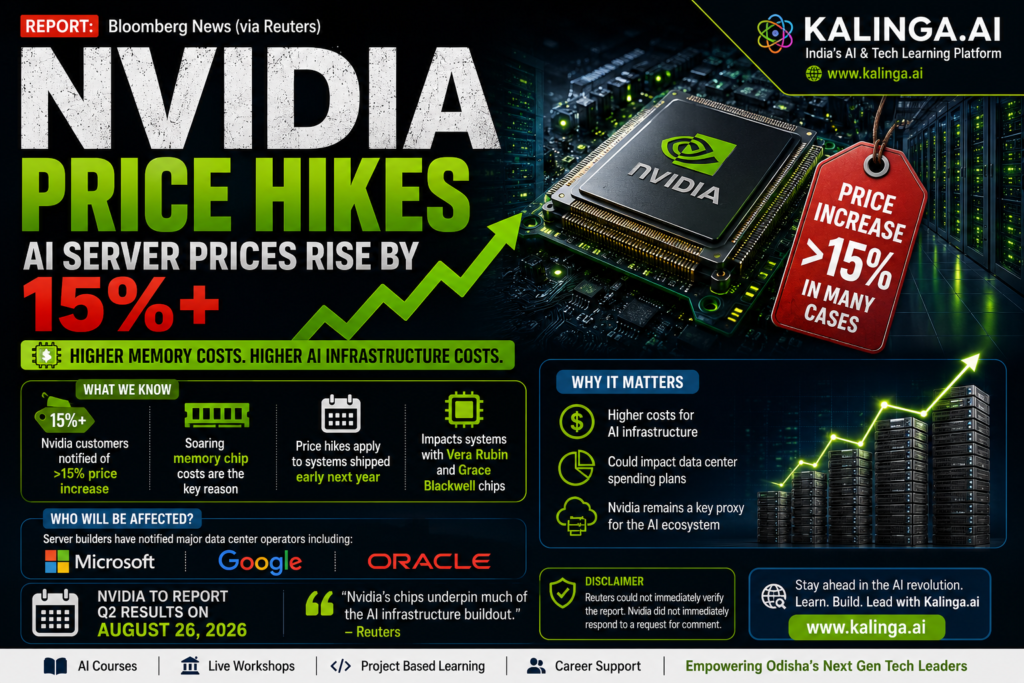
Caption: Nvidia’s reported 15%+ AI server price hikes could raise infrastructure costs as soaring memory prices reshape the economics of the AI boom.
Description: The landscape poster features Nvidia’s AI chips, data-center servers, a prominent 15%+ price increase graphic, and key details about rising memory costs and systems using Vera Rubin and Grace Blackwell chips. It also highlights major data-center customers such as Microsoft, Google, and Oracle, Nvidia’s August 26 results date, and Kalinga.ai branding, making the visual directly relevant to the article’s analysis of rising AI infrastructure costs.
When the cost of an AI server rises by more than 15%, the impact can travel far beyond one chip company,it can affect cloud providers, data-center operators and eventually the economics of building AI systems. According to a Bloomberg News report cited by Reuters, some of Nvidia’s largest customers have been told that prices for servers containing its AI chips will rise by more than 15% in many cases, with higher memory costs a key factor.
The reported Nvidia price hikes are expected to affect systems shipped early next year, including servers using Nvidia’s flagship Vera Rubin and Grace Blackwell chips. Reuters said it could not immediately verify the Bloomberg report, and Nvidia had not immediately responded to a request for comment outside regular business hours.
That uncertainty is important. The report describes information attributed to people familiar with the process rather than a publicly confirmed Nvidia pricing announcement. But if the reported Nvidia price hikes materialize, they could become another sign that the explosive expansion of AI infrastructure is creating pressure throughout the technology supply chain.
Planned Structure
- Why Nvidia price hikes matter to the AI industry
- What is driving the reported increase in AI server prices
- How memory chip costs affect AI servers
- Which Nvidia systems and customers could be affected
- Why Microsoft, Google and Oracle matter
- Nvidia’s role as a proxy for the AI ecosystem
- What the price increases could mean for AI infrastructure costs
- What Nvidia’s upcoming results could reveal
- What students and young professionals should understand
- FAQ
- Bottom line
Focus Keywords
- Primary keyword: Nvidia price hikes
- Secondary keywords: Nvidia AI chips, AI server prices, memory chip costs, AI infrastructure
- LSI/Long-tail keywords: Nvidia AI chip price increase, Nvidia server price hikes, Vera Rubin AI servers, Grace Blackwell server costs
Why Do Nvidia Price Hikes Matter for the AI Industry?
Question → Direct Answer: Why are Nvidia price hikes important?
Because Nvidia’s chips are at the center of much of the infrastructure used to build and operate modern AI systems. When the price of servers containing those chips increases, the effect can extend to companies that purchase, operate or finance large data-center deployments.
Nvidia has become one of the most important suppliers in the AI infrastructure boom. Its processors are used in systems designed for demanding AI workloads, while large technology companies are investing heavily in data centers to support the rapid growth of artificial intelligence.
The Reuters report says companies that build servers under contract for major data-center operators have recently informed customers about the upcoming increases. Those customers include major technology companies such as Microsoft, Alphabet’s Google and Oracle, according to the Bloomberg report cited by Reuters.
That makes the reported Nvidia price hikes more significant than a routine hardware-price adjustment.
If a server becomes substantially more expensive, the company buying it has several choices. It could absorb the higher cost, delay some infrastructure spending, negotiate with suppliers, increase prices for customers, or adjust the scale and timing of its deployment plans.
The final outcome will depend on the companies involved and the contracts they have in place. The supplied reporting does not establish what any individual customer will ultimately pay or whether higher server prices will be passed directly to end users.
Definition + Expansion: AI infrastructure
AI infrastructure refers to the computing hardware, data centers, networking systems, storage and other technology required to develop and operate artificial-intelligence applications.
At the center of that infrastructure are powerful processors and the servers that contain them. Those servers are then deployed inside data centers, where they can work together at large scale to handle AI workloads.
This means an increase in the cost of one component can affect a much larger investment.
Think of it like constructing a specialized factory. If one critical machine becomes 15% more expensive, the total factory cost does not necessarily rise by exactly 15%, but the economics of the entire project can change.
That is why Nvidia price hikes deserve attention even from people who never purchase an Nvidia product themselves.
What Is Driving the Reported Increase in AI Server Prices?
The central factor identified in the Bloomberg report is rising memory chip costs.
The report said some of Nvidia’s largest customers had been told that prices for servers containing Nvidia AI chips would rise by more than 15% in many cases, with memory costs soaring. The increases are expected to vary depending on the Nvidia chip generation and the memory configuration used in the system.
That last point matters.
An AI server is not simply a single Nvidia processor placed inside a box. It is a complete computing system that includes multiple components, and memory is an important part of that system.
As AI models become increasingly demanding, computing systems need large amounts of high-performance memory and other supporting hardware. The Reuters report specifically identifies memory chip costs as a factor behind the reported server-price increases.
Question → Direct Answer: Are Nvidia’s chips alone responsible for the price increases?
Not according to the supplied report. The reported increases are tied to servers containing Nvidia AI chips, and Bloomberg’s sources attributed a significant part of the pressure to soaring memory chip costs. The increase will also vary according to chip generation and memory configuration.
This distinction is useful because it prevents an overly simple interpretation.
It would be inaccurate to conclude from the report that Nvidia has simply announced a blanket increase of more than 15% across all of its chips or products.
Instead, the reporting describes higher prices for certain server systems and says the increases depend on the configuration.
That difference could become important as customers evaluate their AI infrastructure budgets.
How Do Memory Chip Costs Affect AI Servers?
Memory is one of the less visible parts of the AI hardware story, but it can have an important role in overall system costs.
A processor performs calculations, while memory helps the system store and access information needed during those calculations. AI workloads can require substantial amounts of high-performance memory because large models and datasets need to be processed efficiently.
When memory costs rise, the impact can therefore extend beyond memory manufacturers.
A server manufacturer may face higher component costs. That manufacturer may then adjust its system pricing for data-center customers.
Those customers, in turn, are responsible for building and operating infrastructure at increasingly large scale.
Why does this matter during the AI boom?
The AI infrastructure buildout is happening at an enormous scale, according to the broader context provided in the Reuters report. Nvidia’s chips underpin much of that expansion, making the company closely connected to the economics of data-center investment.
When infrastructure is being purchased in large quantities, even a relatively modest change in the price of individual systems can become meaningful at the total-project level.
For example, a company planning thousands of servers has to consider not just the price of one system but the cost of the entire deployment.
The supplied report does not provide enough information to calculate how much the total infrastructure budgets of Microsoft, Google or Oracle could change. It would therefore be speculative to attach a specific dollar amount to their potential additional spending.
What can be said is that higher server prices create additional cost pressure for companies expanding AI data-center capacity.
Question → Direct Answer: Why are memory costs suddenly important to the AI story?
Because memory is a component of the server systems used for AI computing, and the Bloomberg report cited by Reuters says soaring memory chip costs are contributing to reported server-price increases. That means the economics of AI infrastructure depend on more than the headline price of an AI processor.
This is an important lesson for anyone learning about the technology industry.
The AI ecosystem is a supply chain, not a single product.
A change in one part of that chain can affect other companies even when those companies are not direct competitors.
Which Nvidia Systems Could Be Affected?
The reported Nvidia price hikes are expected to apply to systems shipped early next year, according to Bloomberg’s report as cited by Reuters. The systems include configurations using Nvidia’s Vera Rubin and Grace Blackwell chips.
The report also says the size of the increase will depend on the chip generation and memory configuration.
That means customers may not experience a uniform price change.
| Factor | What the Reuters-supplied report says |
| Reported price increase | More than 15% in many cases |
| Timing | Systems shipped early next year |
| Chip families mentioned | Vera Rubin and Grace Blackwell |
| Key cost pressure | Rising memory chip costs |
| Pricing variation | Depends on chip generation and memory configuration |
| Customers affected | Some of Nvidia’s largest customers |
| Verification status | Reuters had not independently verified the Bloomberg report |
The distinction between different configurations is especially important for AI infrastructure buyers.
A system with one chip generation and a particular memory configuration could have a different cost profile from another system. The supplied report does not provide a detailed price list for individual configurations.
Question → Direct Answer: Will every Nvidia AI server become more than 15% more expensive?
The supplied report does not say that every Nvidia AI server will rise by more than 15%. It says some of Nvidia’s largest customers have been told that server prices will rise by more than 15% in many cases, with the exact increase depending on chip generation and memory configuration.
That wording is important for accurate reporting.
The headline figure is significant, but it should not be interpreted as a universal price increase across Nvidia’s entire product portfolio.
Why Do Microsoft, Google and Oracle Matter?
The reported price increases could matter particularly to large cloud and data-center companies because they operate enormous computing infrastructures.
The Bloomberg report cited by Reuters said companies that build servers under contract for large data-center operators such as Microsoft, Google and Oracle have recently informed their customers about the upcoming increases.
These companies are important parts of the AI ecosystem because they provide or operate large-scale computing infrastructure used by businesses, developers and consumers.
When AI demand increases, cloud providers and other data-center operators need additional computing capacity.
That creates a chain:
AI demand → more data-center capacity → more servers → more Nvidia AI chips and supporting components → greater demand for memory and other hardware.
If component costs rise during that expansion, companies building infrastructure have to account for those changes.
Question → Direct Answer: Could higher server prices slow AI investment?
Potentially, but the supplied reporting does not establish that they will. Higher hardware costs create additional pressure on infrastructure budgets, but the eventual effect on AI investment will depend on demand, company budgets, contracts, hardware availability and other economic factors.
This is why it is too early to conclude that the reported Nvidia price hikes will slow the AI boom.
Instead, they represent another variable that infrastructure companies need to manage.
Nvidia Is Becoming a Proxy for the Broader AI Economy
The Nvidia story is bigger than Nvidia itself.
The Reuters report describes the company as a proxy for the broader AI ecosystem, which includes chip companies and businesses financing the rapid expansion of data-center capacity.
Definition + Expansion: Proxy
A proxy is something that investors or analysts use as an indicator of a broader trend.
In this context, Nvidia’s performance and business developments can provide clues about the health and direction of the wider AI infrastructure market because its chips are deeply connected to AI computing demand.
That does not mean Nvidia perfectly represents every part of the AI economy.
A software company, cloud provider, memory manufacturer and chip designer can experience very different business conditions. But Nvidia occupies an unusually important position in the AI hardware supply chain.
That is why Nvidia price hikes can attract attention beyond the company’s immediate customers.
Question → Direct Answer: Why is Nvidia considered a proxy for AI infrastructure?
Nvidia supplies chips that underpin much of the AI infrastructure buildout. As a result, developments involving its chips, customers and data-center demand can provide investors with information about broader trends in AI computing investment.
This makes Nvidia an important company to watch whenever the AI industry enters a new phase.
The reported pricing change is therefore not just about a higher server bill.
It raises broader questions about whether the cost of expanding AI infrastructure is also changing.
What Could Nvidia Price Hikes Mean for the Cost of Building AI?
The simplest implication is that AI infrastructure could become more expensive for some customers.
But the exact impact is difficult to calculate from the supplied information.
The report gives a percentage for many reported server-price increases, but it does not provide the previous price of each affected system, the number of systems customers plan to buy, or the final negotiated price.
That means a precise estimate of the total additional cost would require information that is not available in the report.
Still, the economic mechanism is straightforward.
If the price of AI servers rises:
- Data-center operators face higher equipment costs.
- Infrastructure budgets may need to be adjusted.
- Companies may evaluate deployment schedules more carefully.
- Cloud providers could reassess the economics of additional capacity.
- AI businesses could face higher computing costs if those expenses flow through the ecosystem.
None of these outcomes is guaranteed.
Companies can respond to higher hardware costs in different ways. They may negotiate prices, absorb some costs, change configurations or adjust procurement plans.
Question → Direct Answer: Will AI become more expensive for consumers?
The supplied report does not establish that consumer-facing AI services will become more expensive. It only reports that some Nvidia server customers have been informed of higher system prices. Whether those higher infrastructure costs eventually affect prices paid by businesses or consumers would depend on decisions made further down the supply chain.
That distinction is crucial.
A higher hardware price does not automatically translate into a higher subscription price for an AI application.
There are many steps between buying a server and charging a customer for an AI service.
What Nvidia’s Upcoming Results Could Tell Investors
Another reason the story is attracting attention is timing.
Nvidia is scheduled to report its second-quarter results on August 26, according to the Reuters report.
That makes the company’s upcoming results an important event for investors already watching the AI hardware market.
The reported pricing changes could raise questions about several areas of Nvidia’s business and the broader AI supply chain.
Investors may be interested in understanding:
- How strong demand for Nvidia’s AI products remains
- How the company describes the AI infrastructure market
- How supply-chain conditions are evolving
- Whether memory availability and pricing are affecting customers
- How newer chip generations are being adopted
- What major customers are planning for future data-center investment
The supplied Reuters report does not provide Nvidia’s upcoming financial results, so it would be inappropriate to predict what the company will report.
What is clear is that the results arrive at a time when investors are paying close attention to the sustainability and economics of AI infrastructure spending.
Question → Direct Answer: Why is August 26 important?
Nvidia is scheduled to report its second-quarter results on August 26, making the announcement a major upcoming event for investors following the company’s AI-chip business and the wider AI infrastructure ecosystem.
The results could provide additional context for understanding demand, although the supplied report does not indicate what Nvidia will announce.
What Should Students and Young Professionals Learn From This Story?
The Nvidia story is useful even if you have no plans to become a stock investor.
It demonstrates how modern technology businesses are interconnected.
An AI application might look like a piece of software on your phone or laptop. Behind that application can be a chain involving processors, memory, servers, networking equipment, data centers, cloud providers and electricity.
When one part of that chain changes, the economics of the entire system can change.
Five lessons worth remembering
1. AI is also a hardware story.
Artificial intelligence depends on physical infrastructure. Powerful software requires computing resources, and those resources have real costs.
2. Supply chains matter.
Nvidia may be the most visible company in this story, but memory manufacturers, server builders and data-center operators also play important roles.
3. Price increases do not automatically mean weaker demand.
The reported Nvidia price hikes are occurring in the context of continued AI infrastructure expansion, according to the Reuters report.
4. Headlines need context.
“More than 15%” sounds simple, but the report says the increase varies by chip generation and memory configuration.
5. Verification matters.
Reuters explicitly said it could not immediately verify the Bloomberg report and that Nvidia had not immediately responded to a request for comment outside regular business hours.
That final point is especially important for anyone learning journalism, business research or AI-assisted content creation.
A reported claim should not automatically be presented as a confirmed company announcement.
Why the AI Hardware Supply Chain Is Becoming More Important
The AI boom has created a new kind of technology race.
In earlier technology cycles, attention often focused heavily on software products and consumer applications. The current AI expansion has put enormous attention on the infrastructure required to run increasingly demanding models.
That means companies are competing not only for customers but also for computing capacity, chips, memory, data-center space and other infrastructure.
Nvidia sits near the center of that story.
The company has become closely associated with the rapid expansion of AI computing, while its customers are investing in the infrastructure needed to deploy those systems.
The reported Nvidia price hikes therefore highlight an important question:
What happens when demand for AI infrastructure remains strong while the cost of building that infrastructure also rises?
The answer will influence not only Nvidia but potentially the broader economics of AI.
If customers continue buying systems despite higher prices, it could indicate that the economic value they expect from AI infrastructure remains strong.
If higher costs eventually lead customers to slow deployments or seek alternatives, the competitive dynamics could change.
The supplied report does not provide evidence that either outcome has happened yet.
What Happens Next With Nvidia Price Hikes?
For now, the most important fact is that the reported price increases are expected to affect systems shipped early next year, while Nvidia’s second-quarter results are scheduled for August 26.
That creates two separate timelines.
The first is the immediate investor timeline, centered on Nvidia’s upcoming results.
The second is the infrastructure timeline, where customers are preparing for potentially higher server costs in future shipments.
Those timelines could intersect if Nvidia’s results provide new information about AI demand, supply conditions or the company’s expectations for its business.
For customers, the reported Nvidia price hikes could encourage more careful planning around hardware procurement.
For investors, they could become another data point in assessing whether the AI infrastructure boom is creating sustainable economics throughout the supply chain.
For technology professionals, the story is a reminder that AI progress depends on much more than algorithms.
FAQ
What are Nvidia price hikes?
Nvidia price hikes refer in this report to reported increases of more than 15% in many cases for servers containing Nvidia AI chips. Bloomberg News reported the increases, while Reuters said it could not immediately independently verify them.
Why are Nvidia server prices reportedly increasing?
The Bloomberg report cited by Reuters says soaring memory chip costs are contributing to the increases. The exact price change will depend on the Nvidia chip generation and memory configuration used in each system.
Which Nvidia chips are mentioned in the report?
The report says the affected systems include those containing Nvidia’s Vera Rubin and Grace Blackwell chips. It does not provide a separate percentage increase for each chip family.
When will the reported Nvidia price hikes take effect?
According to the Bloomberg report cited by Reuters, the increases will apply to systems shipped early next year.
Which companies could be affected?
The report says companies that build servers under contract for major data-center operators such as Microsoft, Google and Oracle have recently informed customers about the upcoming increases.
Did Nvidia confirm the reported price increases?
No confirmation is provided in the supplied Reuters report. Reuters said it could not immediately verify the Bloomberg report, and Nvidia did not immediately respond to a request for comment outside regular business hours.
Why does Nvidia matter so much to the AI industry?
Nvidia’s chips underpin much of the AI infrastructure buildout, making the company an important indicator,or proxy,for the broader ecosystem of chip makers, data-center operators and businesses financing AI infrastructure expansion.
The Bottom Line
The reported Nvidia price hikes show how the AI boom is creating pressure across the entire technology supply chain. Bloomberg News, as cited by Reuters, reported that some major Nvidia customers have been told that prices for AI-chip servers will rise by more than 15% in many cases, with rising memory costs identified as a major factor.
But the story should be treated carefully: Reuters had not independently verified the report, and Nvidia had not immediately commented. What happens next will depend on customer contracts, hardware configurations, memory costs and the broader pace of AI infrastructure investment.
For anyone trying to understand the AI economy, the bigger lesson is simple: AI may look digital, but its growth depends on a very physical,and increasingly expensive,technology supply chain.
If you’re exploring how AI infrastructure, chips and data centers are reshaping the technology industry, keep following Kalinga.ai for practical explainers that connect the headlines to the technology behind them.
Meta Description: Nvidia price hikes could raise AI server costs by over 15%. Explore memory costs, Vera Rubin, Grace Blackwell and AI infrastructure.
URL Slug: nvidia-price-hikes-ai-server-costs