File Name: nerve-regeneration-ahr-breakthrough.jpg
Title: Nerve Regeneration AHR Breakthrough
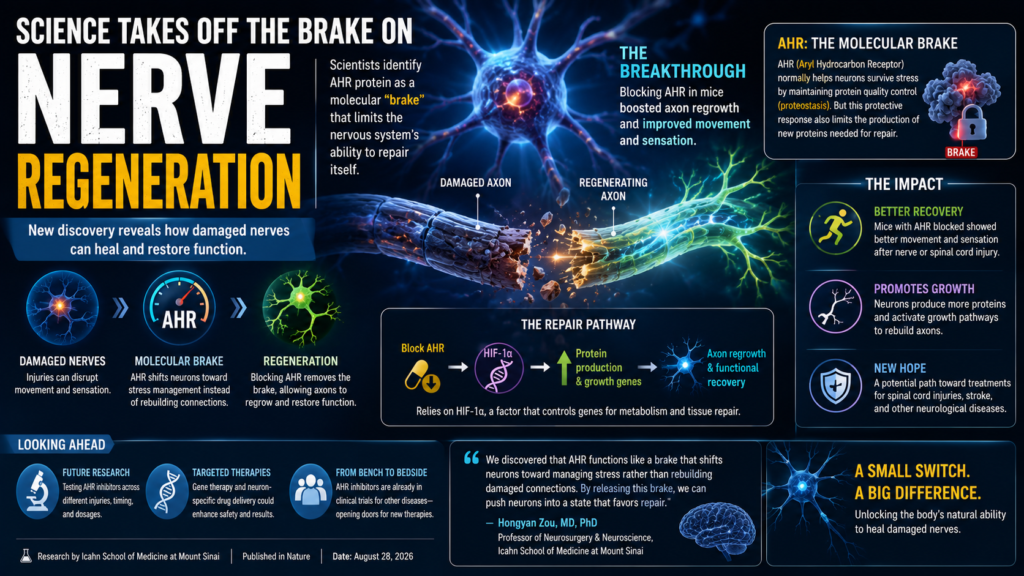
Caption: Scientists have identified a molecular brake that could unlock new possibilities for nerve regeneration and recovery after injury.
Description: This landscape infographic illustrates how blocking the AHR protein may promote nerve regeneration by encouraging damaged axons to regrow. It visualizes the molecular brake, HIF-1α repair pathway, improved movement and sensation in mice, and the potential for future treatments targeting spinal cord and nerve injuries
Alt Text: Scientists discover how AHR blocking may boost nerve regeneration after injury in mice
Planned structure
- Why damaged nerves struggle to repair themselves
- What scientists discovered about AHR
- How AHR creates a survival-versus-repair tradeoff
- Why HIF-1α matters for axon growth
- What the mouse experiments reveal
- Could AHR-blocking drugs become treatments?
- What this discovery means for spinal cord injuries
- What researchers still need to prove
- FAQ: AHR, axons, nerve repair and future treatments
- Key takeaways and next steps
Focus keywords
- Primary keyword: nerve regeneration
- Secondary keywords: damaged nerves, AHR protein, axon regeneration, spinal cord injury
- LSI/Long-Tail keywords: how damaged nerves heal, AHR inhibition for nerve repair, how axons regenerate after injury, future treatments for nerve damage
A damaged nerve can survive an injury yet still struggle to rebuild the connections that make movement and sensation possible. New research from the Icahn School of Medicine at Mount Sinai suggests one reason may be a protein called AHR, which acts like a molecular brake on the repair process. In experiments involving mice, blocking AHR encouraged injured nerve fibers to regrow and was associated with improved movement and sensation.
The finding does not mean scientists have discovered a treatment for human nerve injuries yet. The research, published in Nature, is an early-stage discovery that helps explain why adult neurons often fail to regenerate effectively after serious injury.
But it raises an intriguing possibility: what if damaged neurons could be persuaded to shift their priorities from simply surviving an injury to actively rebuilding themselves?
Why damaged nerves struggle to repair themselves
The nervous system is the body’s communication network. Neurons transmit electrical and chemical signals that allow the brain to communicate with muscles, organs and other parts of the body.
When a nerve is injured, that communication system can be disrupted. Depending on the location and severity of the damage, a person may experience weakness, numbness, loss of sensation or problems with movement.
Some nerves have a limited ability to repair themselves, particularly in the peripheral nervous system. The central nervous system, which includes the brain and spinal cord, is much less capable of effective regeneration.
That difference has made nerve regeneration one of the major challenges in neuroscience.
What is an axon?
Axon: An axon is the long, slender extension of a neuron that carries signals to other cells.
Think of an axon as a biological communication cable. A neuron may have a cell body that processes information, while its axon extends much farther through the body to deliver that information.
If an axon is severed or badly damaged, the neuron needs to grow a replacement connection if normal communication is to be restored. That is considerably harder in adult mammals than it is during early development.
Why can’t adult neurons simply regrow damaged axons?
Adult neurons have limited regenerative capacity, particularly after injuries affecting the spinal cord and other parts of the central nervous system. Scientists have therefore been searching for the molecular signals that prevent injured neurons from switching into a strong repair mode.
The Mount Sinai research identifies AHR as one potentially important part of that equation.
The AHR protein may act like a molecular brake
The study’s central discovery revolves around the aryl hydrocarbon receptor, commonly abbreviated as AHR.
AHR is a protein that can detect certain molecules and influence how cells respond to their environment. It is best known for its role in sensing environmental compounds, including some toxins and pollutants.
The new research suggests that AHR has another important function inside neurons.
According to the Mount Sinai team, active AHR signaling can suppress axon growth following injury. When researchers removed AHR from neurons or blocked its activity using drugs, injured axons showed stronger regenerative responses.
That makes AHR particularly interesting because it appears to influence the decision a neuron makes after damage.
What does AHR do after a neuron is injured?
AHR appears to help the neuron manage cellular stress after injury, but that protective response can come at a cost: it may reduce the resources available for rebuilding damaged axons.
This creates an unexpected biological tradeoff. The neuron is trying to stay alive while simultaneously needing to manufacture new proteins and structures required for repair.
The researchers describe AHR as a kind of molecular brake because its activity appears to favor stress management over aggressive axon regrowth.
That does not mean AHR is simply “bad.” Its normal functions can help cells respond to stress. The challenge is understanding when that protective response becomes an obstacle to regeneration.
Survival versus repair: the tradeoff inside an injured neuron
Imagine a construction crew whose building has suddenly been damaged by a storm.
The crew has two immediate priorities. First, it needs to stop further damage and protect what remains. Second, it needs to rebuild the destroyed sections.
A neuron faces a somewhat similar problem.
After an injury, the cell experiences intense stress. It must protect its internal machinery, maintain protein quality and respond to changes in its environment. At the same time, successful repair requires producing large quantities of new proteins and extending the axon back toward its target.
The Mount Sinai research suggests AHR helps push neurons toward the first priority.
What is proteostasis?
Proteostasis: Proteostasis is the system cells use to maintain healthy, correctly functioning proteins and manage damaged or misfolded proteins.
This process becomes particularly important when cells are under stress. A neuron that has been injured needs to prevent its existing proteins from becoming dysfunctional while maintaining essential cellular operations.
According to the researchers, AHR supports this protective response. However, the same response can restrict the production of new proteins needed to rebuild an injured axon.
When AHR was suppressed, neurons appeared to change their priorities. They increased protein production and activated pathways associated with growth and regeneration.
That shift is at the heart of the new discovery.
Does blocking AHR simply make neurons grow faster?
Not exactly. The research suggests that suppressing AHR changes the broader cellular state of injured neurons, allowing them to devote more resources to growth and rebuilding.
That distinction matters because effective nerve repair is not simply about making an axon longer. The regenerated fiber ultimately needs to navigate through tissue, reconnect with appropriate targets and restore useful communication.
HIF-1α provides another piece of the puzzle
AHR is not working alone.
The researchers found that the regenerative response following AHR suppression also depends on another biological factor called HIF-1α.
HIF-1α is involved in regulating genes associated with metabolism and cellular responses to challenging conditions. In injured neurons, it appears to participate in the shift toward a state that favors growth and repair.
This provides researchers with a more detailed picture of what may be happening inside the neuron.
Rather than one protein switching regeneration on or off, the process appears to involve a network of cellular pathways that control stress responses, metabolism, protein production and growth.
Why is HIF-1α important to nerve regeneration?
HIF-1α appears to help support the biological changes required when neurons move toward a regenerative state. The Mount Sinai findings suggest that the effects of suppressing AHR involve this pathway as part of the broader response.
For researchers, this is valuable because understanding the mechanism could eventually help identify more precise ways to promote repair.
What the mouse experiments showed
The researchers did not stop at examining individual cells.
They also studied animal models involving peripheral nerve damage and spinal cord injury. In these experiments, suppressing AHR encouraged damaged axons to regenerate.
More importantly, the changes were associated with improvements in functional outcomes, including movement and sensation.
That is significant because laboratory evidence of axon growth alone does not necessarily mean that an animal will regain useful function.
A regenerated nerve fiber needs to form meaningful connections. If those connections do not work properly, simply growing more axonal tissue may have limited practical value.
Did the experiments prove that AHR inhibition can repair human nerves?
No. The experiments were conducted in mice, so the findings cannot yet be translated directly into a human treatment.
Animal studies are an important step in understanding biological mechanisms, but researchers still need to establish whether the same mechanism operates in humans, whether AHR-targeting treatments are safe after nerve injury, and how treatment would need to be delivered.
The current discovery should therefore be viewed as a potential therapeutic pathway rather than a proven therapy.
How the new approach compares with conventional nerve-repair strategies
There is no single method that can repair every type of nerve injury. Researchers are investigating several approaches, ranging from surgical repair to biological therapies.
| Approach | Main idea | Potential advantage | Current challenge |
| Surgical nerve repair | Physically reconnect damaged nerve structures | Can restore continuity after some peripheral nerve injuries | Depends heavily on injury location and severity |
| Rehabilitation | Uses repeated movement and therapy to support functional recovery | Can help patients make the most of remaining neural connections | Cannot directly rebuild severely damaged axons |
| Growth-promoting therapies | Stimulate cellular pathways involved in axon growth | Could encourage neurons to regenerate | Must produce useful, correctly connected growth |
| AHR inhibition | Removes a molecular brake on neuronal regeneration | Targets an underlying cellular mechanism | Still at an early research stage |
| Gene therapy approaches | Alter gene activity inside targeted cells | Could potentially provide highly specific biological effects | Safety, delivery and long-term effects remain major questions |
The AHR approach is particularly interesting because it targets the neuron’s internal response to injury rather than simply trying to physically bridge the damaged area.
However, it is unlikely that one mechanism will solve every problem associated with severe nerve damage.
Why spinal cord injuries are especially difficult
Spinal cord injuries present a particularly difficult challenge for nerve regeneration.
The spinal cord is part of the central nervous system, where adult neurons have a limited ability to regrow damaged axons. The injury can also trigger complex changes in surrounding cells and tissue, creating an environment that can further restrict regeneration.
This means that restoring function after spinal cord injury may require more than encouraging neurons to grow.
New axons must travel through the damaged area and establish appropriate connections. The nervous system must then be able to use those connections to control movement and sensation.
Could AHR inhibition help after spinal cord injury?
The mouse experiments provide an early reason to investigate that possibility. Suppressing AHR improved functional recovery in models involving spinal cord injury, according to the researchers.
But the distance between an encouraging mouse experiment and an effective human treatment remains substantial.
Researchers will need to determine the right timing, dosage and delivery method, while also making sure that manipulating AHR does not interfere with other functions that the protein performs throughout the body.
Why an environmental toxin sensor became an unexpected target
One of the more surprising aspects of the discovery is AHR’s original connection to environmental sensing.
AHR can respond to xenobiotics, a scientific term for substances originating outside an organism, including certain environmental chemicals.
Scientists have therefore studied AHR extensively in relation to how cells respond to environmental compounds.
The Mount Sinai findings expand that picture by showing that AHR can also influence how injured neurons allocate their biological resources.
That makes the protein an unusual bridge between environmental sensing and neural repair.
Why does AHR’s original role matter?
Because researchers already know a great deal about AHR biology, the protein may provide an attractive starting point for further drug research.
Some drugs designed to inhibit AHR are already being investigated in clinical trials for other conditions. This does not mean those medicines are ready to treat nerve injuries, but existing research could potentially help scientists understand how AHR-targeting strategies behave in humans.
That could eventually make it easier to investigate whether the pathway can be safely manipulated after neurological injury.
Could existing AHR-blocking drugs become nerve treatments?
This is one of the most exciting questions raised by the study, but it is also where caution is essential.
A drug that affects AHR may have effects beyond neurons. The receptor is involved in multiple biological processes, so blocking it throughout the body could produce unintended consequences.
Researchers therefore need to determine whether AHR can be targeted specifically enough to promote neuronal repair without disrupting other important functions.
The Mount Sinai team says future work will investigate AHR-blocking drugs as well as gene-therapy approaches that reduce AHR activity specifically in neurons.
What would scientists need to prove before human treatment becomes possible?
Several questions need answers:
- Does the AHR mechanism work in human neurons?
- What is the safest timing for AHR inhibition after injury?
- What dose produces a useful regenerative effect?
- Can AHR be targeted specifically in neurons?
- Does axon growth lead to meaningful functional recovery?
- Could long-term AHR suppression create unwanted effects?
- Does the approach work across different types of neurological injury?
- Can the treatment be combined safely with rehabilitation or other therapies?
These questions illustrate why promising laboratory discoveries often take years to become clinical treatments.
The bigger picture for nerve regeneration research
The importance of this study extends beyond one protein.
For decades, researchers have known that neurons can respond very differently to injury depending on their location, age and surrounding environment. The challenge has been identifying the molecular switches that determine whether a neuron remains in a defensive state or begins rebuilding itself.
AHR may be one such switch.
The discovery suggests that the injured neuron is not simply incapable of repair. Instead, it may be making a biological tradeoff that prioritizes survival.
If scientists can understand that tradeoff and manipulate it safely, they may be able to create therapies that encourage neurons to enter a more regenerative state.
That is an important conceptual shift.
Could future treatments combine several regeneration strategies?
Possibly. The complexity of neural injuries makes combination approaches an important area for future investigation.
A therapy might eventually involve manipulating cellular pathways such as AHR, supporting the growth environment around damaged neurons, protecting surviving cells and using rehabilitation to reinforce newly established neural connections.
However, these are research possibilities rather than established treatment recommendations.
What this discovery could mean for stroke and other neurological diseases
The researchers are also interested in whether reducing AHR activity could have applications beyond direct nerve injuries.
Their future work includes investigating possible relevance to conditions such as stroke and other neurological diseases.
Stroke is different from a severed peripheral nerve or spinal cord injury, but it can also damage neural networks and leave patients with lasting difficulties involving movement, sensation or other functions.
If AHR proves to be a broader regulator of neuronal repair, understanding its role could potentially help researchers explore several types of neurological damage.
Still, each disease has its own biological mechanisms. A therapy that works in one injury model may not automatically work in another.
Does this discovery mean a cure for neurological injuries is close?
No. It means scientists have identified a potentially useful mechanism that deserves further investigation.
The distinction is important. Scientific progress often happens through incremental discoveries that explain why the body’s natural repair systems succeed or fail.
The AHR study provides one of those pieces of the puzzle.
The most important takeaway: promising does not mean proven
News about breakthroughs in neuroscience can easily sound more definitive than the underlying evidence.
In this case, the researchers found that manipulating AHR affected axon regeneration and functional recovery in mice. That is encouraging.
But the study does not demonstrate that AHR causes poor recovery in every human nerve injury, nor does it establish that taking an AHR inhibitor would improve recovery in people.
The researchers themselves emphasize the need for additional work.
This distinction is particularly important for patients and families dealing with neurological injuries. Experimental findings should not be interpreted as evidence that an unapproved drug or supplement can repair damaged nerves.
What should readers take from the research today?
The strongest conclusion is that AHR appears to be an important regulator of neuronal responses to injury, and blocking it may promote repair in experimental models.
That finding could help scientists design future studies and potentially identify new therapeutic strategies.
For now, it remains a research discovery rather than a clinical solution.
Why this matters for the future of nerve regeneration
The nervous system has an extraordinary ability to transmit information, but its repair mechanisms are surprisingly limited after serious injury.
The Mount Sinai research offers a new way of thinking about that limitation. Instead of viewing injured neurons as simply unable to regenerate, scientists can ask whether the cells are being held back by competing survival programs.
AHR may be one of those constraints.
If future studies confirm the mechanism and show that it can be manipulated safely, AHR could become a target for therapies designed to encourage injured neurons to rebuild their axons.
That could be especially valuable for conditions where current treatment options focus heavily on managing symptoms and maximizing rehabilitation rather than directly restoring damaged neural connections.
The road from a molecular discovery to a human therapy is long. But understanding the molecular “brakes” on repair is an essential step toward figuring out how those brakes might eventually be released.
Key takeaways
- AHR is a protein that appears to limit axon growth after neuronal injury.
- Researchers found that removing or blocking AHR encouraged injured nerve fibers to regenerate in experimental models.
- The mechanism appears to involve a tradeoff between cellular stress protection and rebuilding damaged axons.
- HIF-1α also appears to contribute to the regenerative response.
- AHR suppression improved movement and sensation in mouse models involving peripheral nerve and spinal cord injuries.
- Some AHR-blocking drugs are already being studied for other medical conditions, but they are not established treatments for nerve injuries.
- The research was conducted in experimental models and does not yet prove that AHR inhibition will work safely or effectively in humans.
- Future studies will need to determine treatment timing, dosage, delivery and long-term safety.
FAQ: What the AHR discovery means for damaged nerves
What is AHR?
AHR, or the aryl hydrocarbon receptor, is a protein that helps cells respond to certain molecules, including environmental compounds. The new Mount Sinai research found that AHR also appears to regulate how injured neurons respond to cellular stress and whether they enter a stronger regenerative state.
What is nerve regeneration?
Nerve regeneration is the process through which damaged nerve fibers, particularly axons, regrow and attempt to restore communication between neurons and their targets. The ability to regenerate varies considerably depending on the type and location of the injury.
Can damaged nerves heal on their own?
Some peripheral nerves have a limited ability to regenerate, particularly when the damaged structures remain appropriately aligned. Injuries involving the spinal cord and central nervous system are generally much more difficult because adult neurons have limited regenerative capacity and the injury environment can restrict regrowth.
Does blocking AHR repair damaged nerves in humans?
Not yet. The Mount Sinai study showed promising effects in mice, including increased axon regeneration and improved movement and sensation, but there is currently no evidence from this study that AHR-blocking treatment can repair damaged nerves in human patients.
Why is AHR important for axon regeneration?
The research suggests that AHR helps injured neurons prioritize cellular stress management and protein quality control. Suppressing AHR appears to shift the cells toward producing proteins and activating pathways associated with growth and repair, potentially making axon regeneration more effective.
Could AHR inhibitors become future treatments for spinal cord injuries?
They could become a subject of future research, but much more evidence is needed. Scientists must determine whether AHR can be targeted safely, whether the effects seen in mice translate to humans, and whether stimulating axon growth ultimately produces meaningful functional recovery.
The road ahead
The most interesting question raised by this research is not simply whether scientists can make injured neurons grow again. It is whether they can teach those neurons to prioritize rebuilding the connections they have lost.
The discovery of AHR as a potential molecular brake gives researchers another target to investigate,and another clue in the much larger puzzle of neural repair.
For more explainers on emerging breakthroughs in AI, science and technology, keep exploring Kalinga.ai and follow the research as laboratory discoveries move toward real-world applications.
.SEO Meta Configuration
Keyword Categorization
Primary Keyword:
- nerve regeneration
Secondary Keywords:
- damaged nerves
- AHR protein
- axon regeneration
- spinal cord injury
LSI/Long-Tail Keywords:
- how damaged nerves heal
- how axons regenerate after injury
- AHR inhibition for nerve repair
- future treatments for nerve damage
Meta Title
Nerve Regeneration: Ultimate AHR Breakthrough Guide 2026
Meta Description: Nerve regeneration research reveals how blocking AHR helped damaged nerves regrow in mice. Discover what it means for future treatments. Read more.
URL Slug: nerve-regeneration-ahr