File Name:
sleep-alzheimers-risk-early-clue.jpg
Title:
Sleep and Alzheimer’s Risk Early Clue
Caption:
Could tiny sleep disruptions reveal an early clue to Alzheimer’s risk before memory problems appear? Explore the latest research.
Description:
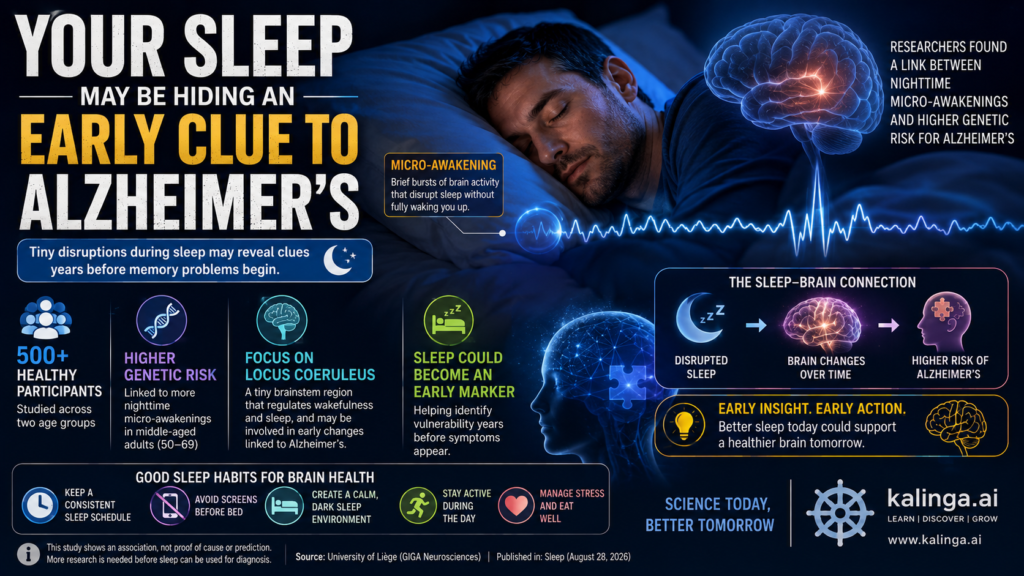
The landscape featured image visualizes the connection between sleep and Alzheimer’s risk, showing a sleeping person alongside a glowing brain, neural activity and EEG-style sleep waves. Supporting elements highlight nighttime micro-awakenings, genetic risk, the locus coeruleus and research into early Alzheimer’s clues, while emphasizing that the findings show an association rather than a diagnosis.
Alt Text:
Sleep and Alzheimer’s risk linked to nighttime micro-awakenings in healthy middle-aged adults.
A restless night may feel like nothing more than a bad night’s sleep, but researchers are discovering that tiny disruptions in sleep could contain clues about how the brain ages. A University of Liège study found that healthy middle-aged adults with higher genetic risk for Alzheimer’s also tended to have more frequent nighttime micro-awakenings. The finding does not prove that disrupted sleep causes Alzheimer’s or that sleep can currently predict who will develop the disease, but it adds to growing evidence that sleep and Alzheimer’s risk may be connected years before obvious memory problems appear.
Planned Structure
- Why researchers are looking for Alzheimer’s clues before symptoms
- What the University of Liège study discovered
- How nighttime micro-awakenings work
- Why the locus coeruleus matters
- What genetics can,and cannot,tell us
- Could sleep become an early Alzheimer’s marker?
- What the findings mean for prevention and future research
- Key takeaways and FAQ
Focus Keywords
Primary Keyword: sleep and Alzheimer’s risk
Secondary Keywords:
- Alzheimer’s disease early signs
- nighttime micro-awakenings
- sleep and brain health
- Alzheimer’s genetic risk
LSI/Long-Tail Keywords:
- can sleep problems predict Alzheimer’s disease
- how sleep affects Alzheimer’s risk
- nighttime awakenings and Alzheimer’s risk
- early Alzheimer’s clues before memory loss
Why Scientists Are Looking for Alzheimer’s Clues Before Symptoms
Imagine being able to identify subtle changes associated with Alzheimer’s disease before someone notices that their memory is getting worse.
That possibility is one reason researchers are increasingly studying the relationship between sleep, brain activity and neurodegenerative disease. Alzheimer’s does not suddenly appear on the day someone first struggles to remember a name or appointment. Biological changes can begin much earlier, which means scientists are interested in finding measurable signals that may appear before clinical symptoms.
The University of Liège research adds sleep to that conversation. The study examined more than 500 healthy people and found that, among participants in middle age, more frequent nighttime micro-awakenings were associated with higher genetic risk for Alzheimer’s disease.
That distinction matters. The researchers did not show that micro-awakenings cause Alzheimer’s, nor did they demonstrate that a person with frequent awakenings will develop the disease.
What are nighttime micro-awakenings?
Nighttime micro-awakenings are very brief bursts of brain activity that interrupt normal sleep without necessarily causing a person to become fully conscious.
In other words, you can experience a disruption in your sleep without remembering waking up. These events may happen so briefly that the person has no idea they occurred during the night.
Researchers can detect such changes using sleep measurements that monitor brain activity and other aspects of sleep. Because micro-awakenings can occur without a person becoming fully awake, they are different from the obvious nighttime awakenings many people notice.
The University of Liège researchers were interested in whether the frequency of these subtle interruptions differed according to participants’ genetic risk for Alzheimer’s.
Question → Direct Answer: Does frequent nighttime waking mean someone has Alzheimer’s?
No. The study found an association between frequent micro-awakenings and higher genetic risk among healthy middle-aged participants, but it did not establish that these sleep patterns indicate that an individual has or will develop Alzheimer’s disease.
That is an important distinction because observational research can reveal patterns without proving cause and effect.
What the University of Liège Study Found
The research team at the University of Liège’s GIGA Neurosciences laboratory studied more than 500 healthy participants across different age groups.
Most participants were younger adults between 18 and 31 years old, while another group consisted of adults between 50 and 69 years old. This age comparison gave researchers an opportunity to examine whether the relationship between sleep and genetic risk changed as people got older.
The researchers calculated each participant’s polygenic risk for Alzheimer’s disease.
Definition + Expansion: What is polygenic risk?
Polygenic risk is a measure that combines the influence of many genetic variants to estimate a person’s statistical susceptibility to a particular disease.
It does not function like a simple genetic test that says someone will or will not develop Alzheimer’s. Alzheimer’s disease is influenced by multiple factors, including genetics and other biological and environmental influences, so a polygenic risk score represents probability rather than certainty.
The researchers then compared these genetic-risk estimates with characteristics of participants’ sleep.
The most notable result appeared in the middle-aged group. People with more frequent nighttime micro-awakenings tended to have a higher genetic risk for Alzheimer’s disease.
Interestingly, the same relationship was not detected among the younger participants.
That age-related difference is one reason the researchers believe the relationship deserves further investigation. It may indicate that the connection between sleep patterns and Alzheimer’s-related biological vulnerability changes over the course of adulthood.
Question → Direct Answer: What was the main discovery?
The main discovery was that healthy middle-aged adults with higher genetic risk for Alzheimer’s tended to experience more frequent sleep micro-awakenings.
The finding provides a possible connection between sleep architecture,the structure and pattern of sleep,and early vulnerability to neurodegenerative disease.
However, the study does not establish that sleep disruption is an early diagnostic test for Alzheimer’s.
Why Tiny Sleep Disruptions Could Matter
Sleep is not simply a period when the brain switches off.
During sleep, the brain moves through different stages and performs important biological functions. Memory processing, changes in brain activity and interactions between different brain systems all occur while we sleep.
That is why researchers have become increasingly interested in sleep as a window into brain health.
A person can appear completely healthy during the day while experiencing subtle changes in their sleep architecture at night. Those changes may be difficult to notice without specialized monitoring.
This is where micro-awakenings become interesting.
If these short interruptions occur frequently, they could potentially alter the overall organization or quality of sleep. Researchers are investigating whether such changes might be related to biological processes involved in neurodegenerative diseases.
The University of Liège findings do not answer that question yet, but they provide another piece of evidence worth studying.
Question → Direct Answer: Why study sleep instead of waiting for memory problems?
Because sleep can potentially reveal measurable changes before a person develops obvious cognitive symptoms.
If future research confirms a reliable relationship between sleep patterns and early Alzheimer’s-related biology, sleep measurements could potentially complement other methods of identifying people who may be more vulnerable.
That possibility is still experimental. The current study should be viewed as an early research finding rather than a clinical screening recommendation.
The Locus Coeruleus: A Tiny Brain Region With a Big Role
One of the most intriguing parts of the research involves a tiny structure deep inside the brainstem called the locus coeruleus.
The region is roughly the size of a grain of rice, yet it plays important roles in regulating wakefulness, attention and sleep.
Because of its location and small size, studying the locus coeruleus in living people is technically challenging. The University of Liège researchers have therefore been using advanced imaging technology to investigate it.
The team previously used a 7-Tesla MRI scanner to study the region in greater detail.
MRI, or magnetic resonance imaging, uses magnetic fields and radio waves to produce detailed images of structures inside the body. A 7-Tesla scanner provides a particularly strong magnetic field and can allow researchers to examine certain brain structures with greater detail than conventional MRI systems.
According to the University of Liège, a preliminary study conducted in 2025 found relationships between sleep characteristics and the condition of the locus coeruleus beginning at a young age.
The researchers also found an association between healthy functioning of this brain region and the quality of REM sleep, a stage of sleep associated with memory and other brain processes.
Why does the locus coeruleus interest Alzheimer’s researchers?
The locus coeruleus has attracted attention because it is among the brain regions where abnormal protein deposits associated with Alzheimer’s disease can appear relatively early.
The research source notes that these deposits may begin accumulating as early as adolescence, although scientists do not yet fully understand what those early changes mean or how they relate to later disease.
That uncertainty is crucial.
Finding biological changes early does not automatically mean those changes will lead to dementia. Researchers still need to understand which changes are harmful, which may be normal, and which combinations of factors actually contribute to disease progression.
Question → Direct Answer: Is the locus coeruleus already a proven Alzheimer’s warning signal?
No. The locus coeruleus is a promising research target because of its involvement in sleep, wakefulness and early Alzheimer’s-related changes, but it is not currently a standalone clinical warning signal that can predict Alzheimer’s disease in an individual.
Genetics Can Raise Risk Without Determining the Future
The phrase “genetic risk” can sound more definitive than it actually is.
Having a higher genetic risk does not mean a person is destined to develop Alzheimer’s. Likewise, having a lower genetic risk does not guarantee that the disease will never occur.
The University of Liège study used polygenic risk to investigate whether subtle differences in sleep were associated with differences in underlying genetic susceptibility.
That makes the research useful for studying population-level patterns, but it does not turn the sleep findings into an individual prediction tool.
Question → Direct Answer: Can a genetic risk score tell someone they will develop Alzheimer’s?
No. A polygenic risk measure estimates statistical susceptibility based on genetic information; it cannot determine with certainty whether a particular person will develop Alzheimer’s disease.
This is particularly important when interpreting headlines about early Alzheimer’s clues. A research association can be scientifically meaningful without being suitable for personal diagnosis.
Sleep and Alzheimer’s Risk: What the Study Actually Shows
It is tempting to turn the research into a simple story:
Poor sleep causes Alzheimer’s.
But that is not what this study demonstrated.
A more accurate interpretation is:
Among healthy middle-aged adults in this study, more frequent nighttime micro-awakenings were associated with higher genetic risk for Alzheimer’s disease.
That difference between association and causation is fundamental.
An association means two characteristics appear together more often than expected in the data. Causation means one factor directly contributes to producing another outcome. Observational studies can identify associations, but they generally cannot establish causation on their own.
Several explanations remain possible.
For example, sleep changes could potentially be connected to early biological processes associated with Alzheimer’s. Alternatively, another factor could influence both sleep patterns and disease-related biology. It is also possible that the relationship is more complicated and involves several interacting mechanisms.
Future studies will need to investigate these possibilities.
Could Sleep Become an Early Alzheimer’s Marker?
The idea is scientifically appealing because sleep measurement could potentially be less invasive and more accessible than some other forms of neurological testing.
Imagine a future in which researchers combine sleep data with genetic information, brain imaging, cognitive assessments and other biological measurements. Instead of relying on one signal, clinicians might eventually evaluate several indicators together.
That is only a possibility at this stage.
The University of Liège researchers suggest that sleep could eventually become an accessible marker for identifying people who may be vulnerable to Alzheimer’s before symptoms appear. But the current evidence is not enough to recommend using nighttime micro-awakenings as a diagnostic test.
What would researchers need to prove first?
Before sleep patterns could become a reliable early marker, researchers would need to establish several things:
- Whether the association appears consistently in larger and more diverse populations.
- Whether the relationship remains after accounting for other important health and lifestyle factors.
- Whether specific sleep patterns are associated with later cognitive decline.
- Whether sleep changes occur before other measurable Alzheimer’s-related biological changes.
- Whether improving sleep changes any relevant disease-related outcomes.
- Whether sleep measurements can accurately distinguish meaningful risk from ordinary variation in sleep.
These questions are much harder than simply identifying a statistical relationship.
Question → Direct Answer: Could a sleep tracker diagnose Alzheimer’s today?
No. Consumer sleep trackers may provide useful information about sleep habits, but the University of Liège findings do not establish that wearable devices or ordinary sleep tracking can diagnose or predict Alzheimer’s disease.
That distinction will remain important as research findings increasingly move into consumer health technology.
Does Improving Sleep Prevent Alzheimer’s?
This is perhaps the biggest question raised by the research,and one the study cannot answer.
If disrupted sleep is associated with Alzheimer’s-related vulnerability, it is reasonable to ask whether improving sleep could reduce future risk.
But an association does not demonstrate that changing the associated factor will change the disease outcome.
The University of Liège researchers are interested in the possibility that sleep could eventually become not only an indicator of health but also a potential lever for intervention. That means future research could examine whether improving sleep quality changes biological or cognitive outcomes.
For now, however, there is no basis from this study alone for claiming that treating sleep problems prevents Alzheimer’s.
The research instead strengthens the case for studying sleep as part of the broader relationship between brain health and aging.
Sleep, Brain Health and the Bigger Picture
The findings fit into a larger scientific effort to understand what happens in the brain long before Alzheimer’s becomes clinically visible.
Alzheimer’s is a complex disease, and no single factor explains every case. Genetics, aging and multiple biological processes interact in ways researchers are still working to understand.
Sleep may be one piece of that puzzle.
The significance of the University of Liège study is therefore not that scientists have discovered a simple sleep test for Alzheimer’s. Its importance lies in showing that a subtle feature of sleep,one most people would never notice,was associated with genetic vulnerability in a healthy middle-aged population.
That makes sleep an interesting research window.
For students and young professionals, the broader lesson is also worth remembering: sleep is increasingly being studied as an active component of brain health rather than merely a period of inactivity.
But scientific curiosity should not become unnecessary alarm.
Having an occasional restless night, waking briefly during sleep or experiencing changes in sleep does not mean someone has Alzheimer’s disease.
Sleep and Alzheimer’s Risk: What We Know vs. What We Don’t
| Question | What the study suggests | What remains unknown |
| Are micro-awakenings linked to Alzheimer’s genetic risk? | Yes, an association was observed in the middle-aged group | Whether the relationship appears consistently in other populations |
| Do micro-awakenings cause Alzheimer’s? | No evidence of causation was established | Whether sleep disruption contributes directly to disease biology |
| Can sleep predict Alzheimer’s? | Sleep may have potential as a future research marker | Whether it can reliably predict disease in individuals |
| Does genetic risk guarantee Alzheimer’s? | No | How different genetic and non-genetic factors interact |
| Can better sleep prevent Alzheimer’s? | The study does not establish this | Whether sleep interventions affect long-term disease outcomes |
| Can consumer sleep trackers diagnose Alzheimer’s? | No | Whether future validated technologies could contribute to screening |
What This Research Means for the Future
The most interesting possibility is not that sleep will replace existing Alzheimer’s research tools.
Instead, sleep could become one component of a broader early-detection strategy.
Researchers could potentially combine information from several sources:
- Sleep measurements to identify unusual changes in sleep architecture.
- Genetic information to estimate statistical susceptibility.
- Brain imaging to examine vulnerable regions such as the locus coeruleus.
- Cognitive testing to track changes in memory and thinking.
- Biological markers to investigate disease-related processes.
- Long-term follow-up to determine which early signals actually predict later outcomes.
This approach would be much more informative than relying on one night’s sleep or one genetic measurement.
It could also help researchers answer a deeper question: when does Alzheimer’s disease actually begin?
If biological changes appear decades before symptoms, the boundary between “healthy” and “disease” becomes more complicated. Scientists need to determine which early changes are meaningful and which are simply part of normal aging.
Why the Findings Should Be Interpreted Carefully
The study is important, but it has limitations.
First, the research identifies a statistical relationship rather than proving cause and effect. The participants were healthy and did not have Alzheimer’s symptoms, meaning the study provides a snapshot of associations rather than evidence of future disease progression.
Second, the genetic-risk measure is not an individual prediction. It summarizes genetic influences but cannot determine a person’s future with certainty.
Third, the difference between younger and middle-aged participants raises additional questions. The association appeared in the older group but not the younger group, suggesting that age may influence how sleep and Alzheimer’s-related vulnerability interact.
These limitations do not make the research unimportant. They show why additional studies are necessary.
Scientific progress often happens this way: researchers identify a pattern, test it in another population, investigate possible mechanisms and eventually determine whether the finding has practical value.
The University of Liège study is one step in that process.
The Bigger Lesson About Sleep and Brain Health
For years, sleep has often been treated as something people sacrifice when work, study or entertainment becomes more important.
Research into sleep and brain health suggests that view may be too simplistic.
Sleep is a complex biological state involving memory, brain activity, wakefulness and communication between different neural systems. Understanding how sleep changes with age could therefore provide researchers with valuable information about neurological health.
The new research does not mean every sleep disturbance is dangerous. It does not mean that frequent awakenings are a diagnosis. And it certainly does not mean that a person should interpret their own sleep data as evidence of Alzheimer’s disease.
What it does suggest is more subtle,and potentially more interesting.
Tiny changes in sleep may contain biological information that researchers previously could not easily see.
That possibility could lead to new research into how neurodegenerative diseases develop long before memory loss becomes obvious.
FAQ: Sleep and Alzheimer’s Risk
Does poor sleep mean I will develop Alzheimer’s disease?
No. Poor sleep or frequent nighttime awakenings do not mean that a person will develop Alzheimer’s disease. The University of Liège study found an association between nighttime micro-awakenings and higher genetic risk among healthy middle-aged adults, but it did not prove that sleep disruption causes Alzheimer’s or predict the disease in individuals.
What are micro-awakenings during sleep?
Micro-awakenings are very brief bursts of brain activity that interrupt normal sleep without necessarily causing a person to become fully awake or remember the event. Researchers can detect these subtle disruptions using specialized sleep measurements.
What did the University of Liège study discover?
The study found that healthy middle-aged adults with more frequent nighttime micro-awakenings tended to have higher polygenic risk for Alzheimer’s disease. This relationship was not detected among the younger adults included in the research.
Can genetic risk determine whether someone will get Alzheimer’s?
No. Genetic risk reflects statistical susceptibility rather than certainty. Alzheimer’s disease is influenced by multiple factors, and a polygenic risk measure cannot determine whether a specific person will eventually develop the disease.
Why is the locus coeruleus important in this research?
The locus coeruleus is a small brain region involved in wakefulness, attention and sleep. Researchers are interested in it because it is among the brain regions where Alzheimer’s-related abnormal protein deposits can appear relatively early, although the significance of these early changes is not fully understood.
Could sleep eventually be used to detect Alzheimer’s earlier?
Possibly, but more research is needed. The University of Liège findings suggest that sleep measurements could potentially contribute to early identification of vulnerability, but they are not currently a diagnostic test or a reliable way to predict Alzheimer’s disease in an individual.
Final Takeaway
The most important message from this research is not that every restless night is a warning sign. It is that sleep may provide researchers with a new window into brain changes that occur long before Alzheimer’s symptoms become visible. The connection between sleep and Alzheimer’s risk remains an active area of research, and larger, longer-term studies will be needed to determine whether these subtle sleep patterns can eventually become useful markers,or even targets for prevention.
For now, the finding is best understood as an intriguing scientific clue, not a diagnosis.
SEO Meta Configuration
Keyword Categorization
Primary Keyword:
- sleep and Alzheimer’s risk
Secondary Keywords:
- Alzheimer’s disease early signs
- nighttime micro-awakenings
- sleep and brain health
- Alzheimer’s genetic risk
LSI/Long-Tail Keywords:
- can sleep problems predict Alzheimer’s disease
- how sleep affects Alzheimer’s risk
- nighttime awakenings and Alzheimer’s risk
- early Alzheimer’s clues before memory loss
Meta Title
Sleep and Alzheimer’s Risk: Ultimate Guide 2026
SEO Meta Description:
Sleep and Alzheimer’s risk may be linked through tiny nighttime awakenings. Discover what new research found and what it means. Read more.
URL Slug:
sleep-alzheimers-risk