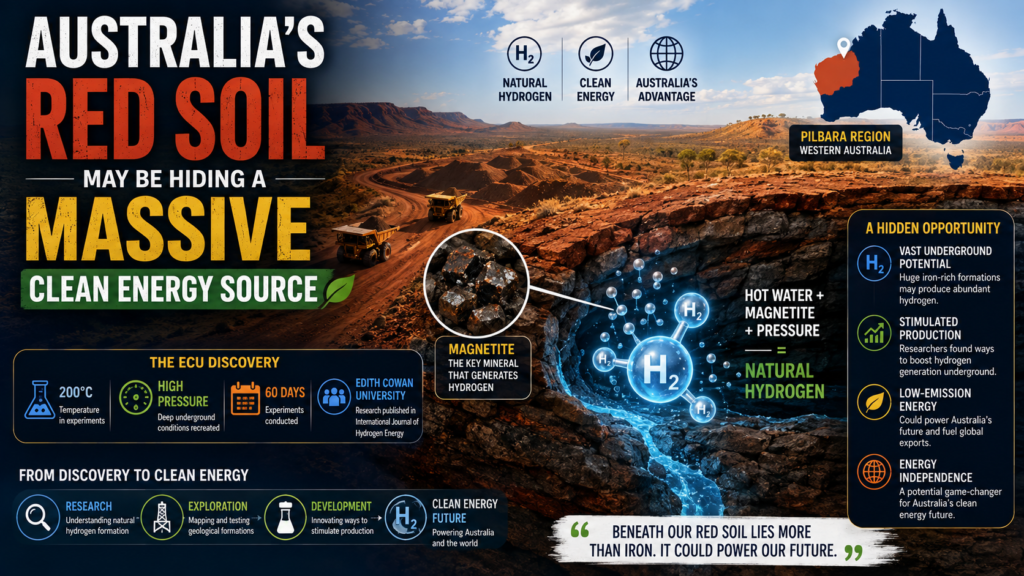
File Name:
natural-hydrogen-australia-pilbara-clean-energy.jpg
Title:
Natural Hydrogen Australia Clean Energy Potential
Caption:
Could Western Australia’s iron-rich Pilbara hide a new source of low-emission hydrogen? Explore the science behind the discovery.
Description:
The landscape graphic visualizes natural hydrogen Australia through a dramatic Pilbara red-soil landscape, iron-rich underground formations, magnetite and glowing hydrogen molecules. It highlights the ECU research showing how hot water, pressure and magnetite can generate hydrogen, while emphasizing Western Australia’s potential as a future clean-energy hub.
Alt Text:
Natural hydrogen Australia concept showing Pilbara iron-rich rocks generating hydrogen beneath red
Planned Structure
- Why Australia’s natural hydrogen discovery matters
- How magnetite can generate hydrogen underground
- The science behind hydrothermal hydrogen
- Why heat, pressure and water matter
- Why the Pilbara could be especially important
- Western Australia’s banded iron formations
- Geology may matter as much as mineral quantity
- Can Australia actually scale natural hydrogen production?
- From laboratory experiments to underground systems
- What needs to be solved
- Natural hydrogen vs green hydrogen vs fossil-fuel hydrogen
- What the discovery could mean for Australia’s energy future
- What happens next for natural hydrogen Australia
- FAQ
- Key takeaways and next steps
Focus Keywords
- Primary Keyword: natural hydrogen Australia
- Secondary Keywords: natural hydrogen, Western Australia hydrogen, magnetite hydrogen production, Pilbara clean energy
- LSI/Long-Tail Keywords: how natural hydrogen is formed, can Australia produce natural hydrogen, hydrogen from iron ore, natural hydrogen from magnetite
Can Natural Hydrogen Australia Unlock a Hidden Clean Energy Source?
What if some of Australia’s biggest iron-ore formations are also hiding a source of hydrogen beneath the ground?
Researchers at Edith Cowan University (ECU) say Western Australia’s iron-rich rocks can naturally generate hydrogen, and their experiments suggest the process can potentially be stimulated to produce more. The discovery does not mean Australia has already found a commercially viable underground hydrogen supply, but it opens an intriguing possibility: the geology beneath the Pilbara could eventually become part of Australia’s low-emission energy system.
The research is particularly interesting because it connects two resources that Western Australia already knows extremely well: iron-rich rocks and energy production. Instead of manufacturing all hydrogen above ground, scientists are investigating whether geological processes can generate hydrogen naturally underground.
That idea is at the heart of the growing interest in natural hydrogen Australia could potentially develop.
The key mineral in the ECU research is magnetite, an iron oxide found extensively in Western Australia’s enormous iron-ore deposits. Under hot, high-pressure conditions, magnetite can react with water and release hydrogen gas.
The researchers also found that the process depends on more than simply having lots of magnetite. The physical structure of the rock — including fractures, pores and pathways through which water can move — can influence how effectively hydrogen is produced.
That detail could ultimately be one of the most important parts of the discovery.
Why Natural Hydrogen Australia Could Be a Big Deal
Hydrogen is often described as a potential clean-energy fuel because it can be used in applications where directly electrifying equipment is difficult. It can potentially support heavy industry, transport, electricity generation and chemical manufacturing.
But hydrogen is not automatically clean.
The environmental impact depends largely on how the hydrogen is produced. Today, hydrogen can be manufactured using fossil fuels, while newer approaches use renewable electricity to split water into hydrogen and oxygen.
Natural hydrogen is different.
Natural hydrogen is hydrogen gas that forms through geological processes inside the Earth rather than being manufactured in an industrial facility.
The idea is relatively simple to describe but complicated to prove at useful scale. Deep underground, minerals can interact with water under high temperatures and pressures. In some geological settings, those reactions can produce hydrogen naturally.
For natural hydrogen Australia researchers, the question is no longer simply whether hydrogen can form underground. The bigger question is whether geological formations can produce enough hydrogen, consistently enough, and economically enough to support real-world energy demand.
Question: Why is natural hydrogen attracting attention?
Because it could potentially provide hydrogen without requiring the same above-ground production process used by conventional hydrogen technologies.
If geological hydrogen accumulations can be found and produced safely and economically, they could become another source of low-emission energy. However, the ECU research is still an early scientific step, not evidence that a commercial natural-hydrogen industry already exists.
That distinction matters.
The discovery is promising because it provides evidence about a mechanism through which hydrogen can form. It does not yet establish the size of any recoverable resource beneath the Pilbara or demonstrate that large-scale extraction will be commercially practical.
How Magnetite Can Generate Hydrogen Underground
The ECU study focuses on one of the most abundant minerals associated with Western Australia’s iron-rich geological formations: magnetite.
Magnetite is an iron oxide mineral. It is also chemically reactive under particular underground conditions, especially when exposed to hot water.
The researchers wanted to understand what happens when magnetite encounters conditions resembling those found deep beneath the Earth’s surface.
Their laboratory experiments placed magnetite samples in water at 200°C under high pressure for 60 days.
The goal was to recreate a simplified version of the environment where hydrothermal reactions can occur underground.
Definition: Hydrothermal reaction
A hydrothermal reaction is a chemical reaction involving hot water and minerals under conditions commonly associated with Earth’s subsurface.
In this case, hot water interacts with magnetite and can facilitate reactions that generate hydrogen. The experiment allowed researchers to examine how the mineral behaves over an extended period rather than observing only a short-lived chemical reaction.
This is important because an energy resource needs more than a reaction that happens once. Scientists need to understand whether production can continue, how quickly it occurs and what geological conditions make the process more effective.
The ECU research helps address some of those questions.
Question: What happens when magnetite meets hot water?
Under the experimental conditions, the interaction produced hydrogen, showing that magnetite can participate in hydrogen-generating reactions under conditions designed to mimic deep underground environments.
The researchers then investigated whether the process could be enhanced.
Their work suggests that injecting a solution into banded iron formations could increase hydrogen generation. That raises the possibility of deliberately stimulating geological hydrogen production rather than relying only on naturally occurring hydrogen accumulations.
But turning that laboratory observation into an energy system would require substantially more research.
The Pilbara Has One Major Geological Advantage
Western Australia’s Pilbara region is already globally important because of its enormous iron-ore resources.
The same geological formations that support mining could also provide an unusual setting for investigating natural hydrogen.
The region contains some of the world’s largest banded iron formations, which are rocks containing layers rich in iron minerals. Because magnetite is present within these formations, the geological environment provides researchers with a potentially large natural laboratory.
For natural hydrogen Australia researchers, this creates an unusual opportunity.
The country is not starting with a completely unknown geological environment. Western Australia has decades of experience studying, mapping and extracting minerals from the Pilbara.
However, extracting iron ore and extracting underground hydrogen are fundamentally different challenges.
Iron ore can be mined because the valuable material is physically present in concentrations that can be excavated and processed. Hydrogen, by contrast, is a gas whose movement and accumulation depend heavily on geological conditions.
That means knowing where magnetite exists is only part of the puzzle.
Question: Does having more magnetite automatically mean more hydrogen?
No. The ECU research indicates that rock geometry and fluid access are also critical.
Water needs pathways through the geological formation to reach fresh mineral surfaces. Fractures and pores can influence how easily water moves through the rock, which can affect hydrogen generation.
This is a crucial insight because it changes how researchers might evaluate potential hydrogen resources.
Instead of simply asking, “How much magnetite is underground?”, scientists may also need to ask:
- How fractured is the rock?
- How easily can water move through it?
- How much fresh mineral surface is accessible?
- What temperatures and pressures exist underground?
- Can hydrogen accumulate or escape?
- Can production continue over useful periods?
- Can the hydrogen be recovered economically?
Those questions could become central to future exploration.
Rock Structure May Matter More Than Rock Quantity
Imagine two underground formations containing similar amounts of magnetite.
One formation is relatively sealed, with little space for water to move. The other contains interconnected fractures and permeable pathways that allow water to circulate through the rock.
They may not produce hydrogen at the same rate.
That is why the ECU findings about geological structure are particularly significant.
The researchers found that hydrogen production depends not only on the amount of magnetite available but also on whether water can reach fresh mineral surfaces through fractures, pores and permeable pathways.
In other words, the underground architecture matters.
Definition: Permeability
Permeability describes how easily fluids can move through a material or geological formation.
For natural hydrogen production, permeability can influence how effectively water reaches reactive minerals and how gases move through the subsurface.
This creates both an opportunity and a challenge. A geological formation with the right mineral composition but poor fluid movement may be less attractive than one with a more favorable combination of minerals, fractures and permeability.
For natural hydrogen Australia, this means future exploration could require sophisticated geological modelling rather than simply following the largest iron deposits.
From a Laboratory Experiment to a Real Energy Resource
This is where the story becomes more complicated.
Laboratory experiments can demonstrate that a chemical process works under controlled conditions. Commercial energy projects must operate across enormous geological areas, deal with unpredictable subsurface conditions and produce energy at a competitive cost.
The ECU team itself describes the research as helping bridge the gap between laboratory experiments and real geological systems.
That gap is enormous.
A commercial project would need to answer questions about underground reservoirs, hydrogen accumulation, flow rates, well design, monitoring, environmental impacts and long-term production.
It would also need to demonstrate that the hydrogen can be extracted and delivered reliably.
Question: Is Australia ready to commercially produce natural hydrogen?
Not yet based on this study alone.
The research provides evidence that magnetite can generate hydrogen under relevant experimental conditions and that the reaction can potentially be stimulated. But more geological exploration and engineering research are needed before the idea can be considered a proven large-scale energy source.
That is not a weakness of the discovery. It is simply where the technology currently stands.
Many energy technologies go through a similar progression:
Scientific discovery → laboratory validation → geological testing → pilot project → commercial demonstration → large-scale deployment
The ECU research sits much closer to the first stages of that journey than the final ones.
How Natural Hydrogen Compares With Other Hydrogen Pathways
The term “clean hydrogen” can sometimes make hydrogen production sound simpler than it is.
Different hydrogen pathways have different energy inputs, emissions profiles and infrastructure requirements.
| Hydrogen pathway | Basic approach | Main energy input | Key challenge |
| Natural hydrogen | Hydrogen forms through geological processes | Geological heat and chemical reactions | Finding productive formations and extracting hydrogen |
| Green hydrogen | Electricity splits water into hydrogen and oxygen | Renewable electricity | Cost, electricity supply and electrolyser scale |
| Fossil-fuel hydrogen | Hydrogen produced from fossil fuels | Natural gas or coal | Carbon emissions and carbon-management requirements |
| Stimulated geological hydrogen | Underground reactions are deliberately enhanced | Geological conditions plus injected fluids | Controlling production and proving long-term output |
This comparison shows why natural hydrogen Australia is attracting scientific interest.
The concept could potentially use geological processes as part of the energy equation rather than relying entirely on large industrial plants.
But natural hydrogen has its own uncertainty: the resource must be discovered and characterized before anyone knows how much usable hydrogen is actually available.
Why This Could Matter to Australia’s Energy Strategy
Australia is already a major exporter of energy and minerals.
The country has extensive renewable-energy resources, large mining operations and established export infrastructure. Hydrogen has therefore emerged as another area of strategic interest.
The ECU researchers believe Western Australia’s geology could potentially support a domestic energy source and, if developed at scale, a hydrogen export industry.
That is an ambitious possibility.
Question: Could Western Australia become a natural hydrogen export hub?
Potentially, but it is far too early to say that it will.
The research suggests a geological opportunity rather than a guaranteed commercial resource. Before exports could become realistic, researchers and industry would need to establish that hydrogen can be generated and extracted at sufficient scale, with acceptable costs and environmental impacts.
Still, the strategic appeal is obvious.
If Western Australia could produce hydrogen from its own geological formations, the resource could potentially complement other hydrogen-production methods.
That could give Australia another pathway for producing hydrogen while also building on the country’s existing expertise in mining, geology, engineering and resource development.
Natural Hydrogen Could Change How We Think About Energy Resources
For more than a century, energy development has largely focused on extracting fuels such as coal, oil and natural gas.
The energy transition is changing that model.
Solar panels harvest sunlight. Wind turbines capture moving air. Batteries store electricity. Green hydrogen uses renewable electricity to create a chemical energy carrier.
Natural hydrogen introduces another possibility: using geological processes that are already happening inside the Earth.
That makes the resource conceptually different from manufacturing hydrogen.
Instead of asking how to build a larger hydrogen factory, researchers can also ask where nature is already producing hydrogen and whether those processes can be accessed responsibly.
This is one reason the Australian discovery is scientifically interesting even before commercial viability is established.
It could expand the search for hydrogen beyond industrial plants and into geological exploration.
What Needs to Happen Before Natural Hydrogen Australia Becomes Commercial
The next stage will require much more than laboratory chemistry.
Researchers need to understand how the process behaves in actual geological formations and whether hydrogen can be produced continuously enough to support an energy project.
Several areas will be particularly important.
1. Geological mapping
Scientists need to identify formations with the right combination of minerals, temperature, pressure and fluid pathways.
The presence of magnetite alone is not sufficient.
2. Subsurface testing
Laboratory experiments need to be complemented by testing in real geological environments.
Actual underground formations are far more complex than isolated mineral samples.
3. Hydrogen flow measurements
Researchers need reliable data on how much hydrogen can be generated and how quickly it can move through the rock.
4. Reservoir behaviour
If hydrogen accumulates underground, scientists need to understand how it is stored, transported and potentially extracted.
5. Economic analysis
Even a technically successful process needs to compete with alternative energy sources.
The cost of wells, infrastructure, processing, transportation and monitoring would all matter.
6. Environmental assessment
Any large-scale underground intervention would need careful assessment of its environmental consequences.
The ability to generate hydrogen is only one part of determining whether a project should proceed.
The Biggest Opportunity May Be Underground
One of the most interesting aspects of the ECU research is that it challenges a common assumption about where energy resources come from.
Western Australia’s red landscapes are usually associated with iron ore, mining and mineral wealth.
The research suggests that the same rocks may also participate in a completely different energy process.
That does not mean every iron-ore deposit is a hidden hydrogen reservoir. It also does not mean Australia has suddenly discovered an unlimited clean-energy supply.
But it does mean geology itself could become an important part of the hydrogen conversation.
For natural hydrogen Australia, that is potentially the most important shift.
The country’s future hydrogen industry may not rely on one technology alone. Green hydrogen, conventional hydrogen production, renewable electricity, storage and potentially geological hydrogen could all occupy different roles.
What the Discovery Means for Students and Young Professionals
For students studying engineering, geology, chemistry, environmental science or energy technology, this research is a reminder that the energy transition is not limited to solar panels and batteries.
Some of the most interesting opportunities sit at the intersection of multiple disciplines.
A natural-hydrogen project could require expertise in:
- Geology to understand underground formations.
- Chemistry to study mineral-water reactions.
- Chemical engineering to understand hydrogen production.
- Petroleum engineering to design wells and manage subsurface fluids.
- Data science and AI to model geological systems and identify promising locations.
- Environmental science to assess impacts.
- Energy economics to determine commercial viability.
- Infrastructure engineering to connect hydrogen production with users and export networks.
That interdisciplinary nature could make natural hydrogen an important research area as Australia investigates new energy technologies.
Why the Word “Potential” Matters
The most important thing to understand about this discovery is the difference between potential and proof.
The ECU study provides experimental evidence that magnetite can generate hydrogen when exposed to hot water under high-pressure conditions. Researchers also found that stimulating the process may increase hydrogen generation.
Those are meaningful scientific findings.
But the study does not establish that the Pilbara contains a commercially recoverable hydrogen reserve of a particular size.
It does not demonstrate that underground hydrogen can already be produced at industrial scale.
And it does not guarantee that such production would be cheaper or cleaner than every alternative.
Good science leaves room for those questions.
For natural hydrogen Australia, the next chapter will therefore be about testing whether a promising geological reaction can become a reliable energy technology.
Could Australia’s Iron-Ore Country Become Hydrogen Country?
Western Australia’s Pilbara has already helped make Australia one of the world’s major mineral exporters.
Now researchers are asking whether its geology could support another resource industry.
The idea is striking: iron-rich rocks reacting with hot underground water could naturally generate hydrogen, while the structure of those rocks may determine how effectively the process works.
The ECU research gives scientists a better understanding of that mechanism.
The bigger challenge is scale.
A laboratory experiment can reveal a chemical pathway. Turning that pathway into a dependable energy resource requires exploration, engineering, economics and environmental assessment.
If those pieces eventually align, natural hydrogen Australia could become an important part of the country’s energy story.
If they do not, the research will still have delivered something valuable: a clearer understanding of how hydrogen forms naturally inside Earth’s geological systems.
Either way, the red soil of Western Australia may have more to teach the energy industry than its iron-ore riches alone suggest.
FAQ: Natural Hydrogen Australia
What is natural hydrogen?
Natural hydrogen is hydrogen gas that forms naturally through geological and chemical processes inside the Earth. Unlike green hydrogen, which is manufactured by using electricity to split water, natural hydrogen can form underground when minerals and water interact under suitable conditions.
How can magnetite produce hydrogen?
Magnetite can participate in hydrogen-generating reactions when it reacts with hot water under high-pressure conditions. Researchers at Edith Cowan University studied this process by placing magnetite samples in water at 200°C under high pressure for 60 days.
Where could natural hydrogen be found in Australia?
Western Australia is an important area of interest because it contains some of the world’s largest banded iron formations and extensive iron-rich geological formations. The ECU research specifically highlights the potential significance of the Pilbara region.
Does Australia already have a commercial natural hydrogen industry?
No. The ECU research demonstrates a promising hydrogen-generating geological process, but additional research is required to determine whether the process can be scaled into a commercially viable energy resource.
Why do fractures and pores matter for natural hydrogen production?
Fractures, pores and permeable pathways can allow water to reach fresh mineral surfaces within rocks. The ECU researchers found that hydrogen production depends not only on the amount of magnetite present but also on how easily water can access reactive mineral surfaces.
Is natural hydrogen the same as green hydrogen?
No. Natural hydrogen forms through geological processes, while green hydrogen is produced using renewable electricity to split water into hydrogen and oxygen. They are different production pathways that could potentially play different roles in a future low-emission energy system.
Key Takeaway
Western Australia’s iron-rich geology may provide a new pathway for hydrogen production, but the discovery is still at an early research stage. The ECU study shows that magnetite can generate hydrogen under hot, high-pressure conditions and that geological structure can influence production. The next challenge is determining whether these findings can be translated from laboratory experiments into a safe, reliable and economically viable energy resource.
If you want to follow the technologies reshaping India’s and the world’s energy future, explore more science, AI and emerging-tech explainers on Kalinga.ai.
SEO Meta Configuration
Keyword Categorization
Primary Keyword:
- natural hydrogen Australia
Secondary Keywords:
- natural hydrogen
- Western Australia hydrogen
- magnetite hydrogen production
- Pilbara clean energy
LSI/Long-Tail Keywords:
- how natural hydrogen is formed in Australia
- can Australia produce natural hydrogen
- hydrogen production from magnetite
- Pilbara natural hydrogen potential
Meta Title
Natural Hydrogen Australia: Ultimate Energy Guide 2026
SEO Meta Description:
Natural hydrogen Australia could unlock a new clean energy source from Pilbara rocks. Discover the science, potential and challenges. Read more.
URL Slug:
natural-hydrogen-australia
I have tried a lot of different platforms over the years and this one keeps me coming back. The VIP program actually rewards loyal players and the daily drops are a nice surprise. It is rare to find this level of consistency online.