File Name:
long-term-melatonin-use-heart-failure.jpg
Title:
Long-Term Melatonin Use Heart Failure Risk
Caption:
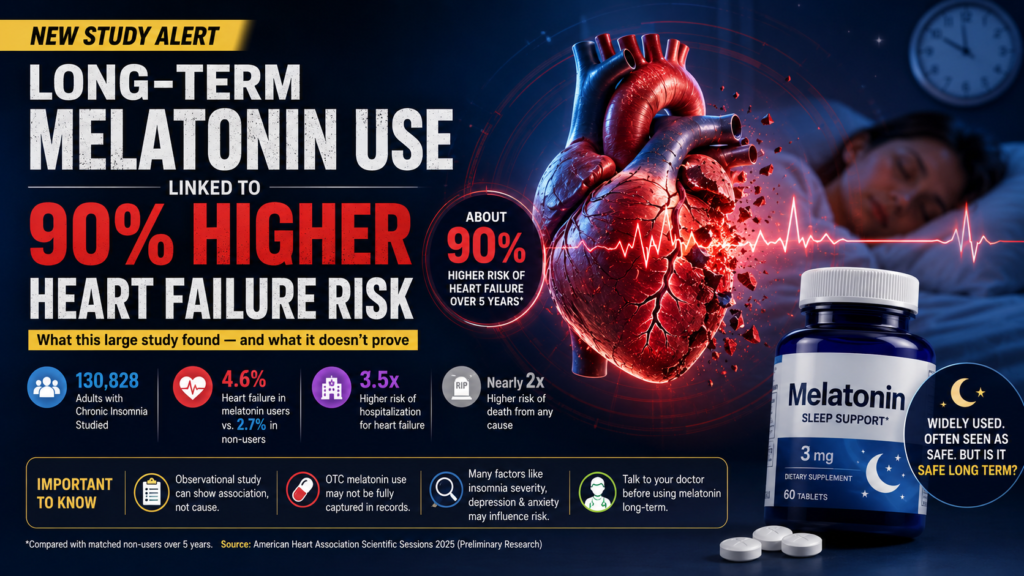
A preliminary study links long-term melatonin use with higher heart failure risk, but researchers stress that it does not prove causation.
Description:
The landscape featured image shows a sleeping person, a melatonin supplement bottle, and a glowing anatomical heart with an EKG line to visualize the study’s central finding. Statistical callouts highlight the 90% higher heart failure risk, 130,828 adults studied, and key limitations, emphasizing that the research is preliminary and observational.
Alt Text:
Long-term melatonin use linked to higher heart failure risk in adults with chronic insomnia, preliminary study finds.
Taking melatonin every night may feel like a harmless way to fix a stubborn sleep schedule,but a large preliminary study has raised an important question about what happens when that habit continues for years.
Long-term melatonin use was associated with about a 90% higher risk of developing heart failure over five years among adults with chronic insomnia, compared with matched people who had insomnia but no documented melatonin use. However, the study does not prove that melatonin causes heart failure. The findings come from an observational analysis presented at the American Heart Association’s Scientific Sessions 2025, and the AHA says the research is preliminary and not yet peer-reviewed as a full manuscript. (American Heart Association)
That distinction matters.
The study involved 130,828 adults with insomnia, making it large enough to attract serious attention. But it also had important limitations, including the possibility that some over-the-counter melatonin users were incorrectly classified as nonusers and that researchers did not have complete information about insomnia severity, psychiatric conditions, or other factors that could influence heart health. (American Heart Association)
So, should people panic about melatonin? No. But should the findings make people reconsider taking a sleep supplement indefinitely without medical guidance? They are a reason to have that conversation with a healthcare professional.
What Did the Melatonin and Heart Failure Study Actually Find?
The headline number is striking: people with chronic insomnia who had documented melatonin use for at least a year had about a 90% higher risk of developing heart failure during the following five years than matched nonusers.
In the primary analysis, heart failure occurred in 4.6% of the melatonin group versus 2.7% of the comparison group. Researchers also reported higher rates of heart-failure hospitalization and death from any cause among people in the melatonin group. (American Heart Association)
Those numbers sound alarming, but they need context.
The study did not randomly assign people to take melatonin or a placebo. Instead, researchers looked backward at electronic health records and compared people whose records showed long-term melatonin use with people whose records did not show melatonin use.
That means the study can identify an association, but it cannot establish that the supplement itself produced the outcome.
Long-term melatonin use , Definition + Expansion
Long-term melatonin use refers in this study to melatonin use documented for at least 12 months in a person’s electronic health records.
Researchers used this definition to examine whether extended exposure was associated with heart-related outcomes over a five-year follow-up period. A separate sensitivity analysis required participants to have filled at least two melatonin prescriptions at least 90 days apart, and the association with heart failure remained, at about 82% higher risk. (American Heart Association)
This is important because the study was specifically asking about extended use,not whether taking melatonin occasionally for jet lag or a few nights of disrupted sleep is associated with the same outcome.
Does a 90% higher risk mean 90% of melatonin users developed heart failure?
No. A 90% relative increase does not mean that 90 out of every 100 people taking melatonin developed heart failure.
In the study’s primary analysis, heart failure occurred in 4.6% of documented long-term melatonin users compared with 2.7% of matched nonusers over five years. The difference is important, but the headline percentage should not be interpreted as an individual prediction. (American Heart Association)
This is one of the most important points for readers to understand when interpreting health headlines.
Why Is Melatonin So Popular as a Sleep Aid?
Melatonin is not an unfamiliar pharmaceutical invented in a laboratory from scratch. It is a hormone naturally produced by the human body.
The pineal gland in the brain produces melatonin, with levels generally rising in darkness and falling during daylight. The hormone helps regulate the body’s circadian rhythm, the internal biological system that coordinates sleep and wakefulness.
Synthetic melatonin is chemically identical to the hormone produced naturally by the body. Supplements are widely used for sleep-related purposes and jet lag, although the regulatory status and approved uses vary between countries. (American Heart Association)
That natural origin is part of the reason melatonin has developed a reputation as a gentle or harmless option.
But “natural” does not automatically mean “risk-free.”
Many substances produced naturally by the body can have powerful effects when taken as supplements. The dose, timing, duration of use, individual health conditions, drug interactions, and product quality can all matter.
Why do people take melatonin for insomnia?
Melatonin is commonly used because it interacts with the body’s sleep-wake timing system and may be useful in certain sleep-related situations.
People may turn to it when they have difficulty falling asleep, experience jet lag, work irregular schedules, or struggle with disrupted sleep timing. But chronic insomnia is more complicated than simply having too little melatonin.
That distinction becomes particularly important when someone starts taking the supplement every night for months or years.
Is melatonin the same as a prescription sleeping pill?
Not necessarily.
Melatonin is regulated differently across countries. In the United States, for example, it is available over the counter as a dietary supplement, while in the United Kingdom it is prescription-only. The difference creates a major challenge for researchers studying long-term use because people can obtain the supplement without generating a prescription record in some countries. (American Heart Association)
That limitation directly affected this study.
How Strong Is the Evidence Linking Long-Term Melatonin Use to Heart Failure?
The evidence is interesting but not definitive.
The American Heart Association explicitly describes the study as preliminary. It was presented as a research abstract at Scientific Sessions 2025 rather than as a completed, peer-reviewed journal article. The AHA notes that conference abstracts are not peer-reviewed in the same way as full scientific manuscripts and that the findings should be considered preliminary until further research is published. (American Heart Association)
That does not make the study meaningless.
The researchers analyzed a very large dataset and used matching methods designed to make the comparison groups more similar. They matched participants across 40 factors, including demographic characteristics, health conditions, medications, blood pressure, and body mass index. (American Heart Association)
But sophisticated statistical matching cannot eliminate every possible source of bias.
What is an observational study?
An observational study examines patterns in existing data without randomly assigning participants to different treatments.
Researchers can discover important associations this way, especially when randomized trials would be expensive, difficult, or unethical. However, observational research cannot always determine whether the exposure caused the outcome because other differences between groups may explain some or all of the association.
That is especially relevant to long-term melatonin use.
People who take melatonin for years may differ from people who do not take it in ways that are difficult to capture completely in medical records.
Can insomnia itself affect heart health?
Yes, and that is one of the major questions raised by the study.
Chronic insomnia can coexist with other conditions, including depression, anxiety, and other health problems. Those conditions may influence both the likelihood of using melatonin and the likelihood of experiencing cardiovascular problems.
The researchers themselves acknowledged this concern. Lead author Ekenedilichukwu Nnadi said that worse insomnia, depression or anxiety, and other sleep-enhancing medications could potentially be associated with both melatonin use and heart risk. (American Heart Association)
This is sometimes called confounding: another factor influences both the exposure and the outcome, making the relationship between the two harder to interpret.
What Other Health Outcomes Were Associated With Melatonin Use?
Heart failure was not the only outcome researchers examined.
The study’s secondary analyses found that participants with documented melatonin use were nearly 3.5 times as likely to be hospitalized for heart failure, with hospitalization rates of 19.0% in the melatonin group compared with 6.6% in the comparison group. (American Heart Association)
Researchers also found a higher rate of death from any cause.
During the five-year period, 7.8% of participants in the melatonin group died compared with 4.3% of participants in the comparison group, according to the AHA’s report. (American Heart Association)
Again, these findings do not establish that melatonin caused either hospitalization or death.
The study was designed to identify associations in medical records, not to prove a biological mechanism.
Does this mean melatonin causes death or heart failure?
No. The study cannot establish a direct cause-and-effect relationship.
The researchers explicitly emphasized that further research is needed to determine whether melatonin itself affects cardiovascular health and, if so, why. The AHA also characterizes the findings as preliminary. (American Heart Association)
That is why responsible reporting should say that long-term melatonin use was associated with higher rates of these outcomes,not that melatonin was proven to cause them.
What Were the Biggest Limitations of the Study?
The study has several limitations that substantially affect how its findings should be interpreted.
The first is melatonin exposure measurement.
Because melatonin is sold over the counter in the United States, someone could take it regularly without having it documented in their electronic medical record. Such a person could therefore appear in the “non-melatonin” comparison group even though they were actually using the supplement. (American Heart Association)
That could make the two groups less different than the records suggest.
The researchers also did not have access to certain important details.
These included the severity of participants’ insomnia and whether they had psychiatric conditions such as depression or anxiety. Those factors could potentially affect both sleep-aid use and cardiovascular outcomes. (American Heart Association)
There was also a complication with the hospitalization data.
Researchers found more heart-failure-related hospitalizations than initial heart-failure diagnoses. The AHA explained that hospitals may enter several related diagnostic codes during a hospitalization, and those codes do not necessarily represent a newly diagnosed case of heart failure. (American Heart Association)
Why do these limitations matter?
They mean the study’s results should be treated as a safety signal that needs investigation, not as proof that melatonin causes heart disease.
A safety signal is essentially a finding that deserves closer examination because it is unexpected or potentially important.
The correct scientific response is not to dismiss it,and not to panic.
It is to conduct better research.
What Did the Study Include?
The size and design of the analysis help explain why the findings attracted attention.
Researchers used the TriNetX Global Research Network, a large database of de-identified electronic health records. The study included adults diagnosed with insomnia and examined medical records over five years. (American Heart Association)
Here are the key study details:
- 130,828 adults were included.
- The average age was 55.7 years.
- 61.4% were women.
- 65,414 participants were in the documented melatonin-use group.
- Long-term use was defined as at least one year in the electronic health record.
- Participants with an existing heart-failure diagnosis were excluded.
- People prescribed other types of sleeping medication, such as benzodiazepines, were also excluded.
- The comparison group was matched using 40 factors.
- Researchers followed electronic health records for five years after matching.
- A sensitivity analysis required at least two melatonin prescriptions filled at least 90 days apart. (American Heart Association)
The study’s large sample is a strength.
But sample size alone does not solve problems of data quality or causality.
Long-Term Melatonin Use vs. Occasional Use: What Can We Actually Say?
This is where readers should be especially careful.
The study focused on documented long-term use among people with chronic insomnia. It did not establish that every person who takes a melatonin tablet occasionally faces the same risk.
It also did not prove that short-term use causes heart problems.
The findings therefore should not be transformed into a blanket statement such as “melatonin is dangerous.”
A more accurate interpretation is:
Researchers found an association between documented long-term melatonin use and higher rates of heart failure and other serious outcomes in adults with chronic insomnia, but the study cannot prove that melatonin caused those outcomes.
That wording preserves what the evidence actually shows.
Does occasional melatonin use have the same evidence behind it?
This particular study does not answer that question.
The analysis was focused on people with chronic insomnia and documented use lasting at least a year. It therefore cannot be used to estimate the heart-failure risk of someone who takes melatonin occasionally or for a short period.
That distinction is important because health headlines often turn a narrow study population into a much broader claim.
Should People Stop Taking Melatonin After This Study?
There is no basis in this study alone for telling everyone to immediately stop taking melatonin.
The findings are preliminary, observational, and subject to important limitations. They do, however, strengthen the argument against treating any sleep supplement as automatically harmless simply because it is available without a prescription.
If someone is taking melatonin regularly for months or years, particularly for chronic insomnia, it is reasonable to discuss the situation with a healthcare professional rather than continuing indefinitely without reviewing the underlying sleep problem.
A healthcare professional can consider the person’s symptoms, medications, medical history, sleep pattern, and possible causes of insomnia.
What should someone do if they rely on melatonin every night?
Do not make a major medication or supplement decision based on a headline alone; instead, discuss long-term use with a qualified healthcare professional.
That conversation can help determine whether continued use makes sense, whether another approach to insomnia is appropriate, and whether there are underlying conditions contributing to poor sleep.
People with existing heart conditions or other significant health concerns should be especially cautious about making changes to supplements or medications without professional guidance.
What Does This Study Mean for People With Insomnia?
The bigger lesson may be about how we think about sleep.
Insomnia is not simply an inconvenience that needs to be covered up with a pill or supplement.
For some people, persistent insomnia can be connected to stress, anxiety, depression, irregular schedules, sleep disorders, medications, medical conditions, or behavioral patterns.
Treating the underlying problem may therefore be more useful than simply trying to force sleep every night.
The American Heart Association’s expert commentary accompanying the study also questioned chronic melatonin use for insomnia and noted that, in the United States, melatonin is not indicated as a general treatment for insomnia. (American Heart Association)
That does not mean melatonin has no legitimate uses.
It means the decision to take it continuously deserves more thought than the label “natural sleep aid” might suggest.
What are healthier questions to ask about chronic insomnia?
Instead of only asking, “Which supplement will help me sleep?”, consider:
- Why has the insomnia continued for so long?
- Is my sleep schedule consistent?
- Could another medication or health condition be interfering with sleep?
- Are anxiety or stress contributing to the problem?
- Am I getting enough daytime activity and light exposure?
- Could I have another sleep disorder?
- Is a structured behavioral treatment for insomnia appropriate?
- How long should I actually use a sleep aid?
These questions shift the focus from simply treating the symptom to understanding the cause.
What Should Researchers Study Next?
The current findings create several obvious research priorities.
First, researchers need better ways to measure actual melatonin exposure, particularly in countries where the supplement is available over the counter.
Second, future studies should investigate dosage, frequency, formulation, and duration.
Third, researchers need to separate the effects of melatonin from the effects of chronic insomnia and related conditions.
Fourth, prospective studies and randomized controlled trials could provide stronger evidence about causality.
A 2026 viewpoint in Open Heart also highlighted the vulnerability of observational analyses of melatonin to issues such as confounding by indication, reverse causality, and exposure misclassification. (openheart.bmj.com)
Those are not minor technical details.
They go directly to the central question: Is the supplement associated with heart failure because melatonin contributes to the outcome, or because the people who take it long term are different in other important ways?
What would stronger evidence look like?
Stronger evidence would come from well-designed prospective and randomized studies that accurately track melatonin exposure and account for insomnia severity, other health conditions, medications, and cardiovascular risk factors.
Until then, the current study should be viewed as an important signal rather than a final verdict.
How Should You Read Health Headlines About Melatonin?
Health headlines often compress complicated research into one dramatic sentence.
“Melatonin linked to 90% higher heart failure risk” is attention-grabbing.
But the complete story is more nuanced.
The study involved people with chronic insomnia.
The exposure was documented long-term melatonin use.
The research was observational.
The findings were presented as a preliminary conference abstract.
And the researchers themselves said the study cannot establish causation. (American Heart Association)
This does not make the finding irrelevant.
It makes the context essential.
A simple checklist for interpreting studies
When you see a health claim online, ask:
- What population was actually studied?
- Was the research observational or randomized?
- What was the comparison group?
- Is the reported number a relative risk or an absolute difference?
- Could another factor explain the association?
- Has the study been peer-reviewed?
- What limitations did the researchers identify?
- Does the evidence apply to someone in my situation?
This approach is useful far beyond melatonin.
It is one of the most important skills for navigating health information online.
The Bottom Line on Long-Term Melatonin Use
The new findings are worth paying attention to,but they are not a reason to conclude that melatonin has been proven to cause heart failure.
In adults with chronic insomnia, the study found that long-term melatonin use was associated with about a 90% higher risk of heart failure over five years, with heart failure occurring in 4.6% of documented long-term users versus 2.7% of matched nonusers. Researchers also found higher rates of heart-failure hospitalization and death from any cause. (American Heart Association)
At the same time, the study has important weaknesses.
Over-the-counter melatonin use may not have been captured accurately. Researchers lacked information about some potentially important factors, including insomnia severity and psychiatric conditions. Most importantly, the study was observational and therefore cannot prove that melatonin caused the outcomes. (American Heart Association)
The AHA also says the research was presented as a preliminary abstract and has not undergone the same peer-review process as a full journal publication. (American Heart Association)
So the most responsible takeaway is simple:
Melatonin should not automatically be assumed to be harmless when used chronically, but this study does not prove that long-term melatonin use causes heart failure.
If you have been using melatonin regularly for a long period, especially for chronic insomnia, the sensible next step is to talk with a healthcare professional about why you need it, whether continued use is appropriate, and what evidence-based options are available for managing the underlying sleep problem.
Frequently Asked Questions
Does long-term melatonin use cause heart failure?
It has not been proven to cause heart failure. A preliminary observational study found that adults with chronic insomnia and documented long-term melatonin use had a higher rate of heart failure over five years, but the researchers explicitly said the study cannot establish cause and effect. (American Heart Association)
How much higher was the heart failure risk?
The study found about a 90% higher relative risk of heart failure among people with documented melatonin use for at least 12 months. Heart failure occurred in 4.6% of the melatonin group versus 2.7% of matched nonusers over five years. (American Heart Association)
Did the study prove that melatonin is dangerous?
No. The research was observational and preliminary. The researchers identified an association, but factors such as insomnia severity, depression, anxiety, and incomplete records of over-the-counter melatonin use could have influenced the results. (American Heart Association)
Should I stop taking melatonin?
This study alone does not establish that everyone should stop taking melatonin. If you use it regularly for months or years, particularly for chronic insomnia, discuss your continued use with a healthcare professional rather than making a sudden change based solely on this study.
Is melatonin safe for short-term use?
This study does not establish the heart-failure risk of short-term or occasional melatonin use. Its analysis focused on adults with chronic insomnia who had documented melatonin use for at least a year, so its findings should not automatically be applied to occasional use.
Why is more research needed?
Researchers need better data on actual melatonin exposure, dosage, duration, insomnia severity, psychiatric conditions, and other potential confounding factors. Prospective and randomized research would provide stronger evidence about whether melatonin itself affects cardiovascular health. (American Heart Association)
SEO Meta Configuration
Keyword Categorization
Primary Keyword:
- long-term melatonin use
Secondary Keywords:
- melatonin heart failure risk
- melatonin and heart health
- chronic melatonin use
- melatonin sleep supplement
LSI/Long-Tail Keywords:
- does long-term melatonin use increase heart failure risk
- is melatonin safe for long-term use
- melatonin use and heart failure risk
- risks of taking melatonin every night
Meta Title
Long-Term Melatonin Use: Ultimate Heart Risk Guide 2026
SEO Meta Description:
Long-term melatonin use was linked to higher heart failure risk in a preliminary study. Understand the evidence, limitations, and what it means. Read more.
URL Slug:
long-term-melatonin-use-heart-failure