File Name:
china-humanoid-robots-market-test.jpg
Title:
China Humanoid Robots Face Market Test
Caption:
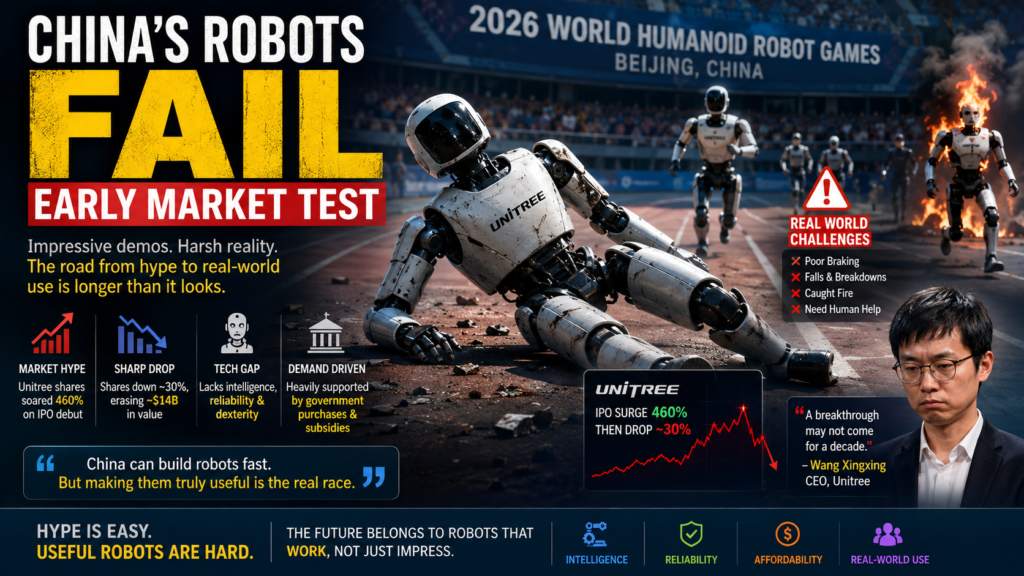
China’s humanoid robot boom faces a reality check as impressive demos collide with reliability, commercial demand, and market pressures.
Description:
The landscape featured image depicts humanoid robots competing in a Beijing stadium, including a fallen Unitree robot and visual cues representing robot failures, market volatility, and real-world challenges. The graphic highlights the gap between China’s rapid humanoid robot manufacturing growth and the industry’s ongoing struggles with intelligence, reliability, dexterity, affordability, and practical commercial applications.
Alt Text:
China humanoid robots face market challenges as Unitree machines struggle with reliability, dexterity, and real-world tasks.
A robot can sprint faster than a human and still fail the simplest real-world task,and China’s humanoid robots are discovering exactly that gap between impressive demonstrations and useful machines.
China’s humanoid robot industry is expanding rapidly, supported by manufacturing strength, government backing, and companies such as Unitree and Agibot. But China’s humanoid robots are still struggling with intelligence, reliability, dexterity, and practical commercial use, raising questions about whether the industry is moving too quickly ahead of the technology.
At the 2026 World Humanoid Robot Games in Beijing, several robots reportedly struggled during events, highlighting the difference between controlled demonstrations and unpredictable real-world environments. At the same time, Unitree’s spectacular stock-market debut and subsequent decline have raised concerns about whether investor enthusiasm has moved faster than actual business demand.
The story is therefore bigger than one robot race.
It is about whether China can turn its manufacturing advantage into a sustainable humanoid-robot business,and whether these machines are genuinely approaching the point where they can work alongside humans.
Planned Structure
- Why China’s humanoid robots are attracting so much attention
- What happened at the 2026 World Humanoid Robot Games
- Why impressive robot demonstrations do not equal commercial readiness
- Unitree’s IPO boom and the growing market-pressure problem
- China’s manufacturing advantage vs. the intelligence gap
- Why humanoid robots are harder to commercialize than electric vehicles
- Government support and the question of real demand
- Can Chinese robotics companies close the technology gap?
- What this means for India and the global robotics industry
- FAQ
Focus Keywords
- Primary Keyword: China humanoid robots
- Secondary Keywords: Chinese humanoid robots, Unitree humanoid robots, humanoid robot industry China, humanoid robot market
- LSI/Long-Tail Keywords: why China humanoid robots are struggling, are Chinese humanoid robots ready for real-world use, Unitree robot commercial applications, challenges facing China’s humanoid robot industry
Why Are China’s Humanoid Robots Attracting So Much Attention?
If you only looked at headlines, China’s humanoid robot industry might appear to be approaching an electric-vehicle-style breakthrough.
Companies are producing robots at increasing scale. Investors are pouring money into robotics companies. Government estimates cited by Reuters suggest that Unitree and rivals such as Agibot could commercially ship around 100,000 units in 2026.
That is an enormous number for a technology that is still relatively young.
China also has something many robotics startups around the world would love to have: a massive manufacturing ecosystem.
The country already has extensive supply chains for electronics, motors, batteries, sensors, mechanical components, semiconductors, and industrial equipment. That gives robotics companies access to suppliers and production capabilities that can potentially reduce costs and accelerate manufacturing.
But there is a catch.
Building a robot is not the same as making a robot useful.
China humanoid robots , Definition + Expansion
China humanoid robots are human-shaped robotic machines being developed and manufactured by Chinese companies for applications ranging from research and entertainment to industrial and potentially household work.
The attraction of the humanoid design is obvious: humans have built environments around the human body. Doors, stairs, tools, workstations, vehicles, and many machines are designed for people. A robot with a human-like body could theoretically operate in these environments without requiring everything to be redesigned.
The difficult part is making that body intelligent, reliable, safe, and affordable enough to perform useful work.
Why are investors excited about Chinese humanoid robots?
The industry combines several powerful trends.
First, AI is becoming better at perception, reasoning, and controlling complex systems.
Second, robotics hardware is becoming cheaper and more capable.
Third, China has enormous manufacturing capacity.
Fourth, governments are actively encouraging robotics development.
That combination creates the possibility of a major new industry.
But possibility is not the same thing as commercial success.
China humanoid robots may have reached an important stage of development, but the industry is now facing its first major reality check: Can these machines actually do useful jobs consistently?
What Happened at the 2026 World Humanoid Robot Games?
One of the clearest illustrations of the current problem came from an unusual setting: a robot sporting event.
The 2026 World Humanoid Robot Games were held in Beijing, with humanoid machines competing in events designed to demonstrate their physical abilities.
On paper, this sounds like the perfect opportunity for robotics companies.
Robots can run.
They can walk.
They can kick.
They can compete against one another.
But the event also exposed how difficult real-world robotic control remains.
According to the Reuters Breakingviews report, the Tiangong Ultra robot won a 100-metre sprint and surpassed Usain Bolt’s human record for the distance.
That sounds spectacular.
Then came the problem.
The robot reportedly crashed into a barrier because it lacked the real-world braking capability required to stop safely.
Other robots also experienced serious problems during the event, with some reportedly catching fire and many requiring assistance to be removed.
The spectacle demonstrated both sides of modern robotics.
Machines can achieve remarkable physical feats.
Yet they can also fail at basic tasks that humans perform without consciously thinking about them.
What does a robot sprint tell us about robotics?
A controlled sprint is very different from navigating a factory, warehouse, hospital, hotel, or home.
In a race, the robot knows the environment.
The track is defined.
The objective is simple.
The variables are limited.
Real life is much messier.
A person walking across a warehouse might suddenly change direction. A box might fall. A wet surface might appear. A machine might malfunction. A worker might ask for help.
A useful humanoid robot must respond to these situations without constant human intervention.
China humanoid robots , Question → Direct Answer
Does winning a robot race prove that a humanoid robot is ready for commercial work?
No. A robot can achieve extraordinary performance in a controlled competition while still lacking the perception, dexterity, reliability, and adaptability required for unpredictable workplaces.
That distinction is crucial to understanding the current China humanoid robots boom.
Why Impressive Robot Demonstrations Do Not Equal Commercial Readiness
Robotics has a long history of impressive demonstrations.
A robot can walk.
A robot can dance.
A robot can perform a backflip.
A robot can run extremely fast.
A robot can pick up an object in a carefully prepared laboratory.
None of those achievements automatically means the machine is ready to replace or assist a human worker.
The hardest robotics problems often appear in ordinary situations.
Picking up one known object from one known position is relatively easy.
Picking up a new object with an unfamiliar shape, on a cluttered table, while another person is moving nearby, is much harder.
What is robotic dexterity?
Robotic dexterity is a robot’s ability to manipulate objects accurately and reliably using its hands, arms, and body.
Humans have extraordinary dexterity because our brains constantly combine vision, touch, balance, prediction, and motor control. We can pick up a fragile glass without breaking it, adjust our grip when an object slips, or use a tool without explicitly calculating every movement.
Humanoid robots still struggle to reproduce this combination reliably.
That creates a major barrier to commercial deployment.
Why is reliability more important than a flashy demonstration?
Imagine a company deploying a humanoid robot in a warehouse.
If the robot performs its job correctly 99% of the time, that might sound impressive.
But what happens during the remaining 1%?
If the machine drops products, damages equipment, blocks a production line, or requires a human worker to intervene repeatedly, its economic value may collapse.
Businesses need machines that work consistently.
A robot that performs brilliantly nine times and fails badly on the tenth may be less useful than a slower machine that works reliably every time.
This is one reason China humanoid robots face a difficult transition from technology demonstrations to commercial products.
Unitree’s IPO Boom Shows the Other Side of the Robotics Story
The technology challenge is happening alongside an extraordinary financial story.
Unitree, founded by Wang Xingxing, became one of China’s most closely watched humanoid robot companies.
When the company debuted on the Shanghai stock market in August 2026, its shares reportedly surged 460% on the first day.
That surge dramatically increased Wang’s paper wealth and pushed Unitree into the spotlight.
But the excitement did not last.
According to the Reuters Breakingviews report, Unitree’s shares later fell by nearly 30% from their debut peak, wiping roughly $14 billion in market value.
Even after that decline, Reuters reported that Unitree remained valued at around $36 billion and traded at more than 400 times its annualised forecast first-half earnings.
Those numbers illustrate the tension surrounding the sector.
Investors clearly see enormous potential.
But the current business fundamentals are still developing.
What does Unitree’s stock performance tell us?
It tells us that expectations for humanoid robotics may be extremely high.
High expectations can be useful because they provide companies with capital to invest in research and development.
But they can also create pressure.
If commercial adoption takes longer than expected, investors may become less willing to pay extremely high valuations for robotics companies.
That makes the transition from prototype to profitable product particularly important.
China humanoid robots , Question → Direct Answer
Is Unitree’s market value proof that humanoid robots are already a mature business?
No. Unitree’s market performance reflects investor expectations about future growth as well as the company’s current prospects. Reuters reported that the company itself acknowledges that commercial applications remain limited.
The difference between future potential and present demand is one of the industry’s biggest challenges.
China’s Manufacturing Advantage Is Real,but Intelligence Is Different
China’s manufacturing ecosystem gives its robotics companies an important advantage.
The country has experience producing millions of complex products at competitive prices.
That experience matters.
Humanoid robots require motors, actuators, batteries, sensors, cameras, processors, circuit boards, mechanical structures, communication systems, and many other components.
China has deep supply chains across many of these categories.
That could allow Chinese robotics companies to iterate quickly and lower production costs.
But manufacturing scale cannot automatically solve an intelligence problem.
Hardware vs. intelligence
A robot needs at least two broad capabilities.
Physical capability: Can it move its body, balance, lift objects, walk, run, and manipulate tools?
Cognitive capability: Can it understand what is happening, decide what to do, adapt to unexpected conditions, and recover from mistakes?
A company can manufacture a million robot bodies.
That does not automatically produce a million robots capable of performing useful human-level tasks.
The second problem requires advances in AI, perception, control, reasoning, simulation, sensor fusion, and real-world learning.
Why is this particularly difficult?
The physical world contains enormous amounts of uncertainty.
AI systems working with text can often generate another answer when they make a mistake.
A physical robot does not have the same luxury.
If it misjudges a step, it can fall.
If it misreads a human gesture, it can cause an accident.
If it applies too much force, it can break something.
If it fails to recognize an obstacle, it can damage itself or its surroundings.
That makes the real-world intelligence gap much harder to ignore.
Why Humanoid Robots Are Harder to Commercialize Than Electric Vehicles
The comparison between China’s robotics industry and its electric-vehicle industry is tempting.
China’s EV manufacturers benefited from strong domestic demand, huge manufacturing capacity, supply-chain depth, government incentives, and intense competition.
The robotics sector has some of those advantages.
But humanoid robots face a fundamental difference:
Who actually needs to buy them today?
Consumers already understand what cars do.
Businesses already know how to use industrial robots.
Humanoid robots are different.
Companies still have to figure out which tasks these machines can perform economically and reliably.
Humanoid robots vs. electric vehicles
| Factor | Electric Vehicles | Humanoid Robots |
| Existing demand | Well-established | Still developing |
| Core use case | Transportation | Potentially many different tasks |
| Technology maturity | Highly mature compared with humanoids | Early-stage |
| Manufacturing ecosystem | Very developed | Rapidly developing |
| Consumer understanding | High | Limited |
| Reliability expectations | Established | Still being defined |
| Government support | Significant in China | Significant in China |
| Main challenge | Cost, range, charging, competition | Intelligence, dexterity, reliability, useful applications |
The comparison reveals why China humanoid robots may not necessarily follow exactly the same trajectory as Chinese EVs.
EVs solve a clearly understood problem.
Humanoid robots are still searching for the applications where their unique form provides enough value to justify their cost.
What Jobs Can Humanoid Robots Actually Do Today?
This is where the industry becomes more complicated.
Humanoid robots are often marketed as general-purpose machines.
The idea is compelling: instead of designing a different robot for every task, build one machine capable of doing many things.
But general-purpose robotics is extremely difficult.
A specialized industrial robot might perform one task thousands of times with remarkable consistency.
A humanoid robot is expected to do many different tasks in many different environments.
That flexibility comes at a cost.
Where could humanoid robots eventually be useful?
Potential applications include:
- Factory operations
- Warehouse handling
- Logistics
- Inspection
- Dangerous industrial environments
- Repetitive material handling
- Basic maintenance
- Hospitality
- Healthcare assistance
- Household tasks
But potential applications should not be confused with established commercial applications.
According to the Reuters report, Unitree acknowledges that its products currently have limited commercial applications.
That admission is significant.
The industry may be producing robots faster than customers can identify economically valuable jobs for them.
Government Support Is Helping,and Also Raising Questions
China’s government has strongly supported robotics and advanced manufacturing.
That support can take several forms, including industrial policy, research funding, local government incentives, procurement, and broader efforts to build strategic technology industries.
For a developing sector, this can accelerate experimentation.
Companies can invest more heavily in research.
Factories can be built faster.
Supply chains can develop.
Talent can move into the sector.
But government support also creates an important question:
How much of today’s demand comes from genuine commercial customers, and how much comes from government-backed purchasing or incentives?
Reuters’ analysis reported that demand for humanoid robots in China is currently supported significantly by government purchases and subsidies.
That does not mean the technology has no commercial future.
It means the industry has not yet fully demonstrated that organic market demand can sustain its current momentum.
China humanoid robots , Question → Direct Answer
Are Chinese humanoid robots already supported by strong private-sector demand?
Not entirely. Reuters reported that current demand is significantly supported by government purchases and subsidies, while companies such as Unitree acknowledge that commercial applications remain limited.
That distinction will become increasingly important as government support evolves and investors demand evidence of sustainable revenue.
Why Price Wars Could Become a Problem
There is another challenge emerging at the same time: competition.
As more companies enter the humanoid robot market, manufacturers have an incentive to lower prices.
That could be excellent for customers.
Cheaper robots could accelerate adoption.
But it can be dangerous for manufacturers if prices fall faster than costs.
Unitree reportedly attributed a 53% year-on-year decline in first-quarter adjusted net profit partly to high research and development costs and rising competition.
This is a familiar pattern in technology industries.
Companies spend heavily to develop new products.
Competitors enter.
Prices fall.
Margins shrink.
Only the companies with strong technology, manufacturing efficiency, distribution, and customer demand survive.
Could cheaper robots solve the problem?
Lower prices help, but price alone cannot solve the core technology problem.
A company may be able to manufacture a humanoid robot cheaply.
The customer still needs to know what the robot can actually do.
If the robot requires constant human supervision, the customer may not save money.
If it breaks frequently, maintenance costs can erase the initial savings.
If it cannot handle unexpected situations, its usefulness remains limited.
The ideal commercial robot therefore needs both affordability and reliability.
The Biggest Challenge for China’s Humanoid Robot Industry
The biggest challenge is not building a humanoid robot.
China has already demonstrated that it can do that.
The harder challenge is creating a robot that can perform useful work repeatedly, safely, autonomously, and at a cost that makes economic sense.
That requires progress across several technologies simultaneously.
What needs to improve?
For the industry to reach mass commercial adoption, humanoid robots need advances in:
- Perception: Understanding objects and environments
- Dexterity: Manipulating objects with precision
- Balance: Moving safely across unpredictable surfaces
- Reasoning: Choosing appropriate actions
- Control: Translating decisions into precise physical movements
- Reliability: Performing tasks repeatedly without failure
- Safety: Working around humans without causing harm
- Battery life: Operating for useful periods between charges
- Cost: Becoming affordable for businesses
- Autonomy: Reducing the need for human supervision
The difficult part is that these challenges are interconnected.
A better AI model does not automatically create better hands.
Better motors do not automatically create better decision-making.
A stronger battery does not automatically make a robot safer.
Commercial success requires the whole system to work.
Could AI Finally Give Humanoid Robots Their Breakthrough?
There is a reason the current robotics wave feels different from earlier attempts.
Modern AI can give robots more flexible perception and decision-making capabilities.
Large AI models can process language, images, and other information.
That creates the possibility of robots receiving instructions in ordinary language and using AI to determine how to complete tasks.
For example, instead of programming a robot with hundreds of specific instructions, a future system might receive a command such as:
“Please move these boxes to the storage area.”
The AI could potentially interpret the request, identify the boxes, plan a route, manipulate the objects, and adapt if something changes.
That is the long-term vision.
But it remains a difficult engineering challenge.
China humanoid robots , Definition + Expansion
Embodied AI is artificial intelligence that interacts with and learns from the physical world through a body such as a robot.
Unlike a chatbot, an embodied AI system must connect perception, reasoning, movement, and physical action. A mistake is not merely a wrong sentence,it can become a collision, a dropped object, or a damaged machine.
This is why progress in AI could be transformative for China humanoid robots, but it does not eliminate the physical engineering challenges.
China vs. Tesla: Who Is Actually Ahead?
The global humanoid robot race is not limited to China.
Tesla has been developing its Optimus humanoid robot, while numerous startups and research organizations around the world are pursuing similar technologies.
The Reuters report makes an interesting comparison: while Tesla had yet to sell a humanoid robot commercially at the time of the report, Chinese companies such as Unitree and Agibot were expected to ship substantial numbers.
That gives China an important advantage in early commercial deployment.
But shipment numbers alone do not determine who wins the robotics race.
The more important questions are:
- How much useful work can each robot perform?
- How reliably can it perform that work?
- What does each robot cost to operate?
- How much human supervision does it require?
- Can customers make money by deploying it?
- How quickly can its capabilities improve?
The company that answers those questions best may ultimately matter more than the company that ships the most units first.
What Does This Mean for India?
The rise of China humanoid robots is also relevant for India.
India has growing interest in AI, electronics, advanced manufacturing, automation, and robotics.
As humanoid robotics develops, Indian companies and universities will have opportunities to participate in areas such as robot software, AI models, sensors, control systems, simulation, component manufacturing, and industrial automation.
India does not necessarily need to reproduce China’s entire manufacturing ecosystem to benefit.
It can specialize.
Where could Indian talent contribute?
Indian students and young professionals could explore:
- Robotics software
- Computer vision
- Reinforcement learning
- Robot operating systems
- AI model development
- Simulation environments
- Embedded systems
- Sensors and perception
- Mechanical engineering
- Industrial automation
- Human-robot interaction
The key opportunity may not be building an entire humanoid robot from scratch.
It could be developing one of the technologies that makes the robot more intelligent and useful.
Are China’s Humanoid Robots Failing,or Just Early?
Calling the entire Chinese humanoid robot industry a failure would be premature.
The evidence points to something more nuanced.
The industry has demonstrated impressive manufacturing capabilities.
Chinese companies are producing humanoid robots at meaningful scale.
Government support is substantial.
Investor interest is enormous.
And the underlying technology continues to improve.
But the industry is also encountering serious obstacles.
Robots still struggle with real-world reliability.
Commercial applications remain limited.
Government support contributes significantly to demand.
Competition is increasing.
Profit margins are under pressure.
And valuations can appear disconnected from current earnings.
So the better description is not that China humanoid robots have failed.
It is that they are undergoing an early market test,and that test is revealing just how much work remains.
China humanoid robots , Question → Direct Answer
Are China’s humanoid robots ready to replace human workers at scale?
No. Based on the Reuters report, current systems still face significant limitations in intelligence, reliability, dexterity, and commercial applications. The technology is progressing, but widespread human-work replacement remains a longer-term possibility rather than an established reality.
What Happens Next for China’s Humanoid Robot Industry?
The next phase will probably be less about flashy demonstrations and more about measurable utility.
Investors will want evidence of real revenue.
Customers will want reliable robots.
Manufacturers will want lower production costs.
Governments will want strategic technology leadership.
And engineers will have to solve the physical-world problems that demonstrations can sometimes hide.
That creates a useful test for the industry.
Instead of asking:
“How impressive is this robot?”
The better question is:
“What useful job can this robot perform, and how reliably can it perform it?”
That question could determine the next stage of the global robotics race.
Five signals worth watching
- Commercial orders: Are private companies buying robots without subsidies?
- Task reliability: Can robots perform repetitive work consistently?
- Operating costs: Can robots create more economic value than they consume?
- AI progress: Are robots becoming better at adapting to unfamiliar environments?
- Real deployments: Are robots moving from demonstrations into factories, warehouses, and other workplaces?
If these indicators improve together, the humanoid robot market could enter a genuine commercial growth phase.
If they do not, today’s excitement could prove to be another technology bubble built around future expectations.
The Bigger Lesson From China’s Robot Reality Check
The story of China humanoid robots is not really about whether robots can run faster than humans.
It is about whether machines can become dependable enough to work with humans.
The Beijing robot games offered a memorable demonstration of the industry’s paradox: a machine can break a human speed record and still struggle with something as basic as stopping before a barrier.
That is not necessarily a reason to dismiss humanoid robotics.
It is a reminder of how difficult the technology really is.
China has demonstrated that it can manufacture humanoid robots quickly and at scale. The next challenge is proving that those robots can create lasting economic value outside competitions, exhibitions, and government-supported deployments.
Unitree’s extraordinary IPO performance shows how much investors believe in that future. Its subsequent share decline and pressure on profits show that investors also want evidence that the future can become a sustainable business.
The same test applies globally.
Humanoid robots do not need to look impressive.
They need to work.
And when they can reliably perform useful tasks in messy, unpredictable environments at a competitive cost, the industry will have crossed a much more important milestone than winning a robot race.
Frequently Asked Questions
Why are China’s humanoid robots struggling?
China’s humanoid robots still face challenges involving intelligence, reliability, dexterity, and real-world adaptability. Reuters reported that the 2026 World Humanoid Robot Games exposed several of these weaknesses despite impressive physical performances.
How many humanoid robots could Chinese companies ship in 2026?
Government estimates cited by Reuters suggested that Unitree and competitors such as Agibot could commercially ship around 100,000 humanoid robots in 2026. However, shipment estimates do not necessarily indicate that all of these robots have established profitable commercial applications.
What happened to Unitree’s stock after its IPO?
Unitree’s shares surged approximately 460% during its Shanghai debut, according to Reuters, before later falling nearly 30% from their peak. The decline erased roughly $14 billion in market value, although the company remained highly valued.
Are Chinese humanoid robots commercially useful today?
Chinese humanoid robots have some commercial applications, but those applications remain limited. Unitree has acknowledged this limitation, while Reuters reported that government purchases and subsidies currently contribute significantly to demand.
Why is humanoid robot dexterity so difficult?
Humanoid robot dexterity requires machines to coordinate vision, movement, balance, force, and precise manipulation. Performing these actions reliably in unpredictable environments is much harder than completing a repetitive task in a controlled setting.
Can China become the global leader in humanoid robots?
China has significant advantages in manufacturing, supply chains, government support, and early commercial deployment. However, global leadership will depend on whether Chinese companies can turn those advantages into robots that are intelligent, reliable, affordable, and commercially useful at scale.
SEO Meta Configuration
Keyword Categorization
Primary Keyword:
- China humanoid robots
Secondary Keywords:
- Chinese humanoid robots
- Unitree humanoid robots
- China humanoid robot industry
- humanoid robot market
LSI/Long-Tail Keywords:
- why China humanoid robots are struggling
- are Chinese humanoid robots ready for real-world use
- Unitree humanoid robots commercial applications
- challenges facing China’s humanoid robot industry
Meta Title
China Humanoid Robots: Best Market Reality Check 2026
SEO Meta Description:
China humanoid robots face a reality check as failures, high valuations, and limited demand test the industry’s path to mass adoption. Read more.
URL Slug:
china-humanoid-robots