| File Name | dog-aging-research-human-longevity.jpg |
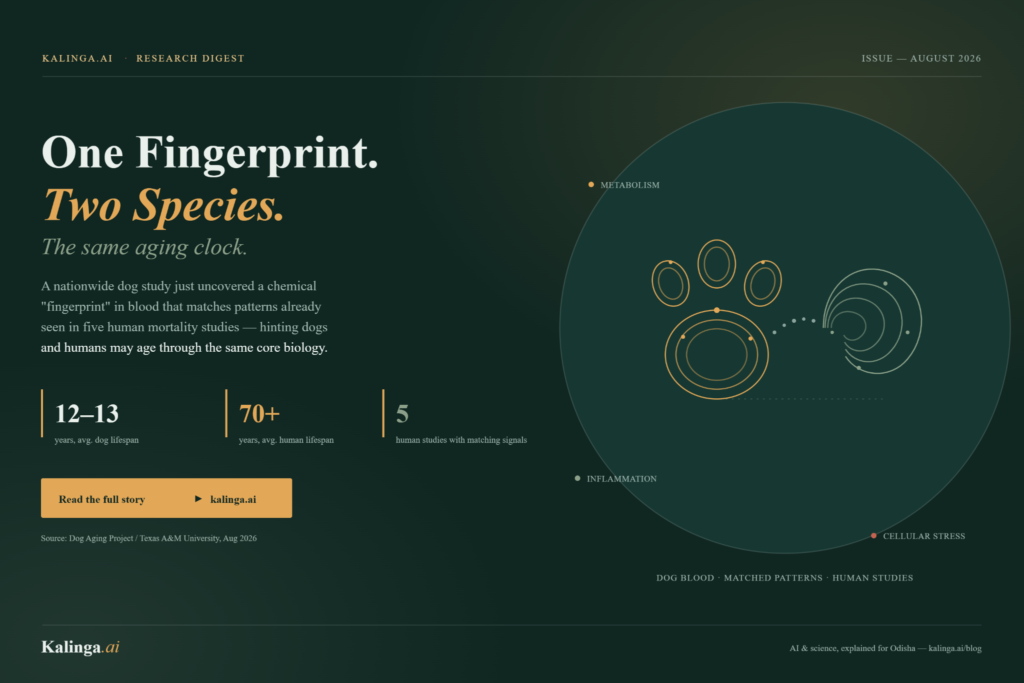
| Title | Dog Aging Research Links Human Longevity Caption-One shared “fingerprint” of aging, found in both dogs and humans — here’s what the science actually shows. Description-A landscape poster illustrating new dog aging research from the Dog Aging Project, visualized as a single print blending a dog’s paw pad with a human fingerprint to represent shared metabolic aging patterns. Amber and moss-toned data points trace the “ridges” of each print, symbolizing the metabolites tied to inflammation, cellular stress, and metabolism discussed in the study. The graphic accompanies an article explaining how these overlapping biological signals could accelerate human longevity research using canine data. Alt Text-Illustration merging a paw print and fingerprint to show dog aging research linking canine and human longevity biomarkers |
Your neighbour’s Labrador is turning grey at nine, while your grandmother is still going strong at seventy , and according to new research, the biology behind both of their aging clocks might be more connected than anyone expected. A study from the Dog Aging Project, published in The Journals of Gerontology and reported by Texas A&M University on August 29, 2026, found that the same chemical “fingerprints” linked to earlier or later death in dogs also show up in large human mortality studies. In short: dogs and humans may share core biological pathways of aging, and that overlap could speed up how quickly scientists understand , and maybe one day slow down , human aging itself.
For students and young professionals in Odisha tracking where AI, biotech, and health research are heading next, this is a good example of how cross-species data science is quietly reshaping longevity research. Let’s break down what was actually found, why it matters, and what it means for the future of aging science.
What Is the Dog Aging Project?
The Dog Aging Project is a large-scale, long-term study that tracks pet dogs living with real families across the United States, collecting survey data and biological samples over the course of each dog’s life. It is not a lab experiment with caged animals , it is a “community science” effort, meaning ordinary dog owners are the ones contributing information about their pets’ health, environment, and habits year after year.
This matters because it means the dogs in the study are living exactly the way most pet dogs live: eating what their families eat, walking the routes their owners walk, and exposed to the same air, stress levels, and lifestyle patterns as the humans around them. Dr. Kate Creevy, chief veterinary officer for the project and a professor at the Texas A&M College of Veterinary Medicine and Biomedical Sciences, said the research benefits enormously from the dedication of owners who enroll their pets and keep contributing data over time. That real-world, everyday-life data is exactly what makes this project so valuable for aging research , it’s messy, human-adjacent, and realistic in a way lab studies often aren’t.
What Did the New Study Actually Find?
Direct answer: Researchers found that specific patterns of small molecules in dogs’ blood, called metabolites, were strongly linked to whether a dog died sooner or later , and that these same patterns have already been observed in multiple large human studies on mortality.
Metabolites are small chemicals and molecules produced during the body’s normal, everyday processes , essentially biological “leftovers” that reveal what’s happening inside cells at a given moment. Think of them as breadcrumbs: they don’t tell you the whole story of aging on their own, but tracking thousands of them together can reveal patterns invisible to the naked eye. In this study, researchers analyzed blood samples from dogs in the Dog Aging Project and looked specifically at which metabolic patterns showed up more often in dogs that died earlier versus those that lived longer.
Why Focus on Death as the Outcome?
Question: Why did researchers choose mortality instead of a health score or disease marker? Because death is unambiguous. Creevy pointed out that determining whether a person or dog has died is straightforward, while many other aging-related health outcomes are far more subjective and harder to measure consistently across a large study. Using a clear, undeniable endpoint like mortality lets scientists work backward and ask: what biological signals were present before this outcome occurred?
That approach let the team connect specific metabolic patterns , tied to processes like metabolism, inflammation, and cellular stress , to real-world survival outcomes, rather than relying on softer, more subjective measures of “health.”
Why Do Dogs and Humans Share Aging Signals?
Instead of chasing single molecules, the research team looked at thousands of metabolites together, searching for broader groupings or patterns rather than isolated warning signs. Creevy described this collective pattern as a kind of biological “fingerprint” , a grouping of molecules that, together, correlates with better or worse outcomes, even when no single molecule stands out on its own.
Here’s the genuinely surprising part: when the researchers compared their canine metabolic fingerprint against five separately published human mortality studies that used similar methods, the patterns lined up. The molecular signals tied to earlier or later death in dogs closely resembled those already documented in people. That consistency across species is one of the strongest pieces of evidence yet that dogs and humans share fundamental aging biology , not just superficially, but at the level of the tiny chemical processes running inside our cells every day.
Definition + Expansion , Biomarkers: A biomarker is a measurable biological indicator , like a metabolite pattern , that helps estimate the likelihood of a particular health outcome. Importantly, a biomarker doesn’t necessarily cause the outcome it’s linked to; researchers stress that finding a biomarker associated with earlier death doesn’t automatically explain why that death happened sooner. But once scientists understand why a biomarker shows up, they may be able to identify the actual mechanism behind it , and potentially find ways to intervene.
As Creevy put it, once you know why a pattern exists, you have a much better chance of figuring out how to change the outcome it’s linked to.
Why Are Dogs a Particularly Useful Model for Aging Research?
Question: What makes dogs better research subjects for aging than other pets? Dogs share far more of their daily environment and lifestyle with their owners than most other companion animals do , which means their bodies are exposed to the same diets, activity levels, pollution, and stress patterns as the humans around them.
Cats, by comparison, tend to live more independent and consistent lives regardless of their owner’s habits. Dogs, on the other hand, largely follow the routines of the people they live with , walking when their owners walk, eating what their owners choose to feed them, and living in the same homes and neighbourhoods. That overlap makes them a much closer real-world proxy for human lifestyle-driven aging than most lab animals could ever be.
There’s also a practical, time-based advantage. Humans typically live into their 70s, while dogs generally live only 12–13 years. That compressed lifespan means researchers can observe an entire aging trajectory , and its outcome , in a fraction of the time it would take to study the same processes in humans.
Comparison: Dogs vs. Other Common Research Models for Aging
| Factor | Pet Dogs | Cats | Lab Mice | Direct Human Studies |
| Lifestyle similarity to humans | High , shares owner’s environment, diet, activity | Lower , more independent daily patterns | Very low , controlled lab environment | Exact match (obviously) |
| Typical lifespan | 12–13 years | Similar range, but less lifestyle overlap | 2–3 years | 70+ years |
| Speed of aging observation | Fast (years, not decades) | Fast, but less human-relevant environment | Very fast | Very slow , decades needed |
| Real-world environmental exposure | Yes , same air, home, routines as owner | Partial | No , artificial lab conditions | Yes |
| Data source in this study | Owner-reported + blood samples (Dog Aging Project) | Not part of this study | Not part of this study | Five published mortality studies |
This table isn’t about ranking one model as “better” outright , it’s about why dogs occupy a genuinely unique middle ground: fast enough to study across a full lifespan, yet lifestyle-matched to humans in a way lab animals simply aren’t.
What Does This Mean for Longevity Research Going Forward?
Direct answer: If dogs and humans share the same underlying metabolic signals of aging, researchers can use findings from one species to accelerate discoveries in the other , essentially turning existing human research into a head start for canine health, and vice versa.
Creevy noted that scientists often already know more about certain biological processes in humans than in dogs, so shared biological targets mean human research can directly benefit veterinary science, and shared observations in dogs could, in turn, offer early clues worth testing in longer, slower human studies. This is exactly the kind of research loop that excites people working at the intersection of biology and data science: two very different studies, run independently for different reasons, converging on the same signal.
For anyone in Odisha’s growing AI and biotech ecosystem, this is a useful case study in how large-scale data collection, metabolomics (the study of metabolites), and cross-species comparison are becoming core tools in modern health research , fields where data analysis skills, not just pure biology, are increasingly valuable.
What Can Dog Owners , and Humans in General , Actually Do With This Information?
The researchers were candid that this is still an early step, not a finished roadmap. However, Creevy did offer a practical takeaway that applies to both species. Here’s what the research points to as sensible, low-risk habits worth maintaining:
- Maintain a healthy body weight , for both dogs and their owners, since excess weight is tied to many of the same metabolic stress patterns being studied.
- Feed a healthy, consistent diet rather than irregular or highly processed food.
- Preserve mobility through regular movement and exercise, which supports metabolic and cellular health in both species.
- Support cognitive health through mental stimulation and engagement, not just physical activity.
- Stay engaged with long-term health tracking, whether that’s regular vet visits for pets or regular health check-ups for people , consistent data over time is what made this entire study possible in the first place.
As Creevy summarized it, what’s good for us as humans is very likely good for our dogs too , the overlap runs deeper than most pet owners probably realize.
The Bigger Picture: An Early Step, Not a Finished Answer
It’s worth being clear-eyed about where this research actually stands. Creevy described the findings as a starting point , the team has now identified specific metabolic patterns tied to lifespan and knows where to look next, but this is far from a cure, a supplement, or a diagnostic test ready for clinical use. Biomarkers associated with mortality are not proven causes of it; there’s a difference between “this pattern shows up before death” and “this pattern causes death,” and the researchers are careful to make that distinction.
What makes this study genuinely exciting isn’t a single breakthrough discovery , it’s the methodology: using a real-world, owner-driven, long-term dataset (the Dog Aging Project) to validate patterns already seen in separate human studies. That kind of cross-species, cross-study validation is a powerful way to build confidence in a biological signal before investing years and resources into deeper research on it.
FAQ: Dogs, Aging Research, and Human Longevity
Q1: What is the Dog Aging Project? It’s a long-term, nationwide study that follows pet dogs living with real families across the United States, using owner-reported data and biological samples to study aging, health, and lifespan over time.
Q2: What are metabolites, and why do they matter for aging research? Metabolites are small molecules and chemicals produced by the body’s normal processes; tracking patterns across thousands of them can reveal biological signals tied to health outcomes like earlier or later death, even when no single molecule stands out.
Q3: Do dogs and humans really share the same aging biology? According to this research, the metabolic patterns linked to earlier or later death in dogs closely resembled patterns already found in five separate published human mortality studies, suggesting shared underlying aging biology between the two species.
Q4: Does this mean scientists have found a way to slow aging? No , the researchers describe this as an early starting point that identifies which metabolic patterns to investigate further, not a proven cause of aging or a ready-made treatment.
Q5: Why are dogs considered a good model for studying human aging? Dogs share much of their daily environment, diet, and activity level with their human owners, and their much shorter lifespan (typically 12–13 years) lets researchers observe full aging trajectories far faster than is possible in human-only studies.
Q6: What can dog owners take away from this research right now? Maintaining a healthy body weight, feeding a healthy diet, preserving mobility, and supporting cognitive engagement are habits the research suggests are likely beneficial for both dogs and their human owners alike.
Keep Exploring How Data Science Meets Real-World Research
Cross-species studies like this one are a great example of how large datasets, pattern recognition, and careful methodology are transforming fields far beyond traditional tech , and it’s exactly the kind of applied data thinking Kalinga.ai covers in its AI and data science learning resources. If topics like metabolomics, biological data analysis, or applied AI in health research interest you, explore Kalinga.ai’s related workshops and articles to see where these skills could take your own career next.
Keyword Strategy
Primary Keyword
- dog aging research
Secondary Keywords
- Dog Aging Project
- aging biomarkers
- human longevity research
- canine health study
LSI / Long-Tail Keywords
- how dogs and humans age similarly
- what is the Dog Aging Project
- metabolites linked to aging
- best habits for pet longevity
Meta Title-Dog Aging Research 2026: The Ultimate Longevity Guide
SEO meta description: New Dog Aging Project research links dog and human aging biomarkers. Discover what this means for longevity science and pet health today.
URL slug: /dog-aging-research-human-longevity
I spend most of my free time here and it never gets old. The game library is constantly updated and I love discovering new favorites every week. Betting odds are incredibly fair and the payout ratios are among the best I have seen. It is hands down the most trustworthy site I have used this year. Join the fun at phwk776